June 23, 2019

Podcast

Ephesians 2:1-7

Intro: Has God answered your prayer this week

(Remember? We were going to pray the following verses all week

Search me, O God, and know my heart!
Try me and know my thoughts!
And see if there be any grievous way in me,
and lead me in the way everlasting! — Psalm 139:23-24)

Last week we learned what neuroscience has taught us about repentance
– at a practical, biological level repentance means changing our brains
• the brain is control center for all the activity of the mind and body
• how do we repent? How are we changed, transformed?

Do not be conformed to this world, but be transformed by the renewal of your mind, that by testing you may discern what is the will of God, what is good and acceptable and perfect (Ro. 12:2)

– why must our idea of repentance be more complicated than gospels?
• because our lives are so much more complicated
• they had lots of physical space and time to reflect
◦ we’re bombarded by massive stimulation and information
(imagine the difference between driving ten miles and walking ten miles — how many more sights, movements and decisions to be made at fifty-five miles per hour)
◦ we’re faced with thousands of choices they never dreamed of

I said before that every human brain writes an owner’s manual
– today we will learn how to read our owner’s manual
Daniel Siegel, Clinical Professor at UCLA School of Medicine, finds it helpful to patients in therapy if they can visualize the activity in their brains and know how to affect changes in it

In Ephesians 2, Paul is answering a question: How did we get here?

That is, here to being “blessed with every spiritual blessing” (Ep. 1:3-14)
– we did not start here
• when God’s light first shined on us, we were dead
– in verse 2, Paul mentions three causes of spiritual death:
1. The world – a spiritual alternative to kingdom of God
◦ opposed to God – in rebellion to God’s will
◦ the world presents our brains with thoughts, images & suggestions
2. The prince of the power of the air (the devil)
◦ tempter, adversary, accuser, “liar,” and “murderer”
3. Our flesh – our natural self apart from God
◦ the part of us that is capable of being tempted, seduced, mislead

But even when we were dead, God made us alive (v. 5)
– dead: a static condition – motionless – no change, stuck
• alive: dynamic, moving, changing
– obviously, this isn’t something we can accomplish on our own
• God involves himself in our repentance – our change
• he is with us every step of the way

For by grace you have been saved through faith. And this is not your own doing; it is the gift of God, not a result of works, so that no one may boast. For we are his workmanship, created in Christ Jesus for good works, which God prepared beforehand that we should walk in them (vv. 8-10)

A few years ago, as Christmas present Barbara gave me a brain

It’s plastic and came with a guide that labels various structures
– the human brain contains billions of cells – neurons
• similar cells run through entire body
◦ these activate every muscle – legs in walking, pupils in dilating
◦ shifting your weight in your chair requires that activation of millions of neurons
• neurons are the basic building blocks to every thought, feeling, action

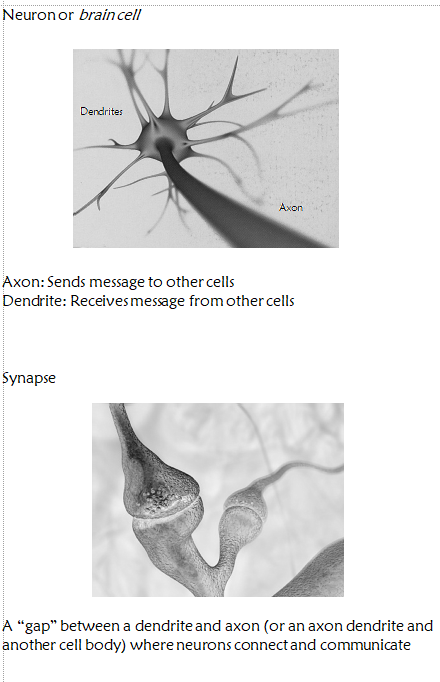
Neuron consists of a cell body – various shapes and sizes
– it communicates with other neurons through minuscule fibers
• a central fiber, the axon, sends messages (bipolar, etc.)
• multiple fibers, dendrites, branch out from the cell body to receive messages
◦ dendrites connect with axons, other dendrites, or the cell body of other neurons
◦ neurons do not actually make contact with other neurons
– there is a tiny gap between contact points – the synapse
• the neuron sending a message releases chemical molecules into fluid between contact points
• neuron can connect with thousands of other neurons
◦ neurons with shorter axons connect with neurons nearby
◦ neurons with longer axons connect with other the neurons of other structures in the brain

What causes neurons to fire?
– incoming messages from other neurons create a minute electrical charge
• by itself, that charge is not strong enough to affect a response
• it takes thousands of messages arriving from other neurons
◦ all of them arriving within a millisecond to produce an “action potential”
◦ this electrical charge runs down the axon from the cell body, releasing chemical molecules
– the brain’s chemistry set is fascinating
• the brain utilizes at least 100 different “neurotransmitters”
◦ to speed up activation, neurons receive glutamate molecules
◦ to slow down activation, neurons receive GABA molecules
• neurotransmitters affect all mental activity
◦ they are frequently implicated in mood disorders

An action, thought, or memory is not contained in one brain cell

Every thought requires thousands of brain cells
– if a thought is repeated, it utilizes the same cluster of cells (mostly)
• this is how our brains form habits
• a repeated thought or action is imprinted on the same neurons
◦ Hebb’s Law, “Neurons that fire together, wire together”
– as a boy, I lived in rural communities
• frequently, the shortest distance between two points was a diagonal line across an empty lot
◦ I would trample the weeds my first time across the field
◦ after enough people used that same route, the weeds died, leaving a clear and compact dirt path
• that trail became the fastest, easiest way to reach the other side
◦ it became, in fact, the only path across the lot
◦ this is similar to the way habitual thoughts and feelings form in connecting neurons in the brain

Habits are helpful, but they tend to dull awareness
– the value of a habit is don’t have to think about it when doing it
• your brain has all the movements memorized
◦ your body acts on its own, leaving you free to think about other things
• but what we miss with our habits is the experience of living
◦ there’s a certain pleasure in riding a bike
◦ but I can lose that enjoyment if I am only in a hurry to get somewhere
– habits sink into the unconscious–that is, we are not aware of them
• there’s a lot our brains do that we’re not conscious of
◦ all the “involuntary” functions of our nervous system
• there are also a lot of thought habits
◦ they are present even if we’re not conscious of thinking them

Suppose a child is made to feel like a jerk by a teacher, playmate, or parent
– that feeling is real to the child
• if reinforced, then the same neurons of that real feeling will be activated
• and every time those neurons fire, they will produce the same chemical reactions in the child’s brain and body
◦ the same neurotransmitters will be released
◦ the same hormones will be launched into the blood stream
◦ the child will feel the same emotion – embarrassment, shame, guilt
(even when he or she is twenty, thirty, or forty years old)
– a record of this repeated is etched into the brain’s owner’s manual
• a person’s “inner belief system” consists of these neural habits
◦ repeated thoughts, feelings, attitudes, judgments, etc.
• we do not doubt our unconscious belief system, because it is deeply embedded within us
◦ our belief system forms our perception of reality
◦ and any little mistake seems to confirm our negative beliefs
◦ with even a little mistake, a voice within says, “See! You are a jerk”

I once shared with Fr. with Romuald my mental self-abuse

He said he was surprised, and told me,
“Well, I suppose we all have those self-deprecating thoughts. I do, though probably not to the degree that you have described. But I don’t see why you would want to identify with them. I am not my thoughts, and I am not my feelings”
– there’s a world of difference between saying,
• “I did something really stupid” and “I am really stupid”
• but my identity, formed in my belief system, tells me “I am
– are you getting an idea of why repentance is so difficult?
• basically, God is telling us,
“You’re not who you think you are, and reality is not what you’ve thought it was. All of that has to change.”
– but haven’t we tried to change?
• through will power – through happy thoughts
• but since we haven’t changed it is most likely because we have not gone deep enough
◦ we have not entered the inner chamber of our brains
◦ repentance is not about having new thoughts, but becoming new persons

Conclusion: Going back to the path we created in a field

Suppose one day we attempt to take our usual shortcut,
– but when we get to the field, someone has put up a fence
• or the whole lot has been graded for development
• we can no longer follow that path
– one part of repentance (change) is to put up fences
• to stop thinking the same thoughts, believing same things
◦ that’s the turning from part of repentance
• the turning to part is trusting God for his grace to assist us

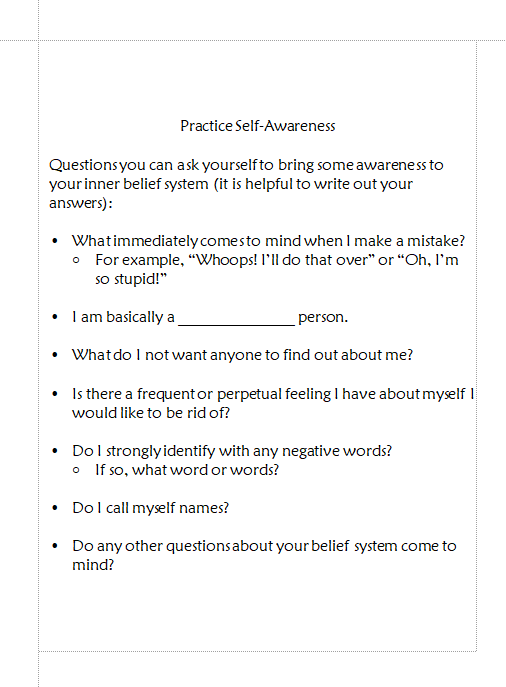
To fully repent, we need to bring our belief system into awareness
We will continue with that project next week
In the mean time,
start paying attention to your daily habits
Notice what your body is doing when walking,
opening a jar or can,
drinking a glass of water,
or reading a book
Pay attention to what it feels like
and you will begin to enter awareness
of some of those unconscious processes
that drive our daily actions
June 16, 2019

Podcast

Matthew 3:1-2 and 4:17

Intro: These were the first public announcement of both John and Jesus

This is the “short form” of the message they brought
– their “elevator speech” that contained three points:
• the kingdom of heaven is finally arriving
• you are not ready for it
• get ready
– the world Jesus entered was not ready for HIM
• many people in Israel were waiting for a Messiah
◦ but their concept of a savior was imperialistic and nationalistic
◦ certainly not a Savior who would suffer and die for the world
• they looked for a Messiah who would change things
◦ Jesus came as a Messiah who would change them

In his parables, Jesus talked about the last part of this message:
the kingdom of heaven
– but in the Sermon On Mount, he elaborated on the first part: Repent
• in his sermon, he turned their world inside out
You have heard that it was said of old . . . . But I say to you . . . (Mt. 5:21, 27, etc.)
• it was as if he said,
“What you have thought about the Messiah is only partially true. What you have thought about God is only partially true. And what you have thought about religion is only partially true. You have lived with these illusions, but I have come to show you what is true. The reality of God and the truth about yourselves.”
– it is not easy for us to see why this was so difficult for them to hear
• but this is not the sort of message we want to hear either

I am not very fond of the word “repent”

Like most of my dysfunctional thinking, this has to do with upbringing
– to repent was to see myself as the worst sinner who ever lived
• to wallow in guilt, to be ashamed and disgusted with myself
• to feel hopeless, because a holy God could never love someone like you
– every Sunday night there would be an “altar call”
• I would beg and beg for forgiveness, but never felt forgiven
◦ because I knew following week I’d be back there again observing the same ritual of failure and shame
• I never felt the guilt leave me
◦ never felt God’s full acceptance or unconditional love
– I’ve learned that always feeling bad about the person I am does not change me
• never being released of guilt sabotages repentance
◦ instead of making progress, you get stuck
• all my angst was based on a faulty conception of repentance

Repentance isn’t a psychological collapse into self-loathing

It isn’t about punishing yourself for your sins
– or groveling before God to win his forgiveness
• very simply, it is about change
• I believe Jesus prefers having calm and rational discussions with us
◦ about where we go wrong
◦ and what he wants from us
– in the Old Testament, another way to talk about repent is turn or return
• when Israel returned from exile, the heard law read and wept
◦ it was a natural response to realizing what their sins had cost them
◦ but their priests and leaders wouldn’t let them get stuck in sorrow
. . . this day is holy to our LORD. And do not be grieved, for the joy of the LORD is your strength (Neh. 8:10)

I think this is one of those times when a Greek word is important
– repent is metanoeite – a compound word
meta: a preposition “with” or “after”
noeo: – think, understand, perceive
◦ so repent is to think after think after,
◦ to have second thoughts, to change your mind
– in classical Greek, repentance engaged not only intellect
• it was coupled with a feeling – regret
◦ regret is not wallowing in guilt and shame
◦ and regret without change is not repentance

The first word we hear Jesus tell us is the command, “Change”

Maybe there’s someone here, so satisfied with life, they wouldn’t change a thing
– for the rest of us, we can think of a few healthy changes
• typically: better diet, more exercise, learn more
◦ be a better spouse or parent, have more self-control
◦ be less anxious, be a happier person
• Jesus’ command to change doesn’t have to be bad news
– but start moving toward change and we discover our inner rebel
• we have more resistance than motivation
◦ we want to change, but we drag our feet when it’s time to begin
The spirit is willing, but the flesh is weak (Mt. 28:41)
• I don’t think we’re convinced we want all the changes Jesus does
◦ “Change my life, but leave me the same”

Psychologists have observed,
– people don’t enter therapy unless problem drives them to it
• we wait until the pain of staying same is greater than the pain of change
– imagine residents in neighborhood petitioning a city for a stop sign
◦ they have seen several collisions at one of their intersections
◦ but stop signs are expensive and require traffic control studies
◦ so the city drags its feet–until there’s a fatality at the intersection
• many married couples avoid therapy at the first realization of trouble
◦ by the time they arrive in counselor’s office, it’s too late

The Psalms describe the wicked as people who
do not change
and do not fear God
(Ps. 55:19)
– Jeremiah described the sin of the nation of Moab like this:
Moab has been at ease from his youth
and has settled on his dregs;
he has not been emptied from vessel to vessel,
nor has he gone into exile;
so his taste remains in him,
and his scent is not changed (Jer. 48:11)
– usually we resist change not because we are content,
• but because we are complacent

Repentance begins with a change in perception, thought, and attitude

What we know about the human person today tells us,
– repentance means making changes to our brains
• it wasn’t always believed this was possible
◦ it was thought that once a person became an adult,
◦ the old dog could not learn new tricks
• now we know it is possible for the adult human brain to be changed
◦ and that changes are ongoing
– but the sort of changes we want to make are not easy

Every human brain writes an “owners manual”
– this is written by experience and education
• everything we experience traces a path across brain cells
◦ a single thought travels from one cell to another,
◦ connecting tens of thousands of them in a single cluster
• the owner’s manual is written through repetition
◦ always thinking same thoughts and feeling the same feelings,
◦ cement the connections between the same brain cells
◦ this becomes the brain’s default setting
– our nervous system runs our body according to this owner’s manual
• our brains do not judge if our thoughts and feelings are healthy
◦ the just recognizes triggers and send signals down the same path
• this results in repeatedly reproducing the same psychological and physiological state
◦ perhaps the same negative thoughts and emotions
◦ and yet we wonder,
“Why do I keep making the same mistakes?”
“Why can’t I control my temper?”
“Why do my anxieties always get the best of me?”

To repent is to rewrite the owner’s manual
– that’s what we’re going to venture into this summer

Conclusion: When Israel returned from Babylon to Jerusalem,

They delayed rebuilding God’s temple
– the project seemed overwhelming for their meager resources
• God sent the prophet Haggai to challenge them to get to work on his house
◦ his message to them was, Consider your ways (1:5, 7)
• the first thing they needed to do was practice self-observation
◦ watch themselves – what they were doing and what they were thinking
The philosopher Adam Smith had this to say about self-observation, “When I endeavor to examine my own conduct . . . I divide myself as it were into two persons; and that I, the examiner and judge, represent a different character from the other I, the person whose conduct is examined into and judged of. The first is the spectator. . . . The second is the agent, the person whom I properly call myself . . . .”
– I have found this happens naturally in contemplative prayer
• it’s as if God’s Spirit reveals to my flawed thinking and illusions
• I become aware of what was written in my owner’s manual
◦ these insights show me what needs to be changed
◦ and those changes usually begins with slowing down and deep breathing
– repent is an invitation to get unstuck – an invitation to freedom

This week, I would like for you to consider your ways
– take some time to sit in quiet with God
• be still and listen for what he wants you to see about yourself
◦ what you’ve been accepting as “normal” or putting up with
◦ what you’ve done over and over without purpose or benefit
• and begin your quiet time with the following prayer:

Search me, O God, and know my heart!
Try me and know my thoughts!
And see if there be any grievous way in me,
and lead me in the way everlasting
Psalm 139:23-24

June 9, 2019

Podcast

Do you not know that you are God’s temple and that God’s Spirit dwells in you? If anyone destroys God’s temple, God will destroy him. For God’s temple is holy, and you are that temple. 1 Corinthians 3:16-17

Intro: Today is Pentecost Sunday

A word derived from the Greek language
– Pentecost refers to an event fifty days after Jesus’ resurrection
– the story of Pentecost is told in Acts chapter 2
• the apostles were in Jerusalem per Jesus’ instructions
◦ he had given them a mission,
◦ but first, they had to be equipped and empowered
• that happened in one of the most dramatic scenes in the New Testament
◦ God’s Spirit descended on them in a way that looked like fire
– those believers who experienced this became something else that day
• the new people of God
◦ when God chose Israel to be his nation, this is what he had in mind:

I will … confirm my covenant with you. … I will make my dwelling among you …. And I will walk among you and will be your God and you shall be my people (Lev. 26:9-12)

• on Pentecost, this did not happen to select individuals,
◦ but an entire community
◦ some people refer to Pentecost as the birth of the church

Although it is Pentecost, that is not why I’m going to talk about
– this last week, I was reading in 1 Corinthians
• when I came to these verses, something happened in me
• I felt them – I knew that God meant this to be true for us
◦ that I could meet him here today with you
– we may not see it, we may forget,
• but this time we spend here together is sacred

Your first reaction might be, “Who, me?” (or “us?”)

Paul was not writing to the premier church
– much of this letter and the next tell them what they were doing wrong
• they got off to a good start – had a lot going for them (1 Cor. 1:4-8)
◦ but Paul begins this chapter with the news that they had not made much progress
• the weren’t as spiritual as they assumed
◦ they were mere infants in Christ
– this is not uncommon – it’s easy to become religious or pious
• nor is it difficult to learn doctrine
• but to undergo fundamental changes in our lives is a difficult process
◦ we must work at letting go of old prejudices and habits
◦ Christian love takes a particular kind of work
◦ and it looks different from working at being religious (1 Cor. 13:1-3)

How could Paul tell that their spiritual life was shallow?

For while there is jealousy and strife among you, are you not of the flesh and behaving only in a human way? (v. 3)

– the community had become divided and formed “tribes”
• they had taken polarized positions regarding individual personalities
• but the leaders themselves were not divided
He who plants and he who waters are one (v. 8)
– 5-10, Paul explained how to regard those they placed on pedestals
• not as celebrities, but servants – fulfilling their assigned tasks
You are God’s field, God’s building (v. 9)
◦ first he uses an agricultural metaphor
(plant and water, two different tasks but devoted to one goal)
◦ then a construction metaphor
(one laid a foundation, another built on it)
• that their roles were different did not entail conflict, but cooperation

In verses 10-15, Paul adds a serious warning to the sub-contractors
(he illustrates why it doesn’t pay to cut corners)
– every building is eventually tested by natural elements
the rain fell, and the floods came, and the winds blew and beat on that house (Mt. 7:25, 27)
• in regard to the church, the foundation is solid–it is Jesus Christ
◦ the problems start with the sub-contractors
◦ and the use of inferior building materials
• many Christians do not realize, they’re not well cared for
◦ they’re entertained, brow-beaten and bossed around, and exploited
◦ they’re kept busy building a house of straw
– 16-17, Do you not know …? – this was the missing piece
• the Corinthians Christians did not know who they were
• they had not discovered their collective identity

Verses 18-20, the wisdom that works in the world, doesn’t work here
– the way governments, corporations, and other institutions run
• there we encounter contenders, competition, and conquest
◦ faith draws something else from us
◦ love requires something else
– 21-23, Paul’s advice: Do not get pulled into one of the cults of personality
• all these sub-contractors are not special
◦ if they’re the real deal, they work for you
◦ God has provided them for your spiritual development

The Corinthian believers were messed up–same as we are

Yet they were God’s temple
– if we dig into the past for the primary purpose of the temple,
• we come to the God’s instructions to Moses for the sacred tent

. . . let them make me a sanctuary, that I may dwell in their midst (Ex. 25:8)
There I will meet with the people of Israel, and it shall be sanctified by my glory. . . . I will dwell among the people of Israel and will be their God
(Ex. 29:43-45)
◦ “sanctified” means to make holy or sacred
• primarily, the temple was a place where people encountered God

One thing have I asked of the LORD,
that will I seek after:
that I may dwell in the house of the LORD
all the days of my life,
to gaze upon the beauty of the LORD
and to inquire in his temple
(Ps. 27:4)
O God, you are my God; earnestly I seek you;
my soul thirsts for you;
my flesh faints for you, as in a dry and weary land where there is no water.
So I have looked upon you in the sanctuary,
beholding your power and glory
(Ps. 63:1-2)
– when these messed up Corinthians met together,
• they were the church – God’s temple
• Jesus Christ was present among them (5:4),
◦ and God’s Spirit lived in them
◦ in other words, God manifested his presence in and to this spiritual community

Do you not know that your are God’s temple?

We do not always know that – or we forget
– one reason may be, that when we see each other,
• we look on the outside only
◦ we see clothes, and mannerisms, and personality quirks
• we don’t see God’s image, because we’re not looking for it
◦ we’re not asking,
“How is Jesus revealing himself through this person?”
– it’s possible to never know all God has for us

I defined sanctified, because I want to emphasize the sacred

Sacred is at the root of the word “sacrament”
– a sacred ritual God uses to pour grace into us
• a sacrament can also be an object or an action
Leonardo Boff, describes a sacrament as an object or action that is real in this world, but opens up to another dimension – something God uses to manifest his presence to us
• Boff says there are three dimensions to a sacrament:
immanent: the object or action is physical — present and tangible
transcendent: the object or action reveals another dimension of reality
transparent: we see through the object or action
– the sacrament is not isn’t magic, but evokes an inner vision
• we see through the sacrament, as if a window
◦ and the light of God’s grace pours through it
• a sacrament is a gate that opens between time and eternity
• a sacrament is meant to wake us up,
◦ to bring us out of our forgetfulness (“remembrance”; 1 Cor. 11:24)
• a sacrament invites us to have eyes that see, ears that hear, hands that feel, and so on

Conclusion: On the day of Pentecost, the church became a sacrament

God formed the church to be a witness to the world
– he desires to manifest himself to the world through his church
• not through the church as an institution
• and not through the doctrines of the church (that doesn’t work)
The natural person does not accept the things of the Spirit of God, for they are folly to [them], and [they] are not able to understand [these things] because they are spiritually discerned (1 Cor. 2:14)
– it is the church as a community of people
• people who are no better than we are
◦ it’s not about being “nice” to each other – polite or friendly
• it’s about listening, and caring, and being safe and available
◦ we have a Christ-effect on each other

What got to me when reading this passage,
is that we have opportunities
to immerse ourselves in the experience of being together in Jesus,
to have a strong sense of his presence,
and to rely on him to be among us.
Let’s know this as our lived experience;
let’s remember it whenever we meet.
We are God’s temple

June 2, 2019

Podcast

Psalm 22

My God, my God, why have you forsaken me?
Why are you so far from saving me, from the words of my groaning?
O my God, I cry by day, but you do not answer,

and by night, but I find no rest (Ps. 22:1-2)

Intro: Friday I was driving three of my grandchildren home from school

Six year old Calum was in the back seat, singing lilting, repetitive lyrics
– I wasn’t paying attention at first – then, when traffic cleared I listened
“This is a distraction song, distraction song, distraction song,
that makes it hard to think”
ME: “Calum, what’s that?!”
CALUM: “It’s a distraction song. Do you get it?”
ME: “Yes I get it! It’s so distracting, I can’t think”
CALUM: “Aha, it works!”

Psalm 22 is a song for when distractions make it hard to think

There are two things we get wrong about this psalm

First, frequently it is referred to as a “Messianic Psalm”
– that is to say, the whole psalm is a prophecy of Jesus’ crucifixion
• it does contain prophetic statements,
◦ but that was not how it was originally read
• like most everyone who suffers, the psalmist felt abandoned by God
– that Jesus quoted this psalm from cross reveals his heart
• how deeply he was plunged into human suffering (cf. Heb. 2:9-10, 17-18; 5:8)
• Jesus shared with us an agony so deep, he too felt abandoned, forgotten

Secondly, it looks like a psalm of despair– at least begins like one
– but it is actually a song of hope
• in it, the poet tells his story – not in detail, but with broad strokes
◦ that actually makes it more valuable for us
• we don’t have to know what he meant by bulls of Bashan
◦ we can think of our own adversities and obstacles
– as we read his story, we learn how he worked his way–
• or “prayed his way”–from abandonment to embrace,
◦ from anxiety to serenity, from distress to peace
• have you ever wished that prayer could change your mood?
◦ maybe there’s a way to approach prayer that does change us
◦ and perhaps God will even change us without changing our circumstances

A quick overview of Psalm 22

The poet begins with a “Why” question
– this is not always the best place to begin, and it is often useless to ask
Daniel Siegel refers to “Why” as “the [brain’s] left hemisphere’s favorite pursuit of exploring . . . . The left side of our cortex appears to specialize in the cause-effect explanations of logical reasoning that is so coveted in science, and in schools, and perhaps in modern society in general.”
• some events defy cause and effect explanations
◦ if there’s an answer to Why?, only God knows it

In the face of a devastating loss, would it really be of much help to learn why it happened?

– nevertheless, like the poet, in deep grief we cannot help but ask why
• the question pushes its way up from our soul

We could title the first two verses, “When prayer doesn’t work”
– or doesn’t seem to work
• the problem may be, we expect prayer to produce a specific effect
◦ that it is supposed to change something in the world
◦ it doesn’t occur to us, prayer is meant to to change something in us
– how can the poet jump from his unanswered prayer to verse 3?

Yet you are holy,
enthroned on the praises of Israel.

• maybe he is saying, “The fault is not in you; you are holy”
◦ this is how the system has worked in the past

In you our fathers trusted;
they trusted, and you delivered them.
To you they cried and were rescued;
in you they trusted and were not put to shame
(vv. 4-5)

• so the conclusion drawn by the poet is,
“I’m not like my ancestors. They were heroes, but

I am a worm and not a man,
scorned by mankind and despised by the people
(v. 6)

◦ this thinking is not unusual, and it is wrong!
◦ it is as wrong as assuming God had abandoned him

Shame does this to us, it undermines our confidence
– before God, in ourselves, and with others

All who see me mock me;
they make mouths at me; they wag their heads;
“He trusts in the LORD; let him deliver him;
let him rescue him, for he delights in him!”
(vv. 7-8)

• those who make fun of him, ridicule his failed system
– again, like in v. 3, he bumps into this contradiction, Yet [9-10]

Once again, as in verse 3, the poet jumps to what seems like a contradiction

Yet you are he who took me from the womb;
you made me trust in you at my mother’s breasts.
On you was I cast from my birth,
and from my mother’s womb you have been my God
(vv. 9-10)

Verses 11-21 repeat the request as the poet describes his affliction
(notice the animal metaphors he uses to describe his enemies)

Be not far from me,
for trouble is near,
and there is none to help.
Many bulls encompass me;
strong bulls of Bashan surround me;
they open wide their mouths at me,
like a ravening and roaring lion.
I am poured out like water
and all of my bones are out of joint;
my heart is like wax within my breast;
and my tongue sticks to my jaws;
you lay me in the dust of death.
For dogs encompass me;
a company of evildoers encircles me;
they have pierced my hands and feet—
I can count all my bones—
they stare and gloat over me;
they divide my garments among them,
and for my clothing they cast lots.
But you, O LORD, do not be far off!
O you my help, come quickly to my aid!
Deliver my soul from the sword,
my precious life from the power of the dog!
Save me from the mouth of the lion!
You have rescued me from the horns of the wild oxen!

– here is something that amazes me regarding biblical writers
• the incredible way they read their bodies
◦ he describes emotional distress in physiological terms:
◦ bones out of joint, heart melted like ways, strength dried up
– one of the lessons we’ve learned from neuroscience:
• situations that are:
◦ extremely hurtful emotionally,
◦ intensely painful physically,
◦ unavoidable or inescapable,
◦ life-threatening,
◦ or simply overwhelming,
• cause communication in the brain to breakdown
◦ the mind goes blank, logic warps, we lose control
(in sports we say someone “choked”)
◦ people say, “I feel like I’m falling apart,” “My mind is scattered”
– if trauma disintegrates, healing integrates – makes whole

In v. 22, it looks like the poet has made a dramatic turn

I will tell of your name to my brothers;
in the midst of the congregation I will praise you:
You who fear the LORD, praise him!
All you offspring of Jacob, glorify him,
and stand in awe of him, all you offspring of Israel!
For he has not despised or abhorred
the affliction of the afflicted,
and he has not hidden his face from him,
but has heard, when he cried to him.
From you comes my praise in the great congregation;
my vows I will perform before those who fear him.
The afflicted shall eat and be satisfied;
those who seek him shall praise the LORD!
May your hearts live forever!
All the ends of the earth shall remember
and turn to the LORD,
and all the families of the nations
shall worship before you.
For the kingship belongs to the LORD,
and he rules over the nations.
All the prosperous of the earth eat and worship;
before him shall bow all who go down to the dust,
even the one who could not keep himself alive.
Posterity shall serve him;
it shall be told of the LORD to the coming generation;
the shall come and proclaim his righteousness to a people yet unborn,
that he has done it
(vv. 22-31)

– it seems like everything now is good, right?
• but that is not exactly what these verses are saying
• this form of speech is referred to as a “vow of praise” (cf. v. 25)
◦ its typical form is: “If you do this for me, I’ll do that for you”
– what it does for the poet, is enable him to be confident
• he is able to feel in the present, a victory that will come in the future
• he can even praise and worship as if his salvation had already come

One more thought
– even though this is one person who prays,
• the presence of others play a crucial role in his life before God
• in both his breakdown and his recovery (v. 22)
– there is a type of communication that links human hearts and minds
• when people feel safe enough to talk without fear
and others are compassionate enough to listen without judgment
◦ a primary ingredient in these conversations is is empathy
• for Paul, life in community leads to having same mind (Ro. 12:3-16)
◦ he encouraged the Philippians to be of one mind (Php. 1:27; 2:2)

When a community (or family) has this sort of integrative conversations
– each individual’s mind is moved toward integration and wholeness
This has happened for us in our weekly practice of lexio divina
(sacred, prayerful reading and sharing of scripture)

By the end of his song, the poet is no longer alone
– he has rejoined the people of God in the worship of God
• he is on his way toward integration and wholeness

Conclusion: Yesterday morning I was feeling stressed over today’s message
(I didn’t have one!)

Also, my granddaughter, Addison, added a little extra stress
– for a couple of weeks she’s been begging me to attend her dance recital
• I’ve explained that Saturday is a workday for grandpa
◦ I promised to be there, providing God worked a miracle
◦ and I had a sermon outline completed in time
• but my mind kept going to all the kids who have no one to who shows up for their little league games or exhibitions
◦ and also how important it must have been to Addison that I be there
– I took a deep breath and loosened my grip–physically and mentally
• I felt a certainty that all would be well
• and that the outcome did not depend on me,
◦ as God has been faithful to show up for me over so many years
So I went, and Addison and her sister Adrianna were the stars of the show

When I first began practice of contemplative prayer,
– God lifted a depression that had lasted for decades
• most of my old anxieties disappeared
• but what I did not anticipate was all the new anxieties!
◦ or that my nervous system is incapable of achieving trust as a steady state
◦ I assumed my mind would have the flexibility to deal with every new anxiety
• yesterday, this psalm walked me back into trust
(notice how many times the poet mentions it in the poem–three times in just two verses; 2 & 3)
◦ trust changes everything – not because it’s an effective psychological tool
◦ but because there really is Someone present who is trustworthy
In you our fathers trusted;
they trusted and you delivered them

After meditating on trust in vv. 3-5 and 9-10, and during my contemplative prayer,
– I realized that God gives us “trust moments”
• when all we have to do is rest in him and enjoy the experience of trust
• an infant at its mother’s breasts is just such a trust moment
◦ this particular example evokes a feeling (comfort, security, nurture)

But I have calmed and quieted my soul,
like a weaned child with its mother;
like a weaned child is my soul within me
(Ps. 131:2)

– in those trust moments we:
• learn the feeling of trust
• are receptive to grace and what it brings into our lives
(this is what we mean when we pray, Give us this day our daily bread)
• bond with the One in whose arms we rest
– a trust moment may be sitting on porch during a break from our chores
• or when you allow another person’s words or arms to hold you,
reassure and comfort you
• it can happen in the time you spend in contemplative prayer,
◦ allowing God to breathe his love into you

Trust moments clear our heads,
calm our emotions,
renew our strength
Trust moments recollect pieces of our minds
when they have been scattered by headlines and deadlines
Trust moments integrate mind and body
in a concentrated focus on our Lord Jesus Christ

May 26, 2019

Podcast

Psalm 147
Praise the LORD!
For it is good to sing praises to our God;
for it is pleasant, and a song of praise is fitting.
The LORD builds up Jerusalem;

he gathers the outcasts of Israel.
He heals the brokenhearted

and binds up their wounds.
He determines the number of the stars;

he gives to all of them their names.
Great is our Lord, and abundant in power;

his understanding is beyond measure.
The LORD lifts up the humble;

he casts the wicked to the ground.
. . . .

Intro: C. S. Lewis, book, Reflections On the Psalms is short but insightful
– he addresses some of difficulties modern readers have with the Psalms
• in the introduction he said,
“Most emphatically the Psalms must be read as poems; as lyrics, with all the licences and all the formalities, the hyperboles, the emotional rather than logical connections, which are proper to lyric poetry. They must be read as poetry if they are to be understood . . . . Otherwise we shall miss what is in them and think we see what is not there.”
– I chose Psalm 147 because I want to talk about worship
• but first, a little history

In 1975, a home Bible study I taught for two years became a church
– Calvary Chapel of Dana Point (now Capo Beach Church)
• when we started meeting Sundays, I knew how to “do church”
◦ I wore a suit and tie and we sang hymns
(accompanied by an organ and piano)
◦ in our home meetings, one person with a guitar led songs
• one night I realized our music and prayers had become stale
◦ it wasn’t what I felt worship should be
◦ it got so bad, one night I got a strong impression that God’s Spirit was about to leave the building
– I talked with our song leader until I had him completely frustrated
• one time, exasperated with me, he asked, “What is worship, anyway?”
• “I don’t know,” I answered, “but this is not it!”

Around that time, I asked my friend Jack, a church consultant,
– to help me develop a better organizational structure for our church
• we went over staff, finances, facilities, and our various programs
• after spending a couple months covering all the business items,
◦ he asked if there was any other area that needed help
◦ I couldn’t think of anything at first, but he kept prodding
◦ finally I said, “Well, our time of worship sucks”
– Jack invited me to his church, Calvary Chapel of Yorba Linda
(which later became The Yorba Linda Vineyard)
• at first I declined, I had lots of exposure to Charismatic worship
◦ and it did not interest me
◦ he said, “This is different. I think it’s what you’re looking for”
• so the following Sunday I went
◦ and for the first times in years, I experienced God in worship
◦ I also began mourning over the death of worship in our church

The following week I gathered the elders and church staff and told them
– for the next month we were shutting down all our programs
• no men’s group, no women’s prayer meetings, no youth meetings, etc.
• also, they were to visit the Yorba Linda church on a Sunday night
– on Sunday mornings I began teaching through the Bible,
• examining everything it had to say about worship
– Rick Founds and Todd Collins had recently been attending our church
• they had been singing before Christian audiences for many years
◦ I asked them to consider leading worship for us
◦ we would borrow the music and format of the Yorba Linda church
• they agreed, so we prayed over them and the change was underway

We soon experienced the most important turning point in our history
– our little community came alive
• we were a more vibrant and healthier group of believers
• we expected God to show up every time we worshiped
– I felt that if we invited people into that environment of worship,
• they would experience God and be moved to open their hearts to him
◦ we kept the focus on God
◦ we emphasized the importance of the Spirit’s inspiration
◦ we sought to develop music that was our own
(the kind we enjoyed listening to when not singing “church music”)
◦ and we wanted to make our music the best possible quality
• in time, that form of worship became our “tradition”
◦ and like most traditions, people developed a loyalty to its form
◦ there were other problems as well

I still believe in the essence of what we did, but its form was not perfect
– some parts of worship were missing and other ingredients were added
• creative artists need freedom to exercise their gifts
◦ however, if the music gets too complicated or too excellent,
◦ it tends to draw attention to itself and become and entertain
◦ it performs for an audience rather that create participants
• music is unique in the way it reaches and stirs emotions
◦ such is its value in engaging the whole person
◦ but worship must reach deeper than emotions to affect change
◦ people may assume their experience was spiritual when it was only emotional
. . . [your people] say to one another . . ., “Come, and hear what the word is that comes from the LORD.” And the come to your as people come, and they sit before you as my people . . . behold, you are to them like one who sings lustful songs with a beautiful voice and plays well on an instrument, for they hear what you say, but they will not do it (Ezek. 33:30-32)
– music was an add-on to Israel’s worship centuries after Moses
• music was King David’s innovation (1 Chr. 15:15-16; 2 Chr. 23:18)
• some Christians think worship is the musical part of the service
◦ music is important, but it is not everything

For awhile, I’ve been wondering what worship looks like for us

Perhaps the first question to ask, is what are we missing?
– Psalm 147 does not tell us everything we need to know
• but it does contain some important elements
– I see the poem as an R.S.V.P. (respond if you please)
• its structured pattern is obvious, and repeats three times:
an invitation (or imperative)
Praise the LORD (v. 1)
Sing to the LORD (v. 7)
Praise the LORD (v. 12)
reasons are given (note the verbs — what he does)
The LORD builds up . . . gathers . . . heals . . . etc. (vv. 2-4)
He covers the heavens . . . prepares rain . . . etc. (vv. 8-9)
For he strengthens . . . he blesses . . . etc. (vv. 13-19)
▫ what he does for the nation, the person, and in nature
▫ from healing broken hearts to giving names to the stars
an observation is made (regarding God, especially who he is)
Great is our Lord . . . (v. 5)
His delight is not in the strength of the horse . . . (vv. 10-11)
He has not dealt thus with any other nation (v. 20)

Worship celebrates our everyday environment

He determines the number of the stars;
He gives to all of them their names. (v. 4)
He covers the heavens with clouds;
he prepares rain for the earth;
he makes grass grow on the hills.
He gives to the beasts their food,
and to the young ravens that cry (vv. 8-9)

Most of us know how close God feels in mountains and forests
– something catches our attention — a sight, sound or scent
• as we observe and enjoy, thoughts come to us
◦ if we remain aware, we begin to see more
◦ our experience goes beyond the thing that is seen to its Creator
• it is quite natural for a prayer or sense of gratitude to stir within is
◦ these are the initial inner movements of worship
– it’s possible to develop a sensitivity to God as his presence is revealed in the world,
• so that ordinary things begin to speak to us
• a bar of soap or a table set for dinner

Praise the LORD!
Sing to the LORD
Praise the LORD

Creating rituals can help us develop a habit of noticing
– Sue Johnson encourages couples to turn small gestures into rituals
• rituals that tell the other person, “You matter to me”
She says, “Rituals are an important part of belonging. They are repeated, intentional ceremonies that recognize a special time or connection. Rituals engage us, emotionally and physically [I would add, spiritually], so that we become riveted to the present moment in a positive way.”
• last week we saw that Jesus ritualized his greeting when he met with his disciples
◦ three times he greeted them with, Peace be with you
◦ Paul encouraged Christians to ritualize their hellos and goodbyes
Greet one another with a holy kiss (1 Cor. 16:20)
– Brother Lawrence, in Practice the Presence of God,
• encourages us to do every chore “for the love of God”
• and to say this to ourselves as we go about our day
◦ for him it may have been, “I am washing and peeling these potatoes for the love of God”

Worship is enhanced by music

Sing to the LORD with thanksgiving;
make melody to our God on the lyre (v. 7)

Neuroscientist and psychobiologist, Jaak Panksepp, encouraged therapists to use music to stimulate “the rhythmic motor impulses of the body.” He noted that “Marathon organizers, recognizing the power of such motor rhythm facilitators, are beginning to ban iPods so that music listeners will not have undue advantages over the silent plodders. Clearly, music and the other arts need to be incorporated into all therapies that are clearly concerned with the human spirit.”
– we enhance the potential of worship to be a source of healing when we sing our prayers, praise and thanksgiving

Worship fulfills one of God’s purposes for our lives

It is not the sole purpose for our lives, but it is a central purpose

Paul wrote, Rejoice always, pray without ceasing, give thanks in all circumstances; for this is the will of God in Christ Jesus for you (1 Thes. 5:16-18)

In heaven, angels and saints sing to God,
Worthy are you, our Lord and God,
to receive glory and honor and power,
for you created all things
and by your will they existed and were created
(Rev. 4:11)

– worship is not what we do in church
• it is how we live every day of our lives

Conclusion: Would you consider writing yourself a reminder

To consider ways that worship can become a way of life

And pray for Reflexion,
– that God will reveal to us our own unique expression of worship
• an expression that shares rituals in common with all Christians
• and at the same time has the flavor and aroma
of our own, unique spiritual community