
October 20, 2019

I commend to you our sister Phoebe, a servant of the church at Cenchreae, that you may welcome her in the Lord in a way worthy of the saints, and help her in whatever she may need from you, for she has been a patron of many of of myself as well.
Greet Prisca and Aquila, my fellow workers in Christ Jesus, who risked their necks for my life, to whom not only I give thanks but all the churches of the Gentiles give thanks as well. Greet also the church in their house. Greet my beloved Epaenetus, who was the first convert to Christ in Asia. Greet Mary, who has worked hard for you.
[The list of names and what these people have meant to Paul and others goes on for ten more verses] Romans 16:1-12

Intro: Thirteen years ago, I stopped going to church

That summer, our church was listed in a survey of Christian ministers
– we rated among forty of the most creative and influential in the U.S.
• but I was broken, burned-out, feeling alone and like a failure
– Barbara was with me and helpful through a slow process of healing
• conversations with Fr. Romuald steered me closer to Jesus
• Barb and I spent Sunday on long walks
◦ we were refreshed as we followed a trail near the ocean
– towards the end of 2006, I found myself missing my church friends
• people, who for thirty years had been my life
◦ a few of them had written to say, missed my teaching
• a year later, I began sending a handful of people Reflections
(personal meditations from my daily reading in the Scriptures)
◦ two years later, Reflexion began with meetings in our home

Romans 16 shows us that Paul never lost sight of the people he loved

In Romans 16, Paul is signing off
– but in doing so, he affirms his connection with his readers
• he mentions names, like Phoebe, Prisca and Aquila
◦ and he adds personal comments:
a servant of the church – my fellow workers – my beloved
◦ he also makes reference to various “churches”
• all the churches of the Gentiles and all the churches of Christ greet you
◦ and churches that met in the homes of Priscilla and Aquila, and Gaius (v. 23)
– it’s obvious that for Paul, “church” was not a building
• at least, not one made of brick and mortar
• You have heard this before:
◦ the church is not an organization, it is an organism
◦ Paul’s favorite metaphor for the church is the body of Christ

When I woke up that one morning, realizing that I missed my friends,
– I realized there was a very clear distinction in my mind
• I missed my community, but I did not miss the institution!
◦ in fact, when I thought about the institution we became, I felt oppressed
• last year, I met up with a close friend from long ago
◦ back then, I glommed on to him for his brilliance
◦ when we talked about my departure from my church, he said,
“I wondered how you lasted so long. You were never cut out for that”
– he was so right

Institutions form naturally within large or growing groups of people

A team, a club, a corporation needs a certain amount of organization
– once organization begins, a structure forms (and an infrastructure)
• systems are needed to maintain the structure
◦ for instance, facility upkeep and formal lines of communication
• then the organization has to be staffed and capitalized
-institutions take on a life of their own
• church institutions initially form to serve the community
• but it does not take much to turn that around
◦ then the community has to maintain and pay for the institution

Why is that a problem?
– first, because community is what defines church, not “business”
• second, institutions must be managed – people must be led
◦ for people to be led, they have to give their consent
◦ managers assign jobs and employees do the jobs they’re assigned
• third, the institution’s goals are survival and not spiritual
◦ in our culture, institutional goals tend to be financial
◦ it’s a tragic day when that gets confused

For example, someone gets in front of the church to “sell” the spiritual value of an event to guarantee a good attendance so the income from the event meets the budget.
Helmut Thielicke, “. . . there is not institutional structure which is in complete accord with the nature of the church. Just as we cannot be justified through works so the church cannot become pleasing to God through institutional perfection.”

– church management became big deal in 70s through 90s
• books and articles were written on it
◦ the job of the Senior Pastor was equivalent to being a CEO
◦ some people assume you manage your way to any goal
Thielicke, “The kingdom of God can use any form of institution as its opportunity if its people are sufficiently quick to hear. The devil too can use any institution as his chance if its members are deaf, indifferent, or too blindly and trustingly content with its well-oiled machinery.”
• Thielicke says this became clear to him when visited America
◦ at first he thought we had the solution to growing large and lively churches
◦ that is, until a closer look revealed the soft underbelly of the beast
Thielicke, “This too, of course, is an opportunity for God. For here he can test the faithfulness and steadfastness of his servants. But, as we said, it is also a chance for the devil: the temptation to be opportunistic, to compromise, and to cover up is always near.”
◦ his conclusion:
“So we should do some thinking about the institutional structure of the church. Their importance, however, should also not be overestimated, for we must remember that they are human ‘works’ on which our salvation does not depend.”

This is why I’ve wanted to avoid using “church” to describe us

Not because of it’s biblical meaning, but because in the larger culture,
– “church” is inevitably linked to “institution”
• institutions are all about the three M’s
◦ Management, Marketing and Money
• the way I see the church in the New Testament is all about
◦ a spiritual community that
◦ glorifies God, builds up its members, and is a witness to the world
– church in the New Testament existed in relationships and interactions
• two Greek words may be helpful here
◦ ekklesia, translated church: a group of citizens called to a public assembly
◦ koinonia, from koine, “to share in common”
◦ translated fellowship, partnership, communion – community
◦ koinonia (community) defines ekllesia (church)
. . . that which we have seen and heard we proclaim also to you, so that you too may have fellowship [koinonia] with us; and indeed our fellowship [koinonia] is with the Father and with his Son Jesus Christ (1 Jn. 1:3)

Loving and serving people, Paul also works to protect them

In verses 17-20, a danger comes by way of troublesome people
– the problems arise from what they “cause” and “create”
• they cause divisions
◦ they exploit disagreements – or invent them

There as six things that the LORD hates,
seven that are an abomination to him:
haughty eyes, a lying tongue,
and hands that shed innocent blood,
a heart that devises wicked plans,
feet that make haste to run to evil,
a false witness who breathes out lies,
and one who sows discord among brothers
(Pr. 6:16-19)

• they create obstacles (sometimes translated “stumbling block”)
◦ they make it difficult for others to live simple life of faith

A few weeks ago, Esther mentioned “high conflict people”
– I learned that term from Jim in our first conversation
• as Paul indicates, these people tend to be charismatic personalities
◦ their smooth talk and flattery are deceptive
◦ though they are charming, there’s venom in their bite
• these characteristics can make them difficult to detect
◦ but when we do detect a high conflict person, then what?
◦ what is the best way to deal with them?
• best way to deal with them, “avoid”
– Paul says, avoid them
Martha Stout, in The Sociopath Next Door says, “The best way to protect yourself from a sociopath is to avoid him, to refuse any kind of contact or communication.”
• these people deceive the naive
• I think we tend to make ourselves naive
◦ we want to trust those who call themselves Christian
◦ but these others create chaos, stir up suspicion, ruin relationships

“Shouldn’t we love everyone?” you ask,
– Yes, but love has a big toolbox, with lots of tools

When I first met Jim it at a coffee shop. As we got to know each other, he told me about his work in anger management, conflict resolution and reconciliation. In the process, he made reference to high conflict people. Everything he said made sense; in fact, I felt like he had been reading my mail. He explained that some of my burnout had come from not having sufficient boundaries for dealing with this type of person, that I had allowed them to get too close to me. Jim spent seven months consulting with Barb and I, teaching us how to discern the of high conflict people. At the end, he said, “Okay, we’ve pretty well covered the profile and behavior of high conflict people. Next week were going to talk about loving them.”
I was shocked. “What?! You’ve been telling us all about these people, how the wreck churches and ruin the lives of pastors. You’ve also helped us learn how to establish firm and healthy boundaries. Now your telling us we need to learn how to love them?”
“Of course,” Jim replied, “we have to love them. But what do you think love is? Do you think you have to be best friends with them? give them whatever they ask? trust them? High conflict people require a certain sort of love. For instance, many of them have never learned to respect boundaries. So by setting boundaries for them, you are loving them by helping them to learn something socially and spiritually important and useful.”

• I’ve met Christians, devastated by a church that split
◦ it was traumatic, like a painful divorce
◦ disillusioned, they vowed never to get involved with another church
• eventually, God will deal with those charming deceivers
◦ he will put an end to their activity it at the source (v. 20)

Let’s leave that unpleasantness and jump to the end of the chapter

Now to him who is able to strengthen you
according to my gospel
and the preaching of Jesus Christ,
according to the revelation of the mystery that was kept secret for long ages
but has now been disclosed
and through the prophetic writings has been made known to all nations,
according to the command of the eternal God,
to bring about the obedience of faith—
to the only wise God be glory forevermore through Jesus Christ!
Amen. Romans 16:25-27

Paul ends his letter with a “doxology”
(a doxology is praise of God and usually includes the word doxa, “glory”)
– this is what worship does – it glorifies God
• Paul loads his worship with theology
◦ perhaps the best we can do with theology is turn it into worship
• theology without worship is like
◦ a lab full of research papers and dead specimens
◦ worship without theology is like the Samaritans
You worship what you do not know (Jn. 4:24)
or the Athenians who built an altar to the unknown god (Acts 17:23)
– notice that three times Paul says, “according to”
• this shows us how he tracks his message back to its source, the command of the eternal God

Conclusion: If you’ve ever been in a group photo before–

Perhaps your team, you and your coworkers, a graduation class–
– when you got a copy of the photo, did you look for yourself in it?
– I wonder if the when the believers in Rome received this letter,
• hoped to hear their names when this last chapter was read

Your names are known here in this little community
You are wonderful people – you live and demonstrate love
And because of you,
I have never enjoyed ministry more than I do now
So, as we move on together in our spiritual journey,
out of our love for God, let’s continue to
know and worship him,
love one another, caring for and serving each other,
as witnesses to God’s love for the world,
To God our Father be glory forevermore through Jesus Christ
Amen
October 13, 2019

Bel bows down; Nebo stoops;
their idols are on beasts and livestock;
these things you carry are borne
as burdens on weary beasts.
They stoop; they bow down together;
they cannot save the burden,
but themselves go into captivity.
Listen to me, O house of Jacob,
all the remnant of the house of Israel,
who have been borne by me from before your birth,
carried from the womb;
even to your old age I am he,
and to gray hairs I will carry you.
I have made, and I will bear;
I will carry and will save.
Isaiah 46:1-4

Intro: I haven’t prepared a sermon today or a Bible study

What I have is more like a personal meditation
– a thought, not so much for the analytical mind,
• as for the thirsty, needy soul
– depth psychology tells us that the thoughts that move us most,
• that motivate and influence us,
◦ are not our most logical or even conscious thoughts
◦ but stories, symbols and images in our unconscious
• for instance, what stirs a patriotic heart
◦ is not an essay on the philosophical government of democracy
◦ but seeing the American flag raised and hearing “The Star Spangled Banner”

This passage in Isaiah is a piece of prophetic poetry

The Hebrew Scriptures use humor at times
– their most frequent forms are puns, sarcasm, and irony
• their favorite targets are pagan gods and especially idols
Walter Bruggemann tells us Isaiah 46 gives us “a reflection upon the decisive contrast between Yahweh and the other gods”
• Bel and Nebo were two of Babylon’s chief deities
– when the poem describes them as bowing and stooping,
• it paints a picture: these are the larger than life idols of Bel and Nebo
◦ Babylon has been conquered and its idols are being carted off to the foreign land of their enemies
◦ as the wheels of the carts hit bumps and potholes, the idols and rock back and forth, and looked as though these gods were themselves bowing
• gods that the Babylonians assumed could not be defeated,
◦ were not only unable to save Babylon, but were themselves taken captive
◦ they were, in fact, “burdens” on the weary beasts that pulled them

Idolatry, was a big issue for Israel, yet seems irrelevant to us

I read through 1 John this week and saw a similar irrelevance
– the last line of John’s letter says,
Little children, keep yourselves from idols (1 Jn. 5:21)
• nowhere in his letter had John talked about idols
◦ the last chapter is full of Jesus Christ, God’s son
◦ for John, Jesus is not past tense – in him, we are in God (1 Jn. 5:12-15)
• his warning seems about idols out of place
◦ but maybe an idol is anything that comes between us and Jesus
◦ especially any material thing (cf. 1 Jn. 2:15-17)
– in Colossians, Paul lists behaviors we need to get rid of
• last in the list is, greed, which is idolatry (Col. 3:5)
• I think greed maybe our nation’s most prevalent sin
◦ people will make or sell anything to get rich
◦ many people have sold their souls

Like the Babylonians, our god of greed has not saved us
– instead, like the others, this idol has become a burden
• it has put the cost of owning a home out of reach for millions
• it has burdened many people with poor health
◦ it has been a burden on our families, friends and co-workers
◦ and our poor planet is burdened with its toxicity

The Lord our God is everything that idols are not

The “decisive contrst” Brueggmann mentioned is clear in this passage
He says, “Yahweh is an active subject and agent, whereas the gods of Babylon are passive, immobile, mute objects.”

Notice how verse 2 is like a negative image of verse 4
The idols: They stoop
Yahweh: I have made
The idols: they bow down together
Yahweh: I will bear
The idols: they cannot save the burden
Yahweh: I will carry
The idols: [they] themselves go into captivity
Yahweh: [I] will save

To get attention of his people, God says, Listen to me, O house of Jacob
– if they pay attention to what God says, they will learn something
• even more, they gain something
• something of real value
– from “birth” to “old age” signifies the span of Israel’s existence
• although the message is collective and for the nation,
• it speaks to individuals as well
◦ what concerns the community concerns the individual

The idea of God carrying his people is deeply symbolic

It is one of those important archetypes of Jungian and depth psychology
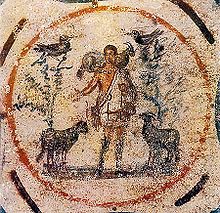
– one of the earliest representations of Jesus is a shepherd carrying a sheep on his shoulders

• being carried in the arms of God is a cherished image from ancient times
◦ for example, from the time of Moses:
The eternal God is your dwelling place,
and underneath are the everlasting arms
(De. 33:27)
• this was still an effective symbolic metaphor in Isaiah’s time
He will tend his flock like a shepherd;
he will gather the lambs in his arms;
he will carry them in his bosom,
and gently lead those that are with young
(Is. 40:11)
– it was still effective all the way into the 19th century
• in 1887 Anthony Showalter, who wrote many gospel hymns,
◦ published “Leaning On the Everlasting Arms”

What a fellowship, what a joy divine, Leaning on the everlasting arms;
What a blessedness, what a peace is mine, Leaning on the everlasting arms;
Leaning, leaning, Safe and secure from all alarms;
Leaning, leaning, Leaning on the everlasting arms.
Oh, how sweet to walk in this pilgrim way, Leaning on the everlasting arms;
Oh, how bright the path grows from day to day, Leaning on the everlasting arms;
What have I to dread, what have I to fear, Leaning on the everlasting arms;
I have blessed peace with my Lord so near, Leaning on the everlasting arms;
Leaning, leaning, Safe and secure from all alarms;
Leaning, leaning, Leaning on the everlasting arms.

• and it still worked in 1955, 1995, and 2010, where that hymn was used in the following movies:
◦ The “Night of the Hunter,” “Wild Bill,” and “True Grit”
◦ and the television series “House of Cards,” “Law and Order: Special Victims Unit,” and, my favorite, “The Simpsons”

I’m convinced that this specific imagery can still resonate in our hearts

How can wake myself up to being in God’s arms?

I think we can begin with the bare experience of life
– the problem is, we have to get out of the house,
• put away our cell phones, and see what’s here with our own eyes
• it is too easy to lose ourselves in mediated experiences
◦ watching other people engage in sports
◦ watching the adventures of others, scripted by human minds
– the world of people, pets and other living things is full of surprises
• full of wake-me-up moments

Yesterday I walked Kona, our yellow Lab, along Salt Creek Beach. As soon as we came within sight of the ocean, I saw dolphins. The number of dolphins in the pod was unusually large for as close as they came to the shore. It was a special moment that I wanted others to experience too. A man and woman passed us, walking the other direction with their heads down. I asked them, “Did you see dolphins?” She said, “Really?!” and he asked, “Where?” The woman did not see them at first, so he pointed to them for her. I left them to their own excitement and walked on.
It bothered me that so many others on the beach were missing the show. Some were tanning themselves, others throwing a football or frisbee, and others were staring into their cell phones. I wanted to yell at them through a megaphone, “You’re missing a miracle!”

I did not give myself this life I have
– I have not earned it, do not deserve it, and I do not sustain it
– life is a gift — “and underneath are the everlasting arms”

Conclusion: God reminded Israel that from birth he carried them

And even to their gray hairs he would carry them
– I wonder what will become of me,
• as I age and continue to decline in strength, mental acuity, mobility and influence?
– I have memories from childhood of falling asleep in the family car
• when we would arrive home, Dad would gather me into his arms, carry me into the house and put me to bed
• I can remember being in his strong arms
◦ feeling secure, comfortable, relaxed

That was my first helplessness
– in old age I’ll come to my last helplessness
• again someone take my hand and lead me
◦ feed me, dress me, and help me into bed
◦ all through, from birth to old age, God holds me
• and I am secure in God’s everlasting arms
◦ his arms are my symbol of trust

Trust the arms of the One
who made,
who carries,
who rescues,
and who loves us beyond imagination.

Lord, you have been our dwelling place
in all generations.
Before the mountains were brought forth,
or ever you had formed the earth and the world,
from everlasting to everlasting you are God (Ps. 90:1-2)

October 7, 2019

This is what the Lord GOD showed me: behold, he was forming locusts when the latter growth was just beginning to sprout, and behold, it was the latter growth after the king’s mowings. When they had finished eating the grass of the land, I said,
“O Lord GOD, please forgive!
How can Jacob stand?
He is so small!”
The LORD relented concerning this:
“It shall not be,” said the LORD.
This is what the Lord GOD showed me: behold, the Lord GOD was calling for a judgment by fire, and it devoured the great deep and was eating up the land. Then I said,
“O Lord GOD, please cease!
How can Jacob stand?
He is so small!”
The LORD relented concerning this:
“This also shall not be,” said the Lord GOD.
This is what he showed me: behold, the Lord was standing beside a wall built with a plumb line, with a plumb line in his hand. And the LORD said to me, “Amos, what do you see?” And I said, “A plumb line.” The the Lord said,
“Behold, I am setting a plumb line
in the midst of my people Israel;
I will never again pass by them;
the high places of Isaac shall be made desolate,
and the sanctuaries of Israel shall be laid waste,
and I will rise against the house of Jeroboam with the sword.

Amos 7:1-9

Intro: Amos has an unusual story, as he explains later

I was no prophet, nor a prophet’s son, but I was a [shepherd] and a dresser of sycamore figs. But the LORD took me from following the flock, and the LORD said to me, “Go, prophesy to my people Israel.” (Amos 7:14-15)

God put him on this mission after Israel passed the point of no return
– they had strayed so far from God, they were no longer “his people”
• God showed Amos the consequences of their betrayal
◦ but the way God delivers the vision is rather interesting
• it is as if he was trying out various possibilities with Amos
◦ there is an obvious pattern here, as if they were following a script
– God described a catastrophe; first, a locust invasion, then a fire storm
• Amos protested to both with the same words (with one exception)
◦ such disasters would result in Israel’s extinction
◦ so both times, God relented, “It shall not be” — or “Okay, not that”
• this sort of conversation has been referred to as “prophetic dialogue”
◦ here the drama is played out to underscore God’s goal
◦ it was not to decimate Israel or destroy them completely

This is explicitly stated near the end of Amos:
Behold, the eyes of the Lord GOD are upon the sinful kingdom,
and I will destroy it from the surface of the ground,
except that I will not utterly destroy the house of Jacob . . . .
All the sinners of my people shall die by the sword
(Amos 9:8-10)

The third vision reveals how God would judge his people selectively
– Amos, what do you see? – a plumb line is a string weighted on one end
• holding the other end, the hanging string would delineate a true vertical
◦ today, building a wall we would use a bubble level or laser
• in the vision, the walls were already built
◦ the plumb line was being used to test the integrity of the walls
◦ the idea: God had a criterion for determining his true followers
– when meditating on this passage, what came to me was this
• almost any object or event can embody a revelation
◦ a carpenter’s tool, a farmer’s harvest, a produce stand
• if we look, we’ll notice; if we notice, we can observe
◦ the language here is important:
“showed me,” “Behold” (4x), and “what do you see?”
◦ asking ourselves, “what do you see?” can take us to a deeper place
◦ into the moment and into ourselves
But do not try to force a meaning on things
Simply listen and whatever God has to show you come to you

I did not choose this passage today to share my meditation on it

Something else is on my mind, and it has bothered me for a long time
– I have always been drawn to Christian mystics
• to those souls that have hungered and thirsted for God
◦ and devoted their entire lives to pursue him in script and prayer
◦ who gave up everything, taking on vows of poverty and chastity
• but on occasion, I’ve been creeped out by their beliefs or practices
◦ an easy example is the severe asceticism of some
(to rivet their attention on God and avoid sin, they abused their bodies)
◦ what bothers me is the absence of support from or correlation to scripture
– I’ve wondered, What is the source of their insights if not Bible?
• their own experience? culture? philosophy? other influences?
• there is a sad history of mystics within the church who went too far
◦ for instance, the Gnostics, Arians, and Montanists

Recently I’ve been reading an author whose name I won’t mention
(because I really enjoy his books and don’t want to discourage anyone from reading them)
– he is insightful, inspiring, helpful and encouraging
• but he describes the awareness gained through contemplation
◦ as “the ground of awareness itself”
◦ and “the flowing luminous vastness that is interior silence”
• years ago I read Paul Tillich’s definition of God as “the ground of all being”
◦ I get it–the statement is true, but it’s an intellectual concept
◦ and it isolates one facet of God while excluding others–
others that are equally important
– what concerns me is the vagueness of these formulations
• Tillich also stressed the idea of God as “the wholly other”
◦ it is true, God is transcendent
◦ but the other half of the truth is that God is immanent
• I realize God is beyond the ability of the human brain to define
◦ but does that bring me any closer to him?

I read somewhere that much of our theology is negative
– we say that he is invisible, intangible, immutable, immortal
• we also refer to him with absolutes
• omnipotent, omniscient, omnipresent, all-loving
– but these statements don’t do much to connect us to him
• they do not spell out the ways he is here for us
• Christian spirituality includes a great breadth of truth
◦ the journey will take us deep in to some regions,
◦ but each region is one vein of an infinite matrix from which no other vein can be excluded

We have to be exercise caution with theology

It can be a short step from truth to heresy
– this happens when one half of a truth is overemphasized
• G. Campbell Morgan referred to St. John as a “contemplative”
(others have used the term “mystic”)
◦ in his gospel, he says the logos that came “was God”
◦ in 1 John, he says God is phos (light), zoe (life), and agape (love)
• these represent multiple aspects of God’s nature
◦ they work because John does not insist on one to the exclusion of any of the others
– read 1 John closely – John’s theology is emphatically personal
• his reference to the “blood of Jesus” is concrete not abstract
◦ the application of Jesus’ blood is mystical
◦ but the shedding of his blood was literal
• in fact, the biblical revelation of God as Person is so strong,
◦ it risks anthropomorphism (describing him in human terms)
◦ yes, there’s the cloud that obscures our vision (Mt. 17:1-8)
but there’s also the voice from the cloud–
the voice of a Person who owns Jesus as his Son

God is not an abstraction nor is he a concept
(and you are not a concept, and I’m not a concept)

I think many Christians pray to their concept of God
– we cannot dispense with our concepts,
• we just have to remember that God is person
◦ he has a name
◦ and he’s revealed it to us so we can call on him
• the prophets’ and apostles’ encounters with God,
◦ were never like floating in a vast luminescence
◦ they were a meeting of minds, conversations, I-Thou
– last week Kelsey reminded us, God is not an object
• we cannot study him under a microscope or find him through telescope
◦ we can’t make images of him, because God is Spirit (Jn. 4:24)
◦ our exp isn’t something we can carve in wood or sculpt in stone
• but we can make this positive and definite statement:
◦ God is person
◦ that is what makes it possible to be in relationship with him

There’s one other facet that needs to be clarified

It has become popular in some circles to stress monism–oneness
– this is obviously important because God is One
• Jesus and the Father are One
◦ we are One with Jesus and One with each other
• but oneness does not obliterate our individual selves
◦ and it does not obliterate dualism
◦ Kelsey pointed out last week that dualism is important
but some believers don’t see it’s importance
and some are even anti-dualism
– we’re told that dualism is a Greek idea, derived from Plato’s philosophy
• that monism was the Hebrew worldview
• but read the first chapter of Genesis
◦ God brought order to the original chaos by dividing things
◦ first light and darkness, then an expanse separating waters,
then the dry land and oceans
• dualism AND monism are two halves of the same whole
◦ we are looking at the reverse sides of the same coin
◦ “diversity within unity” describes both the triune God and his church
– I regret there isn’t enough time to go over this as much as I would like
• but give dualism some serious thought
• the basic categories of scripture are: heaven and earth
◦ God and humankind–i.e., God and us!

Conclusion: What is the true heart of Christian spirituality?

You see, this is the wrong question
– the correct question is Who is the heart of Christian Spirituality?
• there is one obvious answer: Christ!
• not a vaguely defined universal Christ-consciousness
◦ but the man Christ Jesus (1 Tim. 2:5)
– what our souls hunger and thirst for,
• what we are striving for in Christian spirituality is to know Jesus (Php. 3:7-11)
• our progress is measured by our growth in the grace and knowledge of our Lord and Savior Jesus Christ (2 Pet. 3:18)

In my first lengthy conversation with Fr. Romuald, he told me,
“In the Hebrew language, there are no abstract or impersonal words. Everything is concrete and down-to-earth language. All Hebrew says is ‘you’ and ‘me.’ There is no verb in between us. It is, ‘I for you, you for me.’”

This has been my primary concern today
to remind you, make certain your contemplation
is an opening to the Person and to his presence
And that our spirituality is definite
and therefore we speak openly and clearly (2 Cor. 3:12)
Our goal is not to become more spiritual
or mystical,
but to know Jesus Christ
And then, to get to know him even better,
until knowing him, we are fully transformed by him