
August 28, 2022

Welcome and Prayer: Nancy Lopez

Welcome!                 May the Lord be with you!

A few days ago, I was walking down a carpeted hallway, with my shoes and socks on, and as I took my next step, I felt something under the sole of my shoe.  It was this…..a very small pebble of some kind.  Amazing isn’t it, that the nerves in our feet can sense through socks and shoes that there’s something that we’re stepping on and send a message to our brain.  Of course, I had to stop, pull it away from my sole and investigate what it was.  It is hard, with some jagged edges; and it was removed and quickly dealt with.  However, if I would have tried to keep walking, it would interrupt my gait, and I wouldn’t be able to ignore it.

I was thinking that we might have some small, hard pebbles, not only on soles of our shoes, but lodged in our souls somehow.  Perhaps it’s a hard pebble of bitterness or resentment.  Our brain might not notice it’s there, but our heart knows.  We might feel its presence under certain circumstances or with certain people.  We might try to ignore it or get away from the trigger, or we might try to cover it with blame, so we don’t feel its pain.  Anyway, it’s not really dealt with then, is it?

Could the pebble lodged in our soul be unforgiveness?  I wonder what shape that has.  Can you picture how big and pervasive unforgiveness could be?  You know that scripture in Matthew where Jesus teaches that if we’re coming to the altar and realize that our brother or sister has something against us, and we’re told to go reconcile to the person and then come and offer our gift?  I wonder if a part of the reason for that is that then we will come to God more fully present and unencumbered. 

Seemingly small pebbles can still cause great suffering (you know this if you’ve ever had a bone spur or a kidney stone!).  Small things can short-circuit a connection. Bitterness, resentment, unforgiveness (all manner of pebbles) can slow us down; they can cause us to limp.  Some things, unlike the little pebble on the sole of my shoe, aren’t quickly dealt with, but let’s be in agreement with Jesus that we—more and more—want to deal with these things and move forward without needless suffering or a limp, and more fully present.

Will you join me to pray:
Jesus, you said that You came that we may have life and may have it in all its fullness.  Compassionate Lord, we seek Your wholeness, Your forgiveness, Your healing Peace and Presence, renewing us through and through.  You said that we should come to You when we’re weary and carrying heavy burdens.  We acknowledge that seemingly small things could be heavy to our hearts and stumbling in our walk with You. May Your healing hands rest on us; may You bring things to our awareness; may Your life-giving power flow into the depths of our souls, restoring us to peace and strength for service.  Amen

Morning Talk: Beth Khorey

“PRAYER” as “PARTICIPATION”

  • Last time I was with you I spoke of prayer as “encounter” (an ongoing conversational reality with God).
  • within the encounter with Jesus, change can transpire – a “conversion” of sorts – something changes me as I interact with God.
  • I also mentioned that prayer takes place “communally” – the impact of my interaction with God can and does impact others – even as God’s interaction with you impacts me, impacts the world.
  • These things I spoke of were in the context of Acts 9 – Paul’s encounter with Jesus – and – Jesus’ encounter with Ananias – and Ananias’ encounter with Paul.

Today I’d like to talk a little about “prayer as participation” and after the message we’ll share the Eucharist together – A Communion of the Lord’s Supper – which is an interactive  participation in the Life of Christ.

(the Infinity symbol – a help to understand the Eucharist table)

We’ll come to this table and we’ll remember the past – all God’s storied interactions with his people – and – we’ll remember our own histories, the story of  how  GOD has interacted with us.
We’ll also remember our future hope as we hear Jesus say “I will not eat again UNTIL the Kingdom comes and is fulfilled”!
And all of the past and future our bound up  in the immediacy of this present moment when time and eternity meet in the bread and cup we partake in.

A NOTE ON PRAYER LFE OF JESUS

  • A comment by a Scottish theologian – James Stewart – caught my attention recently.
  • He said Jesus never gave any “argument” for prayer – it’s validity, or why we should pray – rather he just prayed. He said of Jesus that “praying was the native breath of his soul.”
  • Stewart continued: “Prayer’s well-spring lay beneath all rationality, beneath the region of argument. It lays in the depts. Of the heart which was made by God and for fellowship with God.”
  • His observations on Jesus’ prayer life led him to notice that Jesus was not at the mercy of moods – though he experienced significant changes in emotion.
  • For Jesus – prayer meant “communion with the Father…the one he loved utterly and passionately and couldn’t bear being away from him…he used every opportunity day or night to speak with God of his love.”

 (James Stewart, The Life and Teaching of Jesus Christ, p.97-99)

PRAYING WAS THE NATIVE BREATH OF THE SOUL

  • It reminds me of the ancient practice of “breath prayer” – a simple practice to attach Scripture to our breath
  • shortening words of Scriptures – attaching them to our breath patterns helps me to take in the Word and the Word becomes me – I speak God’s word and my words become God’s.

Today we’ll here words of Jesus…we may even want to make them our own:

“Father (inhale) – forgive (exhale)” //  “Remember (inhale) – Me (exhale)” //
or “Into your (inhale) – hands (exhale)”

Scripture Narrative I’m drawing from today is:

Luke 23:23-49

THIS WAS A “SPECTACLE” – v. 48

  • Someone claiming to be “King” is crucified as a “criminal”
  • crowds had gathered to ensure what their demand that Jesus be crucified was executed
  • religious leaders were there taunting and jeering to make sure their villain – the one that threatened their power structures, their ways of doing life and notions of God was extinguished.
  • Roman soldiers were there doing their job but having some twisted fun and games at the brutal expense of this holy man
  • And there were watchers– women and other disciples standing at distance watching…in “fear” of the Jews
  • The friends of Jesus were there for a while (but other accounts say eventually they all fled) except for John who stood with the mother of Jesus and other women at the foot of the cross.

 2 OTHERS there identified as “CRIMINALS” v.32

  • These two were “LAWBREAKERS” and “CALLED LAWLESS”
  • Who were executed beside Jesus
  • Jesus – the King of Jews who brought the Kingdom of God near – this “innocent One” – (this is what the criminal and Roman Solider testifies when they see Jesus die)

The nearness of the Kingdom in the King, the nearness of Innocence…what impact might you imagine being so near this Innocent King?

JESUS WASN’T ALONE IN THIS INHUMANE SPECTACLE

  • It’s important to know that Jesus wasn’t alone in his death.
  • this wasn’t a private or a dignified affair – it was the public entertainment of the day
  • this was sheer humiliation beyond our imagination – Jesus was stripped naked, tortured, mocked cruelly
  • Exposed to harshness:  both harsh natural elements (the sun, the earthquake, the darkness) and the cruelty on our darker inhumane natures.

TORTURED AND THE TRUTH

 I’ve watched enough movies and read enough material to know that “torture” has been used to get the “TRUTH” out of war criminals and prisoners. You can find a number of articles and research that states torture to elicit truth doesn’t work…none the less…I’d like to say we can see and hear something of Jesus’ TRUTH when, having been tortured that fatal day, he does SPEAK:

His TRUTH flows from the Cross in the labored 7 statements recorded for us in the Gospels – 3 of which are here in Luke’s account:

34  “Father, forgive them, for they know not what they do.”

43  “Truly, I say to you, today you will be with me in paradise.”

46  “Father, into your hands I commit my spirit!” 

  • 2 statements are prayers
  • the other an invitation to participate in the Kingdom – TODAY

JESUS PRAYS:

34  “Father, forgive them, for they know not what they do.”

This is difficult for me to imagine…I’ve been hurt, betrayed, suffered humiliation, and I’ve tasted, viscerally, resentment and bitterness.
I’ve also hurt others. I’ve said harmful things and in doing so humiliated and injured others and I’ve tasted the shame and guilt of my words and actions, in regret and sorrow.
But when we hear Jesus PRAY from this agonizing place what we are HEARING and WITNESSING is his native tongue, his deepest desires, his genuine sincerity and hospitality – we are seeing embodied in Jesus the most radical form of LOVING OTHERS that a human could offer.

  • He taught “I say to you – forgive…love…pray… for your enemies and those who hurt, persecute, and spitefully use you” (Matthew 5:43-6:18)
  • And here we see the his lack of any vindictiveness, anger, hatred or even just that little bit of …“YOU JUST WAIT AND SEE…”kind of retort!

As you hear Jesus pray in these moments – “Father forgive them they know not what they do” – what impact does Jesus’ prayer have on you?

I don’t know what you are feeling, hearing, sensing – but holding some broken relationships in my heart – I know my soul wants to ASK FOR HELP…to forgive and to pray forgiveness over my relationships.

HERE’S WHAT HAPPENINGS TO ONE OF THE CRIMINALS WHEN HE HEARS JESUS PRAY:

39 One of the criminals who were hanged railed at him,[c] saying, “Are you not the Christ? Save yourself and us!” 

I can’t say with any certainty what “ultimately” transpires for this one who seems to be hard and cold…the contrast between the two criminals and Jesus is glaring…and makes a dramatic point for our own choice today…

I do know that In John 1 & 3 that “Light came into the world and darkness rejects the light lest its deeds be exposed” – Light can be very penetrating if we allow it to search us:

  • There could be a fear of being found out.
  • Light exposes the truth of ourselves, our motivations and our fears, and our actions
  • There may be some immediate felt shame – it’s hard to see things about ourselves…
  • Yet from the beginning – we were created for naked exposure to God – transparency – and to live without shame
  • However, when the first humans hid in shame due to their poor choices and sin – God came looking for them to draw them out with a question – “where are you?”

Today – an invitation comes to us:

Next to Jesus – Might we allow ourselves to be seen, exposed in truth? When we do…we just might hear his welcome – “today, you are with me in paradise”!

Back to the criminal’s jeer: “Are you not the Christ? Save yourself and us!” 

In Mark & Matthew’s account both criminals jeer and taunt Jesus.

The tone of the taunts, scholars assert, is that of SARCASTIC DISRESPECT

  • It’s biting, a type of verbal violence
  • sarcasm may in some circumstances be comic relief – yet at it’s root intention is a defensive strategy to bite and belittle the one we can’t face or the one that hurt us.
  • It’s a way of shutting down, closing the door on, a type of fingered gesture to verbally flip off someone.

The drama in the narrative is contrast – we see the extremes: “Are you not the Christ? Save yourself and us!”
The criminals and folks around Jesus are jeering in sarcastic disrespect. It’s pointed at the one who claimed to save them as King.

  • this is not too far off from the cultural climate we live in as the VITROLIC ATTACKS we hear now of anyone in authority or governance. The Scriptures says we are to pray for those who lead and govern us.

Contrasted to Jesus praying for the forgiveness of those crucifying and humiliating him. He knows the intricacies of the heart of every one of those wounders – he sees their unhealed wounds. Their fears and reactions come out of the pain of those wounds. Fear – left unmet – can become a brutal attacker.

HERE’S THE POETIC IRONY OF THE SPECTACLE:

They were saying something utterly and prophetically true – beyond their own cognition.

Because he chose not to save himself he can save us.

DYING IS NOT A CONCESSION

RATHER IT IS THE LOCATION OF ENCOUNTER

WITH GOD WHO IS GOD

WHO DIES AS LIFE

Andy Root (Church and the Crisis of Decline)

Nothing of Jesus’ death was a “CONCESSION” for him.

A concession is something that happens in negotiations – when one side gives in to what the other side wants.

  • He had clarity about the will and purposes of God from the foundations of the world
  • He knew from where he came and where he was going (John 13)
  • He lived from out of his own truest self-identity as Redeemer of God’s people
  • He agonized in his humanity in PRAYER in Gethsemane over the course his life would take and how it would end and his ultimate desire was for the will of God to be fulfilled. This was not a CONCESSION –  it was nota concession made between negotiating sides! It was his own CHOICE made within the bounds of a LOVING RELATIONSHIP with God.
  • He said “No one takes my life, I lay it down of my own accord (John 10:18)
  • And when the days came for him to go to Jerusalem to suffer and die – He set his face like flint (Luke 9) he wouldn’t change his mind.

His death…and ours in the many choices we make to follow Jesus in the way of the cross – the myriad losses we suffer, the ways we choose to love others, the many ways we “die daily” (as Paul says) and trust God’s way of resurrecting that which dies in faith…IS NOT A CONCESSION

Rather it’s the point of – the location of –  encounter with God who is God who dies as life.

 _____

SO HERE’S WHAT HAPPENS TO THE OTHER CRIMINAL WHO HEARS JESUS PRAY:

40 But the other rebuked him, saying, “Do you not fear God, since you are under the same sentence of condemnation? 41 And we indeed justly, for we are receiving the due reward of our deeds; but this man has done nothing wrong.”

What happened in the space and time  hanging there in those tortured hours of slow death?

SOMETHING SILENCED HIM…and in the “silence” what did he see, hear, come to recognize about himself – about this One Innocent man, the King, who was very very near to him?
I’m not really sure…but let me help you muse about it:

  • Was it enough space/ time and silence to take in the words of Jesus PRAYED? and feel the impact of the PRAYER?
  • Exposed to Jesus and seeing Jesus exposed – did he come to some clarity about his own Self?
  • Did it precipitate an awareness of his own truth and to own it through confession – “I am guilty”?
  • Did owning that truth lead him to a deep inner desire for forgiveness?
  • Did the sense of inclusion of Jesus’ prayer seem inviting when he heard “them”?
  • In that labored “breath-prayer” to the Father – did he yearn for kinship with a benevolent God to find a home in God?
  • Was he deeply and utterly touched by the human and spiritual generosity of One who would pray forgiveness for being unjustly executed?
  • Was there something of hope rising within him as he was in nearness of God Incarnate?
  • And was that rising hope leading him to believe that he might get out of this thing with his life even though he died?
  • Was he gifted with faith…albeit faith the size of a mustard seed – that he could ASK the desire of his heart and TRUST that Jesus could, would hear and answer him with the capacity to save?  

I don’t know for sure what transpired in him…
But I know what Jesus did say and offered! He gave that man who was guilty of lawlessness a promise of participation in the Kingdom.

 42 And he said, “Jesus, remember me when you come into your kingdom.” 43 And he said to him, “Truly, I say to you, today you will be with me in paradise.”

IN THIS SPECTACLE OF IMMANENT DEATH AND THE IMMEDACY OF THE PRESENT MOMENT – ETERNAL LIFE WAS OFFERED AND RECEIVED!

The sincerity is poignant.
The intimacy is compelling.
The outcome hopeful.
Jesus prayed from his heart.
The criminal became silent and reflective.
Out of silence the guilty man prayerfully asked to be remembered.
And Jesus told him – tells us – TODAY you’ll participate in the Kingdom with Me. AND IT’S PARADISE TO BE WITH Me IN THE KINGDOM!

This is the PRAYER – in the immediacy of the present moment, held as a conversational reality of encounter with God that changes me and those I’m involved with.

PRAYER

  • It’s the soul’s native tongue
  • It’s the place of encounter with the living God
  • In we change – conversion occurs
  • Forgiveness is found
  • Relationships are restored
  • Hope rises and moves us onward
  • kinship with a benevolent father is felt
  • Communion with Jesus and others in the Spirit is like a paradise NOW!

DYING – any death, in terms of COMING TO THE CROSS of JESUS and bearing it daily IS NOT A CONCESSION but a location of encounter with the God who is God and who dies as life.

We move into our Eucharist prayers and invitation to participate in the Lord’s supper.

(See Liturgy of Eucharistic Prayers)
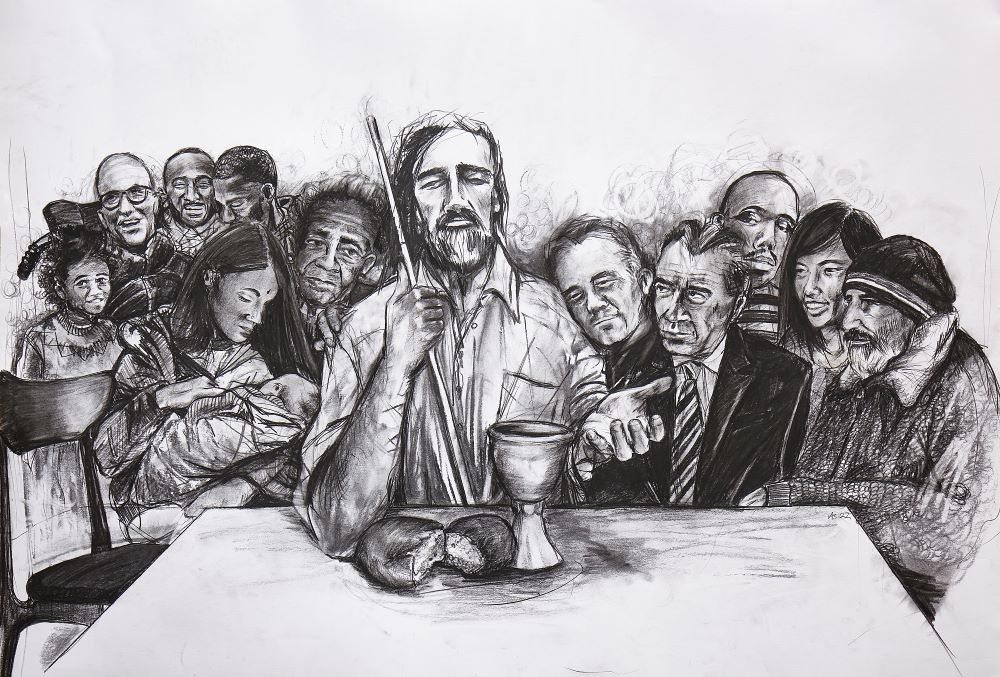
Blind Jesus (No One Belongs here More than You) by Rev. Alan Stewart

Art used by permission of artist.

The artist reimagines our current reality after the first Jesus’ meal and the historic event of the cross. Jesus outstretched his hands on the cross then so he could out stretch his hand of invitation to us now at the banquet feast of our memorial covenant meal.
ALL are welcome at the Lord’s table…many people portrayed at his side. The seat empty next to Jesus is for you. His renowned hospitality during earthy life is core to this portrayal…Jesus eats with tax collectors, prostitutes, lepers, and those outsiders in society, as well as anyone who would seek his company.
The artist pictures Jesus as blind – visually impaired – welcoming all.
Intriguing to me because this was one of the central paradoxes of his teaching as he interacted with religious leaders of his day.
Those who say they see are blind.
Those who admit they’re blind come to see.
The criminal on the cross who is guilty comes to freedom in Jesus.
The One who is crucified as a perceived criminal is the freedom giver – the Savior of the world.
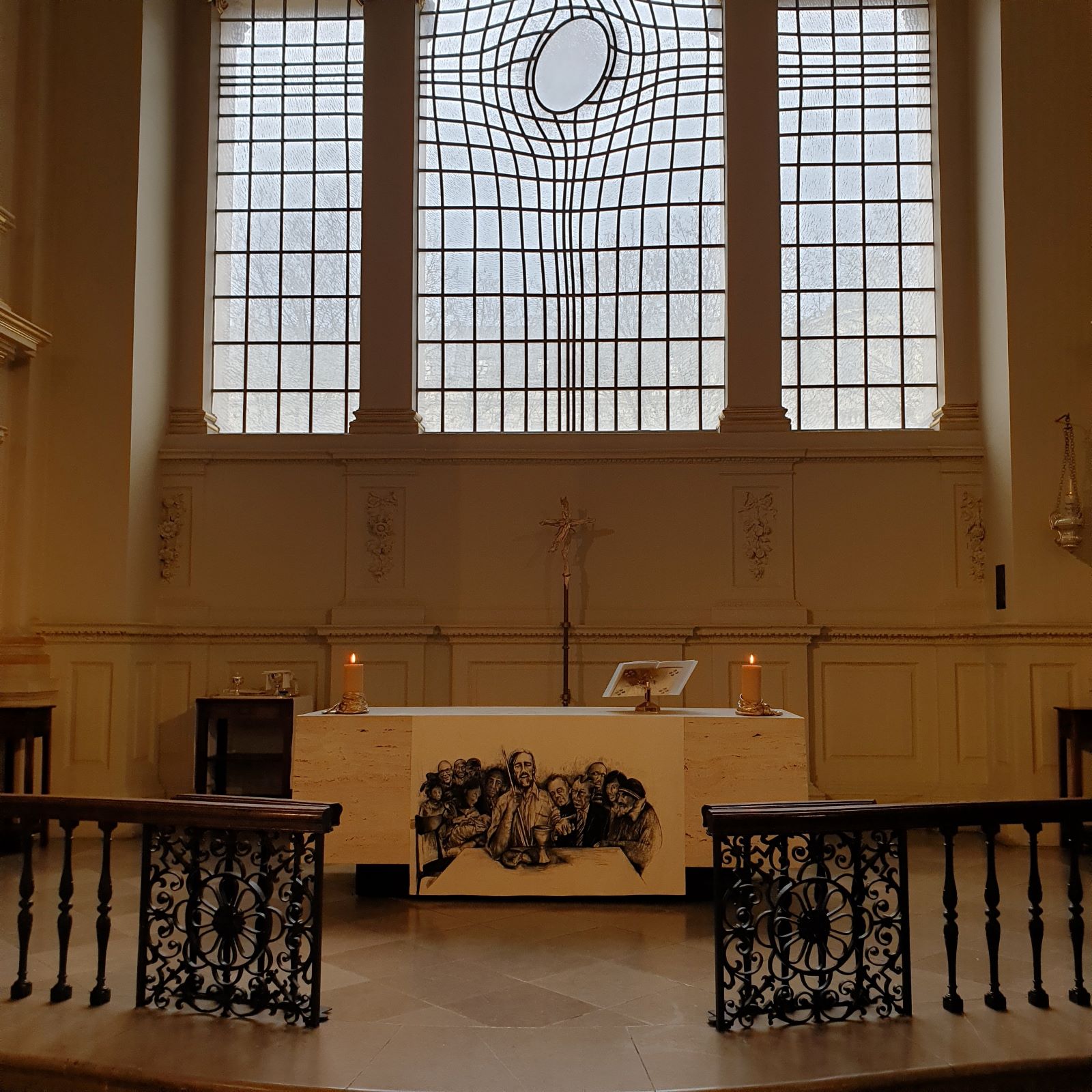
The art is installed in St. Martin of the Fields, London England. One of the oldest Anglican Churches in the world. It’s hung on an altar.
The contemporary stain glass the artist envisioned was a cross in a type of sound wave breathing through creating a portal right at the intersection of vertical and horizontal beams.
The straight rigid mechanical lines of lead warp in as if the Spirit blows right through them creating a visceral visual movement. You can almost feel the vibrations and movement.

A way has been opened up by Christ precisely at the heart of the Cross.

August 21, 2022

Podcast

Facebook

Welcome and Prayer: Nancy Lopez

Good morning, welcome.            May the Lord Jesus be with you!

I think that we are all feeling a bit de-stabilized in this world right now.  Our faith traditions, our politics, our safety, our climate, our health, our economy—there’s so much going on that might bring to awareness our lack of control, and that tends to create anxiety.  It is only natural that we might be looking for relief, looking for someone to save us, or a way that we could save ourselves.  These de-stabilizing ways are ways that might break us or lead us on a track of attempting control– or they might facilitate wisdom, they might remind us of that “one thing we ask and that is what we seek.” 

We will not be overwhelmed if we return to the Beloved, to the One who is worthy of all blessing and honor and glory. What we do matters, our dialog in the world matters, our self-awareness matters, our physical and emotional health matter.  And we remember Jesus, who matters most; we place our trust in Jesus.  More and More.  Again and Again.  When we present ourselves to Him, we remember that He alone is worthy of all blessing and honor and glory.

Before we went live this morning, our in-person community listened to a song written and performed by Andrew Peterson entitled “Is He Worthy?”  I invite you to look for it and listen too.

Join me to pray, will you:

The world is broken, the shadows deepen, but all the dark won’t stop the light from getting through.  Your creation is groaning, Lord Jesus.  Thank you for being the Author and Finisher of our faith.  Thank you for giving us Your kingdom, Your Spirit, and for making us to be priests to stand the gap until you come to bring Your Glory, Your Peace, Your Shalom in fullness. Amen

Morning Talk: chuck smith, jr.

The seventy-two returned with joy, saying, “Lord, event the demons are subject to us in your name!” And he said to them, “I saw Satan fall like lightning from heaven. Behold, I have given you authority to tread on serpents and scorpions, and overall the power of the enemy, and nothing shall hurt you. Nevertheless, do not rejoice in this, that the spirits are subject to you, but rejoice that your names are written in heaven.” Luke 10:17-20

Intro: In any series of talks I give it’s helpful to have a reminder

We are following Jesus through Luke’s gospel learning prayer,
– by listening to Jesus and by watching him
• I sometimes forget the absolute necessity of prayer
◦ when that happens, I treat prayer like it’s optional
• many people think prayer is asking God for things,
◦ and if they don’t get what they want,
◦ they decide it doesn’t make any difference if they pray
– that’s like a married couple who consider communication to be unimportant
• prayer is the hub of our relationship with God
◦ it’s what holds it together – how we stay connected
• prayer is the breath of our spirit – without it, the spirit dies

Today’s talk may sound like I’m backing off from what I said last week

I’m not – if Evangelicals have become confused about evangelism,
– it doesn’t mean that we’re not supposed to evangelize
. . . you must worship Christ as Lord of your life. And if someone asks about your hope as a believer, always be ready to explain it. But do this in a gentle and respectful way (1 Pe. 3:15-17, NLT)
• most of this chapter in Luke is about doing the work of Jesus
• he makes us his partners in doing his work in the world
◦ it matters that we do it right – which means, we do it his way: love, truth, goodness, and beauty
◦ Paul explains his “evangelism strategy” in very clear terms:
To the Jews I became as a Jew, in order to win Jews. . . .To those outside the law I became as one outside the law . . . that I might win those outside the law. To the weak I became weak, that I might win the weak. I have become all things to all people, that by all means I might save some (1 Cor. 9:19-23)

Let’s dive into the story

These disciples are the seventy-two we read about last week
– they’ve returned from their mission, and as Luke says, “with joy”
• joy is the dominant emotional theme in this passage
• it is related to the word rejoice (which appears three times)
– think of what we would like to see happen in the world
• what would excite us? what would bring us joy?
• if we saw the forces of evil weakened and diminished
◦ oppressive governments and institutions collapse, human lives redeemed and liberated
◦ an end to war and the threat of war
He makes wars to cease to the end of the earth;
he breaks the bow and shatters the spear;
he burns the chariots with fire (Ps. 46:9)
. . . and they shall beat their swords into plowshares,
and their spears into pruning hooks;
nation shall not lift up sword against nation,
neither shall they learn war anymore (Isa. 2:4)
◦ addiction and alcoholism would decrease
◦ there would be no more hate crimes or mass shootings
◦ no family would live under shadow of domestic violence

Jesus had a vision of Satan’s power being broken
– he also saw the future successes of his team
• for seventeen hundred years,
◦ Christians had a positive influence in western societies
• if we’re experiencing some slippage now,
◦ it’s because we’ve become distracted
◦ we are less attached to the teaching of Jesus and more involved in politics
– in spite of Jesus’ vision of their victory over “the enemy,”
• that was not where Jesus wanted disciples to find their joy
◦ he did not want them oriented to evil or their battle against it
• the project of many Christians today is defined by what they’re against
◦ looking for dark says, or the Antichrist of the end times,
◦ or praying at the devil – “Satan, we bind you in the name of Jesus”
(why do you want to talk to him?!)

Another theme in these verses is the word “name”
– it was in Jesus’ name that demons were subdued
• this is a resource we all need to remember (with my own demons)
The name of the LORD is a strong tower;
the righteous . . . runs into it and is safe (Pr. 18:10)
Therefore God has highly exalted him and bestowed on him the name that is above every name, so that at the name of Jesus every knee should bow, in heaven and on earth and under the earth, and every tongue confess that Jesus Christ is Lord, to the glory of God the Father (Php. 2:9-11)
– Jesus informs them that their names are written in heaven
• that’s the direction Jesus wanted the disciples to be looking
◦ and also written in heaven were the names of everyone they influenced for Jesus
• they’d been in cities and villages doing for others what Jesus had done for them
◦ whenever we affect someone in positive way in name of Jesus, it brings us joy
◦ our spiritual joy is a specific kind of energy, refreshment, renewal

Luke moves from disciples’ joy to Jesus’ rejoicing
In that same hour he rejoiced in the Holy Spirit and said, “I thank you, Father, Lord of heaven and earth, that you have hidden these things from the wise and understanding and revealed them to little children; yes, Father, for such was your gracious will. All things have been handed over to me by my Father, and no one knows who the Son is except the Father, or who the Father is except the Son and anyone to whom the Son chooses to reveal him (Luke 10:21-22)

Luke uses an odd expression, he rejoiced in the Holy Spirit
– why not, “he rejoiced in his own spirit?” or “with all of his heart?”
• it could mean, he rejoiced in what the Holy Spirit had done with the disciples
• but there’s another possible meaning, and one we must learn
– there’s a form–or state–of prayer that doesn’t come from our minds
• it doesn’t come from our hearts either–though it moves in our hearts
. . . the Spirit helps us in our weakness. For we do not know what to pray for as we ought, but the Spirit himself intercedes for us with groanings too deep for words. . . the Spirit intercedes for the saints according to the will of God (Ro. 8:26-27)
◦ God’s Spirit prays through our spirit
◦ sometimes this is a wordless prayer
What am I to do? I will pray with my spirit, but I will pray with my mind also . . . . (1 Cor. 14:15)
praying at all times in the Spirit, with all perseverance, making supplication for all the saints (Ep. 6:18)
But you, beloved, building yourselves up in your most holy faith and praying in the Holy Spirit, keep yourselves in the love of God (Jude 1:20-21)
• we can pray this way any time and anywhere
“Lord, I don’t know what to pray. Have Your Spirit pray through me”
• prayer is our deepest spiritual experience
◦ in a sense, all our prayers can be in the Holy Spirit

What brings Jesus joy? The way his Father works with people
– I expect highly intelligent people to be able to guide me
• my automatic response is to turn to the experts
• but being well educated is not same as being enlightened
I have more understanding than all my teachers,
for your testimonies are my meditation.
I understand more than the elders,
for I keep your precepts (Ps. 119:99-100)
◦ though Paul was well-educated himself, he celebrated God’s upside-down ordering of enlightenment
For consider your calling brothers [and sisters]: not many of you were wise according to worldly standards, nor many were powerful, not many were of noble birth. But God chose what is foolish in the world to shame the wise; God chose what is weak in the world to shame the strong . . . so that no human being might boast in the presence of God (1 Cor. 1:26-29)
◦ Arthur Deikman described our “ordinary way of knowing”
(the natural way we learned as children, by observation and making associations – then the way we practiced in school, and the way of science and philosophy)
Arthur Deikman, “But a different experience of knowing is also possible.”
(his term for mystical knowing was “intuition,” but there is also revelation)
– Jesus finds joy in watching God’s gracious will at work in our lives
• in this instance, God’s “good idea” was the revelation the disciples received,
◦ that even the demons had to give way to Jesus’ name
Then turning to the disciples he said privately, “Blessed are the eyes that see what you see!”
◦ God’s power at work through Jesus and his representatives
• in chapter 15, Jesus will tell three stories; all with same theme:
I tell you, there is joy before the angels of God over one sinner who repents (Lk. 15:11)
◦ Jesus thanked God for the spiritual progress of his followers
◦ and how God used them to change the lives of others

Conclusion: I want to encourage you this morning

Recognize what God has give you – the unique way he uses you
– as Jesus said in verse 22, he is still choosing to reveal God to people
• you have a role in how Jesus reaches them
◦ you don’t have to preach, or pitch, or push anything down anyone’s throat
◦ you simply use what seems like your natural aptitude
• thumbing through a meditation journal I kept eighteen years ago, I came across something I wrote to myself
◦ I felt a strong impression that this is what Jesus was saying to me at that time:
“Chuck, continue to resist Evangelical “religion,” culture, and dogma. Do not capitulate to Pharisaic faith. Stand your ground. You have not seen the success you’ve desired to achieve in reaching people outside of church who remain untouched by the gospel. But you may be preparing young men and women who will see that success. Continue to encourage and validate them, and show them the way out of religion and into the life and ministry of Jesus.”
That sounds like a Mission Statement
Get to know God’s Mission Statement for you – and live it

August 14, 2022

Podcast

Facebook

Welcome and Prayer: Nancy Lopez

Good morning!       Welcome to RefleXion.     May the Lord be with you!

When my husband was courting me, over 40 years ago, he pursued me…a couple of old-fashioned words there:  courting, pursued.  And I felt loved, that he would come after me, show me in words and actions that he wanted to be close to me, to know me.  He doesn’t make me feel quite that way anymore, and I miss it.  And I have realized lately that I’m missing that with other people too–some friends, many family members (kids, grandchildren, a brother).  And I’ve noticed that I seem to be doing all the heavy lifting in some relationships. 

But here’s the rub:  I want the relationship, and if I move away, will they actually pursue me?  Will I have lost more than even what I have now?  Or will I find that they miss me, that they reach out and find ways to connect to me?

To know that I’m really loved, it feels like I must not necessarily move away, but stand still, and see if love will pursue me.  Love is risky business.

When I am not necessarily pursuing God, if I will notice, He is still pursueing me.  But do you think that sometimes He just stands still, that He desires me to pursue Him?  Not for His ego or neediness, but just that that’s how intimacy works – Desire and Invitation. 

I pulled out an old book, The Pursuit of God by A. W. Tozer; and he has an interesting way of talking about this.  He says that Jesus, by His own flesh torn, removed the veil over God’s heart and gives us access to the Holy of Holies (remember the veil in the Temple was actually, supernaturally, torn when Jesus died.)  Tozer says that God has removed the veil of His heart expressing His desire and invitation to us to come closer, but that there is a closely woven veil over each of our own hearts, and it is our self-life.  He says that we must allow that veil to be lifted.

Here’s a connection to another old-fashioned term:  the bridal veil.  Today it might be just an accessory to the dress.  But traditionally, the veil covered the face of the bride as she walked down the aisle.  Sometimes it was lifted by the father of the bride and sometimes by the bridegroom, but it definitely used to be a part of the wedding ceremony.

One way of knowing Jesus is to know Him as the Lover of our Souls, our Bridegroom.  Let’s pursue Him in all the ways we can to declare that we desire and value intimacy with Him.  “Courtship, pursuing the beloved, removing the veil” all might seem old-fashioned, but I think that they will never go out of style.

Our opening prayer this morning is from Tozer, in the chapter called “Removing the Veil.”  The language is definitely old-fashioned, and I think it’s beautiful.  Will you join me?

Lord, how excellent are Thy ways, and how devious and dark are the ways of man.  Show us how to die, that we may rise again to newness of life.  Rend the veil of our self-life from the top down as Thou didst rend the veil of the Temple.  We would draw near in full assurance of faith.  We would dwell with Thee in daily experience here on this earth so that we may be accustomed to the glory when we enter Thy heaven to dwell with Thee there.  In Jesus’ Name.  Amen

Morning Talk: chuck smith, jr.

After this the Lord appointed seventy-two others and sent them on ahead of him, two by two, into every town and place where he himself was about to go. And he said to them, “The harvest is plentiful, but the laborers are few. Therefore pray earnestly to the Lord of the harvest to send out laborers into his harvest. Luke 10:1-2

Intro: In the first half of this chapter, Jesus launches a campaign

Of course, like Jesus himself, the operation is modest
– there’s no funding and its reps are unskilled volunteers
• but it’s the crew Jesus chose and the plan is simple and low-key
• there is a twofold purpose for this mission:
◦ prepare people for Jesus’ arrival and ministry
◦ for these disciples to experience their first solo-flights in doing his work
– Jesus begins their preparation with an observation:
The harvest is plentiful, but the laborers are few
• based on this observation, he makes a request:
Therefore pray earnestly to the Lord of the harvest to send out laborers
• then he gives them precise and austere instructions

The first issue I want to go over is, what he is not saying

When I address controversial subjects, I try to tread lightly
– I know there will be people who disagree with me
• they have good reasons, and I want to show them respect
• but today I just want to speak my heart
– Jesus did not send these disciples to do what we have been told to do by many Christian leaders
• that is, tell others they need to “get saved”
• “get saved” is shorthand for walking unbelievers through “the simple gospel”:
1. Every human person has sinned
2. Everyone who sins goes to hell – a place of eternal torment
3. Jesus Christ died for everyone’s sins
4. All we have to do is receive Jesus as our personal Lord and Savior
5. If we do that, we are saved from hell and will go to heaven
6. To continue on as a Christian you must read the Bible, pray, go to church, and preach the gospel to others
◦ if someone follows these steps, then they got saved

This is not the gospel Jesus preached – nor is it what Paul described (cf. Ro. 1:1-6)
. . . Jesus came into Galilee, proclaiming the gospel of God, and saying, “The time is fulfilled, and the kingdom of God is at hand; repent and believe in the gospel” (Mk. 1:14-15)
– this is also the message he gave for his disciples to proclaim
And he called the twelve together and gave them power and authority over all demons and to cure diseases, and he sent them out to proclaim the kingdom of God and to heal (Lk. 9:1-2)
Heal the sick in it and say to them, “The kingdom of God has come near to you.” (Lk. 10:9)
Nevertheless know this, that the kingdom of God has come near (Lk. 10:11)
• God’s rulership has entered the world of humans
◦ according to his will, he enlightens us to himself and frees us from a world of oppression
◦ to repent does not mean to feel sorry for your sin and apologize and seek forgiveness
◦ repent means to change your way of thinking and the way you live
Do not be conformed to this world, but be transformed by the renewal of your mind, that by testing you may discern what is the will of God, what is good and acceptable and perfect (Ro. 12:2)
• the gospel is not, primarily, about going to heaven when you die
◦ it’s about living with God here and now in a way that transforms our lives
– listen to a literal translation of the beginning of the Lord’s Prayer:
Father of us, the one in the heavens,
Let be revered the name of you,
Let come the kingdom of you,
Let be done the will of you,
as in heaven, also on earth
(Mt. 6:9-10)
• Jesus is not telling us to pray, “Take me to heaven when I die”
◦ but to ask God to bring the reality of heaven into our lives now
◦ “May we live your will today, and be trapped by the influence of this world”
• when we refer to Jesus as “Lord,” we are recognizing his authority

There are a couple more issues that need to be addressed

Some churches train Christians to be salespeople for God
– this has been called “soul winning” or “personal evangelism”
• it is a form of converting or proselytizing unbelievers or people of other faiths
◦ in practice, it means either to entice or put pressure on people to become Christians
◦ typically with the promise of heaven and the fear of hell, respectively
• some people are really good at this, and they keep score!
◦ what always comes to my mind is the word “buttonhole”
(originally, “buttonhold”; to hang on to a button on a person’s coat if they try to leave a conversation that does not interest them or makes them feel uncomfortable)
◦ people with aggressive or forceful personalities are sometimes unaware of how they do this to others
– we’re told we must convert our family, neighbors, friends, and acquaintances
• there is also “cold-call evangelism”
◦ “street witnessing,” door-to-door, or preaching at every total stranger
• most of us are uncomfortable with this, regardless of whether we’re on the giving or receiving end

Another celebrated form of proselytizing is crusade evangelism
– awhile back I mentioned crusade evangelism to Barry Taylor
• he went straight to heart of it with three words: “It’s an illusion”
• we’re given impression something big is happening
◦ thousands of unbelievers are coming to God for the first time in their lives
◦ but that’s not what’s happening
– if you’ve ever been to multi-level marketing seminar, you know how it works
• machinery of crusade evangelism is highly organized and expensive
◦ the advance work is treated as if it were as important as the event
◦ churches are used to publicize and invite family and friends, and to train ushers and “counselors”
• the event itself is entertaining – music, an interview with a celebrity, laughter at times, and tears
◦ but everything is about closing the sale
1. When the appeal is made, everything slows down–the evangelists may speak in quieter tones
2. The music acts as a soundtrack, tugging on heartstrings
3. People in the audience get a sense of being backed into a corner
• if they do not comply by receiving Jesus immediately, they risk going to hell
4. Clear directions are given, with encouragement that it’s an easy step to take
5. People start to get up and move toward stage–lots of people, in fact
6. If you came at a friend’s or family member’s invitation, you know what they want
• I’ve heard many say, “I didn’t plan on it, but suddenly I was on my feet and walking down the aisle”
• when the cause of your actions are unconscious, it’s likely that you have been hypnotized
7. Near the stage you’re met by two counselors
• they go over the basics and ask if you’d like to pray (the “sinner’s prayer”)
◦ you’re asked to provide your contact information for follow-up
◦ that card you sign is the contract – and with it, they seal the deal
• you are told that you have become a Christian, God’s new creation
Karl Barth, “The great, silent mystery of most of our great orators preachers and writers consists in this that they are excellent salesmen. They know the business of catering to their customers and of arousing their desire to buy. They have learned the art of bargaining . . . . For many a great cause in the world, and for most of the so called spiritual and religious movements, it is not particularly important that they are intrinsically good, or new, or useful; their chief need is shrewd promoters and able salesmen who can sell them to a pleased public. It is the accepted way of getting things done.”

How have we created the illusion “thousands came to Christ”
– the majority of people present at crusades have already been primed
• family or friends have been working on them
• many of them are already church goers,
◦ but they never “went forward” in a service until now
◦ years ago, our church was sent about seventy follow up cards from an evangelistic crusade
◦ on all but three cards, the “newly saved” person listed a church they attended
– for every one person who gets up to walk to the stage and get saved, two counselors follow
• so in the crowd heading toward stage, two thirds are Christians
◦ but most people don’t know that, so it looks like everyone is getting saved
◦ this creates a psychological effect, such as, “I must be missing out on something if I don’t go”
• this is not biblical evangelism, it’s not Jesus, and it’s not working
◦ I should qualify that last statement; it’s not working like we think it is
◦ I know people who have come to God at a crusade and gone on to become true Christians

Jesus asked his disciples to pray for God to send out laborers

If the disciples could have recruited, trained, and deployed people for the work,
– then that is what Jesus would have told them to do
• it is God who chooses, equips, trains, and empowers his work force
• so Jesus’ last words to his disciples, was to stay put in Jerusalem (Lk. 24:49; Acts 1:4-8)
◦ that within a few days God’s Spirit would empower them,
◦ and they’d become his witnesses – bringing in his harvest
(notice that witness is something we become, that we are, before it is something we do)
– what if I want to sign-up? If I want God to use me in his fields?
• first, if I have the desire, it is likely that God is the one who put it in me
• second, all I’m expected to do is give witness to Jesus’ work in my life
◦ I don’t need to have all the answers to every question
Charles Spurgeon, “the difficulty is, that so often when a witness is put into the box, he is more conscious of himself than of what he has to say; therefore, he is soon worried, teased, and . . . by losing his temper, he fails to be a good witness for the cause.” If someone “questions me about other things, I shall tell him that I do not come to bear witness about other matters, but this one thing I do.”
◦ my witness is first of all the life I live – and I need help!
Lonnie Frisbee, “Believe me, I failed many times in every department—but I tried. When I would fail, God would pick me up and instruct me with this truth: We fail our way into the kingdom of God. It starts with grace, and it ends with grace.”

Conclusion: If Jesus told us to pray for something, that something must be important

Am I, or can I, be an answer to his prayer request?

If so, it would help if I could see the world through his eyes
And Jesus went throughout all the cities and villages, teaching in their synagogues and proclaiming the gospel of the kingdom and healing every disease and every affliction. When he saw the crowds, he had compassion for them, because they were harassed and helpless, like sheep without a shepherd. Then he said to his disciples, “The harvest is plentiful, but the laborers are few; therefore pray earnestly to the Lord of the harvest to send out laborers into his harvest.” (Mt. 9:35-38)
If I see what Jesus sees, perhaps I may begin to feel what he feels
Then his desire will become my desire, his prayer will be my prayer, and his work, my work
Then, in the small patch of earth that I occupy,
God’s name will be revered, and his kingdom will come, and his will be done,
to the glory of the Father, and the Son and the Holy Spirit

August 7, 2022

Podcast

Facebook

Welcome and Prayer: Nancy Lopez

Good morning!           I hope you are all well.           May the Mercy of the Lord be with you.

Let us then with confidence draw near to the throne of grace, that we may receive mercy and find grace to help in time of need.  Hebrews 4:16

Some of our friends are carrying a lot of pain.  For some it’s temporary, and they can see the light at the end of the tunnel; for some it’s ongoing, and it can be very overwhelming. May our Gracious Lord offer them His Great Mercy. 

So, we know that God is merciful.  Ps. 145 says that “The LORD is gracious and merciful, slow to anger and abounding in steadfast love.  The LORD is good to all, and his mercy is over all that he has made.”  It seems important to consider that the Lord also wants to see us exercise His character of mercy.  In the OT, God says, “I desire mercy, not sacrifice.”  In the NT, “Mercy triumphs judgment.”

God said He’ll meet us – at the mercy seat.  When Moses was given instructions for building the Tabernacle, or Tent of Meeting, there was to be fashioned a Mercy Seat to be set over the Ark of the Covenant within the Holy of Holies, and this is where God would meet them.  There are 16 verses in Exodus and more in Leviticus and Numbers about the gracious availability of the mercy seat in the Tent of Meeting. 

The LORD is full of mercy, but how do we operate in mercy?  I want to put a little twist on that.  I think that some things we already possess need to be activated.  I think many of the fruits of the Spirit are like that:  Patience, Kindness…they show up when they are needed. I believe mercy is like that too. 

I have a friend who suffers with many long-standing physical ailments.  She has a heart of gold and always wants to commit to serving others, ministering in Jesus’ Name etc.  But very often she cannot finish the work she wants to do, or even has committed to do, because of her frailty.  And she adds to that burden of sickness with Shame. This causes her much suffering–pain upon pain. 

A while back God gave her a vision that I’ve never forgotten.  She said she saw that she was in a circle of people she recognized as people who had done many good deeds with mercy.  Jesus was handing out rewards as He went around the circle, and when He came to her, He handed her the same reward.  She said, “Oh no, Lord I haven’t done as much as the others.”  She said that Jesus told her this: “Those who are merciful and those who stir up mercy are equal in the Kingdom.”  In other words, how would the merciful get to exercise their gifts of mercy if someone else didn’t need mercy?

So, I’m speaking to all of us this morning.  We need each other in profound and mysterious ways.  Let’s remember to pray for others and for ourselves– for mercy and grace.  And let’s allow mercy to be stirred up and activated in us, for we are all God’s children.

Please join me in prayer:

Lord, let us then with confidence draw near to the throne of grace, that we may receive mercy and find grace to help in time of need, help for ourselves, help for others.  Let us be moved with compassion for everyone burdened with sickness, paralyzed with doubt, and those who are struggling with letting go and living with what is.  Let us not neglect the weightier matters of the law:  justice and mercy, and faithfulness.  Lead us in the way that we should go, for Your Name’s sake.  Amen

Morning Talk: chuck smith, jr.

Now it happened that as he was praying alone, the disciples were with him. And he asked them, “Who do the crowds say that I am?” And they answered, “John the Baptist.” But others say Elijah, and others, that one of the prophets of old has risen.” Then he said to them, “But who do you say that I am? And Peter answered, “The Christ of God.” Luke 9:18-20

Intro: This passage is a bit strange

I like the strange passages that call attention to themselves
– and force me to pay closer attention to what is there
• I would not say I did my best Bible reading this past week
◦ I took three of my grandchildren to Flagstaff, Arizona,
◦ where we shared a hotel room – so there was no private space for me to read and pray
• nevertheless, I tried, but with many apologies to the Lord
– so yesterday I sat down with this strange scripture,
• and it demanded that I pay attention
• I heard these verses tell me, This is a very important passage

Verse 18a, If Luke put this sentence in a PowerPoint presentation,

Two slides would appear in rapid succession,
– and the second slide would seem to contradict the first
• in the first slide Jesus is praying and he’s alone
• in the second slide, his disciples are with him
◦ which is it? Is he alone or are his disciples with him?
– let’s take a look at the first slide

We have come to another critical hour in the story of Jesus
– but just before it unfolds, Jesus prays
• this has been the pattern in Luke
• before, during, or after a big moment, Jesus prays
– I imagine Jesus in a quiet room – or maybe outside in a garden or under a tree
• he has shut out the world and turned to the Father
◦ the whole atmosphere around him is sacred
◦ heaven pours into the space of his prayer
• anything could happen when Jesus prays
◦ the world could burst into flames, armies of angels could descend
◦ seeing Jesus pray, I find myself feeling lost and stupid
I realize I do not know how to pray – that I know nothing about prayer

Now, the second slide – the disciples were with him
– how could he be alone and the disciples be with him at same time?
• maybe he was the only one praying, and they were just there
◦ perhaps observing him, learning by watching
• maybe he was alone in prayer, as if having a private conversation
◦ he was alone, but only in regard to humans – he was with the Father
• maybe he was alone they way all of us are alone when we pray
◦ God does not embrace people en masse, but one at a time
◦ no one gets lost in the crowd
▫ we cannot minimize the individual attention we receive from God
▫ if we do, our prayers can become empty words
◦ when we turn to God, he is near and gives his full attention
◦ and for that golden moment, we are alone with God
• maybe Jesus was alone the way he was always alone
◦ he wasn’t like anyone else – even his own disciples didn’t get him
◦ in Matthew, what follows his two questions and statement, is that Peter rebukes Jesus
– Jesus was always alone, because he is an incomprehensible mystery

Verses 18b-20, And now the big moment–and it hinges on two questions

What is the word on the street?
– Luke already gave us a foreshadow of the rumor mill,
Now Herod the tetrarch heard about all that was happening, and he was perplexed, because it was said by some that John had been raised from the dead, by some that Elijah had appeared, and by others that one of the prophets of old had risen. Herod said, “John I beheaded, but who is this about whom I hear such things?” And he sought to see him. (Lk. 9:7-9)
• the first thing about these speculations that intrigues me:
◦ each one refers either to someone long ago or raised from dead
(technically, Elijah would not have been raised from the dead, because he didn’t die)
◦ the crowds recognized a supernatural dimension in Jesus
• the second thing that intrigues me,
◦ no one in the crowds was saying he was a fake,
◦ or that Jesus was a nobody – nothing more than carpenter
– why did Jesus want to know what the crowds were saying?
• I think the point, is to bring the question into sharp focus: Who is Jesus of Nazareth?
◦ if he were only a prophet, a John the Baptist or an Elijah,
◦ then he may be a great reformer, but that would be all
• just another voice for God in a nation that had heard many voices
◦ it was important to learn the chatter of the crowd,
◦ but Jesus also had to hear the disciples’ answer

The disciples lived closer to Jesus – spent more time with him
– they had a more complete knowledge of him
• Peter’s complete answer in Matthew:
You are the Christ, the Son of the living God (Mt. 16:16)
◦ Mark’s streamlined version, You are the Christ (Mk. 8:29)
◦ Luke, You are the Christ of God
• the promised Messiah – the anointed One – Israel’s rightful king
◦ according to the prophets, the Messiah would usher in a new age
◦ he would establish the kingdom of God on earth
– why wasn’t this suggestion regarding Jesus rumored among the crowds?
• because Jesus did not look like the Messiah they expected
• and the kingdom he preached was hidden, invisible (Mt. 13:11, 31-33, 44-46)
◦ the kingdom was present and powerful with Jesus, but not as a political force
◦ people wanted a political Messiah, a military commander

Our concern in these talks is prayer – SO,
– why was it important to Luke that Jesus prayed before asking the questions?
• Matthew tells this story, but doesn’t mention Jesus’ prayer
◦ Mark tells the story too, and he also leaves out Jesus’ prayer
• Luke tells us Jesus prayed–and in this odd context: alone-yet-with
– here’s how I see it:
• Luke knows he has nothing more important to say regarding Jesus than who he is
◦ did the crowds know? Did the disciples know? Do Luke’s readers know?
• this was Luke’s purpose in writing the story of Jesus
◦ do we know who Jesus is?

Someone might argue, “The most important thing Luke had to say about Jesus is, that he was crucified and then rose again”
• but that is only important if we know who it was that was crucified and raised
• so the right answer regarding the person of Jesus had to be stated
◦ his identity had to be revealed
◦ and as we go on in Luke, the revelation becomes increasingly fuller–e.g., Lk. 24:25-27, 44-47

One more stage to the story
And he strictly charged and commanded them to tell this to no one, saying, “The Son of Man must suffer many things and be rejected by the elders and chief priests and scribes, and be killed, and on the third day be raised” Luke 9:21-22
(I told you this passage is a bit strange)

If this story opens with what a seeming contradiction, at this point, Jesus seems to undermine what he wanted to establish
– “Okay, you know the truth. But don’t tell it to anyone!”
• if knowing his identity is everything, why keep it a secret?
– N. T. Wright, a respected New Testament scholar, suggested that “once Jesus was thought of as a potential or would-be Messiah, the movement would swiftly attract attention of the wrong sort.”
• his ministry would’ve been brought to an end much too soon
• or, because he was a different Messiah than expected, it would have caused them to stumble

But there may have been other reasons he kept it secret–for instance:
1. this is a discovery each person must make on their own
All things have been handed over to me by my Father, and no one knows the Son except the Father, and no one knows the Father except the Son and anyone to whom the Son chooses to reveal him (Mt. 11:27)
No one can come to me unless the Father draws him. . . . Everyone who has heard and learned from the Father comes to me (Jn. 6:44-45)
2. we can never eliminate the mystery
• that God’s work is transcendent, hidden, beyond knowing
• that is the mystery of the kingdom of God
3. what God desires most from us is our faith–our trust
• not mere belief in a truth
You believe that God is one; you do well. Even the demons believe—and shudder (Jas. 2:19)
• a personal–and sometimes painful–trust in God

Conclusion: I think Christians in the United States need to wake up

To be a Christian, means that a person knows Jesus
For if someone comes and proclaims another Jesus than the one we proclaimed . . . you put up with it readily enough (2 Cor. 11:4)
I have come in my Father’s name, and you do not receive me. If another comes in his own name, you will receive him (Jn. 5:43)

When I come to know Jesus for who he is, he shows me myself for who I am,
and I learn things I would have rather remained buried
But though Jesus knows me, sins and all, he gives me life in himself
This is what Luke is telling us and what John said so succinctly:
Now Jesus did many other signs in the presence of the disciples, which are not written in this book; but these are written so that you may believe that Jesus is the Christ, the Son of God, and that believing you may have life in his name. (Jn. 20:30-31)