Revelation chapter 11 – 04/28/2024

Podcast

Facebook

Welcome and Prayer: Nancy Lopez

Good morning, RefleXion! Grace and Peace to you!
There’s an adage that says, “It’s not what you know but who you know that counts.” This week during Lectio Divina, an image and an insight were given to me. I apologize to our group for repeating myself here. The passage we were reading was Matthew 7:21-23. It begins, “Not everyone who says to me, ‘Lord, Lord’ will enter the kingdom of heaven, but the one who does the will of my Father who is in heaven.” It goes on to talk about those who say ‘Lord, Lord,” because they have done things in his name: prophesied, cast out demons…mighty works. But Jesus says to them, I never knew you; depart from me.

I had a picture of “being present for a reading of a will.” In this passage—and in the kingdom of this world–the people were doing what they thought a person would want and then hoping to be in the will, being good for the sake of a reward. Generally, unless it is a condition of the will, the beneficiaries don’t have to be present for the reading. The way of the Lord seems to be in the opposite order. First, he wants relationship, he wants us to know him, he wants our presence. The benefit of being present to the reading of the will, of course, is hearing the reading first hand and being clear about what the will contains, especially for us: What is our inheritance? And then the use of what we inherit will follow.

Now, we know that someone must die before a will is executed. Well, Jesus did die. And now his will can be “read,” and must be read to establish the relationship – the knowing of the Voice of the Lord and his will for us. Listen, this world is getting noisier and noisier; there are a lot of voices. And do we know HIS Voice? What is His word to the Church today? What role do we play? How then shall we live? This is our time.

We are invited to the reading of the will of God. We might think of a tradition of reading scripture, prayer, and meditation. Yes, and how else do you rendezvous with God. Without being present to his will, we will be off track, and ultimately could he then say that He never knew us? Can we think of anything worse? We are invited to find ourselves in his will. Knowing his voice and his will for us, then we will know our own inheritance and go and spend it on the world for the sake of the kingdom of heaven. What do you think about that? Maybe it’s all about who you know after all.

Will you pray with me? Lord, Lord may we be ones you know because we make our way by knowing you. Forgive us and lead us not into temptation, deliver us from evil. Enliven us with Spirit and embrace us with Grace. Let us find ourselves in your will; for such a day as this, for such a time as this. In Jesus’ Name and for the Kingdom’s sake. Amen

Morning Talk: chuck smith, jr.

Then I was given a measuring rod like a staff, and I was told, “Rise and measure the temple of God and the altar and those who worship there, but do not measure the court outside the temple; leave that out, for it is given over to the nations, and they will trample the holy city for forty-two months. And I will grant authority to my two witnesses, and they will prophecy for 1,260 days, clothed in sackcloth” Revelation 11:1-3

Intro: We have arrived at the heart of Revelation

Not only the middle of the book, but its central message
– I’m going to take you backstage and show you my work room
• the Bible is many books and among them, different writing styles
◦ there are books of history (written more or less like storytelling), poetry, legal codes, prophetic writings, wise sayings, and letters
◦ each literary style has its own form, rules, and devices, and that style determines how it is to be read and interpreted
• for instance, poetry, wherever it appears in the Hebrew Scriptures, uses lots of parallelism
◦ one line is followed by another (or more than one other) line that mimic or react to it
◦ sometimes the second line repeats the first line backwards, or uses different words to say the same thing, or intensifies the message of the first line, and so on
◦ here’s a sample of poetry that repeats the first line backwards:
When I am afraid,
I put my trust in you.
In God whose word I praise,
in God I trust; I shall not be afraid.
What can flesh do to me? (Ps. 56:3)
– in other ancient writings, some stories and epic poems were written in an unusual style
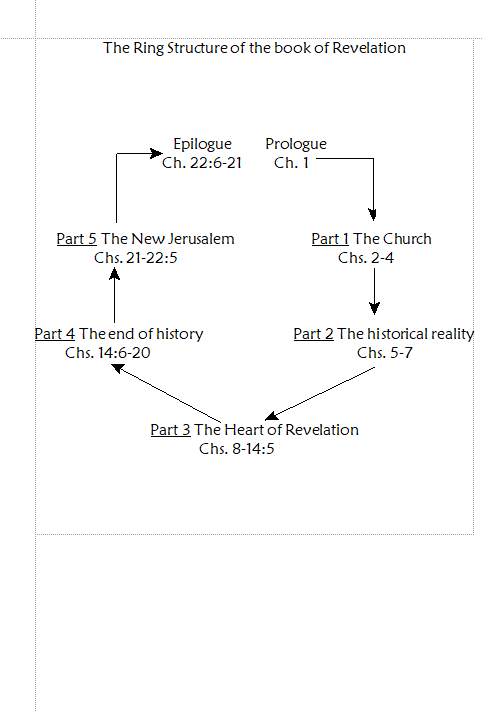
• when laid out in a diagram, they form a ring
Mary Douglas, “the first indication of a ring composition is that the end corresponds to the beginning. . . .
The correspondences are indicated by key words . . . .”
◦ the beginning and end connect as if with a clasp to form a circle like a bracelet or necklace
• the ring involves more than the beginning and end
◦ the development of the message in the first half is written as if going up a staircase,
the development of the second half is like walking down the same staircase
◦ the themes of the first half match themes of second half
– the midpoint of the ring is the key theme or message
Douglas, Thinking In Circles, “The elaboration is not just for fun; it is the way to say that something is important, something serious needs to be said, there is a message that must be heard.”

Jacques Ellul identified a ring structure in Revelation (see handout below)
– the first chapter is a prologue (introduction) and last part of chapter 22 is an epilogue (conclusion)
• the theme of part 1 is church (now), part 5 is the church in future the New Jerusalem
part 1 is promise part 5 is fulfillment
• both part 1 and part 5 play on the words “Then I saw” and the command for John to “write”
– all of part 3 through part 4 have an introduction, a body, and a conclusion
in the introduction an impressive person appears (Son of Man, a mighty angel, the Lamb, another angel)
in the body there is a series of sevens (e.g., seals, trumpets, bowls)
in each conclusion worship is offered to God in doxology, praise or thanksgiving
– I think it’s also important to see how each section overlaps — one part flows into the next
• the seventh seal leads into first trumpet; the seventh trumpet leads into the first bowl, etc.
• that is why we can feel the forward motion as we read Revelation

I’ve dragged you through this to emphasize where we are
– we are still in between sixth and seventh trumpet and the second and third woe
– the visions in this part tell the story of Jesus’ earthly life (chapters 12-14:5)
• but we are shown his life from a heavenly perspective
• and what we find here does not look anything like the four gospels

John is again given a role to play in the visions

Here he is told to take measurements
– there are similar visions found in the Old Testament prophets, who are given a measuring rod
• usually the message is that God’s people fail to measure up to his requirement
• but it’s obvious here that the purpose of John’s taking measurements is not to determine the size of spaces
◦ first, no units of measurement are given (as compared to the city in Rev. 21:15-17)
◦ secondly, there is no temple in New Jerusalem to measure (Rev. 21:22)
(Jesus is the temple – cf. Jn. 2:19, “Destroy this temple . . .” )
◦ third, John was to include “worshipers” in his measurements!
– the point here is to define boundaries and doing so to establish identities
• those inside the lines are worshipers – outside the lines are the nations
• one group worships God, the other tramples his holy city
(trample suggests domination, oppression, and in this context, defilement)

At same time, God authorizes and empowers his two witnesses
– the time-frame is given in two different numbers
forty-two months and 1,260 days — both equal three and a half years
(the Hebrew calendar has thirty days in each month)
◦ This is significant!
• they wear “sackcloth” garments – clothing is important in the visions of Revelation
◦ white robes, fine linen, golden sashes, helmets and crowns
◦ sackcloth typically represents grief, even devastation
– the witnesses wear the seriousness of their mission

The identity and ministry of God’s two witnesses
These are the two olive trees and the two lampstands that stand before the Lord of the earth. And if anyone would harm them, fire pours from their mouth and consumes their foes. If anyone would harm them, this is how he is doomed to be killed. They have the power to shut the sky, that no rain may fall during the days of their prophesying, and they have power over the waters to turn them into blood and to strike the earth with every kind of plague, as often as they desire. And when they have finished their testimony, the beast that rises from the bottomless pit[a] will make war on them and conquer them and kill them, and their dead bodies will lie in the street of the great city that symbolically[b] is called Sodom and Egypt, where their Lord was crucified. For three and a half days some from the peoples and tribes and languages and nations will gaze at their dead bodies and refuse to let them be placed in a tomb, and those who dwell on the earth will rejoice over them and make merry and exchange presents, because these two prophets had been a torment to those who dwell on the earth. But after the three and a half days a breath of life from God entered them, and they stood up on their feet, and great fear fell on those who saw them. Then they heard a loud voice from heaven saying to them, “Come up here!” And they went up to heaven in a cloud, and their enemies watched them. And at that hour there was a great earthquake, and a tenth of the city fell. Seven thousand people were killed in the earthquake, and the rest were terrified and gave glory to the God of heaven Revelation 11:4-13

First, they appeared in the prophecies of Zechariah (ch. 4)
– I find the attention given to their identity there intriguing
• the vision is first a lampstand set between two olive trees
◦ the trees are feeding oil into the lampstand
◦ Zechariah immediately asks “What” the olive trees were — he senses that they are important
“Do you not know what these are?” I said, “No, my lord” (Zec. 4:4-5)
then again later in the chapter, “What are these two olive trees on the right and the left of the lampstand? And a second time I answered and said to him, “What are these two branches of the olive trees . . .?” “Do you not know what thee are?” I said, “No, my lord.” Then he said “These are the two anointed ones who stand by the Lord of the whole earth” (Zec. 4:11-14)
• now, after all these years, the olive trees show up again in John’s vision
– during the period of the witnesses’ ministry, no one can touch them
• at the same time, signs and wonders go with their testimony
◦ when their work is complete, the beast from Abyss kills them
(we haven’t been introduced to this creature yet)
• their corpses will be left exposed
“in the great city that symbolically is called Sodom and Egypt”
Jacques Ellul, describes these cities as “places of the absolute revolt of [humankind], places of the total refusal of the will of God, places of hatred against God.”
◦ Jerusalem had been conformed to the standard of world nations
◦ with this turn, the witnesses are connected to Jesus, and, specifically, to his crucifixion
where their Lord was crucified

For three and a half days,
those who dwell on the earth will rejoice over them
– this is reminiscent of what Jesus told his disciples before his crucifixion and resurrection
A little while and you will not see me . . . Truly, truly, I say to you, you will weep and lament, but the world will rejoice (Jn. 16:19-20)
• like Jesus, they were raised from the dead and ascended into heaven
• is it possible these similarities between the witnesses and Jesus are too much of a coincidence?

Let me remind you that these visions unfold like dreams

Everything is symbolic and not everything makes sense
– Jacques Ellul argues that the two witnesses represent Jesus
Ellul, The description of the ministry of the two witnesses suggests that it “would be difficult to be more explicit in describing the time of Jesus upon the earth (as we have emphasized, the vision must be understood on the basis of this which has been told us; and we must not, for example, become confused by the number ‘two’). Truly then there is here an exact synthesis of the work of Jesus. The two witnesses undoubtedly represent the two dimensions that relate to Jesus Christ.”
– from the first chapters of Revelation, Jesus is described as the faithful witness
• and the faithful and true witness (1:5; 3:14)
◦ this defines his life and ministry–especially in John’s gospel
• of course, we wonder why John would see two witnesses to represent Jesus and not one
◦ for one thing, neither witness is named – they’re identical, and we can’t tell one from the other
◦ secondly, where we read “dead bodies” in vv. 8-9 the Greek text is singular, “their dead body”
– Ellul suggests that the two of them represent the twofold nature of Jesus
Son of Man and Son of God – divine word and flesh–Jn. 1:14
• also, combined in Jesus is the witness of the Word and the witness of the Spirit
◦ I’m not dogmatic about this, but it makes sense that at the heart of Revelation is Jesus’ crucifixion and resurrection

An announcement regarding the three woes
The second woe has passed; behold, the third woe is soon to come

The seventh trumpet sounds and heaven erupts in praise again

Then the seventh angel blew his trumpet, and there were loud voices in heaven, saying, “The kingdom of the world has become the kingdom of our Lord and of his Christ, and he shall reign forever and ever.” And the twenty-four elders who sit on their thrones before God fell on their faces and worshiped God, saying,
“We give thanks to you, Lord God Almighty,
    who is and who was,
for you have taken your great power
    and begun to reign.
The nations raged,
    but your wrath came,
    and the time for the dead to be judged,
and for rewarding your servants, the prophets and saints,
    and those who fear your name,
    both small and great,
and for destroying the destroyers of the earth.”

Then God’s temple in heaven was opened, and the ark of his covenant was seen within his temple. There were flashes of lightning, rumblings,[c] peals of thunder, an earthquake, and heavy hail Revelation 11:15-19

With Jesus’ resurrection, the kingdom of God entered our world
– it’s not the fullness of what is yet to come,
• but it is a real presence and the promise of completion

Conclusion: Jesus defined the identity of his disciples when told them “you will be my witnesses”

He did not say, “You will go witnessing” but “you will be my witnesses”
– we represent Jesus to the world as he represented the Father

Driving my granddaughter Addison home on Friday I was feeling frustrated with the heavy traffic on the road and negligent drivers. Addy sensed my frustration (well, actually, she witnessed it), so I announced, “I am going to start ‘Christian driving.’ I then held up my hand and motioning to the cars around us, I said, “I forgive you. I forgive you, I forgive you.” Addy giggled, and that made my day.

You may know already, the Greek word for witness is martus, from which we get the English word martyr
There is a kind of death we experience when we represent Jesus
A death of our personal concerns so we can tend to the needs of others
In this dying, we lose some things and we gain some things
St. Paul tells us that the losses are worth it

How did the witness of Jesus first come to you? Who brought it?
How did Jesus reveal himself to you through that person?
You are becoming that for someone else

The transformation that occurs with our spiritual development,
is also the process by which we become living witness to God’s love

Handout
Guest Speaker – 04/21/2024

Podcast

Facebook

Welcome and Prayer: Nancy Lopez

Good morning, RefleXion!  I’m so glad that we belong to each other… Grace and Peace to you!

Last Sunday I was talking about our maturing spiritual immunity against what doesn’t belong to us.  During the week someone from RefleXion reminded me that our immunity must be practiced.  We don’t just get booster shots, but we must have healthy practices every day to keep our immunity strong.  I think that spiritual practices, in general, are a resistance to the lie that we are separate, unknown, unloved.  One way to practice is what we might call the gift of “Hospitality,” or “Welcoming.” This week, a friend and I talked about how she was suffering with memory loss.  Another friend encouraged me in prayer.  I sat with someone in silence as they waited on the Spirit’s leading.  A friend from another faith tradition gave me courage.

All of this reminded me of the Ram Dass quote, “We’re all just walking each other home.”  Years ago, at CBC, we had a weekend dedicated to how people had experienced love from other people.  We had about 15 different people over four services share their experiences.  There were all kinds of stories:  an artist felt known and appreciated just because we were a church that hung art on the walls, someone experienced forgiveness for running into the other’s mailbox, another was invited to pour syrup into little cups every Sunday as a way of steady sobriety, and many stories of, well, just people listening to each other.  Conversations, especially those that are spirit to spirit–building up, stirring up, cheering up–are always uplifting.  And, much more, I believe that we are then participating in Christ’s reconciliation of all things, already in operation, but not yet complete.  We belong; we are known.  This is the triumph of love over division and hate. 

Here’s a quote from Parker J. Palmer:  Community is a place where the connections felt in our hearts make themselves known in the bonds between people, and where the tugging and pulling of those bonds keep opening our hearts.

Think you have nothing to offer?  There’s a blessing in each moment we have with each other.  Romans 12 reminds us:  For as in one body we have many members, and the members do not all have the same function,  so we, though many, are one body in Christ, and individually members one of another.  Having gifts that differ according to the grace given to us, let us use them.

Here’s an amazing quote:  “We all come into the world looking for someone looking for us.”  So, who’s looking for you?

Let’s pray:  Lord, we welcome you and each other this morning, and let that welcoming practice continue day after day until we meet you face to face.  Be made known to us in this morning’s message.  May the love that you have incarnated in us lead us this week.  Amen

Morning Talk: Sean Kappauf

Story of El Sal Prison
There’s something life giving when we choose to be a loving presence. Especially to those who
have been out-casted.
I’m addicted to it… but I’m not perfect at it.
I have a sneaky suspicion that after I share about this, I’ll be reminded of how great it is to be a
loving presence and then I’ll get into my truck outside and start driving…
Watch as that just sails away off into the pacific ocean when someone cuts me off
You feel me on that?
Wanting to be a loving presence but falling short in the process?
It’s not easy
So, how is it that we can be a living presence in our life so that in the waking moments of the
day to the end of the day… we are pursuing a path that loves no matter what… that loves even
our neighbor, that loves even the one who speaks badly about us, that loves even those who
hurt us? That loves the Trump-loving-“Christian nationalist,” that loves the democratic socialist
liberal universalist,
that looks above the labels, that transcends our judgments, and sees them as Christ does…
How?
Lets look at Jesus

Luke 15:1-2 NRSV (Updated Edition) – SBL Study Bible

Now all the tax collectors and sinners were coming near to listen to him. And the
Pharisees and the scribes were grumbling and saying, “This fellow welcomes sinners and
eats with them.”

I love this passage
So much going on in here…
Tax collectors and sinners are the outliers. The ones on the fringes of society, the ones society
has deemed dirty, wrong, bad… in a dualistic worldview they are the “bad” ones and you see
them here coming near to Jesus.
And at the same time you have the “good guys” the “holy ones” the pharisees and scribes, the
ones who know the scripture, the ones who know their Bible and tell people what it says…
And you hear them grumbling… “This guy welcomes sinners… accepts them, eats with them”
(which is an intimate space that essentially says you’re good in my eyes)
The ones who culture has deemed Bad, Jesus pursues, to remind them that they are good.

What I love about the life of Jesus
Is that he shows us what it looks like to be human, to live a life
that is full of love, aliveness, that sees beyond the labels…
Some of the obstacles that Jesus encounters with others is with those who are certain that
how they read the scripture is clearly the right way to read it and therefore justify their poor
behavior.
As you read the scripture you’ll see Jesus in these situations where he finds himself having out
with those sinful people like I just stated.
Jesus, in his masterful communication skills, speaks to those who are certain about the text, to
those who are closed off, by sharing stories…
It is often in sharing stories that get people who are closed off to see their perspective in a new
light. He does this not too make them feel dumb but rather to show them that there is a better
way to live our life than to put people in categories like “sinner” and “righteous”…
Because we do not live an “us vs them world,” rather we live in an “US” world… we are all
connected… its our myths that we create that can cause us to divide and in return we miss
out… but there is a way to overcome that way of seeing
We over come it by starting with Love, by choosing to love…
Jesus paints this beautiful picture of what that looks like…
Then Jesus said, “There was a man who had two sons. The younger of them
said to his father, ‘Father, give me the share of the wealth that will belong to me.’ So he
divided his assets between them.
Luke 15:11-12
Lets stop here…
Jesus starts off the story with the younger son asking his dad for his inheritance while his dad
is still alive.
Now in a patriarchal middle eastern society, lack of respect for the father is just beyond
comprehension.
You would never ever do something like this.
By the son saying this, he is essentially telling his dad that he hates him and wishes he were dead.
So for Jesus to start off a story this way, is so bizarre for his listeners because this is just
something that should never happen, something so bad, so wrong, an incredible injustice.
Kind of like us hearing that Spirit Airlines is the nicest airline in the world… that can’t be right…
what? no way…
Nevertheless the Father grants his younger son the inheritance…

Jesus goes on with the story
A few days later the younger son gathered all he had and traveled to a distant region, and
there he squandered his wealth in dissolute living. When he had spent everything, a
severe famine took place throughout that region, and he began to be in need. So he
went and hired himself out to one of the citizens of that region, who sent him to his fields
to feed the pigs. He would gladly have filled his stomach with the pods that the pigs
were eating, and no one gave him anything. But when he came to his senses he said,
‘How many of my father’s hired hands have bread enough and to spare, but here I am
dying of hunger!
Luke 15:13-17
So the son goes away, spends all the money, crashes, hits rock bottom…
How many of us know what thats like? Right?
And he realizes man, the life I’m in right now is no good… I’d be better off being one of my
dad’s servants…
And what ends up happening is the son decides… I’m going home, look what happens:
I will get up and go to my father, and I will say to him, “Father, I have sinned against
heaven and before you; I am no longer worthy to be called your son; treat me like one
of your hired hands.”
Luke 15:18-19
Again, what the younger son did was so atrocious, was so unthinkable in that culture, to go
back home, could be, probably would be, very very problematic for him and the family, but he’s
so desperate that, this is his best option…
So he begins to recite a speech that he is going to have with his dad.
Now, its subtle, but notice how the son views himself, notice the story that the son creates in
his mind about himself
In verse 19 he says,
I am no longer worthy to be called your son
Lets sit with that for a moment.
We each have a story that we are telling ourselves about our own worth.
Right?
We have a tape that plays in our head, we have a story, a narrative that we are telling ourselves
about our story.
We each do.
Sadly, its often negative.
That we are unworthy
That we are not smart
That we are not thin enough
That we are not strong enough
That we are not accomplished enough
That so-in-so is better
That so-in-so can work harder
That so-in-so has more energy
That so-in-so kids are better
That based upon what I’ve done I’m not worthy to be loved by anyone
Sometimes we are beating ourselves up because we have a narrative that speaks to us about
how unworthy we are…
The inner critic is loud within us…
Just like this son who hits rock bottom!

So he set off and went to his father. But while he was still far off, his father saw him
and was filled with compassion; he ran and put his arms around him and kissed him.
Luke 15:20
Oh man… the beauty of the fathers love to his son is so life giving… here his son is thinking oh
man, my dad is gonna kill me… but instead the son receives true love… a love that isn’t based
upon any action, a pure love that always gives no matter what
A love that isn’t based off of obedience or rule following
This kind of love doesn’t make sense in a religious world.
Where in order for you to receive you have to do something good… Rather the father’s love is
freely given… no matter what
And this is what love does, gives life, and life in abundance… to anyone, to everyone
Some of us here today… that is what we need… a loving embrace… someone to tell us that
you are good, its ok, you at your very core, are deeply and dearly loved…
I have stories of how I’ve been personally attacked… my beliefs these days have caused certain
people to react to me in ways that haven’t been too great. As a result is they have caused me to
wonder if I’m bad or whether there is something wrong with me
But if so,
Why is that I feel so much joy, freedom, love, permission to see the world in a wider aperture,
to see love move across cultures, peoples
Yet some of the closest people with whom I’ve grown up are treating me this way

I was sharing this to my therapist and he said…
Sean stop
I want you to imagine, imagine that five year old Sean is sitting in the chair next to you
Five year old Sean is worried about what others are saying about him, sad that the neighborhood
bully has been calling him names
What would you tell your five year old self?
I sat there for a moment… and was shocked by the words that came out of my mouth…
I’d tell my five year old self…
That is going to be okay. That no matter what people say about you–that is not who you are, you
are safe, you are loved, and always will be loved.
Then the therapist looked at me and said… well?
What was this wizardry!
Sometimes what we need is to be reminded that we are good, even when religious bigots
confront us with their certainty trying to confine is their moralistic religious fascism.
Ook I had to get that off my chest
But in all seriousness… to remind ourselves, that we are worthy, worthy of love, worthy
because in God’s eyes he sees us with endless love.

Lets look at verse 21
Then the son said to him, ‘Father, I have sinned against heaven and before you; I am
no longer worthy to be called your son.’ But the father said to his slaves, ‘Quickly,
bring out a robe—the best one—and put it on him; put a ring on his finger and sandals on
his feet. And get the fatted calf and kill it, and let us eat and celebrate, for this
son of mine was dead and is alive again; he was lost and is found!’ And they began to
celebrate.
Luke 15:21-24
Notice the father doesn’t say anything about the most atrocious thing a son could do to a
father… what his youngest son has done, does not even faze him… rather he says…
Get him a robe!
Giving a robe is a sign of sonship, that’s a sign that he belongs in the Father’s eyes
The father is saying, “This is my boy.”
Nothing he can do will change that truth.

So when the son returns home, his father has a different narrative about who he is

Now the son has a decision to make…
Do I trust my version of my story: I’m no longer worthy to be called your son
Or, Do I trust the Father’s version of my story which is: I am dearly loved son. That no matter
what I am deeply and dearly loved.
Does he trust, does he cling to the Father’s version of the story?
Or does he trust, his version of the story?
What would you do? What would you do if you were that father? What would you do if you
were that son?

Lets keep that in the back of our mind…
Now… remember there are two brothers…
The older brother observes all of this … and he is seriously bothered by it
He wants nothing to do with the party for his brother
Look at what happens:
“Now his elder son was in the field, and as he came and approached the house, he
heard music and dancing. He called one of the slaves and asked what was going
on. He replied, ‘Your brother has come, and your father has killed the fatted calf
because he has got him back safe and sound.’ Then he became angry and refused to
go in. His father came out and began to plead with him. But he answered his father,
‘Listen! For all these years I have been working like a slave for you, and I have never
disobeyed your command, yet you have never given me even a young goat so that I
might celebrate with my friends. But when this son of yours came back, who has
devoured your assets with prostitutes, you killed the fatted calf for him!’
Luke15:25-30
You can just feel the rage from the words that Jesus uses to describe the older brother…
The older brother basically makes his case, “I have been over here playing the good
son.
I have been over here doing everything right, doing all these good things for you.
And yet you throw a massive party for “this son of yours”
For those of us who are parents, we’ve done this before… especially when our kid does
something bad and we look to our spouse and are like,
“Well this son of yours decided to take a sharpie and draw all over the walls!”

You’re gonna throw a massive party for this son of yours?
This son who has wronged you and me in so many ways?
What are you doing?!
Why are you doing this?!
In other words he’s asking… Why not me?
Remember the older brother said…
Listen! For all these years I have been working like a slave for you, and I have never
disobeyed your command

Think about that.
The older brother has a story that he is telling about himself as well!
See the younger brother’s story is: “I am no longer worthy” because of all that I’ve done
The older brother’s story is: “I am worthy because of all that I’ve done.”
We’ve seen this before huh?
I did it all right
I was moral
I didn’t do that and that and that… like everybody else did
I tithed 10% of my gross
I went to church every Sunday
I was generous with people
I serve at the local charity every month
Or
I’ve been the good child
I’ve showed up at all the right times
I’ve checked all the right boxes.
Doesn’t that count, doesn’t that get me something?
See the older brother’s story is, “I am your son, your good son, because of all the
good things I’ve been doing for you.
I am worthy because of all that I’ve done.”
Yet the Father tells a different version of the older brothers story…

Look at what the Father says
Then the father said to him, ‘Son, you are always with me, and all that is mine is
yours. But we had to celebrate and rejoice, because this brother of yours was dead
and has come to life; he was lost and has been found.’
Luke 15:31-32
See what the Father does, the Father’s version of the story was, “Yeah ok, all those years that
you stayed home and did all the good work and you were the good son and you were loyal…
that didn’t earn you the reward of being my son
You had that the whole time!
Cuz you are always with me and everything I have is yours.
In other words, “You don’t have to earn my love, my love has always been there and always
will be here for you!”

Isn’t that beautiful?
What an incredible response,
For both sons it is in losing that they discover what they have–who they really are
Look…
You are deeply and dearly loved. Not because of what you have done, rather you are simply
loved by God… even if you have a messy past and even if you’ve been doing great things.
So the question for all of us today is…
The question is for you and me… who’s version of the story will we trust?
Because the reality is,
The story that we’re telling ourselves, deeply shapes how we live in the world. Deeply
shapes how we interact within those around us.
If we believe at the deepest core that we are unworthy, we will tend to act in certain ways that
flow out of that.
If we believe that the world is a cold, dark, empty, nasty place where everyone is for
themselves…and we kick and we shout and we do whatever you can to crush others to get
ahead, that will shape how we act.
But!
If we believe that there is a God, who responds with this endless love that has no favorites with
an undeserved self-giving love… we will begin to see the beauty, wonder, mystery, of life that is
all around us… and we will act in light of that and this love will propel within us and around
others we come in contact with
As we encounter this kind of life giving, others centered love and acceptance it changes us to
do the same to those around us
This reality frees us to be who we are
Thus giving us the capacity then to love those around us… as we love ourselves.

Now here a couple things to consider… a couple action steps so to speak…

The first step is to take no steps
Isn’t that great! Because you’re doing that already. You’re off to a good start.
Just Be
Be still. Stop. Breathe. Reflect on the great mystery of self-sacrificing love. A love that chooses.
A love that freely gives. A love that has no enemies. A love that never fails. A love that is
embracing you right now.

When we are able to just sit in that great love it moves within us, opening the door of
awareness and aliveness… a letting go of control, a letting go of our false self, and embracing
the truth that we are deeply and dearly loved.
In and with God, we are loving everything and everyone—even our enemies.
So in that state… take time to stop. We are always going. Take five minutes each morning to reflect
on the reality that you are loved, not because of something you’ve done, you are are human
being not a human doing…
JUST BE.
Be open, Be Curious, Be present
When we are embraced and aware of the constant love God gives us it frees us to be open, to
be honest, to be present… because
We have nothing to prove, because we are already loved and everything He has is already
ours.
We stem from an abundance of love and acceptance,
show it, publicly and watch as those around you learn what it means to be human too.
Especially with those we have a hard time with, especially with those that we have
“othered” where we have seen them as the “bad guy” or the “sinner”…

I want to challenge us all today that if we have that type of person in our life to take time to sit
and think about that person… but instead of jumping to a conclusion about what we think of
them,
take time to be curious
to be curious about them.
And when the time is right, reach out to them, with the sole purpose of being curious about
their life, what they are passionate about, what they enjoy doing.
Because everyone wants to be seen, known, heard, and understood, especially hurting people
who have detached. It doesn’t mean you have to agree with them… people just want to have
someone to care that they are hurting and acknowledged that they understand without
judgment.
No need to correct or try to win, just be curious and love them by listening.
I can’t count the number of times I thought a person who has said bad things about who I am
and then when I got to really know them, that everything in me changed for the better about
how I view them.
Often we jump to conclusions about someone without ever giving them the time of day.
This way of living is not easy, but its so worth it.

May you know today that you are deeply loved and that love isn’t based upon anything other
than that reality,
may you be embraced by this love
and may it propel you to move forward to be a constant loving presence to those around you, especially with those you may find it hard to love.
I’m going to close today with a prayer that I pray often:
Lets pray
Welcome, welcome, welcome.
I welcome everything that comes to me today, because I know it’s for my healing.
I welcome all thoughts, feelings, emotions, persons, situations, and conditions.
I let go of my desire for power and control.
I let go of my desire for affection, esteem, approval, and pleasure.
I let go of my desire for survival and security.
I let go of my desire to change any situation, condition, person or myself.
I open to the love and presence of God and God’s action within.
Amen

Revelation chapter 10

Podcast

Facebook

Welcome and Prayer: Nancy Lopez

Welcome friends!               Grace and Peace to you!

This past week I had a little cold.  I say little because I was really only sick for a few days.  There was something going around where we live; my friend said it lasted seven days for her, and she said, “Your immune system is probably better than mine.”  That got me thinking about immunity in a broader sense.  We know that a healthy immune response is developed when we’ve been exposed to something and get through it.  I’m wondering if that correlates with our faith. 

If we have experienced doubt, disappointment, or confusion, for instance, could navigating through that build our faith so we don’t have a such a heightened allergic—”all-hands-on-deck”–reaction next time around?  I don’t think, then, that it’s necessarily a bad thing if we’re exposed to something hard, if it causes our faith in God to grow.  I know that I, for instance, used to be very reactive to disapproval; but I know that someone else can’t tell me who I am. Our bodies recognize an invader, something that doesn’t belong; and I think our souls do too. When we are allergic, we overreact.  When we’re immune, the invader is fought off mostly without our awareness of it.  Our relationship with God may include being broken, disheartened—and, well, sometimes miserable.  How could these help to enlarge our capacity and build our immunity to foreign invaders of our souls?

Remember what James said,  “Dear brothers and sisters, when troubles come your way, consider it an opportunity for great joy.  For you know that when your faith is tested, your endurance has a chance to grow.  So let it grow, for when your endurance is fully developed, you will be perfect and complete, needing nothing.”

So, here’s your wellness tip from Nurse Nancy today. Drink lots of water, create space for silence, and if you’re exposed to something unpleasant, maybe you’re just building your immunity to critics, naysayers, and fearmongers.

Let’s pray:  Lord, we confess that we are prone to fleeing, fighting, or some other form of over-reaction.  Let it be that we walk through everything with you, so that you can mature us and form us into people of the Way.  When we repent, will you forgive us.  When we train, will you build us up.  What seems bitter–make it as sweet as honey to us.  Grant us to be strengthened in you, that the mystery of our own souls would be fulfilled, and that we would confidently stand before many in your name.  Amen

Morning Talk: chuck smith, jr.

Then I saw another mighty angel coming down from heaven, wrapped in a cloud, with a rainbow over his head, and his face was like the sun, and his legs like pillars of fire. He had a little scroll open in his hand. And he set his right foot on the sea, and his left foot on the land, and called out with a loud voice, like a lion roaring. When he called out, the seven thunders sounded. And when the seven thunders had sounded, I was about to write, but I heard a voice from heaven saying, “Seal up what the seven thunders have said, and do not write it down.” And the angel whom I saw standing on the sea and on the land raised his right hand to heaven and swore by him who lives forever and ever, who created heaven and what is in it, the earth and what is in it, and the sea and what is in it, that there would be no more delay, but that in the days of the trumpet call to be sounded by the seventh angel, the mystery of God would be fulfilled, just as he announced to his servants the prophets. Revelation 10:1-7

Intro: I get the feeling that when we read the book of Revelation,

We tend to watch each scene unfold from a safe distance
– I don’t think it was meant to read this way,
• we’re supposed to feel a threatening closeness
• we’re drawn into the dream – it’s our collective nightmare
– John was certainly more than a spectator
• characters approach him, converse with, and engage him
◦ in this chapter he’ll be told to take and eat what he has been shown
• we do not merely read the Revelation, we encounter it
◦ we go on an adventure through this fantastical other-world

Initially, there was the scroll with the seven seals
– after the sixth was opened, there was a long break before the seventh seal was opened
• and what happened with the seventh seal was significantly different from first six
◦ so now, there are seven trumpets that sound, and another break between the sixth and seventh
(this break includes all of chapter ten through to chapter 11:15)
◦ again, there is significant difference in what happens when the seventh trumpet sounds
• each series of sevens seems to overlap – like newsreels of the same event, but from different angles
◦ what is happening is the reverse of the creation story
◦ this is the destruction of heaven and earth – the end of the world
– the seventh day of creation is different from the first six days
• the seventh day is holy and a day of rest
• that is the pattern of this section of Revelation (all way to chapter 16)

What happens during this break before the seventh trumpet?

I think it can best be expressed by a verse from Deuteronomy:
The secret things belong to the LORD our God, but the things that are revealed belong to us and to our children forever, that we may do all the words of this law (Deut. 29:29)
– here in Revelation 10, by a dramatic display, we will learn that God has secrets
– soon we are told his mystery will be “fulfilled”
• that God’s project through the millennia of human history will at last be seen and known as it comes about

The last scene of chapter 9 was that of a smoldering landscape

As the survivors were burying their dead, they persisted in doing wrong
– in John’s next vision, he sees a mighty angel descending to earth
• the impression John gives us of the angel’s appearance:
◦ is brilliant light – his face shines like the sun, even legs bright as fire
◦ and above his head, light is refracted into a rainbow of color
• John notices the angel has a scroll in his hand,
◦ that it is “little” and it is “open” (not like the previous scroll that was closed and sealed with 7 seals)
– the angel sets down with his right foot on the sea and his left foot on the earth
• in chapter 13, a satanic beast will rise out of the sea and another demonic beast will rise out of the land
• before that, here is this might angel whose feet on the sea and earth already indicates his dominance
◦ in the book of Joshua, after Israel’s first major conquest, five Canaanite kings were brought to Joshua
He summoned the leaders of the army and told them, “Come near; put your feet on the necks of these kings.” . . . And Joshua said to them, “Do not be afraid or dismayed; be strong and courageous. For thus the LORD will do to all your enemies against who you will fight” (Jos. 10:24-25)
◦ that is how I understand the angel’s stance on the sea and earth

What happens next I do not think is easy to understand
– when the angels speaks, his voice is the roar of a lion
• and then, either in response to his voice or as a loud echo, “the seven thunders sounded”
◦ I’m pretty sure that “seven” indicates full volume
• but when John was about to write what he heard the thunders say,
◦ he was told not to write it – which is unlike the little book that was already written on and open
– so why this build-up and all the fanfare, just to shut us out? Why even mention the seven thunders?
• my guess is that God wants to make it clear to us, there is far more to know than what we’ve been given
◦ if it what they said would have been helpful for us, then it would not be kept from us
Jacques Ellul, “For it must not be forgotten that the Word is revealed only to the extent that it is useful to [humans].”
◦ and St. Peter wrote,
His divine power has granted to us all things that pertain to life and godliness, through the knowledge of him who call us to his own glory and excellence (1 Pet. 1:3)
• some people have an unhealthy interest in the supernatural
◦ various cultures have devised occult means to pry into the unknown
◦ the Scriptures warn us away from all of that
there’s more darkness and deception in those practices than light and truth

John’s attention is drawn back to the angel

In swearing an oath, a person would raise their hand (Ps. 106:26, etc.)
– we still raise right hand today – as do presidents when they are inaugurated
• the angel’s sworn oath is that
there would be no more delay, but that in the days of the trumpet call to be sounded by the seventh angel, the mystery of God would be fulfilled
• God has been working out a plan since the beginning
◦ it has been hidden from us – that’s what mystery means; something hidden or secret
◦ mystery in the New Testament does not mean uncanny, or spooky, or a puzzle to solve
– previously, some mysteries had been revealed
• for instance, Paul’s insight regarding Jesus, which was
according to the revelation of the mystery that was kept secret for long ages but has now been disclosed and through the prophetic writings has been made known to all nations (Ro. 16:25-26)
. . . the mystery was made known to me by revelation, as I have written briefly. When you read this, you can perceive my insight into the mystery of Christ, which was not made known . . . in other generations as it has now been revealed to his holy apostles and prophets by the Spirit (Ep. 3:3-4)
• but here the mystery is not “revealed,” but “fulfilled”
◦ we will realize God’s plan as it unfolds in our world

The ongoing drama becomes even more personal for John
Then the voice that I had heard from heaven spoke to me again, saying, “Go, take the scroll that is open in the hand of the angel who is standing on the sea and on the land.” So I went to the angel and told him to give me the little scroll. And he said to me, “Take and eat it; it will make your stomach bitter, but in your mouth it will be sweet as honey.” And I took the little scroll from the hand of the angel and ate it. It was sweet as honey in my mouth, but when I had eaten it my stomach was made bitter. And I was told, “You must again prophesy about many peoples and nations and languages and kings.” Revelation 10:8-11

The same voice from heaven that told John not to write what the seven thunders said,
– now instructs him to go and grab the open scroll from angel
• when he does this, the angel tells him to take it and eat it
◦ consuming God’s word is a familiar metaphor
I have not departed from the commandment of his lips
I have treasured the words of his mouth more than my portion of food (Job 23:12)
Your words were found, and I ate them,
and your words became to me a joy and the delight of my heart (Jer. 15:16)
◦ Ezekiel was given similar instructions to those John received
“Eat this scroll, and go, speak to the house of Israel.” So I opened my mouth, and he gave me this scroll to eat. And he said to me, “Son of man, feed your belly with this scroll that I give you and fill your stomach with it” Then I ate it, and it was in my mouth as sweet as honey (Eze. 3:1-3)
– I dug up an old meditation from 1999, that I wrote on this verse
My med: “God’s word had to enter him, not as information feeding into his brain, but as a life force which his body assimilated so that it became a part of him and energized him. There is a great deal of Bible study going on, but too little meditation, too little ingesting of God’s word. We have lots of information, but not as much transformation.
Read the Bible, but also feed on it. Taste its sweetness. You savor bits of insight, the discovery of connections between texts, and word studies that reveal a variety of meanings. Let what you receive sit with you for awhile. Let it digest until it becomes a part of you, and then you must live it. That is when it turns bitter. That is the hard part of receiving God’s word. Bible study can be fun. Living the truth can be bitter. Giving God what his word requires of us can bring unwanted changes, deprive you of comforts, take you where you do not want to go, show you things you don’t want to see, and upset your entire world.”
• after eating the scroll, John is given a job to do (v. 11)
• and we’ll leave him there for now

Conclusion: A few weeks ago, Jim suggested a title for these talks

“A Document of Spiritual Direction”
– if so, what must we learn to continue our spiritual journey?

  • We must accept the fact that there are doors we cannot open
    I want a far more vivid awareness of God’s presence, something almost tangible
    But God has not chosen that for me, and I can’t manufacture it
    I’ve had to accept this closed door
  • On the other hand, we must make the most of the doors he has opened
  • We must receive the Scriptures as our necessary spiritual diet
    Be with what we read long enough to digest it, break it down, and draw nutrition from it
  • We must live it, do it, speak it when given the opportunity
    Little children, let us not love in word or talk but in deed and truth (1 Jn. 3:18)
  • What is the message that has been given to you?
    Write it down somewhere
  • How are you going to deliver it?

This is our homework – and it will keep us busy for a lifetime

Revelation Chapter 9

Welcome and Prayer: Nancy Lopez

Good morning, RefleXion!    Grace and Peace to you!

Jesus died and was resurrected, and he appeared to others for 40 days after that before he ascended to heaven.  And we learn that he still had his scars.  He shows them to his disciples to prove his identity, and his humanity.

Have you heard of Kintsugi, the Japanese art of embracing imperfection?  It is the art of taking a shattered piece of pottery and mending every crack with gold, which creates a piece that is even more beautiful than the first by embracing the beauty of the flaw.  A few weeks ago, on 60 Minutes—maybe you saw it—there was a story of a woman (her name is Jennifer Thompson)  who brings together wrongly convicted prisoners and victims who have wrongly identified criminals.  All these lives have been shattered.  In these healing workshops, you know what she does?  She gives them each a bowl and asks them to take a hammer and shatter it.  This represents their shattered lives.  Then she gives them gold lacquer and asks them to mend their bowl with gold.  But before they can mend the cracks representing their wounds, they must look hard at the breaks that need repair, each one and how it connects to another. And that takes time.  Exonerees had been freed and there is still much brokenness, just like us.  Victims had seen justice, and they were shattered with shame and guilt as well as the original injury.  Everyone was a victim; everyone had wounds.

The risen Christ has scars, being raised from the dead does not erase them.  We have scars; becoming free from sin doesn’t mean we don’t still need healing.  In 2 Corinthians, Paul says that he will boast of the things that show his weakness that the power of Christ may rest upon him.  He said that he bore the marks of Jesus on his body.  The gold veins of Jesus’ redeeming, restoring, and healing work in our lives represent our marks of Jesus’. Can we see it this way?  Let his power be made perfect in our weakness.      Will you join me to pray?

Jesus, you bought back our shattered lives. We have wounds, open and unhealed injuries.  Thank you for your continued work in mending our lives.  May each scar—a wound healed—be considered the gold that makes us human, and beautiful.  May each scar represent the glory of resurrection.  Be with us now as we gather in your name. Amen

Morning Talk: chuck smith, jr.
And the fifth angel blew his trumpet, and I saw a star fallen from heaven to earth, and he was given the key to the shaft of the bottomless pit, and from the shaft rose smoke like the smoke of a great furnace, and the sun and the air were darkened with the smoke from the shaft. Then from the smoke came locusts on the earth, and they were given power like the power of scorpions of the earth. They were told not to harm the grass of the earth or any green plant or tree, but only those people who do not have the seal of God on their foreheads. They were allowed to torment them for five months, but not to kill them, and their torment was the torment of a scorpion when it stings someone. And in those days people will seek death and will not find it. They will long to die, but death will flee from them Revelation 9:1-6

Intro: When my children were small, I’d read to them every night

First from a book of fairytales, then from a Bible storybook
– we would pray, say goodnight, and turn off the lights
• we were careful about the last thing that entered their minds before bed
• I doubt we can prevent our kids from having nightmares
◦ but we can do things to help them sleep well
◦ and we can comfort them after a nightmare
– I certainly would have never read from Revelation the last thing before bed!
• this makes me wonder why God gives us this nightmare stuff
• anyway, we know that God can make good use of anything

Somehow in all of this strangeness, we’re given a new view of Jesus
– not the same perspective we as we find in Matthew, Mark, Luke, or John’s previous book
• those relate to us the earthly life of Jesus; their stories are human and historical
◦ they tell of his ministry of healing, his teaching, and especially his death and resurrection
• this book, after all, is “The revelation of Jesus Christ” – Rev. 1:1
◦ it begins with a vision of Jesus, and following that letters from Jesus, and then Jesus is revealed as the Lamb
– in Revelation, Jesus appears in a world of pictures and strange forms
• a realm outside of the space-time dimensions of our experience
◦ and we’ve no rational or realistic way to perceive that realm
◦ John must resort to symbols, images, and exaggerated detail
Jacque Ellul, “At issue is a relation between that which has happened upon earth with and around Jesus, and then the celestial domain, the world of powers, thrones, dominions, angels and demons, but above all the secret of God.”
• we do not need to be surprised at the monsters and devils in the Revelation
◦ we may not see these things in our everyday world, but we can’t avoid them either:
For we do not wrestle against flesh and blood, but against the rulers, against the authorities, against the cosmic powers over this present darkness, against the spiritual forces of evil in the heavenly places (Ep. 6:12)

Where we left off: seven angels with seven trumpets

As each angel sounds a trumpet, a new scene unfolds
– after the first four trumpet blasts, there was a warning: Woe, woe, woe . . . (Rev. 8:13)
• now, the fifth trumpet blast and the first of the three “woes”
• this is not an encrypted message we have to decipher!
◦ for instance: “The scorpions must refer to modern combat helicopters”
◦ we take the information as it comes and let it work within deep recesses of our minds, hearts, bodies, and spirits

The first scene: The sixth trumpet sounds and a star plummets to the earth
– in this alternate reality, the star isn’t a mere object
• it’s a living agent – a “he” who has been given a key
◦ what his key opens is the abyss, or “bottomless pit”
• here are two dimensions: heaven above the earth and the abyss in the underworld
◦ the same Greek word translates into English as heaven or sky
◦ as the sky, it stretches endlessly into space, or as God’s domain it exists in another, infinite, dimension
◦ below is the bottomless pit, and it sinks to an endless depth
– best way I’ve ever heard the bottomless pit was how Charles Spurgeon described it
• as small boy, he was allowed to read the Scripture during his family’s morning prayer time
◦ one morning, he came to “the bottomless pit” and asked grandfather what it meant
◦ he was told to go on reading, but he came back to the same passage every morning
Spurgeon, “The process was successful, for it is by no means the most edifying thing to hear the Mother of Harlots, and the beast with seven heads, every morning in the week.”
◦ his grandfather allowed him to continue doing this (perhaps the child would get the point if he had to endless read the same passage day after day)
But one morning Spurgeon’s grandfather asked, “What is it that puzzles you?”
Spurgeon, “I can remember the horror of my mind when my dear grandfather told me what his idea of ‘the bottomless pit’ was. There is a deep pit, and the soul is falling down . . . The last ray of light at the top has disappeared, and it falls on–on–on, and so it goes on falling–on–on–on for a thousand years! Is it not getting near the bottom yet? No, you are no nearer the bottom yet; it is the bottomless pit. It is on–on–on, and so the soul goes falling perpetually into a deeper depth still, falling forever into ‘the bottomless pit’–on–on–on–into the pit that has no bottom! Woe, without termination, without hope of its coming to a conclusion!”

In our reading, it’s not what goes into pit that is terrifying, but what emits from it
– something erupts from a hidden depth–something horrible
• there’s a way that I can read this in which I learn a lesson about myself
◦ something lurks in the darkness of my own mind
◦ I have been unaware of it until it is triggered and released
◦ when it breaks through into the light of day, its force is terrifying
• this is how some people experience Post-traumatic Stress Disorder
– one of the weird twists of this passage is that the locusts were not to harm the vegetation
• that is the precise threat of a locust invasion — the Hebrew prophets perceived it as God’s judgment
Fire devours before them,
and behind them a flame of fire burns.
The land is the garden of Eden before them,
but behind them is a desolate wilderness,
and nothing escapes them (Joel 2:3)
• here in Revelation they harm only the people who are unprotected
◦ those who don’t have God’s mark on their foreheads (cf. Rev. 7:3)
◦ the forehead, especially in the ancient Mediterranean world, was the part of body that was always visible (it’s the part that exposes us, depending on the name that is stamped there)
– the net result of the locusts’ sting is “torment”
• five months is a long time to suffer excruciating pain
◦ have you ever thought about the difference: pain and suffering?
◦ I think of pain as being physical and suffering as mental
• THINK: what has upset you recently?
◦ a neighbor? – a relative? – finances? – your health? – politics?
there are many sources of aggravation, of pain, and of suffering
◦ God offers us his love, his help, his salvation
and I’m sure heaven wonders why we do not allow him to give us his mark

A description of the locust
In appearance the locusts were like horses prepared for battle: on their heads were what looked like crowns of gold; their faces were like human faces, their hair like women’s hair, and their teeth like lions’ teeth; they had breastplates like breastplates of iron, and the noise of their wings was like the noise of many chariots with horses rushing into battle. They have tails and stings like scorpions, and their power to hurt people for five months is in their tails. They have as king over them the angel of the bottomless pit. His name in Hebrew is Abaddon, and in Greek he is called Apollyon Revelation 9:7-11

At first, the images are familiar (locust, horse, crown) and we begin to visualize them
– but so many odd and unrelated features are added that we give up
• to even come close to illustrating them would require the surrealism of a Salvador Dali
◦ or the fantasy art of a Boris Vallejo
◦ actually, I’ve seen Artificial Intelligence rendition of these beasts – some of them are certainly scary
• they have a king, whose name is given in two languages
◦ Hebrew: ruin or destruction; Greek: destroyer
◦ their attack is not haphazard – it’s led, organized, and purposeful

There is a break at verse 12
The first woe has passed; behold, two more woes are still to come.

This warning does not bring any relief
– it is just an announcement, like an air raid siren

The sixth trumpet blast brings the next catastrophe
Then the sixth angel blew his trumpet, and I heard a voice from the four horns of the golden altar before God, saying to the sixth angel who had the trumpet, “Release the four angels who are bound at the great river Euphrates.” So the four angels who had been prepared for the hour, the day, the month, and the year, were released to kill a third of mankind. The number of mounted troops was twice then thousand times ten thousand; I heard their number. And this is how I saw the horses in m vision and those who rode them: they word breastplates the color of fire and of sapphire and of sulfur, and the heads of the horses were like lions’ heads, and fire and smoke and sulfur came out of their mouths. By these three plagues a third of mankind was killed, by the fire and smoke and sulfur coming out of their mouths. For the power of the horses in in their mouths and in their tails, for their tails are like serpents with heads, and by means of them they wound
Revelation 9:13-19

Just to remind you that “we’re not in Kansas anymore,”
– a voice comes from the altar – specifically, from its “four horns”
• I have thoughts about the significance of the altar, but they’re not profound
• the point is, there’s a disaster that’s been looming over the world
◦ until this specific moment, it has been held back
◦ this is similar to when the sixth seal was opened (four angels restraining four destructive winds)
Robin Robertson, “The Euphrates is the largest river of western Asia, about 1,700 miles in length. It joins with the Tigris river, one of the other great rivers of Asia. Most of the great cities of the ancient Mesopotamian civilization lay within the area bounded by the two rivers, including the greatest of all–fabled Babylon . . . .

In our world, we can be precise when working with numbers
– even when dealing with an enormous magnitude
• commentators try to calculate the numerical references in Revelation to an exact figure
◦ but biblical writers, who did not have access to calculators or computers but make reference to large numbers, are simply saying, “A sum beyond imagination”
◦ we must be careful about taking large sums in scripture literally
(for instance, we may be told that a city’s army had 10,000 soldiers when there were not even 10,000 people who lived in the city or the surrounding area)
• again the description of these troops would be difficult to illustrate in a painting
◦ notice that the horses’ tails “are like serpents”
◦ like scorpions, the very appearance of a snake can frightening — many people have phobias related to scorpions and snakes (and spiders!)
– in verse 19, the power of the horses is in their mouths
• this is reiterated in the Scriptures:
Your tongue plots destruction,
like a sharp razor, you worker of deceit (Ps.52:2)
who whet the tongues like swords,
who aim bitter words like arrows (Ps. 64:3)
(see also the numerous references in Proverbs and chapter 3 of the epistle of James)
• this is the power to spin lies; to ruin a person; to terrify people with threats

The survivors of these catastrophes do not change
The rest of mankind, who were not killed by these plagues, did not repent of the works of their hands nor give up worshiping demons and idols of gold and silver and bronze and stone and wood, which cannot see or hear or walk, nor did they repent of their murders or their sorceries or their sexual immorality or their thefts Revelation 9:20-21

At first, this stubbornness is difficult for us to comprehend
– but the truth is, we get stuck in what we assume is reality,
• and we then come up with other explanations of what is “really” going on
• it’s important to realize that large-scale threats to society, cause people to retreat into tribes
◦ even people smart enough to know better get drawn in to conspiracy theories
Edward Edinger, “Vast collective [paranoid] moods have immense contagious power.”

Conclusion: So why does God give us this nightmare stuff?

There are many theories regarding dreams and nightmares:
• that they are a way our brains sort things out – fears, anxieties, unfulfilled longings, and so on
• that they provide a release of what roils in our unconscious – repressed urges, resentments, and desires
• that nightmares are a way our brains prepare us for emergencies – a simulation practice in a safe environment
• in scripture, dreams and nightmares are a way that God speaks to us
For God speaks in one way,
and in two, though man does not perceive it.
In a dream, in a vision of the night,
when deep sleep falls on men,
while they slumber on their beds,
then he opens the ears of men
and terrifies them with warnings,
that he may turn man aside from his deed
and conceal pride from a man;
he keeps back his soul from the pit,
his life from perishing by the sword
(Job 33:14-18)

At the end of this chapter, we learn what to do if our wrong actions lead to suffering
We change! This is what “repent” means!
We surrender to God and let him bring us back to the right track
Some were fools through their sinful ways,
and because of their iniquities suffered affliction . . . .
Then they cried to the LORD in their trouble,
and he delivered them from their distress.
He sent out his word and healed them,
and delivered them from destruction (Ps. 107:17-20)

Final word: “Pleasant dreams, my friends!”

Easter 2024

Podcast

Facebook

Welcome and Prayer: Nancy Lopez

He is Risen!  He is Risen Indeed!  Grace and Peace to you, friends, and welcome!

Do you ever wake up with a song running through your head?  I wonder what is going on in our dream state, or in our inner person, that it’s right there, already being sung.  I’ve been waking up with the same song every day this week:  How deep the Father’s love for us, (do you know it?)  The lyrics:

How deep the Father’s love for us.

How vast beyond all measure,
That He should give His only Son
To make a wretch His treasure.
How great the pain of searing loss –
The Father turns His face away,
As wounds which mar the Chosen One
Bring many sons to glory.

It’s a mystery to us that searing loss which mar the Chosen One can be on the same plane as deep love and bringing glory.  If you’ve been to Israel, you will remember the proximity of the place of Jesus’s death—the cross–to the garden tomb.  I believe this is symbolic of the deep spiritual reality that is entwined in the Christian experience. Death and resurrection are never far apart.  And the one thing you remember when you visit the Garden Tomb: it is empty.  Jesus died; Jesus rose. 

And I think that’s what’s important for us too.  Sometimes a life going well experiences a loss that plunges us into a dark grief. Or, one who has suffered greatly has been changed by their experience to become a witness and a beacon of hope.  We begin to realize that no matter how good things are for us, our lives are never completely free of the cross; and no matter how hard life is, resurrection is still in progress. We live with suffering, and we trust, and we hope in our resurrection. 

Jesus declared to Martha in John 11:25: I am the resurrection and the life. Whoever believes in me, though he die, yet shall he live,  and everyone who lives and believes in me shall never die.”

That’s why we can have our cross, an instrument of torture, covered with flowers.  Today we remember that we are people of the Resurrection.

Our prayer this morning is from A Guide for All God’s People.  Will you join me?Lord Jesus, you alone are the resurrection and the life; those who believe in you will never die.  Come to us and speak new life upon all our dyings.  Look upon us as we stand at the thresholds of our entombing experiences, unable to see or move because of the grave clothes which bind us.  Set us free (to hope, to love, and to believe in You).  In your name we pray.  Amen

Morning Talk: chuck smith, jr.

The women who had come with him from Galilee followed and saw the bomb and how his body was laid. Then they returned and prepared spices and ointments.
On the Sabbath they rested according to the commandment. But on the first day of the week, at early dawn, they went to the tomb, taking the spices they had prepared. And they found the stone rolled away from the tomb, but when they went in they did not find the body of the Lord Jesus. While they were perplexed about this, behold, two men stood by them in dazzling apparel. And as they were frightened and bowed their faces to the ground, the men said to them, “Why do you seek the living among the dead? He is not here, but has risen Remember how he told you, while he was still in Galilee, that the Son of Man must be delivered into the hands of sinful men and be crucified and on the third day rise.” And they remembered his words, and returning from the tomb they told all these things to the eleven and the rest. . . . [and] to the apostles, but these words seemed to them an idle tale, and they did not believe them.
Luke 23:54 -24:1-9, 11

Intro: They came on the first day of week, first thing in morning

They knew what spices and ointments to bring,
– and knew what they were doing – they had done this before
• what they did not know, was that overnight their world had changed
• so what they found at the tomb was not what they expected
– I love the lines:
Why do you seek the living among the dead? He is not here, but has risen
• they had come to the wrong place, looking for wrong thing
◦ they came to a cemetery looking for a dead body
◦ but Jesus wasn’t there – and he wasn’t a corpse
• they were wrong that morning – but not they were not the only ones who were wrong
◦ the apostles were wrong to not believe them
◦ the two on the road to Emmaus were wrong when they said, “We had hoped” – using the past tense
(Jesus still was “the one to redeem Israel”; v. 21)
◦ the disciples were wrong when Jesus appeared to them and they mistook him for a ghost
But they were startled and frightened and thought they saw a spirit (Lk. 24:37)

When we come to this day of resurrection we can be wrong too

For instance, one way that we tend to go wrong,
– is to fixate on secondary statements and miss the primary message
• we read the envelope and throw away the letter
• that’s what Jesus meant when he told the Pharisees
you tithe mint and dill and cumin, and have neglected the weightier matters of the law: justice and mercy and faithfulness. . . .You blind guides, straining out a gnat and swallowing a camel! (Mt. 23:23-24)
◦ Paul told Timothy to tell other believers
not to quarrel about words, which does no good (1 Tim. 2:14)
◦ too often that is precisely is our mistake — we make too big a deal about specific words
– some very pious people will scold you if you say “Happy Easter”
• they’ll tell you Easter is a pagan celebration named for a pagan goddess
(the truth is, origin of “Easter” is uncertain, but let’s say they’re right)
◦ what is the reason we must be informed of this pagan background?
Because we did not know about it
◦ for most of us, Easter has always been the day of Jesus’ resurrection
• the meaning of many words change over time
◦ Easter is one of those words!
◦ if to us, if Easter refers to “resurrection Sunday,” then that is its meaning for us
◦ the talk about paganism is irrelevant
• now if you’re not going to say Easter because it supposedly has a pagan origin,
◦ what words will you use for the seven days of the week?
◦ they’re named after Roman and Norse deities

Whether we say Easter or Resurrection Day is not the main point
– what matters is, He is not here [in the tomb], but has risen
• what we call it doesn’t change anything
• but what happened that morning changes everything

As people gradually recognized Jesus, it was an eye-opening experience

Luke tells us, when Jesus first joined the two on the road to Emmaus,
their eyes were kept from recognizing him (v. 16)
– and as we read before, when he appeared to the others, they thought he was a ghost
• this has been a problem for the disciples all along in Luke’s gospel
• they did not have eyes to see or ears to hear what Jesus meant when he predicted his crucifixion
But they did not understand this saying, and it was concealed from them, so that they might not perceive it. And they were afraid to ask him about this saying (Lk. 9:45)
But they understood none of these things. This saying was hidden from them, and they did not grasp what was said (Lk. 18:34)
– something happens in this chapter that changes them
• first, the two on the road
When he was at table with them, he took the bread and blessed and broke it and gave it to them. And their eyes were opened, and they recognized him. And he vanished from their sight (vv. 30-31)
• as for the others
Then [Jesus] said to them, “These are my words that I spoke to you while I was still with you, that everything written about me in the Law of Moses and the Prophets and the Psalms must be fulfilled.” Then he opened their minds to understand the Scriptures (vv. 44-45)

So this eye-opening did not happen during their discipleship, but after Jesus’ resurrection
– as Jesus spent time with them, their eyes were opened

The day after Easter in 2004, God spoke to me

“Don’t cross Easter off your calendar and move on.
Keep Easter in your heart”
– that week was the first time I visited the hermitage up north
• I returned a few weeks later and noticed in their liturgy, they were still focused on Easter
• I mentioned it to my mentor-friend who lived there
◦ “Oh, yes,” he said, “and we will continue with Easter until Pentecost”
◦ that’s when I learned that for them, Easter is a season
– we have this Easter season to ask Jesus to open our eyes and allow him to do it
when he opens our eyes to himself:
◦ we find him near everywhere
When we’re together, we have all kinds of conversations about Jesus
We read about him, we discuss his teaching, we tell our own “Jesus stories”
Not always, but sometimes, we discern his presence with us
I ask myself, “Why not always?”
He assured us that he would be with us
Am I too spiritually insensitive? Too asleep?
Am I being prevented from discerning his presence?
Is it a process?
Is it a growth factor, so it’s hit or miss?
I suggest that in our prayers we practice looking and listening,
so that by Pentecost we have received an eye-opening encounter with Jesus
when he opens our eyes to himself, simultaneously our eyes are open to ourselves
In Peter’s first encounter with Jesus, he was so moved at the wonder of him that he said, “Depart from me, for I am a sinful man, O Lord” (Lk. 5:8)
The two disciples walking with him to Emmaus later said: “Did not our hearts burn within us while he talked to us on the road, while he opened our eyes to the Scriptures?” (v. 32)
◦ they discovered something new stirring within them
◦ with open eyes we see our need for him, and we see how he meets that need
then, on another level, when he opens our eyes we begin to see through his eyes
◦ when that happens, we feel what he feels in his heart
◦ there is no judgment, no condemnation — there is love and compassion and mercy

Conclusion: He has risen

Jesus is risen from the dead
He is also risen from these pages that tell us about him
he’s not trapped in the printed words of an ancient past
He has risen from history into today

Jesus is risen here and now

I would like you to pray with me:

Lord Jesus, we ask You
to give us the Spirit of wisdom and revelation to know you
Enlighten the eyes of our heart

This week,
let us enjoy an extraordinary encounter with You
If we have a moment of free time,
and we’re not amusing ourselves with some distraction,
grab our arm and pull us outside to take a walk with you

But if our encounter is not that obvious or experiential,
train our faith to embrace the fullness of the revelation of You that we already have
and in that richness, enable us to discern Your presence

This we ask through
the goodness of our heavenly Father
the love of our Lord Jesus
and the grace of the Holy Spirit
Amen