Sermon OTM – 11/24/2024

Podcast

Facebook

Welcome and Prayer: Jim Calhoun

Come Lord join us here this morning

We have no way to tell of our gratitude
Our words are little even as our hearts are full
Still we try
To speak our heart
In our affection for all you do

In our vulnerability
In our blindness
We trust you for your care and consideration
Your great goodness surrounds us
Envelopes us
Holds us together

Your steady hand guides us
Pushing us forward
Pulling is back
Just as needed and
Just when needed

We offer our thanks for the times
We feel you near
Sparrows are gathered
Mountains move

And we offer our thanks for the days we felt alone
The universe echoing, rattling
Our world crumbling
Only to find you were at hand All along

You have set us free
To rejoice in our lives as given
Not sugar-coated
Not turning our backs on injustice
And human suffering
But to rejoice and praise you
Full of gratitude
For who you are
And who you are making us
And for our work together
With you
To repair this world
With kindness
And patience
And joy
Amen

Morning Talk: chuck smith, jr.

Blessed are those who hunger and thirst for righteousness, for they shall be satisfied.
Blessed are the merciful, for they shall receive mercy Matthew 5:6-7

Intro: When I began preparing today’s talk, there was a sudden moment when I felt very small

The spiritual wisdom of Jesus rivals every other enlightened text
– even gurus, like Gandhi, who rejected Christianity have admired the Sermon
• reading the words of Jesus, and trying to explain them to you,
◦ leaves me feeling inadequate and foolish
◦ like a four-year old who is told, “Explain quantum physics
– what I know about these two Beatitudes, I learned on the job,
• not from other Bible teachers or commentaries,
◦ but in my own ministry of applying the words of God to the lived experience of people on this journey
• what we’ll go over today may be challenging, but it will be practical and liveable,
◦ and what I believe Jesus wants us to learn
– we will discover that the message of these two Beatitudes, is richer and healthier than what we’ve ever known

Blessed are those who hunger and thirst for righteousness

Righteous is a key theme in the Sermon, and perhaps even the central theme
– if it’s that important to Jesus, it must be important to us
• for years, I thought “righteous” meant: pious, religious, ultra-strict
◦ someone who kept all the rules, obeyed all the commandments
• then twenty years ago a spiritual mentor explained to me,
Fr. Romuald, “We have made the Law [of Moses] moral; it’s not, it’s relational.”
– for the Pharisees, the Law was moral – all about right and wrong
• their task was to learn it and obey it, and they found they could do that in a way:
◦ that made them feel superior to others
◦ that cut them off from others rather than connect with others
◦ that empowered them to judge and condemn others
◦ that made them believe they were more righteous than others
• they reduced religion to the bare minimum
◦ this was Jesus’ criticism of Pharisee piety
For you tithe mind and dill and cumin, and have neglected the weightier matters of the law: justice and mercy and faithfulness (Mt. 23:23)
– living by the rules is like “painting by numbers”
• it is not authentic art – and it has no life of its own
• this is what Christianity has become to many people
◦ but it is not what God had in mind or what Jesus taught

I immediately felt the truth and power of Romuald’s words
“God’s Law is not moral it is relational”
– I don’t think I’ll ever feel like I’ve emphasized this point enough
– the purpose of the Law was to seal a covenant relationship
• the Ten Commandments begin with Israel’s exclusive relationship with Yahweh
◦ then they reveal how we show love to God and to others
• I will take you to two passages that clearly illustrate the relational nature of the Law
1. Jesus was asked, “Which is the greatest commandment in the Law?” He answered,
“You shall love the Lord your God with all your heart and with all your soul ad with all your mind. This is the great and first commandment. And a second is like it: You shall love your neighbor as yourself. On these two commandments depend all the Law and the Prophets” (Mt. 22:36-40)
2. Paul wrote, “Owe no one anything, except to love each other, for the one who loves another has fulfilled the law. For the commandments, ‘You shall not commit adultery, You shall not murder, You shall not steal, You shall not covet,’ and any other commandment are summed up in this word: ‘You shall love your neighbor as yourself.’ Love does not wrong to a neighbor; therefore love is the fulfilling of the law (Ro. 13:8-10)

Jesus says that those who hunger for righteousness are blessed

Hunger is a state of deprivation – we know it by how it feels
– it is an unpleasant feeling, a discomfort, a void that demands attention
• when Jesus applies this need, this craving, to righteousness, he gives it a new application
◦ in this instance, it is not the body that hungers, but the soul
• I can think of three ways this hunger for righteousness works in us:
◦ we long to be in a right relationship with God
◦ we long to be in right relationships with others
◦ we long to see the entire world in right relationships (nationally, socially, and personally)
– when we look at nations, cities, and human society in general, and our hearts break over hatred and war, crime and cruelty, suffering and starvation, we are hungering for righteousness
• sometimes so deeply, that it feels like we’re starving for righteousness
• we even hunger to be better people than what we are
◦ but with our best plans and efforts, we still screw up
◦ we hunger for a completeness, a wholeness, that we lack

Jesus sees this hunger as a “blessed” state
– it means we desire the right things:
• people who love – show kindness – give assistance – and support others
• we long to see humankind motivated by goodness
◦ not all of the self-centered, worldly-centered values, that have us at odds with each other, scrambling over each other to get there first, or get the most, or get the best, leaving the crumbs for the poor
– Jesus see our hungering souls as blessed, because we shall be satisfied
• a new age will bring a new world that will be just like the one we dream of and wish for
◦ in the meantime, Jesus will teach us to pray:
Your kingdom come,
your will be done,
on earth as it is in heaven
– it should now be easy to see how this hunger leads to the next Beatitude

Blessed are the merciful

Two times, quoting the same verse, Jesus will criticize the Pharisees for their failure to show mercy
Go and learn what this means: “I desire mercy, and not sacrifice” (Mt. 9:13)
If you had known what this means, “I desire mercy, and not sacrifice,” you would not have condemned the guiltless (Mt. 12:7)
– I’m not sure what woke me up to mercy, but one day I was overwhelmed with the realization, of how unmerciful I was, and what a terrible thing that is
• to get to the heart of mercy, we can jump ahead in the Sermon
Judge not, that you be not judged. For with the judgment you pronounce you will be judged, and with the measure you use it will be measured to you (Mt. 7:1-2)
– here’s the question:
How much mercy do you want God to show you?
• I would have to be crazy to say, “I want God to be hyper-critical of my every thought and action”
• however, that is precisely how I would be judged, if I use a very fine criteria in the way I judge others

Our nation has become overwhelmingly judgmental and hyper-critical
– and it will be 100 times worse if Project 2025 has any role in the new administration
• it’s very easy to judge others for sins that are not our own
• easy for me to judge the woman contemplating abortion, or the gay person, or the trans-gender person
◦ at the very least, we need to try to understand those we want to condemn
◦ I do not live inside their heads, nor can I see them through the eyes of Jesus

Almost everyone is familiar with John 3:16, but fewer know that verse’s less famous twin, John 3:17,
For God did not send his Son into the world to condemn the world, but in order that the world might be saved through him.
Jesus would not be much of a Savior if he came to condemn every sinner.

– but even still, it’s almost impossible not to judge others
• God designed our nervous system to detect danger, and we do it and make judgments based on it unconsciously
• so I think the point of mercy, is to catch ourselves when we judge someone else
◦ I feel God’s blessing when I do catch myself
◦ when I catch myself, or God alerts me to a snap judgment I’ve made on another person,
I say, “Thank You, God! I don’t know anything about that person, I am in no position to make a judgment, much less a condemnation. Bring them to Yourself and bless their day.”
– one side of mercy is suspending judgment
• the other side is suspending forgiving
• Paul argued, that no one knows what’s in another person’s heart,
Therefore do not pronounce judgment before the time, before the Lord comes, who will bring to light the things now hidden in darkness and will disclose the purposes of the heart (1 Cor. 4:5)

For they shall receive mercy

If ever you were pulled over for a traffic infraction, and you were able to drive away with only a warning, then you know the blessed state of receiving mercy
– we can only know this blessedness–abundant life–blessing if we are merciful

When I first began attending John Wimber’s Vineyard church in its early (when it was still a Calvary Chapel), I discovered that worship could create a perfect environment in which to become aware of the presence of God. There was another discovery I made. When John spoke, I felt God’s mercy for me–that he knew my struggles, my intentions, my hopes–that he knew me and received me to himself. He received me, not because I was good enough, but because he was merciful enough. I remember leaving one of John’s services thinking, “If I had spent the last hour in conversation with Jesus, this is how I would feel. I would know the mercy I experienced from him.” This realization alerted me to the importance of receiving and showing mercy.

I want to show you now how righteousness and mercy are intertwined (from Matthew 25:36-44)
“Come, you who are blessed by my Father, inherit the kingdom prepared for you . . . .” Then the righteous will answer him saying, “Lord, when did we see you hungry and feed you, or thirsty and give you drink . . . .?” “Truly, I say to you, as you did it to one of the least of these my brothers, you did it to me” (Mt. 25:31-40)

Conclusion: Christian spirituality isn’t about working miracles

It isn’t about transcendence, ecstatic moments, seeing angels
(though I would never say no to any of those experiences)
Christian spirituality is about the changes that take place within us
Those that we make, and those we must allow God to make, because we cannot do it all ourselves
And as those changes occur in our lives,
they have us hungering and thirsting for righteousness and showing mercy
The Novi Community – 11/17/2024

Welcome and Prayer: Jim Calhoun

Come Lord, join us here today.
Sometimes we get it all wrong
Sometimes we ask the wrong questions
Focus on the wrong things.
Sometimes we are confronted by a situation
A problem
A disaster
And we ask ourselves
If we are clever enough
Or strong enough
Or rich enough
To handle it, manage it,
beat it back
Or make it go away.
Or maybe we try to ride the wave of circumstance hoping,
hoping everything will be okay,
at least for us.

Acting like this is a solo project
And we are on our own
The beginners and finishers
The ones in control
Like we are some kind of super hero
Or just folk lost and forgotten,
alone.

And this is our mistake
And we ask your forgiveness
For in truth we know you are with us.
We feel it in the cool breeze
We feel it in the warmth of the sun
We see it in the warmth of a smile
You are with us in all the ambiguity of life
In all of its complexity
In all of its brokenness

And Lord, we are with you
Willing
Remembering just who you are
And who you have been to us
Knowing you are steady in ways we can never be
Trustworthy in ways we can never be
Concerned and considered and loving in ways we can never be

And we are with you
Partners by your invitation
Made family by your invitation
No longer slaves but friends
Working together for the things your hold dear

Come close today Lord
Hold us dear
Fill us with your concerns
And fill us with your joy
And send us out
Together
To do as you ask
Full of expectation
Full of your peace
Knowing all shall be well
Because You are You
Amen

Morning Talk: Steve Gumaer

Steve and his wife Oddny founded The Novi Community, an non-profit organization devoted to the care of children in war-torn parts of the world. With the help of a clinical psychologist whose passion and mission has been to help children process the traumatic experience of living in a war zone. Without the loving support, close attention, and interaction with care givers who understand their needs, children are left to deal with the cruelty and chaos on their own. Novi provides much needed training to teachers, therapists, and parents to meet these needs. The majority of the training they provide is hands-on, showing care givers how to make use of play, games, personal interactions, and other projects to regulate the hearts, minds, and bodies of these young souls.

The first big question we ask in life is, “Who am I?”
– at first, our sense of identity is derived from our parents
• later on, it is society that is telling us who we are
◦ besides these influences, we are also affected by how we fit in at school and are treated by other kids
• having some idea of who we are, we try to settle into our place in the world
– then life throws us a curve and we get a shock
• perhaps a divorce, or the death of someone we hold dear, or the loss of a job
◦ then we realize we’re not who we thought we were
• at this point, we begin our adult search, “Who am I now?”
◦ we peel back the layers of a self defined by others
◦ we want to get down to the essence of our true self

When I began this adult quest for a sense of self, I read books
– at first I read the Bible
• I assumed that if I did what it said, I would become my true self
◦ I was dutiful in my reading and compliance to scripture,
◦ but I discovered that it’s not that simple
– I read other books as well
• high on my list were books on psychology
◦ from them I learned:
The true self is often hidden by what happened to you as a child
• I realized that was what had kept me from finding the answer to who I am
◦ my early trauma did not result from living in a war zone, but from my childhood home

[It turns out that following Jesus requires us to lose our self in order to find our self (Mt. 16:24-25). We need to see that our “perceived self,” defined as it is by the world (parents, culture, and other influences) is not our true self, which we find in following Jesus. Paul makes a similar contrast between the old self and the new self (Eph. 4:20-24).]

Early in our marriage, my wife Oddny and I found ourselves in Thailand
– we were visiting refugee camps, providing desperately needed supplies to survivors of the ethnic in Myanmar
• during one of our visits, we met Rose, who was a well-known figure in the camps
◦ she had a reputation for the many ways she had assisted others
◦ she launched a program to assist children who were being overlooked in the refugee camps, because they came without parents or older siblings, and had no one to look after their welfare
• Rose had created a “library” for the women refugees
◦ the library consisted of stories the women shared with each other in small groups
◦ Rose’s compassionate leadership allowed them to feel safe enough to tell their stories of being violated by Myanmar soldiers
– in spite of all that she had suffered personally,
• we witnessed within Rose a power, an inexhaustible energy to do good for others
• as I observed Rose, it seemed to me that she had more of Jesus in her than I

A research crew came to Myanmar

They were there to document the plight of the ethnic peoples who were being driven from their villages, and either killed or enslaved
– the crew visited one burned out village, where at first they found no survivors
• but a soft cry led them to one little girl
◦ either her parents hid her and their own bodies were among the dead around the village
◦ or she was separated from them when others fled for their lives
• the crew brought the little girl to Rose
◦ fortunately, the little girl had heard of Rose, and trusted her
◦ Rose became her foster parent
– Rose needed financial support to care for the child
• when asked how much money she would need annually,
◦ she sat down and began calculating what it would cost for food, clothing, and education
◦ she determined the amount necessary to meet the girl’s needs would be $30.00

This, and other experiences like it, sent me back to the Bible

In all my previous study of the Scriptures, what had I missed?
– what I found was a beautiful thread that began in the first five books and ran all the way through to the end
• again and again, God emphasized his concern for the widow, the orphan, the stranger, and the poor
◦ and again and again, he revealed to his people that it was their job to care for the widow, the orphan, the stranger, and the poor
– when Jesus was asked what one must do to “inherit eternal life,”
• he affirmed the two greatest commandments:
You shall love the Lord your God with all your heart and with all your soul and with all your strength and with all your mind,
and love your neighbor as yourself
• when asked, “And who is my neighbor?” Jesus told the parable of the “Good Samaritan”
◦ the parable illustrates what Jesus taught elsewhere,
◦ and the message is anti-racism, showing love to the enemy, caring for the stranger
But if anyone has the world’s goods and sees his brother in need, yet closes his heart against him, how does God’s love abide in him? Little children, let us not love in word or talk but in deed and in truth (1 Jn. 3:17-18)

Today’s news is filled with sights and sounds of the devastation and atrocities of wars around the world
– the suffering and heartache of it is so distressing that we can’t handle it and turn away
• that’s okay to turn away, but it doesn’t mean that we do nothing
• we return to the greatest commandments for instructions as to how we must respond

When Rose took that little girl in and become a mother to her,
– she wasn’t just being a “good Christian”
• she wasn’t just obeying a commandment
• she was love in action
– Rose did not have to advertise her ministry
• people simply knew that they could come to her
• the great commandment is not about doing our duty
◦ it’s about pulling back a curtain and revealing love
◦ to reveal love, is to reveal God to others, for “God is love”

Who am I?
– when we discover the truth, it becomes a whole new source of life and energy in us

Why is The Novi Community in Ukraine?

Why are we in other war zones?
My wife, Oddny, was in Iraq during the United States conflict with Isis
– one night she and her team had to take shelter from a wave of missle strikes
• in the morning they exited from their shelter to a mass of human bodies
◦ out of the rubble, a father came to her with his twelve year old daughter
◦ one arm was bound because it had been severely damaged by shrapnel
• Oddny told the father, “We have to get her to the medic right away”
◦ but he waved her off and speaking English he said,
“Her arm is not her biggest problem. No, her biggest problem is that she is not talking, she is not eating, she is not sleeping, she is not responding to anyone or anything.”
◦ his next words will ring in our ears forever
“It is nice to heal her body, but who will heal her heart?”
– that question has become our challenge
• how can we heal the hearts of children that have been broken by war?

With that goal in mind, we found a clinical psychologist whose research and work has been helping children traumatized by war
– he has been going into Ukraine with us, training teachers, therapists, parents, and other care givers
• they are learning how to work with children to help the process the enormous challenge of living through the nightmare of warfare

Conclusion: The Novi Community is about healing a child’s heart
If their hearts are not healed properly, they’ll be incapacitated to ever live a normal life,
or they’ll be reactive and neurologically dysregulated, unable to control their actions,
or they will be forced to adopt other ways of coping, which may include crime and violence
We have learned from the research of qualified specialists,
that the most reliable to predict a child’s potential healing is
“One adult that the child can trust”
So we go
to war zones
to be with the children there, and walk with them through the nightmare
The person who goes out to love, becomes the embodiment of love
And that is what we strive to be
But the work before us is massive, and we can’t do it alone

We are told that humans are social creatures, that we belong in communities
And it is true; we are all connected
Reflexion–your spiritual community here in Orange County–is a part of The Novi Community
We are one
We are grateful for your love, prayers, and support
You are alongside us and assisting us to have boots on the ground,
providing resources that are helping and healing a generation
Thank you

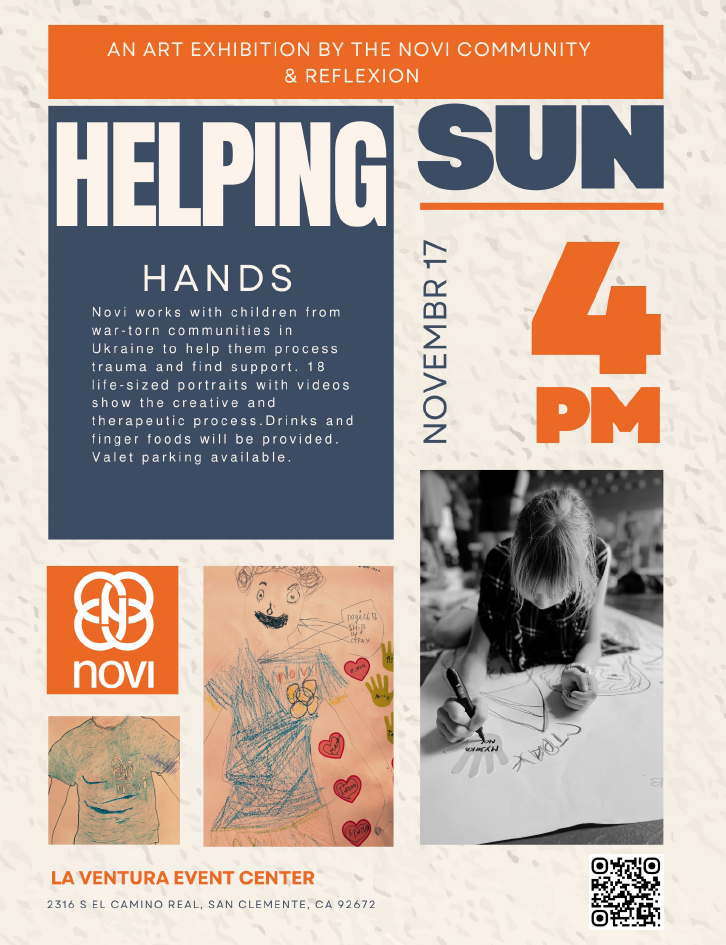
Helping Hands Exhibit

Sunday, November 17 The Novi Community will host an art exhibit, featuring hand drawn portraits made by children living in several of war-torn cities of Ukraine. Their work will be on display at the
La Ventura Event Center
2316 South El Camino Real
San Clemente, California
The doors will open at 4:00 pm and will run for four hours. There is no admission fee.

Children living in warzones are deprived of basic needs such as safety, education, and nutrition that are required for positive development. They are also exposed to violence, loss, displacement, and all the disturbances created by war. These factors often lead to severe emotional trauma, mental development, social disorders, and skills necessary to thrive throughout their lives and into adulthood.

In the chaos of violence, where young lives are fractured and isolated, Novi reconnects, heals, and uplifts. Supported by care and compassion, these children don’t just survive—they learn, grow, and rediscover joy. Novi equips them to form and maintain friendships and build their futures. We provide specialized training and tools to volunteers, social workers, teachers, therapists, and others who work with children in these high-stress environments. All Novi interventions are based on regional needs and are initiated through local professionals and caregivers. We cooperate with community organizations and institutions, obligating ourselves to the highest ethical standards.

Helping Hands is a play-oriented group activity that helps young children develop emotional awareness and healthy ways to cope with their feelings. Children begin by drawing a life-sized self-portrait and then are led to identify strong emotions, where they are felt on their bodies, and what helps them to cope with these feelings. These impressions are expressed artistically in their drawings. The intervention is adaptable for special needs and can be used in multiple sessions, with a focus on regulation, triggers, coping, and processing. In brief, we are working to preserve the normal childhood life experiences. This activity is just one part of a program that includes play, games, and lots of fun.

We invite you to visit the exhibit and witness the effectiveness of Helping Hands in the lives of the children whose artwork will be on display.

For more information on The Novi Community, please visit novi.ngo

Sermon OTM – 11/10/2024

Podcast

Facebook

Welcome and Prayer: Jim Calhoun

Come Lord join us today.
Our lives are are sometimes volatile
Fluctuating between our joys and sorrows
Our celebrations and our heartbreaks
Between victory and defeat
This week’s election has brought as much fear to some as elation to others
And that in itself can give each of us pause
Knowing that many, who are our neighbors,
Understand the world in ways distant from our own thinking
And believing their needs will be best met by attitudes, policy and actions we hold as destructive.
Help those who celebrate to do so with grace and generosity
And help those who are heartbroken find hope again in you
And for all of us fill us with your spirit to do as you call us
To love our neighbor
Even our neighbor who is our enemy
And to put flesh on the bone of that prayer teaching us,
leading us,
directing us to better love
And to remember this day and each day to love the least among us:
Our neighbors who are ill
Our neighbors who are hungry
Our neighbors who are alone
Our neighbors from other cultures
and who speak other languages
Our neighbors in jail
Come Lord and join us
And lead us into another day
Eager to do good
Amen

Morning Talk: chuck smith, jr.

Blessed are those who mourn, for they shall be comforted.
Blessed are the meek, for they shall inherit the earth Matthew 5:4-5

Intro: Welcome back to Jesus’ Sermon On the Mount

He begins with the Beatitudes – not to be confused with “benedictions”
– they are more like a series of riddles
• he describes conditions in which people are already blessed
◦ already acceptable to God and discovering the abundant life
◦ but what he says sounds like the opposite of abundant life
• we would never tell a friend who is grieving, “You’re so blessed”
◦ and even in Jesus’ time and culture meekness was a deficit
– for this reason, we must pat attention to both lines of each Beatitude
• the first line is an incomplete picture
◦ something else comes after the situation Jesus identifies
◦ his “Blessed are” lines are explained in the “for they shall be” lines
• Jesus surprises us in order to enlighten us
◦ he reveals the contrast between worldly values and heavenly
◦ I admit, the most difficult place to practice the Beatitudes is in real life

“Blessed are those who mourn”

I’m going to combine grieving and mourning because both involve sorrow but they are not same
grieving is a response to suffering a specific loss
• usually, the death of someone close to us – or even a dog or cat
• when we experience grief, we mourn our loss
mourning, however, doesn’t require a death or loss
• many things can break the human heart
◦ like the way Hannah mourned her inability to have children (1 Sam. 1:5-7)
• we can mourn human suffering, here or anywhere,
◦ or the corruption of industry and politics,
◦ or the damage we’ve done to our planet,
◦ or the lives of friends or loved ones ruined by addiction or alcoholism

Whatever the cause, mourning can last a lifetime
– that doesn’t mean it’s always as intense as the first shock wave
• in many instances, the pain never goes away,
◦ but slips into the background,
◦ like all the other pains and noises we learn to live with it
• but in quiet moments, it can sneak up on us
◦ a sudden, unexpected memory brings a deep sigh or tears
◦ and we say, “I sure miss my old friend,” or a parent, or mentor
– we witness such moments in the Scriptures
Then Jacob tore his garments . . . and mourned for many days. All his sons and all his daughters rose up to comfort him, but he refused to be comforted and said, “No, I shall go down to [the grave] to my son, mourning.” Thus his father wept for him (Gen. 37:34-35–in LXX, has same Greek word for mourning that Jesus used here)
Many years after the love of his life died, Jacob told his son Joseph, “As for me, when I came from Paddan, to my sorrow Rachel died in the land of Canaan . . . .” (Gen. 48:7)

I’ve officiated a lot of funerals (we don’t like that word, so we host “memorials” or “celebrations of life”
– I want to share with you something from my experience
• we have to stop putting emotional band aids on grief
◦ we need to avoid empty clichés: “I know how you feel,” “It must be God’s will,” “They’re in a better place”
Amy-Jill Levine says that phrase “does not comfort the mourner who may be thinking, The better place is here, with me. . . . If I hear again at a funeral that ‘heaven needed another angel,’ I may actually throw something. Let’s not dismiss mourning, which is what such platitudes try to do. The New Testament takes death seriously . . . Death is real. Death is painful.”
– to me, nothing sounds less sincere than, “I’m sorry for your loss”
◦ I assure you that silence is often the better response to another person’s mourning,
◦ perhaps with a gentle touch on the shoulder or hand
• it’s not our place to try to cheer up a broken heart
Whoever sings songs to a heavy heart,
is like one who takes off a garment on a cold day,
and like vinegar on soda (Pr. 25:20).
◦ instead of that, Paul says,
Rejoice with those who rejoice, weep with those who weep (Ro. 12:15)

There’s no way to suppress the physical agony of mourning
– it is not pure emotion — mourning is physical, neurological, and visceral
• our bodies can release into bloodstream an excess of specific peptides that prevent the nervous system from self-regulating
◦ we feel that agony in our stomach, and heart, and lungs (grief can be suffocating),
• there’s no way to control the deep pain of grief
– I have a theory–it’s mine, and I have no science to back it up, but here goes–
• until I experienced my most significant loss,
◦ I didn’t know how deeply it was possible to feel emotional pain, or how bad it could get
◦ my insides felt like a bottomless well, and I was in free fall
◦ with every degree I descended it felt like death was closing in on me
• but from that pain, I discovered, how deep my soul went
◦ if our souls can feel pain to that depth
◦ they can also feel love to that depth; and comfort to that depth

Which brings us to second line: “for they shall be comforted”

Jesus did not intend for this to be a consolation
– he is telling us that God won’t let our sorrow go to waste
• for me, every loss increases my longing for heaven
• one of the richest lines in the book of Revelation is,
He will wipe every tear from their eyes, and death shall be no more, neither shall there be mourning, nor crying, nor pain anymore . . . (Rev. 21:4)
– when Isaiah prophesied the time when God’s takes over world
Your sun shall no more go down,
nor your moon withdraw itself;
for the LORD will be your everlasting light,
and your days of mourning shall be ended (Isa. 60:20)
The Spirit of the Lord GOD is upon me,
because he has anointed me
to bring good news to the poor;
he has sent me to bind up the brokenhearted,
to proclaim liberty to the captives,
and the opening of prison to those who are bound,
to proclaim the year of the LORD’s favor,
and the day of vengeance of our God;
to comfort all who mourn;
to grant those who mourn in Zion–
to give them a beautiful headdress instead of ashes,
the oil of gladness instead of mourning,
the garment of praise instead of [the spirit of heaviness] (Isa. 61:1-3)

Isaiah also described Jesus as
a man of sorrows and acquainted with grief (Isa. 53:3)
– he knows grief, and he gives us a new perspective on our sorrows
• they are just one type of life’s experiences that prepare us for realm of God
• that is not a consolation, it is a benefit, because we can begin to experience that realm now
Amy-Jill Levine, “In part those who mourn are blessed because not everyone can mourn. . . . a heart that knows how to grieve is a heart that knows how to love.”

The next Beatitude is “Blessed are the meek”

If you’ve read commentaries or heard teaching on the Beatitudes, you’ll see how many of those who write and preach try to avoid the word “meek”
• it’s perceived as a weakness, so they opt for humble, gentle, or mild
◦ meek can be a weakness when you refuse to defend yourself or fight back
◦ if you let others go first and if you give up trying to control everything and everyone
• Jesus used this word to describe himself
Come to me, all you who labor and are heavy laden, and I will give you rest. Take my yoke upon you, and learn from me, for I am [meek] and lowly in heart, and you will find rest for your souls (Mt. 11:28-29)
◦ he is saying that he is approachable and not overbearing
◦ he is inviting us to be with him and to be like him
– we must be humble to be a true disciple of Jesus
• we must admit that we don’t know all we need to know
• we cannot come to Jesus self-assertive and aggressive, and smug in what we think we know,
◦ and expect him to take us on as disciples
◦ we must come as children

Jesus isn’t advocating low self-esteem
– I don’t think his concern here has anything to do with psychology
• meekness isn’t a fault or disorder that needs fixing or correcting
• it’s a way of being in the world, without being like the world
◦ it is kindness rather than rudeness, empathy rather than indifference, humility rather than egoism

The outcome here is, “for they shall inherit the earth”

Jesus is quoting Psalm 37, where we read, “The meek shall inherit the land” (v. 11)
– in the Old Testament, the land represents more than the territory within Israel’s borders
• it is attached to God’s covenant relationship with Israel
◦ it fulfills God’s promise to his people
enter my rest is synonymous with entering the land (Ps. 95:11)
◦ enjoying being with God in a space that he occupies
– it is the fullness of all that God has prepared for his people

Conclusion: We’re beginning to pick up the rhythm of the Beatitudes

A disturbing or difficult challenge in first line, becomes a benefit in the second line
Again, the second line is not “compensation” but the reward of something better
Every tear we shed becomes a seed of a harvest that is yet to come
Those who sow in tears
shall reap with shouts of joy! (Ps. 126:5)
Like everything else worthwhile, we live now for the best possible future

Sermon OTM Matthew 5:3 – 11/03/2024

Podcast

Facebook

Welcome and Prayer: Jim Calhoun

Come Lord and join us here today.
In truth, Lord, most of us are worried over something
We are afraid and it has us all tied up
And it is so common a thing
We act like this is our lot in life
Like this is just how life goes
We are concerned about the election
All of its vitriol
All of its deception
All of it ugly meanness and the aftermath and the fights to come
and the impact of the next administration
We are concerned about money and bills
About children and grandchildren
About demands we might not be able to meet
About expectations we may not be able to fulfill
About choices we make
And choices others make and how they will work out
Or not work out
We are concerned for our health
And the health of others in our lives
And treatments and procedures
And pain
And life and death
And how will we ever make it through
And how will we possibly manage after
We are concerned that we will be found out
That our secrets will be divulged
Our inner lives revealed
That our reputations will be ruined
That our hearts will be laid bare
That we will lose our friends
That we will be abandoned and alone
In our worry In our fear
We look to ourselves
We become our own focus
We get a little lost
So this morning we turn again to you
Anxious and expectant
That we can keep calm
Because all things are in your hands
Because all things will refine us
Because all things are perfectly perfect
Just as they are in this moment
And we turn to you
Anxious and expectant
Ready to carry on
Because you call us to you
Because we are partnered with you
Because you have given us others to love
Because you lead the way
We turn to you Wanting to ease our worries,
Our concerns
Our fears
Knowing all along
The path to peace is loving
Amen

Morning Talk: chuck smith, jr.

Blessed are the poor in spirit, for theirs is the kingdom of heaven Matthew 5:3

Intro: Recently, I came across an interesting ad:

The caption said, “Free AI Sermon Generator”
“Free AI sermon outlines help you preach a confident, creative message. AI sermon starter ideas make your sermon fresh and relevant.”
– I realized, from now on my life could be easy; for example,
• last week I mentioned my frustration with “kingdom” (bringing to mind the idea of a nation with borders)
• more than one person recommended that we talk about the “realm of God”
– when I searched for a definition of realm online,
• an AI response automatically popped up, with a list, included:
A realm is a domain or area of activity, interest, or influence.
It can refer to a kingdom or territory ruled by a monarch.
Philosophically, it can be a specific sphere of existence or reality.
Realm can also imply a level of consciousness or a state of being.
• so, for now, Jesus is going to walk us into the “realm of heaven”

Of the four gospels, only Matthew uses “kingdom of heaven” rather than “kingdom of God
– there’s no difference, except where the emphasis is placed
Amy-Jill Levine, “. . . Matthew is setting up a contrast between heaven and earth: heaven is where God’s will is done; heaven is where God rules rather than where the ‘kings of the earth’ . . . hold sway. Heaven is a different place, a better place, a real place, a place where God rules and life is as God wants rather than as humanity has constructed.”
• Jesus’ Sermon illuminates the realm of heaven and its here, now reality
• we enter the Sermon through the Beatitudes
– my Mom once explained, “They are not the ‘Do’-attitudes, but the ‘Be’-attitudes
• despite Mom’s wisdom, Jesus isn’t teaching attitudes here
◦ he’s not laying out rules, and he’s not handing out blessings
• so what is Jesus doing in the Beatitudes?

Matthew’s synopsis of Jesus message when he first began preaching was:
“Repent, for the kingdom of heaven is at hand” (Mt. 4:17)
– “repent” means “change” and especially a change of mind
• this includes our perspective, perceptions, thoughts, motives–and all the rest of it
◦ as we change, we become “a new creation” (2 Cor. 5:17) our new self (Ep. 4:24)
• that’s what Jesus is doing in us with the Beatitudes and his entire Sermon
◦ he is preparing us to receive our full citizenship in the realm of God
– Jesus is changing us, and he is doing this from the inside out

If the Beatitudes are not Do-attitudes, what are they?

To learn the answer, there’s a mess that must be cleaned up first
– in the Hebrew Scriptures, two words are translated “blessed”
• these words have two different meanings
1. one of the words refers to blessings given by God and others
• for instance, fathers to sons, priests to people, one person to another (cf. Ruth 2:4)
◦ to pronounce a blessing is to give a gift from one’s soul
◦ when in the Psalms, people bless God, they give him praise (Ps. 103:1)

(One of the most common ways that Hebrew prayers begin is,
Baruch hashem Adonai, Eloheinu Melech Ha’Olam
“Praise to the Lord God, the Ruler of the universe”)

• God blesses people by showing them his favor, doing good
◦ Leviticus 26 and Deuteronomy 28 contain lists of this type of blessing,
which generally consist of fertility, health, prosperity, success in war, and shalom
Jonathan Pennington points out that the opposite of “to bless” (baruch) is “to curse”
• we tend to associate these blessings with emotional responses
Happy are the people whose God is the LORD (Ps. 144:15)
◦ when we hear someone say, “I was so blessed,” they are usually referring to the joy they felt
2. the other Hebrew word refers to a state of being: esher
Blessed [esher] is the one
who walks not in the counsel of the wicked (Ps. 1:1)
• the esher blessing is not a gift and it doesn’t involve a transaction
Pennington says it is “a certain way of being in the world”
◦ a way that pleases God
Pennington: the opposite of “be blessed” (esher) is “woe” (Lk. 6:20-26; Mt. 23)
• the New Testament continues to make same distinction as the two Hebrew words
◦ and, unfortunately, translates both words as “blessed”
• the word Jesus uses here in the Beatitudes is makarios, and it describes a state of being in God’s will
◦ so in the Beatitudes, Jesus was not pronouncing blessings on people
◦ he was saying these are already in a blessed state
– we do not have an English word that matches the meaning of makarios
• we could say something like, “a fortunate situation is theirs . . . .”
• Jesus isn’t pronouncing blessings on people who have these traits
◦ he’s saying they’re fortunate because they’re already on the right path

A philosophical quest began hundreds of years before Jesus

Socrates asked, “What was the best life that a human could live?”
– a century after Jesus, the quest was taken up by Cicero, who asked, what is the summum bonum
(“the greatest good” that people could reach in their lives)
• his answer included a life of virtue, wisdom, moderation, and courage
◦ the Beatitudes are Jesus’ answer to that question
• only, unlike the virtues of Greek and Roman philosophers,
◦ the Beatitudes are not accomplishments
– Jesus is not saying the poor in spirit pursued poverty of spirit, and so were blessed
• instead, he was saying, if for God’s sake you find yourself in this unpleasant condition,
◦ you’ve stumbled onto the right path
• let’s take a closer look at this

There are two parts to each Beatitude

I know that observation is obvious, but it’s important to keep it in mind
in the first line of each Beatitude, Jesus declares a person to be in a fortunate state
• because they exhibit a certain trait, or they’re in a certain situation,
◦ or practice a specific behavior toward others or God,
◦ or they are persecuted for righteousness sake
• but each first line comes like a slap in the face
◦ it doesn’t make sense – it’s a contradiction (how are those who mourn, blessed?)
◦ in that culture, humility was a liability, a disgrace
• so the first line contradicts the values of the corrupt world and turns secular virtues on their head
◦ it doesn’t seem like Jesus is describing a blessing, but a hardship, a need, a disadvantage
◦ these are things that people of the world seek to avoid
the second line of each Beatitude reveals why the first line is a qualifier for blessed state
• and it is linked to the summum bonum, or what Jesus called the “abundant life”
– notice that the list of the Beatitudes begins and ends with the kingdom (or realm) of heaven
• in between the first and last Beatitude, the blessed state includes comfort, an inheritance, mercy, and so on
◦ each of these verses look to the future, “shall be”
◦ but the two verses that end with the kingdom of heaven are present tense, “theirs is
• Jesus wants to make us aware of God’s realm,
◦ then to value it, and then to seek it
◦ when we’re cut-off from the world and its vision of “good life,” we’re closer to the heavenly realm

I think we’re ready now to cross the threshold

“Blessed are the poor in spirit, for theirs is the kingdom of heaven”
– poor in spirit can be anything that breaks a person, that puts them at a disadvantage
• it could be material (Luke gives the bare version of the first Beatitude, “Blessed are you who are poor” )
◦ or it could physical, or psychological – I can imagine something like a mood disorder
◦ anxiety, depression, or bi-polar disorders
Pennington, “‘Poor in spirit’ may seem like a positive Christian virtue, but in an ancient Near Eastern and Greco-Roman setting of honor and shame, the poor in spirit are in low places in society . . . .”
– there was only one other kind of person of whom Jesus said something like,
“theirs is the kingdom of heaven”
• those were the children parents brought to him for his blessing
“to such belongs the kingdom of heaven” (Mt. 19:14)
◦ the poor in spirit are often reduced to the status of a child
• I think we hear echoes of the prophet Isaiah
“For the says the One who is high and lifted up,
who inhabits eternity, whose name is Holy;
I dwell in the high and holy place,
and also with him who is of a contrite and lowly spirit,
to revive the spirit of the lowly,
and to revive the heart of the contrite” (Isa. 57:15)

To suffer hardships and setbacks and unhappiness in the world,
– does not deprive us of the experience and enjoyment of God’s realm
John Calvin, “The disciples of Christ must learn the philosophy of placing their happiness beyond the world, and above the afflictions of the flesh.”

Conclusion: I can imagine people in the crowd, listening to Jesus

When they hear him say, “poor in spirit,” they look down
– they try to make themselves small, so no one notices them
• they don’t want to be exposed for what they are; that is poor in spirit
• but then they hear Jesus say, the realm of heaven is theirs
◦ not only in some distant future across the galaxies,
◦ but here – now – with Jesus on the Mountain

Jesus shows us ourselves through his eyes –
A perspective that is hopeful and positive
He opens our eyes to the realm of God – and invites us in
We find that even though we do not experience its fullness
it is here already, transforming our liabilities into assets