January 26, 2014 – Genesis 40

Let God In

Then it came about after these things, the cupbearer and the baker for the king of Egypt offended their lord, the king of Egypt. Pharaoh was furious with his two officials, the chief cupbearer and the chief baker. So he put them in the house of the captain of the bodyguard, in the jail, the same place where Joseph was imprisoned. Genesis 40:1-3

Intro: As you read through the story, be aware of the following:

■ Joseph was twenty-eight years old when these things took place
■ a “cupbearer” or “butler” was a wine-server who chose, sampled, and recommended wines to the king
– he held a powerful position, always standing next to the king
■ the butler’s dream was elaborate, containing seven visual images and lots of action
■ the baker’s dream was sparse but wild, contained only three visual images and one action
■ both of their dreams incorporated symbols of their occupations


God makes his next move

God has an objective, but he doesn’t pursue it with brute force
– the game board on which he makes his moves is the natural world
• it’s cluttered with humans who have their own objectives
○ their objectives may interfere or conflict with his
○ but God doesn’t violate their free will
• God can use any situation humans construct
○ he works through the ordinary circumstances of our everyday lives
– if it were a chess match, God knows every possible move and every countermove
• he never loses–he always achieves his objectives Continue reading

January 19, 2014 – Genesis 39

The Question of Character

Now Joseph had been taken down to Egypt; and Potiphar, an Egyptian officer bought him from the Ishmaelites, who had taken him down there. The LORD was with Joseph, so he became a successful man. And he was in the house of his master, the Egyptian. Genesis 39:1-2 

(If you are not familiar with the story, please read the entire chapter)

Intro: The chapter begins and ends with parallel statements

  • the Lord was with Joseph
  • whatever he did the LORD made to prosper
  • Joseph found favor in the sight of his master and jailer
  • Joseph was over all of Potiphar’s “house” and the jail “house”

Between these textual bookends, the center of the chapter reports the attempted seduction


The point of this episode is to highlight Joseph’s sterling character

In this regard, his story bears a strong resemblance to other stories in the Hebrew Scriptures
– especially Esther and Daniel, where we find:

  1. A Hebrew in exile and alone
  2. Faces great risk and personal sacrifice
  3. Up against fierce antagonists
  4. The quality of each of these characters is outstanding
  5. Each one finds “favor” with their (Gentile) supervisor
  6. Each one rises in prominence and holds an office close to the ruler or king
  7. Each one uses their position to promote the welfare of their people

– the lesson of these stories taught Israel how good God’s man or woman behaves in exile
• therefore, Joseph’s character, like Esther’s and Daniel’s, is a crucial element in story


Joseph rides the emotional roller coaster

We are on the emotional roller coaster whenever our circumstances carry us up and down Continue reading

January 12, 2014 – Genesis 38

Big Apologies

The reason we did not live stream on Sunday was because our technician was under the weather. We had planned to provide a video feed this week when we opened a conversation about Genesis chapter 38 in place of our usual Bible study. We are sorry we were not able to share it with those of you who were hoping to join us online. At any rate, a good questions were raised and several very insightful observations were made.

Make sure you have read Genesis 38 before looking at the notes that follow, which outline the topics that came up on Sunday:

Background information

This episode is definitely out of chronological sequence. It would have been impossible for Judah to meet a Canaanite woman, father three sons, watch them grow until the oldest two reached a marriageable age, see both of them die, suffer the death of his wife, and some time later father two more children by Tamar in the space of time it took Joseph to travel from Canaan to Egypt! 

Notice that the last verse of chapter takes us to the same scene in the first verse of chapter 39, but from two different perspectives (from Canaan, 37:36, and in Egypt, 39:1). This tells us that the brief account of Judah’s story overlaps this one episode in the ongoing story of Joseph’s life.

Besides building suspense as we wait to learn what will happen to Joseph in Egypt, the strange account of Judah’s marriage and what followed, provides an interlude between the story of Jacob, Judah’s father (chapters 27-37) and Joseph, Judah’s brother (chapters 39-50).

If the storyteller is not concerned with historical sequence, he nevertheless finds a unity of themes in chapters 37-39 that he artfully connects. For example: Continue reading

January 5, 2014 – Matthew 26:26-30

 The First Step Into A New Year

While they were eating, Jesus took some bread, and after a blessing, He broke it and gave it to the disciples, and said, “Take,eat; this is My body.” And when He had taken a cup and given thanks, He gave it to them, saying, “Drink from it, all of you; for this is My blood of the covenant, which is poured out for many for forgiveness of sins. But I say to you, I will not drink of this fruit of the vine from now on until that day when I drink it new with you in My Father’s kingdom.”
After singing a hymn, they went out to the Mount of Olives. Matthew 26:26-30 

I am always surprised at how quickly this phase of the meal is over. From the outside, the words spoken over the bread and cup do not look like ritual or the forging of a covenant between God and humankind. Jesus acts in ways that are simple and ordinary–blessing the bread, giving thanks for the cup. His speech is concise and direct. For all the build-up to this moment, it almost seems like a skyrocket that flew high above the ground but did not explode.

So why did the first Christians make such a big deal of the Lord’s Supper? Why did it become the central ritual of the church? Why did church fathers expand it into this elaborate, sacred drama? Why did they configure their liturgy around it, so that it is the climax of Christian worship?

Because they sensed in the gift of the bread and cup the profound reality with which Jesus infused it. The Graphic imagery of body and blood stunned them. There was no way Jesus could place himself before them with greater force. Handing them his very life, he said, “From now on, everything rests on Me and your total acceptance of Me.”

God’s covenant with us through Jesus Christ is sealed in his body and blood. Getting this inside of us, where it can purify, heal, and transform us, is the sole objective of our spiritual journey.

Through the centuries, those who knew that the life of Spirit was more than words and became teachers and guides in Christian spirituality, have always recognized the profound potential of the Lord’s Supper. They have always treated it as deeply sacred mystery. They encountered Jesus in the breaking of the bread and sipping from the cup more frequently and consistently than anywhere else. And each time they brought their faith to the communion table, something changed inside them. God took hold of them and their life in him became more real-world and authentic.

Through their experience, they discovered the mystery of incarnation; namely, that what is spiritual touches us through what is physical.

So, Jesus took, blessed it, broke it, and gave it. Then he took the cup and gave thanks for it and gave it. Jesus gave and as he did, he said, “Take.”

Yesterday, after mulling over this passage for awhile, I went outside to work in the yard and rest my mind. The whole time I was outside trimming, weeding, and cleaning up my mess, my thoughts kept returning to that one word, “Take.” It is human nature to eagerly take what appears to be valuable or what we believe will satisfy our discontented souls. It is our nature to take. It is God’s nature to give. Jesus presents himself to us and says, “Take. I am yours.”

What if we do this, what if we take the bread, drink from the cup, and nothing happens? What if we’re as unaware and oblivious as the disciples, who took, and drank, and went outside and fell asleep contrary to Jesus’ desperate request?

First, something happens between God’s Spirit and our spirit when we observe the Lord’s Supper, even if our sluggish minds sleep through it.

Secondly, we do not have to fear the experience of nothingness. God is not rendered helpless when we sit in emptiness, but he works in our nothingness. He works with our nothingness.

When I go to work on a project, I begin by collecting supplies–perhaps lumber, nails, glue, and several rolls of duct tape. From these materials, I make something. When God begins a project, he uses nothingness–this is the material with which he makes something.

“. . . God who gives life to the dead and calls into being that which does not exist” (Romans 4:17)
“For God, who said, ‘Light shall shine out of darkness,’ is the One who has shone in our hearts” (2 Corinthians 4:6)

Sometimes when we think God has abandoned us, he has not abandoned us, he has only abandoned our concepts of him. God removes himself from our limited and mistaken ideas. We come to God with ideas about him–our pre-formed theologies. But by sitting quietly and receptively in our nothingness, we give him something else to work with–a blank canvas, a vast emptiness like the first day of creation.

So we enter this new year, bringing to our lips the bread and wine that seals our covenant relationship with God. It is of little importance whether we see visions of angels or observe the ritual feeling nothing. Either way, both us and our new year are placed in the hands of God and all will be well.
December 29, 2013 – Psalm 73


Psalm 73

Two Perspectives On the New Year

Psalm 73

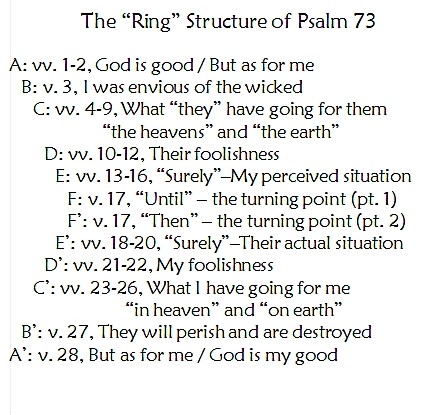
INTRO: This psalm incorporates an art form that may be hidden from us

Mary Douglas referred to it as “ring composition”

Douglas, “The minimum criterion for a ring composition is for the ending to join up with the beginning.”

– the text develops a thought in one direction (from the top of the circle, downward)
• it reaches a turning point, then moves backward through the thought to the beginning
○ the outline above is my rough attempt to show the general pattern of Psalm 73

Mary Douglas, “Friends ask me, what does it mater? Why is it important to know the construction? This leads to another point: in a ring composition the meaning is located in the middle. A reader who reads a ring as if it were a straight linear composition will miss the meaning. Surely that matters!”

The poet tells us his story – he takes us on a journey
– he begins the poem with, “God is good” and “But as for me” (vv. 1-2)
– he ends it with, “But as for me” and “God is my good” (v. 28)
• these form the clasp that hold the ring together
• in between, he narrates the bitter struggle he had with the ways of God Continue reading