March 27, 2016 – Luke 24:13-32

The Best Bible Study Ever!

And behold, two of them were going that very day to a village named Emmaus, which was about seven miles from Jerusalem. And they were talking with each other about all these things which had taken place. While they were talking and discussing, Jesus Himself approached and began traveling with them. But their eyes were prevented from recognizing Him. And He said to them, “What are these words that you are exchanging with one another as you are walking?” And they stood still, looking sad. Luke 24:13-17

Intro: We find only a few post-resurrection stories in the Gospels

These are brief narratives that leave out many details
– yet the depth within these short stories is profound
– it seems that each one addresses a lingering concern or need:
• Thomas: the need to resolve doubt and disbelief (Jn. 20:25-29)
• Peter: the need to experience forgiveness and reconciliation (Jn. 21:15-19)
• the disciples: the need to know how the Scriptures comes together in Jesus (Lk. 24:27, 44)
◦ and whether it was even possible to go on without Jesus’ physical presence
• the women: the need for building hope and trust that death is not the end (Mt. 28:1-10)

Today’s story, stretching from Jerusalem to Emmaus is one of our favorites
– two disciples receive private tutoring from Jesus on this seven mile walk
– but even more important is the fact that this is our–Reflexion’s–defining story
• this is who we are and the path we’re on
• as we take this Easter walk with the Lord and two disciples, look for Reflexion’s reflection


They were traveling

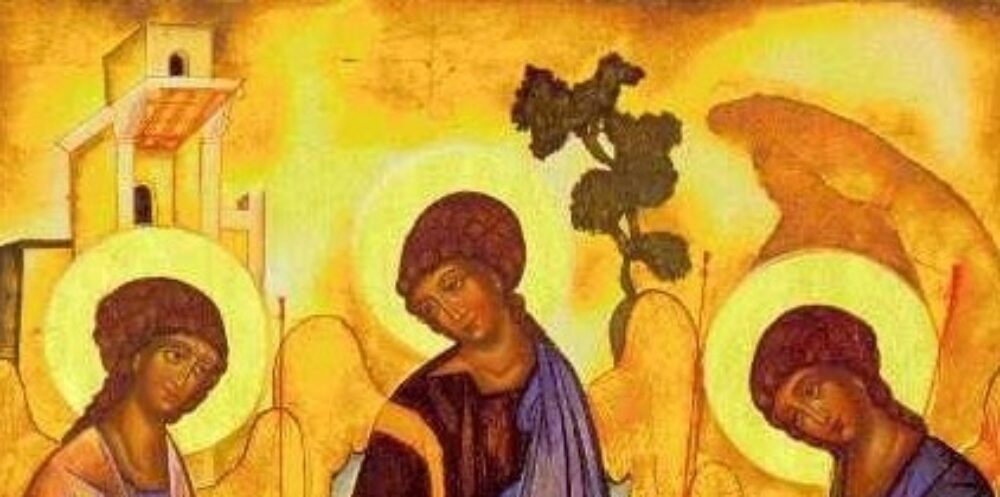
Yesterday, Jim took a group of us through an art show at Trinity Epicopal Church in Orange
– the artist is a Russian woman, Ludmila Pawlowska, who came to faith in the Soviet era
• she found inspiration for her work in Russian Orthdox icons
• her paintings and collages invite viewers to look through them
◦ her works do what good sermons should do; awaken us to God’s presence
– at end of the tour, Jim invited us to sit down and Lectio our experience
• that is, to bring awareness to what the art stirred within us and reflect on those responses
• one person’s favorite piece was titled “On My Way Home”
◦ she said, “Looking at it, I could see the path, but were are lots of obstacles”
◦ this was the road the disciples were on and it is our road too

After they had preached the gospel to that city and had made many disciples, they returned to Lystra and to Iconium and to Antioch, strengthening the souls of the disciples, encouraging them to continue in the faith, and saying, “Through many tribulations we must enter the kingdom of God.” (Acts 14:21-22)

All the way through life we encounter both good and bad situations, smooth times and hard times
– God’s purpose is that the good times refesh us and the difficult times strengthen and purify us
– the metaphor we use for this ongoing progress in Christ is spiritual journey
• it is sometimes a solemn quest and other times it is a grueling hike up a steep trail
• in seasons of grace it is more like a reflective walk at the beach or in the hills
• every morning begins a new “starting place” (cf. Num. 33:2)
And this is Reflexion


They were traveling together

The walk to Emmaus was difficult, but not lonely Continue reading →

March 20, 2016 – The Gospels

Jesus’ Grand Entrance

Our Scripture reading is based on Mark 11:1-10, but combines details from all four Gospels.

As they approached Jerusalem, at Bethphage and Bethany, near the Mount of Olives, He sent two of His disciples, and said to them, “Go into the village opposite you, and immediately as you enter it, you will find a colt tied there, on which no one yet has ever sat; untie it and bring it here. If anyone says to you, ‘Why are you doing this?’ you say, ‘The Lord has need of it’; and immediately he will send it back here.” They went away and found a colt tied at the door, outside in the street; and they untied it. Some of the bystanders were saying to them, “What are you doing, untying the colt?” They spoke to them just as Jesus had told them, and they gave them permission.
This took place to fulfill what was spoken through the prophet:
“Say, ‘Fear not’ to the daughter of Zion,
‘Behold your King is coming to you,
Gentle, seated on a donkey,
Even on a colt, the foal of a beast of burden.’”
These things His disciples did not understand at the first; but when Jesus was glorified, then they remembered that these things were written of Him, and that they had done these things to him.

Intro: Most of us have read or heard this story many times

But have you ever asked, What purpose does it serve?
– how does this fit into entire ministry of Jesus?
• what value is there in this quasi-political rally around Jesus?
• what does the makeshift parade accomplish with all its shouting and flag-waving?
◦ only they did not have flags or imperial banners so they gathered leafy branches from nearby fields
◦ and there was no red carpet, so thrift-store clothing was tossed on the ground for him to ride over
– Jesus had never allowed the crowds to do this before (cf. Jn. 6:15), so why now?
• what does it change? What does it prove? By the end of the week he was dead

Later on, the disciples were asking the same question
– as John said, they did not understand these things at the time
• but with reflection it came to them
• they saw in it the fulfillment of scripture written long ago, in Zechariah and Psalm 118
– with uncharacteristic public display, Jesus arrived at the very gates of Jerusalem
• he assumed the role that was uniquely his, confirming what Peter had confessed
◦ that Jesus is “the Messiah, the Son of the living God” (Mt. 16:16)
◦ although, at that time, Jesus ordered his disciples to “tell no one about Him” (Mk. 8:30)

This morning we will observe Jesus through the lens of these Palm Sunday events


Jesus had been making preparations for this day

I don’t mean, he made “arrangements”
– William Barclay thought Jesus had made a previous arrangement with the owner to use his donkey

William Barclay, “‘The Master needs them,’ was a password by which their owner would know that the hour which Jesus had arranged had come.”

• I’m doubtful that was the case – the essence of this story is not its careful planning, but its spontaneity
• not everything had been worked out
◦ still, Jesus was certain it would come together — note how well he perceived how things would unfold:

Go into the village and this will happen
Untie the colt and this may happen
If that happens, say these words and this will happen

– this is what I mean by “making preparations”
• Jesus had been preparing, not the big event, but himself
• preparing himself for this moment of recognition, for this final week of conflict with rigid religion
◦ preparing himself for Gethsemane, rejection and crucifixion
◦ he tried to prepare the disciples, but they could not fathom what he said — so he just prepared himself

The hour has come for the Son of Man to be glorified. . . . Now My soul is troubled; and what shall I say, “Father, save Me from ths hour”? But for this purpose I came to this hour. Father, glorify Your name. (Jn. 12:23, 27)


It’s always a little surprising to see that, like us, Jesus had needs Continue reading →

March 13, 2016 – Acts 9:32-43

What Have We Been Missing?

Now as Peter was traveling through all those regions he came down also to the saints who lived at Lydda. There he found a man named Aeneas, who had been bedridden eight years, for he was paralyzed. Peter said to him, “Aeneas, Jesus Christ heals you; get up and make your bed.” Immediately he got up. And all who lived at Lydda and Sharon saw him, and they turned to the Lord. Acts 9:32-43

INTRO: I know some of us still don’t get contemplative prayer

Or why we begin Sunday mornings in silence, seeking God or waiting on him
– it is difficult to sit a few minutes in openness, responsiveness and receptivity, so why bother?
– I hope that the answers becomes clear for you today


When we catch up with Peter, he is on the road

Maybe he was following leads to locate pockets of believers
– or perhaps he was looking for such communities to encourage them
• or he was simply drifting, allowing the Spirit to direct him
– Lydda is modern day Lod, the location of Ben Gurion Airport
• it was there that Peter “found” Aeneas – as though he was on the alert for opportunities
• Luke is skimpy on the details
◦ it seems he just wants to keep the story moving — we would like a lot more information
◦ like how did Peter know that Jesus was healing Aeneas?
– “Sharon” refers to the coastal plain that ran from Joppa to Mt. Carmel
• Aeneas’ physical healing resulted in people making a turn to the Lord
• I once heard an evangelist quoted as saying, “People change, but not that much”
◦ but Luke has been showing us that it is possible to change that much

Now in Joppa there was a disciple named Tabitha (which translated in Greek is called Dorcas); this woman was abounding with deeds of kindness and charity which she continually did. And it happened at that time that she fell sick and died; and when they had washed her body, the laid it in an upper room. Since Lydda was near Joppa, the disciples, having heard that Peter was there, sent two men to him, imploring him, “Do not delay in coming to us.” Acts 9:36-38

Peter’s next destination was Joppa, a seaport on the Mediterranean (modern Jaffa)
– in Luke 8:1-2 we are told the twelve disciples were with Jesus on the road
• but Luke also tells us there women were also present
◦ the women, however, are not specifically referred to as disciples
• but here, Tabitha is a disciple–the only New Testament use of the feminine form of “disciple”
– the little we know about Tabitha is what we read here
• nevertheless, there’s enough to reveal the impact made by the kindness of a good person
• that is why the believers in Joppa were not ready to let her go

So Peter arose and went with them. When he arrived, they brought him into the upper room; and all the widows stood beside him, weeping and showing all the tunics and garments that Dorcas used to make while she was with them. But Peter sent them all out and knelt down and prayed, and turning to the body, he said, “Tabitha, arise.” And she opened her eyes, and when she saw Peter, she sat up. And he gave her his hand and raised her up; and calling the saints and widows, he presented her alive. It became known all over Joppa, and many believed in the Lord. Acts 9:39-42

At this point we may feel like we’re experiencing de ja vu
– it is as though we were watching a rerun of events reported in Luke 8

  • Jairus had “implored” Jesus to come to his home (Lk. 8:41)
    ◦ the messengers “implored” Peter to come to Joppa
  • In his home, Jairus’ daughter was dying (and died before Jesus arrived, Lk. 8:43, 49)
    ◦ Tabitha’s body lay dead in the upper room in Joppa
  • Mourners were already present and weeping in Jairus’ home (Lk. 8:52)
    ◦ widows were weeping in the upper room when Peter arrived
  • Jesus sent the mourners out
    (leaving only Jairus, his wife and Peter, James and John; Lk. 8:51 & cf. Mk. 5:40)
    ◦ Peter sent the mourners out
  • Jesus took the girl’s hand and spoke two words to her (Lk. 8:54)
    ◦ Peter reversed order, first speaking two words to Tabitha, then taking her hand

Peter’s education and training had prepared him for this moment
– having been with Jesus, he followed the example that had been set for him
– in Joppa, the physical miracle resulted in people coming to faith in the Lord

And Peter stayed many days in Joppa with a tanner named Simon. Acts 9:43

Again, Simon Peter is associated with another “Simon”


What does it take to turn our lives toward God?

Or to come to a faith in God when you had never believed or trusted in him?
– we assume it takes exactly the sort of thing we see in this passage: a miracle
• but that is exactly what Jesus hoped we would transcend (Jn. 20:29)
◦ however, that is not my concern right now
• what I want us to consider is that two bodies were the focal points of the miracles
◦ one body was paralyzed and the other was dead

Psalm 139 is a psalm of wonder
– wonder is not the theme of the poem, but its tone

For You formed my inward parts;
You wove me in my mother’s womb.
I will give thanks to You, for I am fearfully and wonderfully made;
Wonderful are Your works, and my soul knows it very well.
My frame was not hidden from You,
When I was made in secret,
And skillfully wrought in the depths of the earth;
Your eyes have seen my unformed substance;
And in Your book were all written
The days that were ordained for me,
When as yet there was not one of them.
How precious also are Your thoughts to me, O God!
How vast is the sum of them.
If I should count them, they would outnumber the sand.
When I awake, I am still with You.
 (Ps. 139:13-18)

• the psalmists frequently write this way: my heart, my bones, my kidneys, my lips
◦ all that is felt or done by these body parts are experiences, functions, and expressions of me
◦ nor was it only Israel’s poets who paid attention to external and internal stimuli
• visceral sensations were indicators of how a person was doing

When I kept silent, my bones wasted away
Through my groaning all day long.
For day and night your hand was heavy upon me;
My life’s juices were turned into the drought of summer.
(Ps. 32:3-4, literal)

◦ listening to our body, we can recognize even mild anxiety, fear, or upset
◦ the body also reveals the status of a person’s relationships — with God and others
– furthermore, God attempts to communicate with us through our bodies

“Knowledge of God somehow thrusts deeper roots within the human organism itself even beyond the mind’s ability to think and analyze.” Edwin McMahon & Peter Campbell


A model of the brain as a three-story building Continue reading →

March 6, 2016 – Acts 9:1-32

Christ, the Ruler of All

Now Saul, still breathing threats and murder against the disciples of the Lord, went to the high priest, and asked for letters from him to the synagogues at Damascus, so that if he found any belong to the Way, both men and women, he might bring them bound to Jerusalem Acts 9:1-2

Intro: Do you remember the 1997 movie, Amistad?

African men and women were on a slave ship from Cuba to the U.S.
– they staged a revolt on board and took control of the ship
• misled, they sailed into U.S. waters and were apprehended by the American navy
• put on trial for mutiny, they were at a loss not knowing the English language
– one of the slaves began thumbing through a Bible, “reading” the drawings in it
• from those pictures alone he was able to decipher the story of Jesus
◦ in it he found comfort and hope

Perhaps you’ve seen children’s Bibles with illustrations of some of the stories
– these are meant to increase a child’s interest and his or her understanding
• God’s design for his sanctuary included sacred art (Ex. 25:18-20; 26:1)
• when serving in the Holy Place, the priests were surrounded by angels
– so we begin this morning with sacred art


Early Christianity’s form of sacred art: Icons

In my religious upbringing, there was no place for icons
– what we were told, Roman Catholics worshiped idols
• we were never taught the difference between idols and icons
◦ or between worship and veneration
• nevertheless, we had pictures
◦ in our “Sunday school” classes we colored in pictures of Bible stories
◦ sappy paintings of Jesus decorated the front wall of the sanctuary
– when exposed to icons, I thought they looked weird – I didn’t get them
• but prior to my first trip to Russia, a friend had me to rethinking icons
◦ then, when visiting orthodox churches, I found myself deeply moved
◦ it was learning to read and art appreciation at the same time
• there is still a lot of junk art that that annoys me, but icons are–something else

Like books, icons communicate through visual symbols
– they deliver their message not only conceptually, but directly
• their purpose is facilitate an encounter — to give the viewer an opportunity to:
◦ experience the story they tell
◦ experience the truth they proclaim
– what could be done with the interior walls of churches?
• Nilus, a fifth century monk suggested the following:

“Let the hand of the artist fill the church on both sides with pictures from the Old and the New Testaments, in order that the illiterate, who cannot read the Divine Scriptures, should, by looking at the painted images, bring to mind the valiant deeds of those who served God with all sincerity and be themselves incited to rival the glorious and ever-memorable exploits, through which they exchanged earth for heaven, preferring the invisible to the visible.”

◦ in the seventh century, John of Damascus, the great defender of icons wrote:

“What the written word is to those who know letters, the icon is to the unlettered” (though “all of us,” he added “benefit from what is painted in the icons”)

• when you see an icon, think of it being like a book – a “devotional”
◦ it is something you read to warm the heart to God’s presence
◦ a tool that serves to inform and inspire


But why the funny looking art form? Continue reading →

February 28, 2016 – Acts Chapter 8

The Word Goes On the Road

Saul was in hearty agreement with putting him to death. And on that day a great persecution began against the church in Jerusalem, and they were all scattered throughout the regions of Judea and Samaria, except the apostles. Some devout men buried Stephen, and made loud lamentation over him.
But Saul began ravaging the church, entering house after house, and dragging off men and women, he would put them in prison. Therefore, those who had been scattered went about preaching the word. 
Acts 8:1-4

Intro: In this chapter we are going to get lessons in evangelism

I rarely address this subject and for a number of reasons

  1. Both “personal” and programmatic evangelism have been overemphasized
    • the term “Great Commission” never appears in the Bible
    ◦ the great commandment (and second) do appear–in Jesus’ teaching
    ◦ but they are often ignored or merely given lip service
    • John 3:16 is a foundation for thinking theologically about evangelism
    For God so loved the world, that He gave His only begotten Son, that whoever believes in Him shall not perish, but have eternal life.
  2. Step-by-step methods of “soul-winning” miss the point
    • it is typical that in our western world we reduce evangelism to a “science”
  3. Evangelism is less about what we do than who we are
    • the hypocrite’s preaching betrays rather than supports the gospel
    Klyne Snodgrass, in discussing the parable of the Good Samaritan said, “The parable, like most of Scripture, is concerned with identity. In effect, when people asked Jesus ‘What do I have to do?’ he asked in return ‘What kind of person are you?’ . . . what we are cannot be torn from what we do.”

To be clear: Evangelism is the communication of the evangel, with the intention to persuade people to receive the message, respond with faith and repentance, be forgiven their sins and become followers of Jesus Christ.

Evangel is “gospel” in the New Testament, meaning a good message or good news
– evangelizo is to evangelize – bring good news
• this word occurs five times in this chapter and is associated with four other words:
1.) the word, 2.) the Spirit, 3.) baptism and 4.) rejoicing (the effect of receiving it)
– to evangelize is to tell the story of Jesus
• but those who tell it must have a personal experience of salvation through Jesus
◦ they are witnesses of Jesus’ power to transform a human life
◦ this has been emphasized in Acts from the start (1:8, 22; 2:32, 40; 3:15; 5:32; etc.)


Verses 1-4, Incentive to take the word on the road

Here’s something you won’t find in any Guide to evangelism:

To Pastors: The way to motivate your congregation to get out of the church and preach the gospel, do something to bring such intense persecution that they are driven from the church. Or set the building on fire.

– verses 1-4 could have been a fitting conclusion if placed at end of chapter 7
• their purpose here is to provide a transition to the events of this chapter
• perhaps there is benefit in seeing the gospel thrive under the shadow of persecution

Stephen’s death unleashed a flood of pent up rage
– we do not know persecution
• at least not like believers at other times and in other places
• I grew up in a denomination that considered itself persecuted
◦ it wasn’t persecuted, but we were criticized and ridiculed for being weird
– there’s no need to go looking for persecution
• if we don’t live in a time of persecution, let’s not create it
◦ but neither is it right to avoid persecution at all costs
◦ and at the very least we are to:

Remember the prisoners, as though in prison with them, and those who are ill-treated, since you yourselves also are in the body. (Heb. 13:5)

• follow Jesus as authentically as you can and you will come under attack
◦ and most likely, the assault on you will come from other Christians

An odd effect that we will see repeated in Acts: Continue reading →