
April 23, 2017 – Luke 9:23-25

Taking Care of Business

And He was saying to them all, “If anyone wishes to come after Me, he must deny himself, and take up his cross daily and follow Me. For whoever wishes to save his life will lose it, but whoever loses his life for My sake, he is the one who will save it. For what is a man profited if he gains the whole world, and loses or forfeits himself?” Luke 9:23-25

Intro: Behind me is another painting loaned to us by Hyatt Moore
http://www.hyattmoore.com/egallery/2017/04/20/demo-feedback-and-next-show-at-the-house/

He told me that next week we will have the one painted for Reflexion
– meanwhile he showed me two that were available today
• one was inspired by Van Gogh’s “Good Samaritan”
◦ it was large and vibrant with bright colors
◦ the other was dark and moody
• he told me that I could choose either one
◦ then, in the same breath, he said, “I think this one”

I know it looks like we are moving backwards
– last week we meditated on Easter and this week return to empty cross
• but this has been one of Christianity’s unique traits through history
• to paint the cross, engrave it in stone, wear a cross, write songs about the cross, sign the cross, and so on
– the resurrection sends us back to the cross
• it makes us ask, why was this necessary?
◦ what was so important that Jesus gave his life for it?
◦ and what actually happened there?
• through the study of scripture and hours of reflection,
◦ the apostles found answers that yielded a theology of the cross
◦ and that theology is central to Christian faith


This first part will be brief because you know it well

According to John’s gospel, Jesus’ last words were, It is finished
– finished translates the Greek word teleo, which means not only done or come to end
• but also complete, accomplish, fulfill
◦ a short time before Jesus’ final statement from the cross, we read:

After this, Jesus knowing that all things had already been accomplished, to fulfill the Scripture, said, “I am thirsty” (Jn. 19:28)

• accomplish and fulfill are two forms of this same word, teleo
– what did Jesus finish on the cross?
• there are two positions biblical scholars take today
◦ as with most major theological controversies, I drift toward the middle
• short answer: Jesus finished everything necessary for redemption
◦ that includes defeating the powers of sin and evil, and resolving our guilt


Secondly, we return to the cross because of our unfinished business

That brings us back to our passage in Luke
– the cross reaches into our lives in various ways

In The Cost of Discipleship, Dietrich Bonhoeffer made the now famous statement, “When Christ calls a man, he bids him come and die.”

• these words were meant to shock
◦ but no more shocking than how Jesus put it–e.g., take up his cross
• we need to get behind the metaphor of the cross
◦ we have a term for when a person’s “self” is dead: vegetative state
◦ Jesus did not mean that, nor did he mean that we carry a literal cross
– in verse 24, “life” translates the Greek word for soul
• soul is the total inner life:

◦ mental intelligence
◦ emotional intelligence
◦ sensate intelligence
◦ visceral intelligence

• this is the person or the self–the soul

So how can losing one’s soul, save it? Continue reading
April 16, 2017 – John 20:19-31

Reaching For Proof

So when it was evening on that day, the first day of the week, and when the doors were shut where the disciples were, for fear of the Jews, Jesus came and stood in their midst and said to them, “Peace be with you.” And when He had said this, He showed them both His hands and His side. The disciples then rejoiced when they saw the Lord. So Jesus said to them again, “Peace be with you; as the Father has sent Me, I also send you.” And when He had said this, He breathed on them and said to them, “Receive the Holy Spirit. If you forgive the sins of any, their sins have been forgiven them; if you retain the sins of any, they have been retained. John 20:19-23

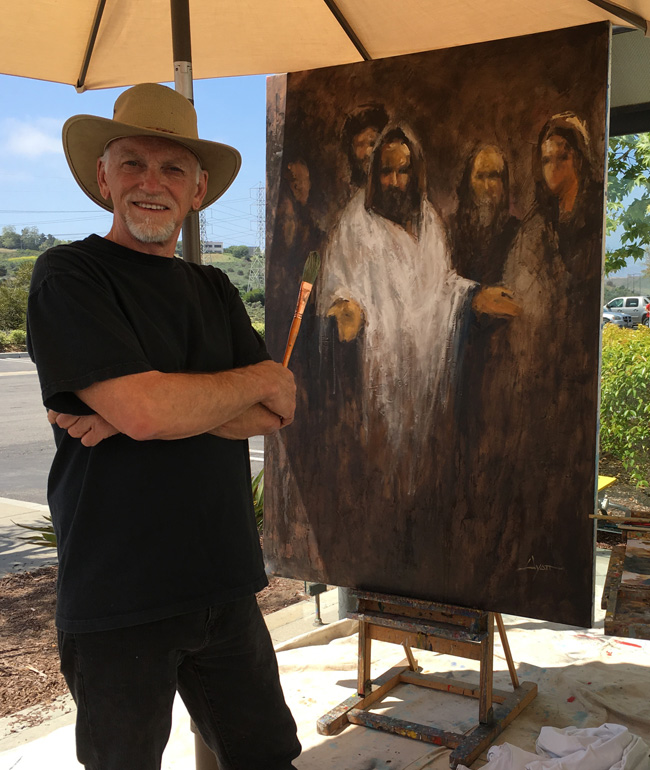
Intro: The painting you see is Hyatt Moore’s “Easter Night”

http://www.hyattmoore.com/blank-slate/

The scene depicted is the climax of John’s story
– namely, the experience of the living Jesus after his resurrection
• John wrote this book after years of reflection
◦ in fact, the other three gospels were already in circulation
• why did John add these particular events to the record?
◦ why did he feel compelled to tell the “Jesus story” his way?
– we do not have to guess, because he explains it to us
• we will come to that shortly


John sets the scene with “when” and “when”

When: evening of the day Jesus rose from the dead
When: the doors were bolted, because the disciples were afraid

Earlier that day, Mary Madalene had visited them twice
– the first, she brought the message that Jesus’ body was missing
• there is something lovely in the way she personalized her concern to the angels

To the disciples: “They have taken away the Lord out of the tomb, and we do not know where they have laid Him” (v. 2)
To the angels: “. . . they have taken away my Lord, and do not know where they have laid Him” (v. 13)

• in her mind, Jesus belonged to her
◦ she believed that his body was her responsibility
– in her second visit, she delivered the message Jesus had given her

Then that evening, Jesus himself came to them
– first word he spoke was Peace, and he spoke it into them (cf. Jn. 14:27; 16:33)
• then he held out his hands and pulled back his cloak
◦ to let them see his, still fresh, wounds
• that was their moment of recognition
– this was important to John; that they were able to ID Jesus
• in verse 14, when Mary first saw Jesus, she did not know it was Jesus
◦ when the disciples on the lake saw Jesus on the shore, they did not know it was Jesus (21:4)
• recognition came when he spoke
◦ when he said or did something characteristic of him (cf. Lk. 24:30-31)
◦ when Mary recognized him, she cried, “Teacher!” and on the lake, John said, “It is the Lord”

With recognition, came joy (which is no doubt an understatement)
– so Jesus again said, Peace be with you, perhaps this time to calm their excitement
• then he assigned them their mission:
◦ as he had been sent by the Father, they are now being sent by them
– this meeting was a stage in their final preparation
• he imparted his Spirit to them (cf. Jn. 14:17)
• he also indicated the gravity of their responsibility
◦ illustrated in proclaiming the forgiveness or retention of sin


But Thomas, one of the twelve, called Didymus, was not with them when Jesus came. So the other disciples were saying to him, “We have seen the Lord!” But he said to them, “Unless I see in His hands the imprint of the nails, and put my finger into the place of the nails, and put my hand into His side, I will not believe.” John 20:24-25

I’m thinking Thomas was upset because he missed out

Continue reading

March 9, 2017 – John 12:12-21

If We Don’t Look, We Won’t See

On the next day the large crowd who had come to the feast, when they heard that Jesus was coming to Jerusalem, took the branches of the palm trees and went out to meet Him, and began to shout, “Hosanna! Blessed is He who comes in the name of the Lord, even the King of Israel.”
Jesus, finding a young donkey, sat on it; as it is written, “Fear not, daughter of Zion; behold, your King is coming, seated on a donkey’s colt.” These things His disciples did not understand at the first; but when Jesus was glorified, then they remembered that these things were written of Him, and that they had done these things to Him.
So the people who were with Him when He called Lazarus out of the tomb and raised him from the dead, continued to testify about Him. For this reason also the people went and met Him, because they heard he had performed this sign. So the Pharisees said to one another, “You see that you are not doing any good; look, the world has gone after Him.” Now there were some Greeks among those who were going up to worship at the feast; these then came to Philip, who was from Bethsaida of Galilee, and began to ask him, saying, “Sir, we wish to see Jesus.”
 John 12:12-21

Intro: Before we settle in, and listen to the Palm Sunday story,

We remember other Christians in other churches around the world
– they are also observing Palm Sunday today
• earlier this morning in two of those churches terrorist bombs took 37 lives
• ISIS has taken credit for the attacks on two Christian churches in Egypt
– this juxtaposition of celebration and death is disturbing
• I wonder, is it alright for us to stick to the program and keep our tradition?
• or should we cancel Palm Sunday this year in honor of those whose died?

In John’s report of this event–much more so than others–
– we see a confusion of competing and conflicting forces
• the crowds finally allowed to openly cheer for him
◦ adding to the electricity in the air, are the testimonies of Lazarus resurrection
• at same time, the Pharisees are furious
◦ they met to plot not only Jesus’ death, but the death of Lazarus too
– besides those crisscrossing issues, we learn of the inner turmoil of Jesus
• this is the biggest event of Jesus’ life (bigger than his birth or baptism)
◦ from chapter 2 on, he has predicted his “hour” that had not yet arrived
◦ now, on this day he says, “The hour has come” (v. 23)
• surprisingly, however, he is not overjoyed

Now My soul has become troubled and what shall I say, “Father, save Me from this hour”? But for this purpose I came to this hour.”  (Jn. 12:27)

◦ a week later he will be tortured and crucified
◦ those things are included in his hour

So, it is not incongruous for the shadow of death to fall across Palm Sunday
– this is, in fact, at the heart of the tradition
– Jesus’ triumphal entry is the prelude to his crucifixion


From this chaos of personal agendas and motivations, a request

John introduces the request in his own distinct way
– the Pharisees had just said, “look, the whole world has gone after Him”
• then, immediately following their statement, John says,
“Now there were some Greeks among those who were going up to worship at the feast”
• these were most likely converts to Judaism or else curious tourists
– they came to Philip–the one disciple with a Greek name
• “Sir,” they said, “we wish to see Jesus”
• that is, to meet him and talk with him

This same wish has been the dominant theme of my entire Christian life
– in the 1970’s, I began reading books on human consciousness
• what is consciousness? how is it related to functions of the brain?
• I wanted to make sense of statements like Practice Presence of God
◦ is awareness of God’s immediate presence an innate but atrophied human ability?
◦ is it something we can develop or is the experience always pure grace?
– for twenty years my chief prayer for myself was to be given prophetic vision
• then, in 2004, I felt a strong impression that God told me,
“I am birthing something new in you”
• I literally crossed “prophetic vision” off my prayer list
◦ at the same time, I began to see Jesus
◦ not in visions, like I had wanted–it was something different


A few years ago, I spent a month in hermitage

It was one of the best things I ever did for my soul
– I prayed while walking through forests
• alone on a stretch of beach, I meditated on scripture
• I saw two dear one morning before dawn on my way to vigils
◦ and I watched sun set over the edge of the ocean each evening before vespers
– the whole time I was zealously praying, “Show me your glory”
• one morning, reading Psalms with the monks, it hit me
• I had been seeing God’s glory every minute of every day

So now I have to ask myself, “Do I make the most of vision I have?”
– do I look for beauty? Continue reading