“Please Stay”
They said to one another, “Were not our hearts burning within us while He was speaking to us on the road, while He was explaining the Scriptures to us?” Luke 24:32
Intro: Finally, we have our painting
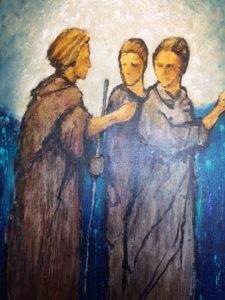
It is not my place to name another person’s artwork–however . . .
– Hyatt pointed out for me some interesting details in how this came out
• for example, the motion that moves across the canvas as we follow the raised arms
– the two disciples are saying, “Please Stay”
• and that would be my choice for the title of this piece
When the five or six of us here decided to meet formally,
– I began to formulate a vision for Reflexion
• my intent was to define our community and give it direction
◦ but I got a very strong impression that was not what God wanted
◦ instead, we were to let his Spirit do as he wished and then see what shape it took
• in our first meeting, all I could say for sure was what we weren’t
◦ e.g., a “church”
– if we were to illustrate what Reflexion is with a story
• it would be the narrative of these three figures and their interaction
◦ we are the two characters standing side-by-side
◦ we are traveling–each of us for our own reasons–, but together
• and Jesus is traveling with us
◦ we are a spiritual community sharing a spiritual journey
◦ this is Reflexion
The story behind the painting
Sometime in the afternoon, on the day of Jesus’ resurrection, two of his followers left Jerusalem on a seven mile walk for a village named Emmaus. This is how Jesus had sent his followers out on an earlier mission–by twos. Since early morning rumors had been flying about how the Lord’s body had gone missing overnight and that a small group of his female followers had seen a vision of angels announcing that he had risen from the dead. To the and realistic, hard-headed apostles, this sounded like nonsense and they refused to buy it.
The two disciples on their way to Emmaus were talking about the events of the previous four or five days. That they were discussing those things, indicates they were searching together for answers. Of course, there is no way for us to know the specifics of their dialogue, but something that never entered the conversation was how all those things were a wonderful fulfillment of scripture or how so many of the ancient prophecies now made sense. It is more likely that remembering the details stabbed them with bitter grief. However, they could not hold those things in silence, but had to talk their confusion out loud.
As they went on, a stranger approached them, either crossing paths from a side road or by catching up to them. Matching his pace to theirs, he walked with them and soon he inserted himself into their conversation. Perhaps responding to their serious expressions and the dark tone of their words, he spoke as if curious regarding the subject of their discussion. They reacted as though he had exposed their bleeding hearts and for a moment the three of them stood still, frozen in silence. Clearing the lump in his throat, one of them asked the intrusive stranger, “Are you the only visitor to Jerusalem who does not know what’s happened these last few days?”
He responded, somewhat naively, “What happened?”
“What happened, was that Jesus of Nazareth had come to the holy city. If you haven’t heard, he was a prophet who, when he spoke his words were power and when the sick were brought to him, he worked miracles. But our priests and leaders turned on him, condemned him and handed him over to the Romans who crucified. And we had been hoping that he was the One, the Messiah and Redeemer of Israel.”
“The whole thing was over quickly. His body had been laid to rest and the dust was beginning to settle. Then, this morning, some women from our group went to the tomb, found it open but did not find his remains. They reported to the apostles as story of seeing angels, but it made no sense.”
With sudden assertiveness, the stranger took the two disciples to task, “How foolish you’ve been! So slow to catch on and trust what is right in front of you. Can’t you see that everything you have described is exactly what was written by the prophets? Was it not necessary for the Messiah to suffer the rejection, the abuse, the cross and then to enter his glory?”
Then, for the remainder of their walk to Emmaus, he walked them through the Scriptures from the early period of Moses right through to the last prophet, pointing out passages that spoke of these events in which predictions and promises had been fulfilled. The disciples were making two journeys with Jesus; the ordinary walk down a dirt road and an extraordinary walk through biblical history.
Not far from the city gates of Emmaus, Jesus stopped to conclude his speech, wish them well and made as if he intended to continue on his way. But the other two begged him, “Stay with us.” So he did, right up to the moment when they sat to share a meal. Then something in the way he took took the bread and blessed it, and broke it opened their eyes. And he was gone.
How does this serve as illustration of Reflexion? Continue reading