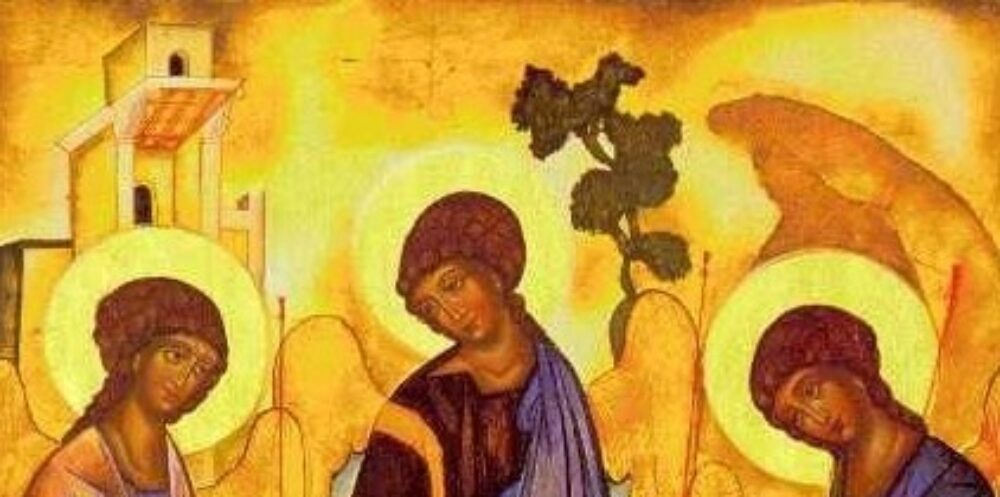
Abram the Blessed 04/26/2026

Genesis 12:1-9 (Robert Altar's translation)
And the LORD said to Abram, “Go forth from your land and your birthplace and your father’s house to the land I will show you. And I will make you a great nation and I will bless you and make your name great, and you shall be a blessing. And I will bless those who bless you, and those who damn you I will curse, and all the clans of the earth through you shall be blessed.” 
And Abram went forth as the LORD had spoken to him and Lot went forth with him, Abram being seventy-five years old when he left Haran. 
And Abram took Sarai his wife and Lot his nephew and all the goods they had gotten and the folk they had bought in Haran, and they set out on the way to the land of Canaan, and they came to the land of Canaan. And Abram crossed through the land to the site of Shechem, to the Terebinth of Moreh. The Canaanite was then in the land. 
And the LORD appeared to Abram and said, “To your seed I will give this land.” And he built an altar there to the LORD who had appeared to him. And he pulled up his stakes from there for the high country east of Bethel and pitched his tent with Bethel to the west and Ai to the east, and he built there an altar to the LORD, and he invoked the name of the LORD. 
And Abram journeyed onward by stages to the Negeb

Morning Talk: chuck smith, jr.

Intro: Prior to this moment, Abram was merely a name on a list

Now he becomes a person; he’s given an identity
- he emerges from the genealogy into space and time
• he has a history and he is given a destiny
where he is from and where he is going is what has defined him
◦ where he is from: “your birthplace and your father’s house”
◦ where he is going: “to the land that I will show you”
• God is in the process of redefining Abram’s life
◦ he will no longer be the person shaped by family history
◦ he will become a person living in a covenant with God
- normal course of a person’s life: grow up in family system
• each person has there place and is assigned a role
◦ this does not happen consciously,
◦ it works itself out in interplay of each personality
• psychology would encourage us to ask two questions:
◦ how did I get were I am?
◦ where do I go from here?
▫ and this may require that we escape from our family system
▫ or the neighborhood where we grew up
			
But let’s move on with Abram

God tells Abram he is destined to be the epicenter of his will
- that his life, through his descendants,
• will move outward in ever-widening circles, until,
“all the clans of the earth through you shall be blessed”
• but this will not happen if he stays in his family’s settlement
◦ he and his wife are going to be traveling, and
◦ for the rest of their lives, they will live among strangers
- so we join them on their journey westward
• when they reach Canaan, God appeared again to Abram
◦ we can learn a lot from these two verses, 7 and 8
• God speaks to Abram, and in response, he builds an altar
◦ then Abram wants to call on God, so builds another altar
◦ the altar it is central to Abram’s contact with God

Growing up in a conservative Christian home,
- my siblings and I learned that the circumference of our home,
• revolved around the “family altar”
◦ that prayer is what held us together – and to the Lord
• our regular practice was to go there together
◦ and especially when facing challenges–an illness or a move
- Abram going to the altar was his response to God’s initiative
• but he also could take the initiative to approach God
• I don’t think prayer was ever meant to be a monologue,
◦ with us doing all the talking
◦ a lot of our spiritual development is focused on learning to listen and to hear

The last line in which we’re introduced to Abram reads:
“And Abram journeyed onward by stages to the Negeb”

The Negev is the desert south of Canaan, stretches all the way to Egypt
	- the first point I want to stress is his entire life was a journey
		• years ago, I spoke at a family retreat in Western Australia
			◦ a couple told me how grateful they were to be learning Bible
			◦ “We thought we had grown in the Lord as far as we could”
		• No! We haven’t arrived–we never arrive in this lifetime
			◦ the writer of Hebrews describes Abram’s life this way:
“By faith Abraham obeyed when he was called to go out to a place that he was going to receive as an inheritance. And he went out not knowing where he was going. By faith he went to live in the land of promise, as in a foreign land, living in tents . . . .” (Heb. 11:8-9)
	- Abram could only journey “by stages,”
			traveling with extended family and servants,
				and herding and pasturing livestock
		• that is another lesson we learn about our spiritual journey
			◦ the progress we hope to make does not come all at once

I realized something for the first time just a couple weeks ago
- reading through the Book of Acts, I kept coming to the familiar phrase where someone was, “filled with the Holy Spirit”
My meditation: “I have assumed I knew what it meant to be filled with the Spirit–and now it seems I was partially correct. I have conceptualized it as a static condition, that once a person was filled with the Spirit, they remained filled. We used to refer to some people as being ‘Spirit-filled.’ But now it is becoming apparent to me that people, like the apostle Peter, were filled with the Spirit multiple times on different occasions.
What is it to fill a glass with water? Similarly, with each ‘filling,’ the Spirit is ‘poured’ into someone in that moment and for that moment. Then somehow an energy or power flows out of them. This reminds me of what happened with Jesus in Luke chapter 8,
‘And Jesus said, “Who was it that touched me?” When all denied it, Peter said, “Master, the crowds surround you and are pressing in on you!” But Jesus said, “Someone touched me, for I perceive that power has gone out from me”’ (Lk. 8:45-46)
Now I remember reading something Francis Schaeffer wrote: ‘Though we today are immediately indwelt by the Holy Spirit when we accept Christ as Savior, being indwelt is not the same thing as having the fullness of the power of the Holy Spirit. . . . There are to be many “fillings.”’”
• I don’t often talk like this any more
◦ partly because it verges on sounding like “working magic”
◦ and partly because of the weirdos who always talk this way
• but still, the life we have in God is mediated by his Spirit
- how are we to make sense of this? 
• how does it become real to us?
• St. Paul’s answer would be, “we walk by faith not by sight”
◦ no one really likes this answer,
◦ but once we begin to trust God for his Spirit, we emerge into a new knowing and experiencing

I skipped a part of Abram’s story

But now I want to work my way back to it
- in my late twenties, a cousin recommended a book:
• Seasons of Man’s Life
◦ a longitudinal study that tracked stages of male development
◦ not unlike Gail Sheey’s Passages
• lots of young men stress over turning thirty
- I think, perhaps, God was preparing me for that transition
• as I read through the Scriptures, I kept bumping into thirty
◦ Joseph’s age when he entered the service of Pharaoh 
◦ the age at which priests could serve in temple
◦ David’s age when he became king
◦ and “Jesus, when he began his ministry was about thirty years of age” 
• I began looking forward to turning thirty
◦ I felt it could be a positive turning point in my ministry
◦ perhaps becoming more effective, more skilled

If I continue living to the half-way point of this year,
- I will turn seventy-five years old
• if you had asked me at thirty where I’d be at seventy-five,
◦ I’d probably say, “I hope to be dead by then”
◦ or else retired
• I don’t mind confessing, that if for my next birthday,
◦ God told me, 
“My biggest plans for your life’s work will begin this year,”
◦ I would feel completely discouraged and overwhelmed
- but we read, “Abram went forth . . . being seventy-five years old when he left Haran”
• I began meditating on this January 3rd,
◦ the same day my oldest son turned fifty
• and now I’m going to burden you with the possibility,
◦ that God may be telling you,
“You have not yet hit your stride. Your best and most important life’s work is still ahead of you.”

All I will add to that is:
- don’t let the world tell you, “You’re too old”
• or too poor, too uneducated, too unqualified
• if God is calling you to something, 
◦ you aren’t too anything that would disqualify you

Conclusion: God’s call on Abram’s life was to be a blessing

A blessing that spread out to “all the clans of the earth”
Can you imagine anything lovelier than that?
You and I and all Christians everywhere, being a blessing to the world

Jesus and Peter 04/19/2026

Podcast

Intro: So that you can see where I’m going with this talk, I’ll start with a question:

What was the primary responsibility Jesus gave to Peter?
– if you’re not sure, then listen to what I’m about to read,
• because Jesus makes Peter’s assignment absolutely clear

When they had finished breakfast, Jesus said to Simon Peter, “Simon, son of John, do you love me more than these?” He said to him, “Yes, Lord; you know that I love you.” He said to him, “Feed my lambs.” He said to him a second time, “Simon, son of John, do you love me?” He said to him, “Yes, Lord; you know that I love you.” He said to him, “Tend my sheep.” He said to him the third time, “Simon, son of John, do you love me?” Peter was grieved because he said to him the third time, “Do you love me?” and he said to him, “Lord, you know everything; you know that I love you.” Jesus said to him, “Feed my sheep” John 21:15–17

◦ Peter’s calling was to devote himself to the care of Jesus’ sheep
• these are not Peter’s sheep – Jesus refers to them as, “my sheep”
◦ the Lord did not tell Peter to use the sheep to make a fortune for himself
◦ in fact, from now on, his life wasn’t his own, and it would not be easy or what he would choose for himself
“Truly, truly, I say to you, when you were young, you used to dress yourself ad walk wherever you wanted, but when you are old, you will stretch out your hands, and another will dress you and carry you where you do not want to go. . . .” “Follow me.” (v. 19)
– giving Peter this responsibility, Jesus answers his own prayer in Matthew:
“When he saw the crowds, he had compassion for them, because they were harassed and helpless, like sheep without a shepherd. Then he said to his disciples, ‘The harvest is plentiful, but the laborers are few; therefore pray earnestly to the Lord of the harvest to send out laborers into his harvest.’” (Mt. 9:36-38)
• a long time ago, I heard someone say,
“It must be nice being a preacher; you only have to work one day a week”
◦ when Paul felt some members of the Corinthian church had turned on him,
▫ he described all of the hardships he endured for them and the other churches in his care
◦ most of it what he suffered was far more extreme than most pastors ever experience,
▫ but when he comes to the end of his list he adds,
“And apart from other things, there is the daily pressure on me of my anxiety for all the churches” (2 Cor. 11:28)
I believe the “pressure” of human need–physical, mental, and spiritual–is something all true pastors experience
• that may not be the case for many mega-church pastors
◦ I’m pretty sure that those posts are handled best by narcissists
(you simply cannot have empathy for, or carry all the burdens of 500, 1,000, 5,000 members)
◦ there are many good people exhausting themselves for much smaller Christian communities

The shepherd care-giver is one of the warmest images in scripture
– this was not a typical opinion in the ancient Mideast
• shepherding was a chore for children and slaves
◦ adult shepherds were largely looked down upon
Bruce Malina, “Although shepherds could be romanticized . . . , they were usually ranked with . . . despised occupations. Being away from home at night they were unable to protect their women and therefore were considered dishonorable. In addition, they often were considered thieves because they grazed their flocks on other people’s property.”
◦ in scripture, “shepherd” it is the chief metaphor for leadership
• more than one prophet use this metaphor to rip into Israel’s leaders
“‘Woe to the shepherds who destroy and scatter the sheep of my pasture!’” declares the LORD” (Jer. 23:1)
“Thus says the Lord GOD: Ah, shepherds of Israel who have been feeding yourselves! Should not shepherds feed the sheep? The weak you have not strengthened, the sick you have not healed, the injured you have not bound up, the strayed you have not brought back, the lost you have not sought, and with force and harshness you have ruled them. So they were scattered, because there was no shepherd . . . .” (Eze. 34:2-5)
◦ these were both religious and civil leaders
– there are many angry men with women behind pulpits today
• red-face, veins in their neck popping out, shouting at the sheep
◦ it’s like they’re trying to soothe their own inner turmoil by screaming at their kids
• others are almost too calm, hiding their rage, and smiling as they strike

Perhaps the worst shepherds serve to highlight the best

One of God’s promises to Israel was,
“And I will give you shepherds after my own heart, who will feed you with knowledge and understanding” (Jer. 3:15)
– in a beautifully poetic promise in Ezekiel, God says,
“I myself will search for my sheep and will seek them out” and then describes how he will rescue them, provide pasture for them, and protect them so that they “shall lie down in good grazing land, and on rich pasture they shall feed on the mountains of Israel” (Eze. 34:11-16)
• this kind of care is what stirs tender feelings toward shepherd
• like in Jesus’ parable of the shepherd searching for a lost sheep
◦ the he adds a detail that creates a sense of affection: “carrying it on his shoulders”
– of course, the classic expression of the shepherd metaphor is Psalm 23
• this is precisely the role in which Jesus places himself
“I am the good shepherd. I know my own and my own know me” (Jn. 10:14)
◦ and it is the job description that he passes on to Peter
• however, prior to Jesus, there was another stellar prototype

The Bible’s introduction of David into its history is symbolic

It reveals something about David, with something something about God’s call on his life
“There remains yet the youngest, but behold, he is keeping the sheep” (1 Sam. 16:11)
– when Israel came to David to embrace him as their king, their representatives announced,
“. . . it was you who led out and brought in Israel. And the LORD said to you, ‘You shall be shepherd of my people Israel . . .” (2 Sam. 5:2)
◦ later, God sent a prophet to David with this message
“I took you from the pasture, from following the sheep, that you should be prince over my people Israel” (2 Sam. 7:8)
◦ this is remembered and celebrated in Psalm 78
“He chose David his servant
and took him from the sheepfolds;
from following the nursing ewes he brought him
to shepherd Jacob his people, Israel his inheritance.
With upright heart he shepherded them
and guided them with his skillful hand” (vv. 70-72)
– it is one of the sad traits of our human nature,
that we easily adjust to any increase of wealth and influence
• upward mobility changes people
◦ they become accustomed to luxuries, they assume they need first-class products and accessories
• this dark cloud passed over David’s life, and it brought tragedy with it

Nearing the end of his life, David hardly resembles the young shepherd with his father’s flock in hills around Bethlehem
– I think David lost sight of this shepherd aspect of leadership
• he developed an expectation to be served rather than to serve
• not long before is death, he got it into his head to do something very wrong
◦ his general, Joab, strongly opposed his decision
◦ but King David stubbornly stuck to his plan and gave the order
– afterward, it was not only David that suffered, but the nation
• when he saw the harm he had caused, it broke him
◦ he cried out to God in confession, “I have sinned greatly”
“And David said to God, ‘Was it not I who gave the command to number the people? It is I who have sinned and done great evil. But these sheep, what have they done?” (1 Chr. 21:17)
• how I understand this, is that David had lost sight of this facet of his rule;
◦ that is, until he witnessed the suffering it caused his people
◦ that’s when it came back to him; that he was a shepherd and the people were not his subjects, but God’s sheep

All of what I’ve said, was my meditation yesterday morning

And it got me thinking about you
– each week I have a task to perform, and that is to bring a message from scripture to you
• my typical approach is to decide what I think you need to hear
◦ so it’s more about what I assume is best for us, than it is about what you may actually need
• I want to be a better shepherd than that
◦ what difference does it make how much you know, if it’s not relevant to what you need
– some of us are passing through very difficult times
• what does God have for us, to get across this bridge?
• pray for me, that I do a better job of responding to your needs

Conclusion: There’s one more thing I want to draw from John
Peter turned and saw the disciple whom Jesus loved following them . . . . When Peter saw him, he said to Jesus, “Lord, what about this man?” Jesus said to him, “If it is my will that he remain until I come, what is that to you? You follow me” John 21:20-22

“What is that to you?” – a great line!
You have your instruction, “Follow me”
we get stressed over what others do or say, and Jesus tells us,
“Stay in your own lane. You have your assignment – they have theirs”
We know people who must have an opinion about everything
But I find relief when Jesus says, “What is that to you?”
It removes excess pressure from my mind and body
We don’t need to babysit or police everyone else
It’s a waste of energy trying to correct everyone;
especially those who don’t want correction

When you get all worked up over something this week,
see if it will help if you can hear Jesus say,
“What is that to you? You follow Me”

O Breath of God 04/12/2026

Podcast

Welcome and Prayer: Jim Calhoun

Come Lord, join us here today

It is so difficult
To understand
To make sense of
To make real
That we share
Your resurrection
In some meaningful
And tangible way
In our lives.

Fill our hearts and minds
Teaching us what is life giving
And what is soul destroying
Clarifying
In real time
How to love others
While loving ourselves
So all who are loved by you
Are also loved by us

But this life
of resurrection and
Restoration
doesn’t come all at once
Only bit by bit
Over lifetimes
So grant us forgiveness
For ourselves and each other
Because we will need it
To give space and try again
And try again
And try again
Learning the way

And grant us courage
And hope
And perseverance
To keep at it
To stay the path
Being born
And born again
And raised from the dead
And let transformation,
Your victory over
Sin and death,
Do it’s work
In each of us
Amen

Morning Talk: chuck smith, jr.

“If you love me, you will keep my commandments. And I will ask the Father, and he will give you another Helper, to be with you forever, even the Spirit of truth, whom the world cannot receive, because it neither sees him nor knows him. You know him, for he dwells with you and will be in you. I will not leave you as orphans; I will come to you. Whoever has my commandments and keeps them, he it is who loves me. And he who loves me will be loved by my Father, and I will love him and manifest myself to him.” John 14:15-19, 21

Intro: I am going to take a risk this morning

Aside from whatever ways I’m supposed to help others,
– my own life in God has been driven by one passion
• that is, to experience everything Jesus promised his disciples
• my primary rationale is to take Jesus at his word
◦ to be more specific:
– what is on the table for me is not that I work miracles
• at least, not extraordinary miracles, I’m okay with ordinary miracles
◦ like bringing a smile to a baby’s face
• I know I’m not called to “signs and wonders”
◦ what I’ve longed for is personal, and has been my longing from childhood

In the scripture I read, Jesus is telling his disciples goodbye

In this entire section of John, from chapter 13 through 16, Jesus is downloading his final revelations and instructions
– the way John introduces these chapters says it all:
“. . . when Jesus knew that his hour had come to depart out of this world to the Father, having loved his own who were in the world, he loved them to the end” (Jn. 13:1)
• to the disciples, this message was confusing and disturbing
◦ that’s why, when we come to ch. 14 he needs to tell them,
“Let not your hearts be troubled” (Jn. 14:1)
• I think the disciples’ reaction is predictable,
“How can you expect our hearts to not be troubled? You’re going, we don’t know where, and you say we cannot go with you. But our whole lives depend on you!”
◦ Thomas and Philip ask nervous, desperate questions
– Jesus gives them reassurance that they’ll be okay
• they now know God for themselves, because they’ve seen and encountered God in Jesus
• so now he begins to unlock their future
◦ he makes a few conditional statements – “if-then”
“If you love me, you will keep my commandments”

It’s critical that we remember his commandments

They all stem from one core commandment in the previous chapter
“A new commandment I give to you, that you love one another just as I have loved you, you also are to love one another” (Jn. 13:34)
– this is the most important requirement for being a disciple
• if we’re going to move forward and further with Jesus,
◦ love must be the underlying dynamic and motive
• otherwise, the human ego gets in the way and ruins everything
– then what? What door is opened for us if we love others?
“And I will ask the Father, and he will give you another Helper, to be with you forever, even the Spirit of truth . . .”
• there are two points I want to make here:
First, “Helper” is a weak word when referring to the Holy Spirit
◦ other possible translations include:
“Advocate” – is the role an attorney plays in assisting in court
“Counselor” and “Comforter”
◦ besides the role Jesus describes, the Spirit will also empower the followers of Jesus
Second, the word “another” – two Greek words could be used for another:
heteros means “another of a different kind”
allos means “another of the same kind” — this is the word used here
◦ the Spirit is another Counselor of the same kind as Jesus
Pentecostal and Charismatic Christians have sometimes made the Spirit seem scary; e.g., the “Holy Ghost”
– but as Jesus was with the disciples, so is God’s Spirit is with us
• there is one Spirit of God, who is also the Spirit of Jesus

I need to explain that I’m not trying to do theology right now

I’m hoping to show you that we can have a deeper, stronger connection with God than what most Christians experience
– Jesus is telling his disciples that he’s going away;
• and he did go away, BUT he did not leave them “as orphans”
• we were never meant to live at a distance from God
◦ never meant to lose touch, to not feel his presence, or hear his voice
– Jesus began speaking very directly to me when I was 18
• I did not hear a voice, but in my mind I heard thoughts that were not my own
• at that time, the Lord was preparing me for, and steering me toward ministry

That went on for a couple of years
– it wasn’t something I experienced every day,
• but occurred at critical moments of transition
• and then it stopped
– the Lord continued to work on me, guide me, teach me,
• but not with the same direct and forceful impression
◦ I think there was a lot I needed to learn–and to unlearn
◦ so I became a student, a disciple – and that went on for years
• then, in my late twenties, I wanted to hear Jesus again like I had before
◦ the path I took was to study whatever I could to understand how God speaks to his people

Of course, most of my research was biblical
– but I also wanted to understand the nature of our human consciousness
• my question was: Have we been given a mental capability to tune into God’s voice?
◦ and if so, is it possible to strengthen and increase this ability?
• around that time cognitive science became very big
◦ partly because of the rapid growth of computer technology
◦ we had new tools for understanding how the brain organizes and processes information
• soon after the cognitive sciences expanded, neuroscience began to make rapid process
◦ that was also advanced by new brain-imaging technology,
◦ and new surgical devices for working with a live brain
– most scientists in these fields are not interested in religion
• but some are, and some of those participate in an important institution
◦ The Center for Theology and the Natural Sciences
◦ they have published papers from a conference in 1998, Neuroscience and the Person
• one chapter was written by biochemist, Arthur Peacocke
◦ he titled his paper, “The Sound of Sheer Silence” – referring to when God spoke to Elijah on Mount Horeb
◦ Peacocke asks questions about receiving messages directly into the brain and not through the five senses
– in his paper he asks exactly the same question I had been asking (but not as intelligently)
Peacocke, “In such instances, is it necessary to postulate some action of God whereby there is a direct communication from God to the human consciousness that is not mediated by any known natural means, that is, by any of the constituents of the world. Is there, as it were, a distinctive layer or level within the totality of human personhood that has a unique way of coming into direct contact with God?”

Eventually, I realized, even if I had answers to such questions, they wouldn’t help me at all
– the only way to develop a greater receptivity to God’s Spirit would be through practice
• the spiritual discipline of listening
• this is the essence of contemplative prayer

Listen again to Jesus’ promise:
“Whoever has my commandments and keeps them, [they are those who love] me. And [those who love] me will beloved by my Father, and I will love [them] and manifest myself to [them]”

Here are some of my recommendations for improving our reception of the Spirit’s communication:
Flood your mind with Jesus — do this and he will become more real to you
– read and reread the gospels – choose a favorite and return to it frequently
• take specific scenes and find yourself in them

In quietness, relax your body, surrendering yourself to Jesus
• you don’t have to try to feel anything other than to sense his nearness
• whisper his name and fall into his presence
– you’ll see that you control your thoughts, they won’t control you

The Spirit is a bridge – our connection with God is Spirit to spirit
“The Spirit himself bears witness with our spirit that we are children of God” (Ro. 8:16)
– remind yourself that the Spirit surrounds you, and quietly say “You”
• he’s the only one there, and that will help you realize he’s there and he hears you
• allow yourself to sense him here and now

Conclusion: If you’ve ever rappelled, you know,

when you stand at the edge of the cliff preparing to descend, you must lean back
At first, it feels wrong – until you do it – and then it feels right
Because now you feel secure, steady, and in control
Your weight isn’t working against you, but for you,
holding you snug against the cliff

Practice leaning back into God’s Spirit
One day you will certainly wake up to him
You’ll know this is right, that he is with you,
because you will be at peace

Announcement for April

Reflexion will not be meeting in person April 19 and April 26.

We are very fortunate to be able to meet most Sundays in the beautiful La Ventura Event Center in San Clemente. On occasion the facility has a previously scheduled event for a Sunday morning, and when that happens, we get the morning off.

Chuck will still give a talk those mornings, which can be watched here (note the button in the sidebar) or on our Facebook page: “Reflexion, a spiritual community.”

Meanwhile, “Give thanks in all circumstances; for this is the will of God in Christ Jesus for you” (1 Thessalonians 5:18)

Easter 04/05/2026

Podcast

Welcome and Prayer: Jim Calhoun

Come Lord, join us here today
The not so well to do,
Have reason enough to smile today
So do the needy,
And the broken.
Those who are sick
And beat down
Those disappointed
Those left longing and disappointed
The resentful
The worried and
those filled with fury
All of us.
All of us knowing
The stone was rolled away
That death isn’t the final word
That the frailties in ourselves
And in all we know
And that long and painful tail
of consequences
And hurts
Are not the final word
That life begins its fullness
As we die a little
And you make us new.

So, Yes Lord
Yes. Yes.
A thousand times yes
Roll away the stone
Bring us into life with you
Make us whole
Make us new
and we will sing
And shout
And have reason enough to smile
Thank you Lord
Thank you
Amen

Morning Talk: chuck smith, jr.

That very day two of them were going to a village named Emmaus, about seven miles from Jerusalem, and they were talking with each other about all these things that had happened. While they were talking and discussing together, Jesus himself drew near and went with them. But their eyes were kept from recognizing him. And he said to them, “What is this conversation that you are holding with each other as you walk?” And they stood still, looking sad. Then one of them, named Cleopas, answered him, “Are you the only visitor to Jerusalem who does not know the things that have happened there in these days?” And he said to them, “What things?” And they said to him, “Concerning Jesus of Nazareth, a man who was a prophet mighty in deed and word before God and all the people, and how our chief priests and rulers delivered him up to be condemned to death, and crucified him. But we had hoped that he was the one to redeem Israel. Yes, and besides all this, it is now the third day since these things happened. Moreover, some women of our company amazed us. They were at the tomb early in the morning, and when they did not find his body, they came back saying that they had even seen a vision of angels, who said that he was alive. Some of those who were with us went to the tomb and found it just as the women had said, but him they did not see.” And he said to them, “O foolish ones, and slow of heart to believe all that the prophets have spoken! Was it not necessary that the Christ should suffer these things and enter into his glory?” And beginning with Moses and all the Prophets, he interpreted to them in all the Scriptures the things concerning himself.
So they drew near to the village to which they were going. He acted as if he were going farther, but they urged him strongly, saying, “Stay with us, for it is toward evening and the day is now far spent.” So he went in to stay with them. When he was at table with them, he took the bread and blessed and broke it and gave it to them. And their eyes were opened, and they recognized him. And he vanished from their sight. They said to each other, “Did not our hearts burn within us while he talked to us on the road, while he opened to us the Scriptures?”
Luke 24:13-32

Intro: Every week I spend two days in Scotty’s home

I’ve been doing this for years–making meals for my grandchildren:
– one breakfast for Calum (and afternoon snacks), one lunch for Adrianna, and three dinners
• I’m still taking two of them to and from school
• in the lull, while they’re at school, I’ve been taking walks around the undeveloped land near their neighborhood
◦ it’s been a good time to practice focusing my awareness on the presence of God’s Spirit
◦ maybe three months ago, I began sharing moments of my walk on Facebook
– from the very first book of the Bible, walking is used as metaphor
• it usually refers to the way we live out our days with God in closeness to him
• however, in this Easter story, these two disciples (whom otherwise we do not know),
◦ find themselves actually walking with Jesus for real!
◦ what Jesus shares with them turns their lives around, literally
“And they rose that same hour and returned to Jerusalem” (v. 33)

This story informs me of what God has in mind for us in our Reflexion community
first, we are all on a spiritual journey
• we never stop and settle in – our lives are in constant flux
◦ we travel through verdant fields and pleasant streams
◦ but there are also desert wastelands and dark valleys
• all of it is for our instruction and training
◦ our faith is being toughened through hardship and trials
◦ the further we go, the more our trust and hope grow
secondly, we are making this journey together
• I may be more aware of this than others, but it’s true for all
• we are sharing our lives in God with each other
– then third, Jesus is with us all the way
• sometimes we need to remind each other of that truth

This Easter morning, I want to focus on verses 15 and 16
“Jesus himself drew near and went with them. But their eyes were kept from recognizing him.”

I’m sure they thought they knew Jesus–they were disciples of his after all
– turns out, volumes could be written about what they did not know
• so this walk became like all the other walks with Jesus prior to the cross and tomb
◦ with the Lord instructing them regarding himself and his life’s purpose,
◦ he gave them a general survey of the Hebrew Scriptures from Moses through the Prophets
• not recognizing Jesus is a common theme in resurrection stories
◦ Mary Magdalene in the garden, the eleven disciples in a locked room, and so on
– I’m not sure what we’re supposed to think of that
• he was still Jesus–scars and all, but somehow different
• maybe he appeared in a truer form of himself
◦ or maybe simply the shock of seeing him alive made them doubt their vision

This past Friday held a special surprise for me

I’ve enjoyed a friendship that began fifty years ago
– it’s been a while since we spent time together,
• but his wife told me he had been hospitalized with a serious illness,
◦ and I knew I had to see him
• we had developed a bond from many deep conversations
◦ we also experienced the miraculous healing of young girl
◦ what I did not expect, was the warmth of love I still felt for him
– these bonds we’ve formed with each other are very important
• I hope you understand that
• I don’t mean here on Sundays
◦ but in all the ways we meet and communicate with each other
• I would say that includes our extended community,
◦ that joins us each Sunday by way of the Internet

Walking the Easter road, we get to enjoy Jesus together
– all of us long for the same things:
• to be grounded in integrity and faithful devotion
• to avoid making serious mistakes that darken the soul
• to assist each other when life is overwhelming
• and to have an ever-increasing awareness of Jesus’ presence
– we are here for you – what does that mean?
• we don’t have a paid staff–pastors, counselors, or prayer team
◦ you are the team, each other’s partners in prayer, comfort, and motivation
• we’re like the musketeers, “All for one and one for all”
◦ we inspire each other – and bind each others’ wounds

So we journey together, and Jesus is with us

But like those two disciples, we don’t always recognize Jesus
– I’ve been exposed to many Christians who don’t expect Jesus to show up for them in their grief
• it’s as if they believe Jesus only appears for celebration
◦ that we’re supposed to go from victory to victory
• those are typically the people who are always telling us to “smile”
– in heartache and loss, one of the most common prayers is, “God, where are You?”
• like both Martha and Mary, who when their brother Lazarus died, each in turn said to Jesus,
“Lord, if you had been here my brother would not have died” (Jn. 11:21 & 32)
• sometimes people assume suffering and grief are punishments
◦ we forget that Isaiah described the Messiah as
“a man of sorrows and acquainted with grief” (Isa. 53:3)
◦ let that sink in: “acquainted with grief”
Jesus spent a lot of time with sorrow

Grief creates a unique quality of–intensity
– the pain of our loss is especially keen
• but so are the moments of consolation
,• I remember well. passing through my deepest sadness
◦ every time I sat in worship, I choked up
It was like I felt the full meaning of every word in every line of every song
◦ as I began to heal, I regretted knowing that once my heart mended and was whole again,
I would no longer feel the full impact of worship to that same depth
– in those most intense moments of sorrow, Jesus is here

Jesus is here, but we may not know it

And that is what I hope this story can do for us, that it will show us
– even when we don’t recognize Jesus, he is here and that it’s our job to help each other remember
• there is a great deal about God that we don’t understand
◦ and what we think we know, we know imperfectly
• there are other truths we know, but don’t realize we know them
◦ Jesus has to be with us to show us what is already ours
◦ he has to open our eyes

This is the most wonderful truth in this story

Our eyes can be opened – and that changes everything
– I am in this ongoing development of awareness
• I find it very difficult, because there is absolutely no curriculum
◦ it is experiential – but not tangible
◦ insight is increased – but not information
◦ much is given – but it cannot be measured
• we cannot think our way into the eye-opening moment
◦ it is like we are walking backwards into it
◦ Bible studies prepare us for it, but does not produce that awareness
(scripture is necessary–in fact all of it; v. 44,
but it still requires a mind-opening gift from Jesus to see; v. 45)
– as for these two disciples, when were their eyes opened?
• not on the road, even though as Jesus taught them, their hearts burned within them
◦ their eyes were not yet opened
◦ later on, when they met up with the eleven apostles,
“they told what happened on the road, and how he was known to them in the breaking of the bread” (v. 35)
• the Lord has given us rituals in which we pray with our bodies
◦ those are often the moments when our eyes are opened

Conclusion: Before Jesus began explaining to these two disciples,
the meaning of his death and resurrection, he said,
“O foolish ones, and slow of heart to believe all that the prophets have spoken!”
That was a spiritual diagnosis
Then he began to administer the cure
He does the same for me – for you – for all of his disciples
Keep in mind, the education Jesus gives is not theoretical
Everything is to be practical and experiential
What we learn in the Scriptures, we live in ritual, prayer, and contemplation

In one of the hospital visits I made early in my ministry, I met with and prayed for a young woman who had broken both legs in a hang-glider accident. Leaving, I got on an elevator on the fifth floor. Descending one floor the elevator stopped, the doors opened and a woman stepped in. She looked at the floor numbers on the panel and then asked me, “Do you know which floor the maternity ward is on?” I answered, “I’m sorry, this is my first time in this hospital, and I don’t know.” She said, “That’s okay. I have just now been with a friend who is close to death, and I wanted to look at new life before I left.”

She wasn’t interested in hearing a lecture or reading a pamphlet. What she wanted was to experience a fresh, new life. And we do not need another sermon on the nearby presence of Jesus; we need a living experience of his nearness. Are we ready to open our hearts in a daily pursuit of that?