April 17, 2011

And He said to them, “Where is your faith?” They were fearful and amazed, saying to one another, “Who then is this, that He commands even the winds and the water, and they obey Him?” Luke 8:25 (Read Lk. 8:22-39)

INTRO: How should we read the Bible?

The way we read a school text-book? A novel? A love-letter? A newspaper–reading the headlines and then jumping to our favorite section and skipping the rest?

There are lots of different ways to read scripture
– books like Job and Psalms were meant to be read as poetry
– other parts of the Bible were meant to be read as history, stories, letters, and so on
The best way to get at its message and meaning is to read scripture as it was meant to be read Continue reading →

Implications of Jesus’ Teaching In Luke 6

Although Jesus’ concerns were not political, there are always political consequences attached to beliefs that are strongly held and practiced–provided the beliefs are significant and life-changing. It is therefore necessary to look closely at the teaching of Jesus and ask how it could affect our participation in various social systems–e.g., political, corporate, and religious. It is a characteristic of social and economic systems to produce classes like those in verses 20-26; poor and rich, hungry and well-fed, ostracized and praised, etc.

Since this was not the theme of our Bible study, I thought it might be helpful to add a few thoughts for us to consider along these lines. I hope the following stimulates your own ideas and creativity. I have adapted these points from Helmut Thielicke’s, The Evangelical Faith, vol. 2.

  • All human systems, no matter how compassionate or well-intentioned, will be corrupted by humans. This fact alone should prevent us from becoming politically or religiously fanatic.
  • Programs that aim at changing a system or conditions within a system without changing the human heart are doomed. (Slave owners in the South found ways to continue to enslave African Americans after the Civil War without referring to it as slavery.) Greed and self-love can find ways to abuse others in any human system.
  • The essence of the gospel is that nothing can “separate us from the love of God, which is in Christ Jesus our Lord” (Ro. 8:38-39). This includes corrupt, human systems.
  • We cannot be complacent about the ways in which systems abuse people. Within the systems surrounding our lives, we will find unguarded places where we are free to make our own decisions and in some way counteract the dehumanizing effects of the system.
  • Some people are held more responsible than others for a system’s abuses–”there are levels of guilt. . . . Dependents and those on fixed incomes who are reduced to poverty are far less to blame than the powerful class of politicians and managers” (Thielicke).

Miscellaneous – Matthew 19 & 20

First Light

Some mornings, I get so enthused over what emerges from my meditation in scripture
that I feel a need to share it with someone else. I really should know better, because
what looks terribly interesting to me in the predawn stillness may appear silly or
uninteresting to others in the glaring light of day. Regardless, I am naive enough
to think you will find something worthwhile in this morning’s contemplation.

When those hired first came, they thought that they would receive more; but each of them also received a denarius. When they received it, they grumbled at the landowner, saying, “These last men have worked only one hour, and you have made them equal to us who have borne the burden and the scorching heat of the day. Matthew 20:9-12 (If you are not familiar with this passage or the story of the wealthy young landowner, you will want to read Matthew 19-20 to get the context of this parable.)

The physics of the kingdom of heaven: A person can be brought into a workplace on the lowest rung, work the least amount of time, do the least work, suffer the least, and receive the same award (wages earned) as those who were first and had worked long and grueling hours (thereby relativizing the status of “first place”). Strange physics, that one percent of the labor on a project can produce the same benefits to the laborer as twenty, fifty and one hundred percent of the labor did for the others (Mt. 20:1-9). Continue reading →
December 18, 2010

Do not be afraid; for behold, I bring you good news of great joy which will be for all the people; for today in the city of David there has been born for you a Savior, who is Christ the Lord. Luke 2:10-11 (read verses 1-20)

INTRO: Let me say this just once this year:

I do not like the direction that our culture herds us at Christmas time

For example, there is the television commercial that lists all the important things a husband should tell his wife
– then we’re told that the way to communicate these things is with a gift of diamonds
I not only resent being told how I am supposed to express myself (let alone the cost of diamonds), but also the idea that a thing given can substitute for the words we need to say to each other and the deeds we need to perform for each other
– I think that too frequently we are trying to buy with gifts the affection we are too lazy to earn through our undying devotion Continue reading →

Gray Day Meditation

Who is the wise man that may understand this? And who is he to whom the mouth of the LORD has spoken, that he may declare it? Jeremiah 9:12
When I saw her, I wondered greatly. And the angel said to me, “Why do you wonder? I will tell you the mystery of the woman . . .” Revelation 17:6-7

This is the way of prophecy; it ventures into the territory of imponderables and mysteries. It divulges a secret, yet even then the message or vision remains inscrutable until explained. Continue reading →

Here’s Something New

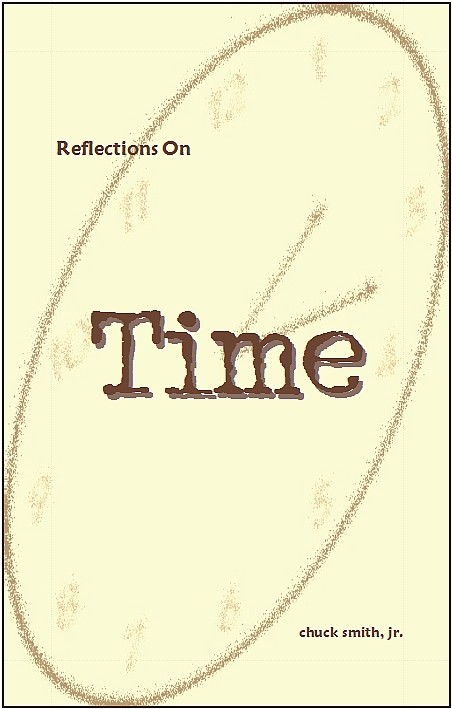
From the weekly Reflexions that I wrote for three years, here are several having to do with time, reprinted along with a couple of extra chapters not previously published.

You can find this at Lulu.com

http://www.lulu.com/product/paperback/reflections-on-time/11773905

And notice that you can download a less expensive version as a PDF file with no shipping costs!

You also have the option of writing a wonderful and glowing review of this book once you’ve read it.


Also, reprinted and published in a new binding (otherwise the same with the addition of three poems) is Reflections On Breath. Hopefully I will also finish Reflexions On Church within a couple more weeks and then on to the much larger and, I believe, really helpful books, Reflexions On Prayer.

http://www.lulu.com/product/paperback/reflections-on-breath/11771231

From My Private Vault

Don’t ask why, because I don’t know. But I decided to blog my meditation from this morning.

This year I am reading through the New Jerusalem Bible, so if the passages I quote sound strange to you, that is why. Also, I am reading three chapters from the Old Testament each morning and one from the New. That’s all the explaining I’m going to do. Anything else in the following meditation that doesn’t make sense to you will have to remain a mystery.


But who can detect his own failings?
Wash away my hidden faults.

Psalm 19:12 Continue reading →

Deep As A Well

Reflexion is polyvocal, which means that our message is told and our prayer is offered in multiple voices. These voices are as varied as our human members, so among them you will hear precision and metaphor, exploration and certainty, report and story. Every voice is beautiful and contributes something to the symphony of our spiritual community.

Here is one of the voices we always enjoy hearing.

I’ve been thinking about wells versus fountains today. Decorative fountains are fabricated and draw our attention by their beauty or the sound they make. They are useful to cover a less attractive area or to elevate it. Fountains move water in a way that is spontaneous, even joyful. Continue reading →

June 19, 2010

Then the righteous will answer Him, ‘Lord, when did we see You hungry, and feed You, or thirsty, and give You something to drink? And when did we see You a stranger, and invite You in, or naked and clothe You? When did we see You sick, or in prison, and come to You?’ The King will answer and say to them, ‘Truly I say to you, to the extent that you did it toone of these brothers of Mine, even the least of them, you did it to Me.'” Matthew 25:31-46 (37-40)

INTRO: Whenever the Scriptures brings up the last judgment, it is to force us to look at ultimate issues
When my life reaches its final hour, what will it equal?
 – what will be the sum total of everything I’ve done?
 – taken as a whole, what was my life’s value? its spiritual and moral quality? its contribution?
– what was the meaning of my life?
These are the issues that are put on trial before the Son of Man in Matthew 25 Continue reading →