July 28, 2013 – Genesis Chapter 20

“Dare I presume . . .?” “No.”

Now Abraham journeyed from there toward the land of the Negev, and settled between Kadesh and Shur; then he sojourned in Gerar. Abraham said of Sarah his wife, “She is my sister.” So Abimelech king of Gerar sent and took Sarah.Genesis 20:1-2

INTRO: We’ve already encountered a story like this (Gen. 12:10-20)

At first, I considered skipping or just skimming, because it’s not the most flattering picture of Abraham
– but more closely I looked, the more interesting it became
• remember, people first heard these events in Genesis from storytellers
• when two episodes share identical plot and details, the audience would recognize them
○ they would think, “I know this story! I know what happens”
– these episodes that share identical plot lines have been referred as “type-scenes”
• the type-scene connects the experiences of individuals to a larger history — God’s program


Vv. 1-2, Abraham is moving around

It doesn’t look like he has a travel plan or itinerary
– he was probably moving to wherever he could find pasture for his livestock
– in verse 13, he’ll say, “when God caused me to wander” — that’s what he’s doing, he’s wandering
• we wouldn’t be able to locate his destination on map
• but God knew where he was taking Abraham
○ not to a place on a map, but to a place in history

We need to find peace with the fact that God’s Spirit directs our spiritual journey
– until we discern God’s purpose for “event,” we trust Him
• and if we never discern a purpose, then all we need to discern is what we’re supposed to do next

Meanwhile, Abraham’s wanderings at times puts God’s promise at risk Continue reading

July 14, 2013 – Genesis Chapter 18

Indicators of Growth

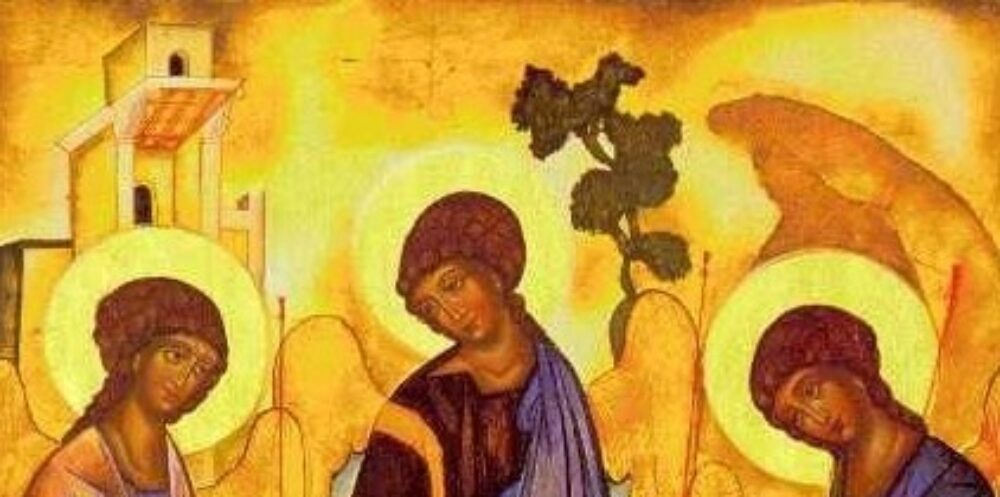
When [Abraham] lifted his eyes and looked, behold, three men were standing opposite him; and when he saw them, he ran from the tent door to meet them and bowed himself to the earth, and said, “My Lord, if now I have found favor in your sight, please, do not pass your servant by. Genesis 18:1-8

INTRO: Some years ago, I found myself frustrated with my Calvary Chapel colleagues

Our mission was to teach the Bible
– and the goal was make sure people in our churches “knew the Word”
• but I became disappointed when I realized what kind of Christians that produced
• moralistic, opinionated, self-righteous, argumentative
– it bothered me that I wasn’t hearing the importance of integrity or godly character
• we weren’t talking about becoming better people
○ kinder, more thoughtful or loving
• so even if we knew God’s word, it’s not like we were automatically living it

If you’re a parent, would you agree with me,
– it’s more fun and exciting to have a baby than to raise a child?
– how this translates into church life:
• it’s more fun and exciting to do evangelism than to grow Christians
○ growing Christians, you have to deal with all the hard challenges – every day!
• sometimes the exciting church is the one that keeps its members babies
○ this is something that frustrated New Testament writers (1 Cor. 3:1-2; He. 5:12-14)


How can we tell if we’re becoming spiritually mature? Continue reading

June 23, 2013 – Genesis Chapters 14-15

Abram’s Next Big Step

After these things the word of the LORD came to Abram in a vision, saying,
“Do not fear, Abram,
I am a shield to you;
Your reward shall be very great.”
Abram said, “O Lord GOD, what will You give me, since I am childless, and the heir of my house is Eliezer of Damascus?” . . . And He took him outside and said, “Now look toward the heavens, and count the stars, if you are able to count them.” And He said to him, “So shall your descendants be.” Then he believed in the LORD; and He reckoned it to him as righteousness. Genesis 15:1-6

INTRO: There’s something we need to know before going on

Who was Abraham and why is he important?
– to Israel?
– to Christian faith?

. . .

“Abram” takes his next big step with God


Chapter 14, a brief history of the geopolitical situation

Four nations in the east–from the general area of Babylonia
– invaded and defeated kingdoms in the valley south and southeast of the Dead Sea
• including Sodom and Gomorrah
• the defeated kingdoms paid tribute for twelve years, then rebelled
– the eastern armies returned, conquered again, and emptied the cities
• they took Lot and his family – to use or sell as slaves
• that’s how we find out Lot had settled in Sodom
○ he and his family had been taken captive

A survivor escaped and came to Abram’s camp with a report
– Abram rallied his servants
• he also mustered his allies – literally, covenant lords
• i.e., their peace treaty included a commitment to band together for mutual defense
– they launched a night attack in which they defeated the invaders and chased them north
• Lot was rescued

The actual battles pass by us in a flash Continue reading

May 19, 2013 – Genesis Chapters 6-8

The Raven and the Dove

These are the records of the generations of Noah. Noah was a righteous man, blameless in his time; Noah walked with God. Genesis 6:9

INTRO: This is one of the most famous stories in the Bible

It has been a favorite of both comics and critics
– from Bill Cosby to Eddie Izzard
• even John Huston played a comedic Noah in his otherwise serious take on The Bible
– others have taken it very seriously — even making expeditions in search of Noah’s ark

The story begins with God being grieved over the human condition
– “earth was corrupt” and “filled with violence”
• God was grieved at what we did with what he had given us
• grieved over what we did with our potential, resources, and freedom
– shouldn’t God (the “God” and Creator) be upset?
• would it be better if he just didn’t care?
○ better for us and this planet? Continue reading

A Reflexion Event: Practicing Forgiveness

A Contemplative Workshop

Although forgiveness is a foundational spiritual practice, we seldom receive much useful help when it comes to the actual process of forgiving another person, how to work through personal obstacles, or what to do next when we find that forgiveness is impossible.

Many believers are confused regarding what it means to forgive. For example, some people assume that to forgive would mean they would have to put up with repeated abuse–that is not the case.

It is possible that the direction and training you will receive in this workshop will be the next important step in your spiritual journey. Forgiveness not only liberates the soul, it deepens our awareness of God’s presence in every moment, and takes us into a place of improved physical, mental, emotional, and spiritual health.

April 13, 2013
9:00 – 4:00
The Dana Point Community Clubhouse
24642 San Juan Avenue
Dana Point

See more details and register to attend at: http://practicingforgiveness.eventbrite.com/

September 16, 2012 – John 2:1-11

Why Did Jesus Say That?

When the wine ran out, the mother of Jesus said to Him, “They have no wine.” And Jesus said to her, “Woman, what does that have to do with us? My hour has not yet come.” John 2:3-4

INTRO: Last week we began looking at statements Jesus made in John’s Gospel and asking,“Why did Jesus say that?”

This week brings us to a small village not far from Nazareth
– it is not on any major road
• it sits on a hilltop, where the homes are clustered close together
• descending from the village, the hillside is terraced, like steps, where they planted olive orchards and vineyards
– the valley below Cana, is one of most fertile in Galilee

We arrive here on a good day – a wedding feast is being celebrated
– elderly people are sitting under shade trees, children are chasing each other, and of course the bride and groom are being paraded around and given lots of hugs and mazal tov
– there are also several widows in attendance – not sad-looking, “poor me” women, but take-charge types
• one of them plays an important role in the story, though she is not named
• she is simple referred to as “the mother of Jesus”
– Jesus also was invited, along with five or six of his first disciples Continue reading

June 24, 2012 – Matthew 11

Now when John, while in prison, heard of the works of Christ, he sent word by his disciples and said to Him, “Are You the Expected One, or shall we look for someone else?” Jesus answered and said to them, “Go and report to John what you hear and see” Matthew 11:2-3

INTRO: Why are you here this morning?

I’m here to do whatever I can to move us into the best life possible
– to me, the best life is not an achievement or a static condition, but a process, because the best life is a life of constant growth

Since material success isn’t essential to the full enjoyment of life, we concentrate on the spiritual journey
– “journey” implies waypoints, destinations we have to reach to move toward our goal
– there are developmental tasks that require us to learn new information and skills

In Christian spirituality, these waypoints are usually referred to as “stages”
– but I think that introduces a view that’s too systematized
• it implies that we all travel by the same route, hitting the same mile marks in the same order
– God’s Spirit determines what we need next
• we hope to eventually experience all the waypoints, but we don’t move out of one “stage” into the next as if ascending the runts of a ladder
• whatever we learn from one experience, carry with us into next
• sometimes, the Spirit takes us back to an earlier place, which we must relearn or penetrate to a deeper level

C. S. Lewis, “We all know the old joke, ‘You’ve given up smoking once; I’ve given it up a dozen times.’ In the same way I could say of a certain man, ‘Have I forgiven him for what he did that day? I’ve forgiven him more times than I can count.’ For we find that the work of forgiveness has to be done over and over again.”

– so it may be that God brings us back to an old resentment (or ego issue, guilt, etc.) several times before it is finally resolved

We can go to school to learn we need for the spiritual journey — “The University of Jesus Christ” Continue reading

March 25, 2012 – Present Your Bodies

But let a man examine himself, and in so doing he is to eat of the bread and drink of the cup. For he who eats and drinks, eats and drinks judgment to himself if he does not judge the body rightly. 1 Corinthians 11:28-29

INTRO: Today we’re going to read through three passages

Each passage brings us to a new understanding of the relationship between our bodies and Jesus
– as we read, pay attention to what Paul says is the wrong thing to do, think, or say, and the right things


1 Corinthians 11:23-32 – instructions regarding the Lord’s Supper

What does he say is wrong (or wrong way to approach the Lord’s Supper)?
– “unworthy” – specifically, 29, “not discerning the body”

What does he say is right (or right way to approach it)?
– we must examine ourselves and with that inward focus eat and drink

The Lord’s Supper is where we symbolically begin with Jesus
– whatever happens when we meet him and receive him, it is celebrated in the Lord’s Supper
– we return to this place of our beginning repeatedly Continue reading

Listening to ones internal organs in the Hebrew Scriptures

Body Parts In Scripture
The internal organs

The Abdomen – meim

  • the belly or “bowels”
    – includes intestines and internal reproductive organs (Ge. 15:4)
  • specifically, female reproductive organs – rechem, the womb (Jer. 20:17)
  • male and female reproductive organs — beten — also “belly” or  appetite
  • the innermost parts of the body are hadre beten
    –  the
    bed chamber and inner rooms of the temple — hadre/heder (2 Ki. 6:12 and 1 Chr. 28:11)
    – Yahweh searches these inner places of the person (Pr. 20:27)
  • all of the “inner parts” located in the body cavity — qereb (Pr. 14:33)
  • the liver – kebed
    – from kbd, “heavy,” “weight” – probably for its size
    Lam. 2:11, “My heart (kebed) is poured out on the earth”

“This is a way of describing measureless grief; in his sorrow the poet is no longer in control of his innermost feelings; his very life is poured out with his liver.” Hans W. Wolf, Anthropology of the Old Testament Continue reading

Mar4ch 11, 2012 – Present Your Body

Behold, You desire truth in the innermost being,
And in the hidden part You will make me know wisdom.
Psalm 51:6 (read entire Psalm)

INTRO: What is your body trying to tell you?

Antonio Damasio is a respected scientist and one of his fields of research is the neurology of emotion
– he had identified a brain-body loop that is necessary for processing emotions
– messages are carried from the body to the brain chemically (in the blood) and electrically (in the nervous system)

Think about this for a moment? How do we know we’re hungry? We feel sensations of hunger
– there are some people, who when really hungry, slip into a bad mood
-the body affects the brain, producing emotional responses to various sensations

Damasio says that in our western society today, we cut ourselves off from a lot of the body’s messages
– he guesses that in earlier times that was not the case

“It must have been easier to sense life within . . . . I suspect they were able to sense more about themselves than many of us, the unforewarned, are able to sense these days.”

There’s no need to guess that ancient people were more aware of went on in their bodies – all we have to do is read the Old Testament
– I’ll point out just one example I read a couple months ago: Continue reading