July 17, 2022

Welcome and Prayer: Nancy Lopez

Good morning, dear ones!          May the Lord be with you!

A while back, I was waiting for my car to be serviced and a woman with a young dog, actually a puppy, came in to the waiting room.  The puppy was wearing a vest that read, “Support Dog in Training.”  She told the dog to Sit, and he did.  But he was looking all about, distracted with everything in the room.  Then she said, “Settle,” and the dog sort of half-heartedly relaxed, but was still very distracted as if he would jump at the chance to be released from this torture of sitting.  She looked at him and kindly but firmly repeated the order, “Settle.”  He calmly lay down beside her with a completely relaxed posture, head down, not looking for any way out.

I borrowed these terms for myself; knowing that often I am like that puppy, distracted by many things.  I can move from Sit (ok I’m sitting, Lord) to Settle–letting go of distractions, settling my heart (I’m safe, I’m loved, one thing I desire), settling my mind (I’m fixed on my intention to be-here-now, letting go of everything else), as well as settling my body, relaxing my muscles, relaxing breath.

Then I was introduced more recently to the beautiful phrase “Sink Down to the Seed.” Isaac Pennington wrote those words in 1661.  Pennington was one of the early members of the Religious Society of Friends, or Quakers.  Here it is in context, I call it a prayer to settle our souls:

Give over thine own willing, give over thy own running, give over thine own desiring to know or be anything and sink down to the seed which God sows in the heart, and let that grow in thee, and be in thee, and breathe in thee, and act in thee; and thou shalt find by sweet experience that the Lord knows that and loves and owns that, and will lead it to the inheritance of Life, which is its portion.

Sink down to the Seed.  So now, the movements for me are Sit, Settle, and Sink Down.

I’m offering those words to you.  You can use them in your Quiet Time this week if they seem right to you.  See where they take you.  Are they helpful?  Do they seem lovely?  Do they speak to your soul, as they do to mine?

So, as we begin:  Sit.   Settle.   Sink Down to the Seed that God has sown in your heart.

Morning Talk: Beth Khorey

I’ve chosen ACTS 9, the episode of Saul’s encounter with Jesus as a demonstration of my
definition of the religious word “prayer.”
PRAYER: an ongoing conversational reality with God, myself and others.
Monastics for centuries have said in a “nutshell”:
ALL OF LIFE IS PRAYER
PRAYER IS ALL OF LIFE
Prayer is an integrating dynamic:
• OF ENCOUNTERING JESUS–his person, his words, and his works
• OF CONVERSION OF SELF OR SOUL–or the continuous change (or transformation) of the soul in Christ
• OF EXPANDING OUR COMMUNAL EXPERIENCE within the TRI-UNITY of God and others in
the world.

What Jesus pointed to as the two great commands to follow were LOVE GOD and LOVE
OTHERS as I love you. In conjunction with spiritual reading and faith formation practices, PRAYER
CONTOURS THE WAY JESUS-FOLLOWERS:
• live and die,
• learn to love in tangible life giving ways,
• experience conflict both inner and outer – the frictions and fractions of being human and
longing for the Divine
• which leads to forgiveness and the freedom of being forgiven, (absolved of guilt and
shame)
• to see the invisible and visible signs of God-With-Us in the world
• endure hardships and heartaches, patiently, with the hope of restorative healing and
reconciliation
• and the imagination to inhabit God’s-story, embodying it as a “livable faith”
o something more than spectator or observer – but as a participant
o something more enriching than the acquisition of religious knowledge and information
out of curiosity – but a becoming a flourishing and wise person as God intended
[Please read ACTS 9]

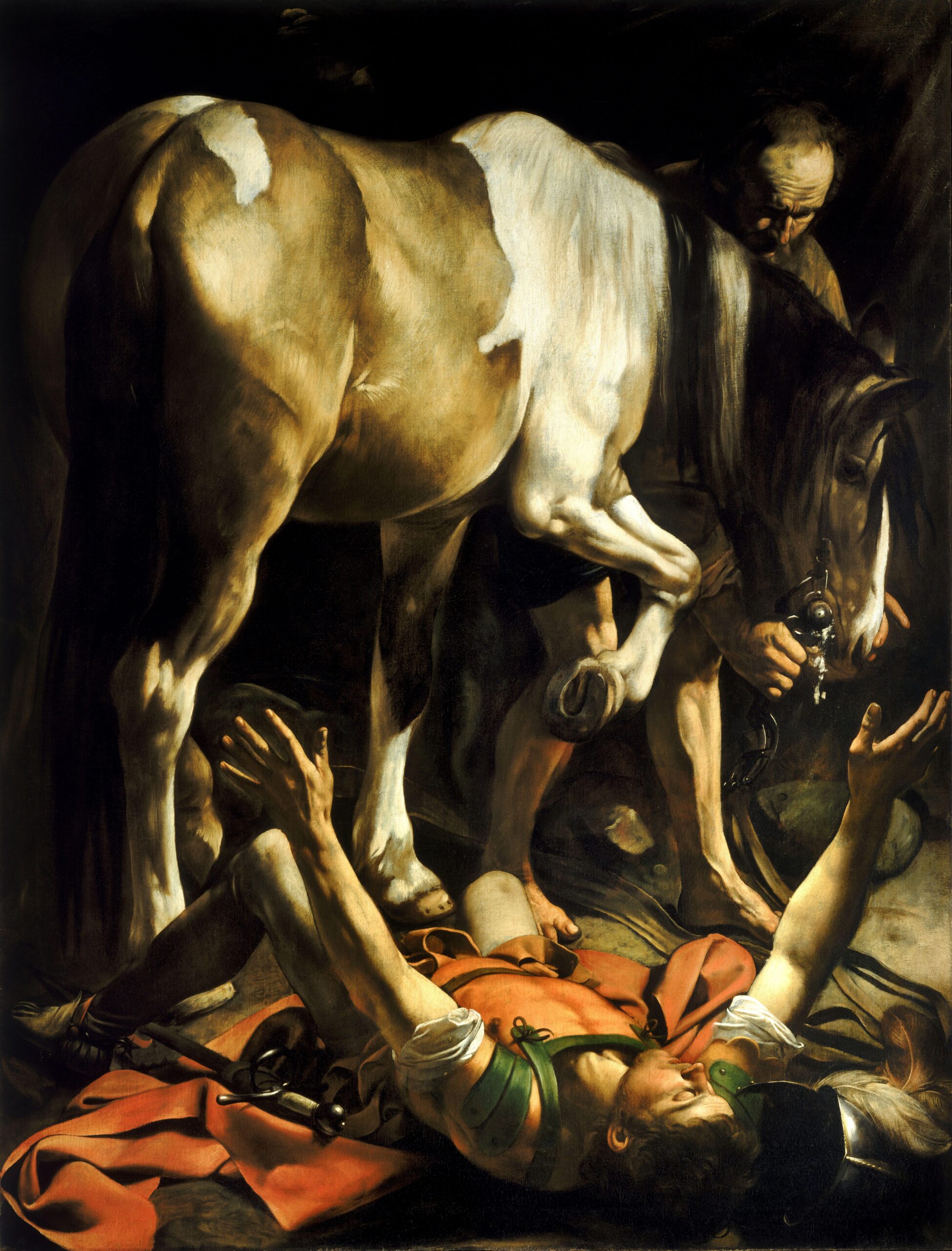
(In public domain)


PRAYER as ENCOUNTER WITH JESUS
(With reference to the painting by Caravaggio – a visual narration of Saul’s
conversion as told in by Luke, Paul’s traveling companion and author of Acts.)
A story of Saul’s on his murderous mission to apprehend Jesus’ followers, “breathing threats”
with the backing of the “religious leaders”!
Back Story: In Chapter 8 Luke tells us: that Saul approved and applauded the execution of
Stephen one of the early friends of Jesus.
Saul was a young zealous Jew – trained, skilled, educated, and because of his Hebrew pedigree,
he was given a prestigious position with the religious leaders to take on a this mission with full
backing and authority to APPREHEND and ARREST any friend of Jesus.
Saul encounters Jesus on his way to Damascus (the conversational reality begins!)
• Jesus, comes – (always coming to meet his people) – with disruptive invitation to stop the
violence
and reorient Saul on a new course.
To STOP the violence: German scholar Klaus Wengst stated of God’s people (The Church),
We are “the sphere of interrupted violence in the midst of a violent world.” (quote taken from
Michael Gorman’s, Cruciformity)
• A Light Shone From Heaven: (later in Paul’s life I wonder if he was thinking of this moment
and connecting dots when he said to the people of Corinth:
“For God, who said, “Let light shine out of darkness,” has shone in our hearts to give the light of
the knowledge of the glory of God in the face of Jesus Christ.”
2 Cor.4:6
I believe this was a Genesis Moment for Paul – a generative moment of making a NEW
CREATION in Paul – (thinking of “prayer” as generative, making new as I encounter Jesus, the life
and the LIGHT of the world).
(I think the NEW CREATION is linked inextricably to stopping the violence, the death, the damage
of sin and destructive actions of humans bent on life “without” God.)

PRAYER as CONVERSION
We may know this episode in the life of Paul as his “conversion” and conversion is another
religious word that may connote a “one time event.” Unlike what we might have understood of
conversion in the Christian tradition–I don’t think it’s a one time event … but rather more like the
entrance into ongoing conversational reality of relationship with God in Christ.
Our conversion is not static but fluid.
• It ebbs and flows into developmental spiritual growth;
• it takes place in the prayerful conversation and encounters with Jesus (through his person
and his Word); with our relational exchanges with others; and in our circumstances
It’s an ongoing, lifelong rhythm of change
While still retaining foundational marks of the JESUS-FAITH and the JESUS-STORY we find
ourselves in need of:
o rethinking,
o re-imagining
o re-embodying the whole God-story… in order to grow in relationship with God, the
self and others
Thomas Merton (a 20th century American Trappist monk, activist, writer and theologian of the contemplative life) wrote:
“We are not converted only once in our lives, but many times; and this endless series of
large and small conversions and inner revolutions, leads to our transformation in Christ.”
(quote taken from Bradley Holt’s, Thirsty for God)

I would like to suggest that Saul’s encounter with Jesus and conversation shaped an ongoing
imagination and prayerful dialectic with Jesus for the rest of his life: for his experiential life, his
vocational work and his circumstances (as Jesus stated in Acts 9 “he is my instrument…I will
show him all the things he will suffer for my name’s sake.”
)
• Paul’s conversation didn’t scrub him of all his education and knowledge of God from the
Hebrew Scriptures rather the analogue to that knowledge with Jesus
• Jesus would begin to intricately stitch together all the Scriptures in Paul (as he wrote in Romans 1 says the “Gospel of God” is the whole story)
• Paul would become the best source for telling the integrative story of the Jesus-life
• For centuries, leading scholars and theologians continue to parse out Paul’s literature to
make sense of the Jesus-life
• Psalm 139–and Paul in some of his biographical literature indicates this is true of himself–God knew him in the womb – his entire life was known by God
• His knowledge and education is put to use – AND – put in appropriate order after
meeting Jesus (Php. 3 – counting all things loss for the excellent knowledge of Jesus)
(With reference to the painting)
Combined with the Scriptural narration – there’s a rather revelatory artist insight offered to us in
the painting by Caravaggio. It shows me a little bit of how Saul’s encounter, conversion and
conversation with Jesus contoured his personhood:

The Artistic intuition reveals these things:
LIGHT FROM HEAVEN SHONE ABOUT HIM
• The otherliness of the exaggerated use of light and darkness – Saul is bathed in brilliance
– shining on his face – in contrast to his dark surroundings as the overshadowing of the
Divine Presence “off the canvas frame” indicating it comes from “outside” of our selves
– it is Other than our selves.
• Articulates a change: something of the Genesis account hints at the description of the
Holy Spirit hovering, brooding over the dark waters – the formless and void – precreation
earth – in a waiting anticipation for the new creation to take shape.
• Light and darkness also articulates the paradoxical poetics of Saul’s sightedness (he
could see, yet was blind, he was blinded, yet could see). His eyes and ears needed Divine
adjustment in the New Creation-Making of his being.
HE FELL TO THE GROUND
• let’s say he was “grounded” maybe for the first time . . .
• This grounding posture conveys the soul’s receptivity in prayer to God’s Spirit who imbues
the soul with power to change the human self.
• Bodily posture is the most vulnerable – we are the least physically strong on our backs –
indicating a type of openness, vulnerability and humility, that became for Paul a
patterned posture (Php. 2 “Let this mind be in you which was also in Christ, who humbled
himself . . .”
)
• Defenses dropped/Knocked off his high horse, sword falling to his side – All the horse-like structures and weapons used to power up, posture ourselves as better, stronger, bigger, “more than you.” All this
falls away in the presence of Jesus (through prayer – the ongoing conversational reality I engage in when meeting Jesus – who comes to meet me – to stop the violence and to convert my soul and transform me into His likeness).
{Michael Gorman in his work of Pauline literature in his book Cruciformity asserts in the early days of his
conversion Paul was with the disciples (Acts 9:19), learning the ancient creedal prayer of Php. 2 from
which Paul would base his entire spirituality and teaching on to the entire Church.}
INNER AUTHORITY
• Lastly Paul askes: “who are you LORD?” – an intuition emerging, though unrecognized in
his conscious state – that who he was meeting was “The Lord.”
• In prayer we learn to listen to the inner intuition and authority. It is THIS voice – the voice
of Jesus we follow. (Paul was given “authority” by the religious leaders – now, he learns
the real authority in his life – Jesus).
A revelatory experience of TRUE DIVINITY and TRUEST HUMANITY engaging together

HERE’S THE INVITATION FOR US
When we follow Jesus as LORD, instead of a “muscled up” – clinched fists, highly defended stand, we take a posture of vulnerability, honesty, arms open as receptive (almost a “cradle posture” of a babe waiting for parental embrace)
It’s an invitation to live the Jesus-Paradox:
• weakness is the new faculty of understanding;
• strength is located in risked vulnerability;
• true power is reconstituted in Christ’s own HUMILITY, DEATH and resurrected life;
• and love is demonstrated in a self-donating hospitality through the Spirit of the Crucified-
RISEN LORD JESUS.
It’s a new creation identity and vocation: “FLESH AND BLOOD DID NOT REVEAL IT”
• Instead of gaining authority, prestige and position from religious leadership or popular
political affiliations or crowd wining – people-pleasing antics – We follow Jesus, we learn
to listen to his voice, discern his guidance, we live and move and have our being in him.
It’s also a creation model of vocation: we act in the authority of Christ–to co-labor and
collaborate with Christ, in the power of the Spirit of Christ for the sake of Christ being
formed in others (Galatians 4:19)

PRAYER as COMMUNAL ACTIVETY
PAUL WAS PRAYING / ANAIAS WAS READY IN PRAYER
JESUS and PEOPLE – this is how deeply Jesus is relationally committed to people – it’s UNION.
“Why are you persecuting Me?” Indicates just how integrated Jesus is in the life of his friends.
“I in them, and Thou, Father, in Me, that they may be made perfect in One…. And the glory which
Thou hast given me I have given them, that they may be One as we also are One.”

(John 17)
• Unless we come into this realization, religion is reduced to a privatized affair – and that’s
just not what God’s Story pictures.
• HUMANITY is God’s intimate and ultimate concern – his heart beat beats with
compassion, reconciling and redeeming the people to himself in Christ.
• I believe wholeheartedly Paul learned something KEY to his formation – GOD IS FOR US –
NOT AGAINST US – and that we are to live for Christ’s sake and the sake of others.
• The only way I know to become “FOR OTHERS” instead of “AGAINST OTHERS” is in and
through the ongoing conversational reality of encounter and conversion through the
Jesus experience.
WHILE PAUL WAS PRAYING . . .
• PRAYER includes waiting and listening.
ANOTHER CONVERSATION WITH JESUS WAS HAPPENING…
• Ananias is addressed by Jesus in a vision simultaneously to Paul’s silent prayer
• Ananias is responsive to Jesus: “HERE I AM LORD”
• Ananias has his own encounter and conversion experience in conversation with Jesus –
specifically with his perception of Saul – the way he thinks and sees another person he
doesn’t know personally. In prayer, Saul goes from perceived enemy (AGAINST US) to
Friend of Jesus – enabling Ananias to meeting him with affectionate intimacy “BROTHER
SAUL”

• Ananias is led from a posture of defensive distance-keeping to nearness and intimacy as
he “lays hands”
HEALING often transpires within a COMMUNITY of pray-ers.
Thomas Merton shortened the John 17 prayer of Jesus as:
“I in You (Father) and You in me;
You in them;
Them in me.”
THE OUTCOME
Saul sees and is filled with the Holy Spirit – a redemptive baptism into new creation life.
EARS TO HEAR THE VOICE OF JESUS
EYES TO SEE THE FACE OF JESUS

CLOSING PRAYER
I am going to close with a prayer that is a poem written by E.E. cummings (1894–1962)
I Thank You God . . .
I thank You God for this most amazing
day: for the leaping greenly spirits of trees
and a blue true dream of sky; and for everything
which is natural which is infinite which is yes
(I who have died am alive again today,
and this is the sun’s birthday; this is the birth
day of life and love and wings: and of the gay
great happening illimitably earth)
how should tasting touching hearing seeing
breathing any—lifted from the no
of all nothing—human merely being
doubt unimaginable You?
(now the ears of my ears awake and
now the eyes of my eyes are opened)

June 19, 2022

Welcome and Prayer: Nancy Lopez

Good morning!  Welcome to RefleXion.  May the Spirit of the Lord be with you!

The air we breathe….did you ever meditate on air?  The Genesis story of beginnings tells us that God created Light and Dark, Heaven and Earth, the Seas, (no mention of air), Plants and Trees (don’t they need air?), stars, sun and moon, sea creatures and birds, beasts of the earth (birds and beasts need air!), and then men and women.  Maybe the elements were created to form air. 

I don’t know, but what we learn is that when the LORD God formed the man from the dust of the ground, He breathed into his nostrils the breath of life, the man became a living soul.  Finally, some breath, so we are God-breathed into life; were the other creatures?  And His Breath is not just oxygen, because we can pump oxygen into a dead body, and that will not bring it to life.  God’s Breath is Life itself. (Our True Father on Fathers’ Day)

And think about this, the air we inhale is also exhaled, as is and was the air that every creature from time immemorial breathed in and out.  We’re connected in some fundamental way. So, while we aren’t likely to breathe the same atom of oxygen that Brad Pitt did, every breath we take has, at one time or another, been associated with another living organism.  It’s recycled of course.  The plants breathing in the carbon dioxide we exhale give us back the oxygen we need, but if the plants are polluted, is the air they return to us also polluted?  Once again, a reminder that we are connected to all of life.   

We know that we have polluted air, and not just with the industrial waste and smog.  But do you think that our air can be polluted with anger, or division, or fear? 

What if the air we breath in can be further polluted by us with the stuff we carry around: shame, fear, anger, and then we breath that out?  There is actually a contemplative compassion meditation practice called Tonglen where the practice is to breathe in someone’s suffering and to purposefully allow that air to be transformed by the gifts of our heart:  peace, kindness, goodness, wisdom, and then exhaled for the benefit of the suffering person or for the world.  Interesting, isn’t it? 
Just some things that I’m pondering.

Morning Talk: Cheryl Smith

Philippians Overview
Joy is to be resident in our lives
John 15:11 Over
800 rejoicing texts (Pollyanna)
Psalm 16:11
Joy in our culture can appear
Irresponsible
Insensitive
This is due to a misunderstanding of Joy

Our joy resides and is due to Jesus
Who He is
What He has done
His promises

Philippians
Known as the Epistle of Joy
Joy mentioned in every chapter
Extraordinary
Paul in prison in Rome
Awaiting verdict from his trial before Nero
This epistle tells us about Joy

Perspective of Joy
Pursuit of Joy
Priorities of Joy
Practice of Joy

Philippians 1- Perspective of Joy
Verse 1- Servant of Jesus
Paul’s perspective
Paul was not the victim of Nero, Rome, unscrupulous men, false accusations
Paul was a servant of the Jesus the Messiah
As such wherever Paul was – Her served Jesus
Whatever Paul did- He served Jesus
However Paul acted was in service to Jesus
Paul gave everything to Jesus – Use this Lord for your glory
Therefore, Paul found reasons to rejoice even in his trial and imprisonment
Great mission field – preached Christ and the whole palace guard heard it
Emboldened others
Even those who didn’t like Paul were preaching Jesus.

Verse 21 – For me to live is Christ and to die is gain
With a perspective like that joy is assured
Keep me here and I will continue to serve Jesus with joy
Kill me and I go to be with the Lord in the presence of Joy

Philippians 2- Pursuit of Joy

The pursuit of Joy is to have the mind of Christ
Verse 5, “Let this mind be in you which was also in Christ Jesus, who, being in the form of God, did not consider it robbery to equal with God, but made Himself of no reputation taking on the form of a servant, and coming in the likeness of men. And being found in appearance as a man, He humbled Himself and became obedient to the point of death, even the death on the cross.”

The mind of Christ will guarantee Joy in our fellowship and relationships
Consolation in Christ
Comfort of Love
Fellowship in the Spirit
Affection and Mercy
These done with the mind of Christ will result in joy
Like minded- same pursuits
Same love
One accord
One mind

Vv. !2-18 God is working individually with us and corporately to work in us a desire and deliberation toward His good will
He works this through our circumstances
He works this in us as we hold on to the Word of Life
Paul then mentions two men who had this joy imparting mind of Christ
Timothy
Epaphroditus

Philippians 3—the Priorities of Joy
Not rules and regulations that others try to add to Jesus
Not accomplishments of the past
Not the measurements of society

These priorities lead to: Comparison, competition, criticism, conceit and condemnation
Priorities are:
The knowledge of Jesus Christ
To know Jesus as much as humanly possible on earth
To be found in Jesus
To claim His righteousness as my own
To know the power of Jesus
To fellowship or join with Jesus in my suffering
To forge forward
Leave the past to the past
Find the purpose of Christ for me
Heaven!
Eagerly wait for Jesus to come
Transformation of our lowly bodies to be glorious like His

Philippians 4—Practices of Joy

Help others to get along – Euodia and Syntyche
Practice His presence – Rejoice in the Lord
Take everything to the Lord in prayer
Every anxiety
Every problem
Every dilemma
Every request
With thanksgiving – thanksgiving reminds us of
All we have
All God has already done

Filter your thoughts – Keep only the thoughts that are:
(Cognitive Therapy)
True
Noble
Just
Pure
Lovely
Good report
Virtuous
Praise worthy

Learn (a process that you apply yourself) to be content by
Drawing on Christ’s strength
Knowing that God will provide all your needs always
Give as the Philippians did (18) be generous

God desires that His children be Joyful Children
Take time to think of all the reasons you have to rejoice in the Lord
His presence
His productivity in your life
His peace

Joy is promised for us through the work of Christ for us and in us
We can rejoice today because we have the perspective, pursuit, priorities and practices of Christ which will produce Joy!

July 10, 2022

Welcome and Prayer: Jim Calhoun

Heavenly Father
In this age and in this land
Where we have tried to bring your kingdom by power and force,
Where we have abandoned your path of loving others,
Where we exchange truth for lies,
Renew our experience of your good great love,
Compel us to love each person we encounter,
In our private lives and
In our public lives,
With the very love you pour into us.
Grant us a compassion that is robust,
Remembering those it would be easy for us to forget:
The dismissed, the outcast, the rejected, the troubled, the unlovely;
Those without homes,
The destitute,
Those born in other lands,
Those born in other neighborhoods,
The stranger,
The refugees whose homes are torn apart by war and violence,
Those held prisoners,
The old and the sick,
The orphaned and abandoned,
The misused and abused,
The fearful and angry,
The addicts,
The mentally ill,
And all who have none to care for them.

Help us to bring healing those who are broken in body or spirit,
Even the resistant, the belligerent, the arrogant, the ignorant,
And to turn their sorrow into joy.
Move the hearts of every man and woman,
Who claims your name,
So the barriers which divide us may crumble,
Suspicions disappear,
And hatreds cease;
That our divisions may be healed,
And we may live in justice and peace.
Grant all this, Father,
for the love of your Son,
who for our sake became poor,
Jesus Christ our Lord.
Amen

This Morning’s Talk: chuck smith, jr.

While he was in one of the cities, there came a man full of leprosy. And when he saw Jesus, he fell on his face and begged him, “Lord, if you will, you can make me clean.” And Jesus stretched out his hand and touched him, saying, “I will; be clean.” And immediately the leprosy left him. And he charged him to tell no one, but “go and show yourself to the priest, and make an offering for your cleansing, as Moses commanded, for a proof to them.” But now even more the report about him went abroad, and great crowds gathered to hear him and to be healed of their infirmities. But he would withdraw to desolate places and pray Luke 5:12-16

Intro: A man, “full of leprosy” came to Jesus

This was a bold move – desperation can inspire great courage
– lepers were not allowed in cities or to approach others
• if he did, he was sure to hear the shouts of angry voices
• he was not only isolated from community – but rejected by it
◦ it was a sad, lonely life
◦ and he had done nothing to deserve it
– this man came looking for Jesus, and when he found him
he fell on his face
• not literally, but he dropped to his knees suddenly and quickly,
◦ begging Jesus, Lord, if you will, you can make me clean
◦ later, a father would bring his son to Jesus, and say,
If you can do anything, have compassion on us and help us (Mk. 9:22)
• the Lord did not like that; he replied, “If you can?!”
◦ notice the difference between what the father said and what the leper said:
If you can do anything
If you will, you can . . .
◦ the leper placed himself in Jesus’ hands, to do what he willed or wished
– I imagine that Jesus was pleased with the leper,
• and with a gentle smile, Jesus did the forbidden; he
stretched out his hand and touched him, saying, “I will; be clean”

Jesus wanted to keep this miracle on the down-low
– but an event like this cannot be kept quiet; news traveled fast
• then the crowds came; some limping on crutches,
◦ others guiding a blind friend, or carrying a sick child
• huge crowds arrived to hear Jesus and be healed by him
– do you know why so many people showed up?
• not only because they heard about the miracle, but because of Jesus’ “I will”
◦ they knew he was not only able to heal, but willing
◦ they heard that Jesus was merciful
• my grandchildren work me
◦ they ask, because they know eight out of ten times, “I will”
◦ Jesus can, and Jesus will, if we ask

How does Jesus manage this massive response?

Think of it! This is the first sign of a significant movement
– this is the time to announce his next public appearance,
• to collect donations, recruit volunteers, sell books,
rent the stadiums and theaters that the Romans built all over Israel
But he would withdraw to desolate places and pray
• and not this one time, but his response whenever crowds arrived
– the Greek word for desolate places is also translated desert and wilderness
• it refers to a secluded and uninhabited area
• he found a space where he could be alone, undisturbed
◦ Jesus left the crowds to be with God

Last week, we began this prayer journey with Jesus through Luke

To know Jesus requires a lifetime of ongoing prayer
– and it needs to be this kind of prayer
• an intentional move from everyday distractions to focused attention on God
◦ this was not “prayer on the go”
◦ this was making time and finding space to be with God
• Christian parents used to ask their kids, “Did you say your prayers?”
◦ but that is not what Jesus does here
◦ these prayers were not rote or repetitious
– I’ve always felt it’s unfortunate that the content of his prayers were not recorded
• but then, what would we do with them?
◦ would we ever pray with our own words, thoughts, and concerns?
• we do not know what Jesus prayed
◦ we do not even know why he prayed
◦ what it was he needed or, maybe what he wanted
Maybe he prayed from desire more than necessity

Observing Jesus, we learn the importance of a desolate place

I’ve lost count of how many times I’ve heard people say,
“I feel closer to God in nature than in church”
– it’s true that God’s creation provides the best inspiration
• the fragrance and colors of a forest, or austerity of the desert,
or sounds and rhythms of ocean awaken something within us
• it’s a luxury to find a secluded, quiet meadow or shoreline
◦ some people design gardens for this purpose
◦ in serene spaces, meditation occurs without effort
– what if we’re stuck in the city?
• Jesus taught the disciples to pray in a private space
. . . when you pray, go into your room and shut the door and pray to your Father who is in secret. And your Father who sees in secret will reward you (Mt. 6:6)
• the “room” was a secret chamber (for storage or privacy)
◦ this type of prayer is a conversation between two parties only

The point is that we find space where we can focus our minds on God
– and if we can’t find it, we create it
• a painting or photograph, plants, candle, or incense may help
• but the value of a desolate place is that you’re grateful for the basics
◦ for shade, a cup of water, a slice of bread
– it is not easy for me to find that place
• where I can clear my mind of everything but Jesus
◦ to pray and not be distracted by the things I pray about
◦ to simply be with him
• we cannot say that there are no distractions in desolate places
◦ we carry our distractions with us
◦ our brains can create dozens of worries anywhere, or drag along our wishes, regrets, or fantasies
– but in desolate places there’s less we can do about those things
• diversions are not so close at hand
• going into a desolate place is a kind of fasting

What will we do in our desolate places?

Practice the art of prayer — pray with our hearts
(Remember, you are an artist)
– how will my soul express itself to God?
• in this time of my life? Given my current circumstances?
◦ and now that I’m in this deserted, quiet space?
• listen to David, the poet:
O God, you are my God; earnestly I seek you; / my soul thirsts for you; my flesh faints for you, as in a dry and weary land where there is no water (Ps. 63:1)
◦ that is the prayer of a person who wants God for God

We will practice praying deep and real issues — pray with our minds
– not merely, “O God, get me through today” – But:
• “Lord, show me what keeps me from a complete trust in You”
• or “Take me deeper into Your will, O God”
– I’ve learned from Paul to pray my spiritual needs and longings
• he prayed for the Ephesians,
that the God of our Lord Jesus Christ, the Father of glory, may give you the Spirit of wisdom and of revelation in the knowledge of him, having the eyes of your hearts enlightened, that you may know the hope to which he has called you . . . (Ep. 1:17-18)
• yeah, I pray that

We practice meaningful posture and gestures — pray with our bodies
– we know people who talk with their hands as much as their mouths
• we may pray with lifted hands, or open hands, or clenched fists (if our need is intense)
– prayers we see in scripture utilize varieties of body language

We will practice silence and listening in prayer — pray with our spirits
– prayer is not only learning to talk with God
• it is also developing sensitivity to the subtle movements of his Spirit

Prayer in a desolate place is often serene, intimate, and restorative

But sometimes it is the place where we face our demons
– after his baptism, Jesus
was led by the Spirit into the wilderness for forty days, being tempted by the devil (Lk. 4:1-2)
– life itself can bring us to desolate places and spiritual conflicts
• and when we meet with God, there are prayers that help us through those times too

Conclusion: Where the English Standard Version says Jesus “would withdraw to desolate places,”

The New American Standard Bible has “He Himself would often slip away to the wilderness”
Can you think of prayer this way?
that you slip away with Jesus
Many believers before us discovered a fulfilling intimacy with Jesus
they kept themselves close to him through prayer in desolate places
Spending time with Jesus is what changes lives
Our world needs believers who spend much time with Jesus,
and through intimacy with him, become like him
Our world needs that more than any other kind of Christian

July 3, 2022

Podcast

Facebook

Welcome and Prayer: Jim Calhoun

Heavenly Father
So often we find ourselves at our wit’s end
not knowing how to manage day to day
At times left overwhelmed and undone. 
We fear being hopeless and helpless
We fear becoming numb or complacent or cynical.
We fear becoming bitter and resentful
We fear we may break and never be whole again
Help us to remain tenderhearted, 
Open to you
Able to know your presence when are at our breaking point
Continually transformed in you
Eager to come as you call,
Full of confidence that in you all shall be well.

Amen

Today’s Talk: chuck smith, jr.

Now when all the people were baptized, and when Jesus also had been baptized and was praying, the heavens were opened, and the Holy Spirit descended on him in bodily form, like a dove; and a voice came from heaven, “You are my beloved Son; with you I am well pleased Luke 3:21-22

Intro: There are three words in these verses I want to highlight

“and was praying”
– between the time Jesus was immersed in water and the heavens opened,
• he was praying – and this intrigues me
◦ in the life of Jesus, this is the first mention of him praying
• of course we have only a glimpse of his childhood
◦ but those snapshots reveal someone already conscious of God
And the child grew and became strong, filled with wisdom. And the favor of God was upon him (Lk. 2:40) And Jesus increased in wisdom and in stature and in favor with God and man (Lk. 2:52)
– in the story of Jesus, this is his critical rite-of-passage
• immediately after this Luke tells us:
Jesus, when he began his ministry, was about thirty years of age
• baptism is also a rite-of-passage for us; an entry point
◦ it symbolizes our initiation into Jesus
◦ and baptism is also associated with a believer’s first (real) prayer
. . . look for a man of Tarsus named Saul, for behold, he is praying . . . . Then [Saul] rose and was baptized (Acts 9:11-18; cf. Acts 19:5-6)

There is another reason these three words intrigue me
– Matthew and Mark also report Jesus’ baptism
• but neither of them mention that he was praying
◦ for Luke, this little detail was too important to leave out
• in fact, it turns out Luke includes other instances like this,
◦ where Jesus prayed at critical moments that are not mentioned elsewhere
Before choosing the twelve apostles (he prayed all night; Lk. 6:12-16)
Before asking his disciples, Who do the crowds say that I am? Lk. 9:18)
At the moment of his transfiguration
And as he was praying, the appearance of his face was altered, and his clothing became dazzling white (Lk. 9:29)
◦ Luke also tells us, when large crowds came to hear him,
he would withdraw to desolate places and pray (Lk. 5:16)
◦ getting away to pray was a regular practice for our Lord
– Matthew provides some of Jesus’ teaching on prayer
• Mark provides less of what Jesus had to say about prayer
◦ but Luke’s attention to prayer is extraordinary
• he wanted us to know that Jesus lived prayer

“Lord, teach us to pray” Luke 11:1

The disciples made this request after watching Jesus pray
– their request itself is a prayer
• and it will be our prayer through this series
• we are going to learn prayer from Jesus–according to Luke’s gospel
– along the way, I am going to highlight four themes:
That we learn to pray with our minds
– Ecclesiastes gets to the point (though with a sharper edge than I would)
Guard your steps when you go to the house of God. To draw near to listen is better than to offer the sacrifice of fools, for they do not know that they are doing evil. Be not rash with your mouth, nor let your heart be hasty to utter a word before God, for God is in heaven and you are on earth. Therefore let your words be few (Ecc. 5:1-2)
– I confess, my tendency is to say repetitious prayers
– in too many spontaneous prayers, the person strings a bunch of clichés together
“O Lord, we just pray that You will bless each and everyone here tonight; that Your word might go forth in power. Please anoint our preacher with Your Spirit. Yada, yada, yada.”
• it’s not that we have to prepare a speech or present an essay
◦ but I need to give thought to what I pray
• to make this my own prayer and use my own words
– we want to remind ourselves that we’re talking to God

That we learn to pray with our hearts and souls
– scripture encourages us to pray fervently and earnestly
– I am also thinking that we could pray more creatively
• prayer in the Psalms is like spirit-poetry
• art is birthed in the heart–with all that it suffers and enjoys
◦ all of its hopes and disappointments
• if you write out your prayer, something special happens
◦ it’s a different experience from saying or thinking a prayer
– I am not saying, create a masterpiece
• we’re not trying to impress God, but to express ourselves

That we learn to pray with our bodies
– in Romans, where Paul urges us to present our bodies to God,
• he refers to this as our spiritual worship – or “service”
◦ Jesus’ baptism prayer was a gearing up for service
• some of the service we provide God and others can be considered a prayer
◦ in this respect, we are “doing” our prayer
◦ we can be in prayer also as we perform our service
◦ it feels natural for me to pray for my grandkids when preparing their lunch
– praying with our bodies can also be with posture and gestures

That we learn to pray with our spirits
– in prayer, a fusion occurs between God’s Spirit and our spirit
– we’ll come to this when we get to the tenth chapter in Luke

Our experience of prayer will always be an encounter with mystery

There are no experts when it comes to prayer
– if someone claims that they receive everything they pray for God to give them,
run away! – they’re trying to sell you something

There is no perfect way to pray, no method or formula
– we do the best we can with what we have
• sometimes all a person can do is groan
• there are depths of prayer in which words are optional

Prayer is the easiest thing we will ever do,
– and it will be the most difficult thing we ever do

Prayer is so simple that children do it well,
– and it is so difficult that many adults give it up

Prayer is the entry-level practice for beginners,
– and it’s the ultimate service of the greatest saints

Nothing else is more rewarding than prayer,
– and nothing else is more frustrating than prayer

In prayer we experience our closest intimacies with God,
– and in prayer we find ourselves wrestling with God

If my prayers are true, aligned with God’s will, and in his Spirit,
– then the result will more likely change me than change the world or my circumstances

The shortest prayer in Bible was sometimes a person’s first prayer

It is just one word in Hebrew: hinne, “Here I am”
– this is what Abraham said when God called his name–and what Jacob said and Moses and Samuel and Isaiah
• we do not initiate this conversation with God
• he calls our name and we respond to him
◦ he first sought us out, he first reached out, he first loved us
– give this some thought
• how will you say “Here I am” to God with your mind?
• how will you say “Here I am” to God in your heart and soul?
• how will you say “Here I am” to God with your body?
• how will you say “Here I am” to God in your spirit?

Conclusion: Last week Guy Gray described Christianity as

Being on a life quest to know and follow Jesus
– does it really take a lifetime to get to know Jesus?
• listen to Paul, who had known Jesus for many years when he penned these words:
whatever gain I had, I counted as loss for the sake of Christ. Indeed, I count everything as loss because of the surpassing worth of knowing Christ Jesus my Lord. For his sake I have suffered the loss of all things and count them as rubbish, in order that I may gain Christ . . . that I may know him and the power of his resurrection and may share his sufferings . . . . (Php. 3:7-10)

Knowing Jesus is a life of ongoing prayer
– it’s not like we meet with him for dinner one time and then think we know him
• or if we meet up with him occasionally and think we know him
• Jesus tells us to keep on asking . . . seeking . . . knocking
– and if we don’t knock on his door often enough to get to know him, he says,
Behold, I stand at the door and knock. If anyone hears my voice and opens the door, I will come in to [them] and eat with [them] and [they] with me (Rev. 3:20)

Every time we pause, and calm ourselves, Jesus is there
Ready to listen, to respond, to help, and to guide us to safety

June 12, 2022

Welcome and Prayer: Nancy Lopez

Welcome to our Spiritual Community.  May the Spirit of the Lord be with you!

I’ve been thinking so much this week about the image of the threshing floor from Chuck’s message last week, and particularly about the chaff and the wheat.  Have you?

I was wondering what actually IS whole wheat, wheat bran, wheat germ, the chaff.  Well, I learned that the edible part of the wheat is the kernel (which includes the bran, germ, and endosperm) and that is the part that is alive.  The husk surrounding the seed is called the chaff, and it is not alive.  But what’s interesting to me is that the chaff and the wheat kernel are made from the same mother, the same seed, the same material produced them both.  Yet, one is alive, the other is dead, or at least not alive in the sense that it can produce more life.  One is essential for the sustaining of life; one is useful for filler, bedding, or fuel for the fire. 

The kernel is planted to grow more wheat.  If you plant only the chaff, even though it’s of the same material, it will not grow.  You can imagine that with any seed, can’t you…an outer layer protecting the inner seed, but eventually the protective covering must be separated from it.

 Didn’t Jesus say something about that:  John 12:24, “unless a grain of wheat falls into the earth and dies, it remains alone; but if it dies, it bears much fruit. ““If it dies…”  I’m thinking it’s like the false self, the chaff. It’s not evil; it’s protective. But that’s why it’s so hard, our chaff is made of our very self, so it feels like dying.  Dying to self isn’t easy or pleasant.  You’d think we’d be glad to get rid of it, but it’s a part of us! 

And above all, trust God.  He has built in us the becoming, just like the wheat seed can becoming wheat, nothing else.   We allow the wind, the breath of the Spirit, to blow away the chaff in us in due season.  The seed of life in us will bear the fruit of life.  Amen?

Let’s pray:

God, we believe that you began a good work in us and that you will be faithful to complete it.  We pray that we will be faithful to follow your leading and put our hands and hearts into the tasks you give us.  We trust in the unfolding grace that Your Spirit breathes on us.  May we more fully believe that we are in Your care and trust that You know us best and love us most.  Now will you come to open our ears, our hearts, and our minds to receive You.  Amen

Morning Talk: chuck smith, jr.

Now Boaz had gone up to the gate and sat down there. And, behold, the redeemer, of whom Boaz had spoken came by. So Boaz said, “Turn aside, friend; sit down here.” And he turned aside and sat down. And he took ten men of the elders of the city and said, “Sit down here.” So they sat down. Ruth 4:1-2 Ruth 4:1-2

Intro: We’ve arrived at the most critical moment in story of Ruth

Last week, Naomi set the plot in action
– we could say that her maneuvering was relational; she was working with people
• this week, Boaz sets the plot in action, and his maneuvering is legal; he is using the law
– moving through the interaction that takes place in this scene,
• is an important factor that we could miss in all the action
• that is, the reality and depth of Boaz’s devotion to Ruth
◦ last week, Ruth asked Boaz, Spread your wings over [me]
◦ that is what Boaz does in this episode

Reading through the Bible will often bring your to a city gate

The obvious purpose of a building a wall around a city was protection
– the gate was a crucial concern – it a potential weakness
• the entire structure of the gate was built wider than the walls,
◦ sometimes with enough room for stone benches on either side
◦ otherwise, just inside the gate there was an open square
• appointed leaders would sit there to handle legal matters
◦ Abraham haggled with the elders of Hebron in their city gate (Gen. 23:1-17)
– it was inevitable that Boaz’ relative would walk through the city gate
• something unusual and interesting happens here
◦ every key character in the story is mentioned by name (cf. vv. 9-10)
◦ several other important names occur, and the chapter ends wit a list of names
◦ the naming of Ruth’s baby also has a special twist
• however, this one character–the qualified redeemer–is not named
◦ Boaz refers to him as “friend,” but that does not appear in the Hebrew text
– it is not unusual for many biblical characters to be present but anonymous
• frequently, people are not named simply because it is not necessary to know their names
• but this person was not identified by name intentionally
◦ the Hebrew text reads paloni almoni, which could mean “such a one”
◦ a person not worth naming
(the preferred translation of several important scholars is: “So-and-so.” Perhaps by the end of the story you will have figured out why he is treated this way)

(Please read verses 3-4) Boaz presents the legal issue to Mr. So-and-so

The specific concern Boaz mentions is a parcel of land
– when Israel settled in the land, it was divided among the tribes
• cities and villages were identified, and then then personal property was allocated
• the property of a family or clan belonged to them forever
◦ if a family lost its property to debt, it could be “redeemed” (that is, “bought back”)
◦ this is spelled out in the law of Moses (Lev. 25:23-28)
– so the first legal matter has to do with ownership of property
• Boaz had not mentioned the parcel of land to Ruth
◦ that was not his primary concern
• at this point, he hasn’t mentioned Ruth to Mr. So-and-so
◦ we have come to most suspenseful moment in story

Our hearts sink when Mr. So-and-so says, “I will redeem it”
– it ruins everything – Boaz tried, but failed
– in the movie, “Princess Bride,” a grandfather reads a story to his sick grandson
• a character in it says that the hero, Wesley, is dead
◦ the grandson interrupts, agitated and upset– “He’s dead?”
◦ the grandfather indicates that this story will not turn out like he expects
The Grandson: Grandpa! What did you read me this thing for?
Grandpa: You know, you’ve been very sick and you’re taking this story very seriously. I think we better stop now.
The Grandson: No, I’m okay. I’m okay. Sit down. I’m all right.
• that’s how I imagine the original audience reacting to the story of Ruth at this point

(Please read verses 5-6) Boaz presents a second legal issue

Boaz set this up, so that at first redeeming land would look good to Mr. So-and-so
– but now it’s time to drop the other shoe–a complication
• there is another regulation in the law of Moses
◦ if a married man died before having a child, an heir,
◦ a surviving brother was obliged to sire a child with the dead man’s wife, who would then be heir to her dead husband rather than to her brother-in-law
• Mr. So-and-so would have to perform that duty for Ruth and her dead husband, Mahlon
◦ then Elimelech’s property would belong to Ruth’s child, and not Mr. So-and-so
– Boaz implies another downside to this arrangement
• he specifies, “Ruth the Moabite” – Moabites were not mere foreigners in Israel
• they were specifically excluded from entering God’s sanctuary
◦ their women, in particular, caused great harm to Israel
◦ Ruth was a liability, and as such could damage Mr. So-and-so’s reputation

Mr. So-and-so’s response to Boaz is short and to the point
– his answer begins and ends with the same words: “I cannot redeem it”
• he refers to an “it,” because he is thinking only of the property and not Ruth
• I find the way he words his response to be very moving
“Take my right of redemption yourself, for I cannot redeem it”

(Please read verses 7-10) The storyteller reports a custom attached to transaction

What I find interesting, is that there is a memory of the law,
– but the details have become confused
• this is not surprising if we remember first sentence of Ruth
In the days when the Judges ruled . . .
◦ in those days, Israel had lost direct contact with God’s law
◦ yet they still held onto traditions and customs, though they did not understand them
• here’s how the law reads:
And if the man does not wish to take his brother’s wife, then his brother’s wife shall go up to the gate to the elders and say, “My husband’s brother refuses to perpetuate his brother’s name in Israel; he will not perform the duty of a husband’s brother to me.” Then the elders of his city shall call him and speak to him, and if he persists, saying, “I do not wish to take her,” then his brother’s wife shall to up to him in the presence of the elders and pull his sandal off his foot and spit in his face. And she shall answer and say, “So shall it be done to the man who does not build up his brother’s house.” And the name of his house shall be called in Israel, “The house of him who had his sandal pulled off.” (De. 25:7-10)
◦ less shame was attached to the uncooperative brother the way that the writer of Ruth remembered it

Boaz’ speech to the elders begins and ends with the same words,
“You are witnesses this day . . .”
– notice that he has no problem with Ruth’s status, but refers to her again as the Moabite
• you are probably tired of me reminding you that in scripture,
◦ a “name” means more than it does to us
◦ it is not always the person’s literal name, but the person himself or herself–their identity
• in the Old Testament there is no clear or consistent doctrine of life after death
◦ a person lived on in their reputation, their family, and the property they shared with their descendants
(that what it means to perpetuate the name of the dead)
◦ to continue to show respect for their ancestors who once lived here

(Please read verses 11-12) The blessing of the elders

Rachel and Leah were the matriarchs of the twelve tribes of Israel
– more locally to the people of Bethlehem, Tamar was the matriarch of the tribe of Judah
• Tamar was also a widow, and her brother-in-law refused to provide her with a son
◦ Perez was the son she bore (to her father-in-law)
◦ the blessing, in essence, was: “May Ruth’s son be like Perez, our ancestor”
– what would it be like if blessings flourished in our culture?
• not just in church, but in social, legal, and personal interactions
◦ constant expressions of good will and invocations of divine goodness?
• neuroscience tells us we would all be much healthier
◦ our generous gifts of blessings would help to regulate the anxious or angry emotions of others

(Please read verses 13-17) The story does not resolve until this moment

Naomi’s husbands and sons had been taken from her
– if not for Ruth, she would have never held a grandchild
– in a chapter where naming is emphasized, there’s an oddity
• neither the mother nor grandmother name the baby

(Please read verses 18-21) Naomi and Ruth enjoy more than survival in the present

They bring Israel a promise for the future
– Ruth’s great-grandson would be David, God’s chosen king of Israel

Conclusion: There are two points I want to stress

The obvious one is that we have a Redeemer
– this is the message of Redemptive History
• but it is not history so much as it is a story – the story of the entire Bible
◦ God redeemed Israel from slavery in Egypt (De. 7:8)
◦ now he redeems us from sin and death
In [Jesus] we have redemption through his blood, the forgiveness of our trespasses (Ep. 1:7)

We underestimate the value of a human soul — of our own soul
For what will it profit a man if he gains the whole world and forfeits his soul? Or what shall a man give in return for his soul? (Mt. 16:36)
Truly no man can ransom [or redeem] another,
or give to God the price of his soul,
for the ransom of their soul is costly
and can never suffice,
that he should live on forever
and never see death
(Ps. 49:7-9)

This is what I hear in Mr. So-and-so’s statement,
Take my right of redemption, for I cannot redeem it
There is nothing else I can say to Jesus
God has given us our soul, and given us the choice of what to do with it
He is willing to redeem our soul to himself, and we can make that choice

Once he begins to work redemption in us, everything is redeemed
Even the wrong that we’ve done, and seems irredeemable
There is nothing in us or about us that Jesus does not want to redeem
Nor is there any person whose soul he does not want to redeem
And at last . . .
For we know that the whole creation has been groaning together in the pains of childbirth until now. And not only the creation, but we ourselves, who have the firstfruits of the Spirit, groan inwardly as we wait eagerly for adoption as sons, the redemption of our bodies (Ro. 8:22-23)

Redemption now only works in us, down to our core,
but it flows through us as well
We become messengers of redemption,
announcing to the entire world that there is a Redeemer

Ruth was a Moabite, but that did not matter to Boaz,
nor does it bother Jesus that we are not saints
The Lord characterized himself as a friend of sinners
Okay, so you and I are part of the anonymous cast
So what if our names will never appear when the credits roll
No matter, our names are written in the book of life (Php. 4:3)
Adele Reinhartz wrote a book about the many nameless people who appear in the Bible. She says, “These bit players, minor as they are, have major literary functions.”
And the same is true of us,
only our functions are not literary, but literal
and God will use us to bring others himself
Prepare yourself to play that bit role this week

May 29, 2022

Podcast

Facebook

Welcome and Prayer: Nancy Lopez

Welcome to RefleXion…Good Morning!         May the Lord be with you.

Naomi and Ruth were survivors.  We are all survivors.  Perhaps Naomi thought that when she married Elimelech that finally she was loved, and maybe when she had her two sons she felt in control of her destiny, and when they moved to Moab, she felt secure.  We have all developed this way, with strategies for making life work.  And then life happens.

We all, at some time when we were little, felt alone and disconnected; and we let our Ego create ways of being OK.  We developed an adaptive self for coping with life that would substitute for the more direct inner knowing, because that’s all we knew to do, and thank God we could do it—we survived. Our illusion of separateness just led us down any track away from shame, fear, or lack of control.   It created the persona that we use to cover our nakedness and shame.  The problem is that ego, who took on this task, is small and disconnected compared to soul, with no real source of life. All during our lives, fears arise about our own inner deficiencies and about threats in our environment that could unmask or destroy this assumed self, so, we just keep piling on the covers.  But the beautiful thing is though that no matter what we survived or how we developed, it did not touch our core authentic self (you can call it the True Self, the Imago Dei, the Beloved or Essence).  It is the REAL because of the divine indwelling, the Holy Spirit; it is our birthright.

Now our work is to let go of everything that doesn’t belong, all the scaffolding, the pretense, and to integrate all that is redeemed.  I’m not saying it’s easy, but are we willing?  The world is changing.  Our small self will not be enough for the demands of the days to come.  Contraction in to the little me will not help or heal ourselves or the world.   Here’s the phrase I’m sitting with: 

“We’re afraid to give up the control we think we have over the life we think we are living.”

Paul said it this way in Galatians 2:20: “I have been crucified with Christ. It is no longer I who live, but Christ who lives in me. And the life I now live in the flesh I live by faith in the Son of God, who loved me and gave himself for me.”

Join me in prayer, will you? Thank you God for the Real Life freely granted to us.  Let us not remain unaware of our own presence connected to Yours.  Let the strategies lose their grip on us, not in hopelessness but in hope.  Let us be transformed by the renewing of our minds not in arrogance, but in humility. You call us new creatures and that we need no longer live in the old way, but in the new and living way.  May we, like Naomi and Ruth, find ourselves on the journey home.  Amen

Morning Talk: chuck smith, jr.

Now Naomi had a relative of her husband’s, a worthy man of the clan of Elimelech, whose name was Boaz Ruth Chapter 2

Intro: In the apartment complex where my son Scotty lives,

There’s an old vending machine where residents can buy sodas
– Calum was six the first time I bought him a cola drink from it
• we inserted the money, he pressed button, machine rumbled,
◦ and a can of soda dropped into the slot at the bottom
• then before we could insert more money, the machine rumbled again and another soda dropped down
◦ as I was worrying about how we could return the drink we had not purchased,
◦ Calum exclaimed, “Oh! It’s my lucky day.”
– that could be the title for this chapter
• it’s a lucky day for all three of the main characters
• at first, people are just doing ordinary things, but
◦ before day ends, something extraordinary has happened

The chapter opens with a small piece of information
– the storyteller introduces to “a worthy man”
• the Hebrew word for worthy suggests force or strength, and elsewhere is translated mighty man of valor
◦ but it can be used also for a person of great wealth
• in some instances, the word refers to the quality of a person’s character
◦ here: Boaz was either wealthy or a man of integrity
◦ same word is used of Ruth, which is translated virtuous in the King James Version (Ruth 3:11), but could just as easily be translated a woman of integrity
• Boaz is also a relative of Naomi’s husband
– but this information in verse 1 is not helpful–it doesn’t explain anything
• however, it prepares us for what is about to happen
• it foreshadows a future development
Smith, jr., “Our storyteller is using a device that is similar to what modern movie makers use: focusing the camera briefly on a specific object—a glove, a cufflink, a coffee cup—without giving any explanation for it. The experienced moviegoer will recognize the importance of that brief closeup as a clue to the plot and will keep it in mind. At this point in Naomi’s story, Boaz has no clear role. But we need to keep an eye on him.”

(Please read verses 2-3) A quick scene change: Ruth goes to work

The storyteller alone will refer to Ruth by name,
• no one else will speak her name
◦ the storyteller also reminds us she is “the Moabite”
◦ her status as a foreigner remains in the foreground
• she volunteers to follow the harvesters and scavenge for grain
– Ruth intends to find someone who will treat her well
• we’ll see further one that the harvest field could be dangerous for a young woman
◦ she wants to find favor in someone’s sight – someone who will treat her kindly
◦ it could be one of the harvesters, an older woman, or one of the other locals
• this is an ironic twist on stories of famous Israelites in foreign lands
◦ Joseph found favor in Egypt; Esther found favor in Persia — these are key themes
◦ Ruth, however, is a foreigner in the land of Israel looking to find favor in someone’s eyes
– Naomi simply says, “Go, my daughter”
• she gives her permission, but she is not enthusiastic
• I think Naomi assumed Ruth’s gleaning after the harvesters was a necessary risk

Now we learn why the chapter began with that bit of information
– Ruth “happened” to stumble onto a field belonging to Boaz
• the meaning of the Hebrew means more than an event
◦ it refers to a happenstance, to happen by chance, a coincidence
• biblical Hebrew has a way to forcefully emphasize special word
◦ by saying the word twice: the heaven of heavens, the Song of Songs, the holy of holies
(there is a lot of this in the later chapters of Isaiah)
◦ Ruth happened to happen upon just this particular field
– it’s a total coincidence the the field she gleaned belonged to the man mentioned in verse 1

(Please read verses 4-7) The storyteller tells us to look at who shows up

Robert Alter tells us that in scripture, a person’s first recorded words reveal that person’s character
– if so, we learn a lot about Boaz when he greets his crew
• their back and forth blessing is part of the charm of the Book of Ruth
• but after that, Boaz gets straight to business
◦ there is one particular woman Boaz did not recognize and inquired about
“She is the young Moabite woman who came back with Naomi”
◦ and she had been a hard worker from early morning

(Please read verses 8-13) This conversation is too rich to cover all the details

What is obvious is the role Boaz plays, which is authoritative and paternal
– immediately and quite naturally he begins telling Ruth what to do
• it’s as if he’s giving instructions to one of his servants (cf. vv. 15-16)
◦ at same time, he promises her protection under his care
◦ and he grants her the privileges of his hired crew
• it wasn’t necessary for Ruth to bow before Boaz
◦ it is a dramatic gesture that illustrates the depth of her gratitude
◦ here is the person she hoped to find, in whose eyes she found favor
– Boaz explains his generosity, and then adds his blessing (v. 12)
• what Boaz has to say about God is noteworthy
◦ he says his name, Yahweh, then identifies him as “the God of Israel”
• when in chapter 1 Ruth said she would swap her gods for Naomi’s God,
◦ we cannot know if that was a cultural accommodation or true conversion
◦ it is possible storyteller wants us to know Ruth’s faith was real
– put a mental bookmark here at verse 12 at this metaphor of Ruth finding refuge under God’s wings (cf. Ps. 91)
• in chapter 3, Ruth will finding refuge under someone’s wings will recur in the next chapter

One thing Ruth makes very clear, is her status in Bethlehem
– verse 10, I am a foreigner – and now here in verse 13
you have . . . spoken your servant, though I am not one of your servants
• Boaz has giver her preferential treatment as if she belonged with his hired crew
• but she wants to point out that she is not his servant
◦ she may be holding to the line of her outsider status
◦ or she may be implying,
I’m not your servant, but I could be something more

(Please read verses 14-17) Boaz continues to take a special interest in Ruth

And to grant her special privileges:
– she is allowed to join him and his crew for a meal–baked bread dipped in wine
• his instructions to his crew, do not reproach her, do not rebuke her
• she was allowed to glean, not only in the harvested field,
◦ but also around the bundled sheaves where more grain might have fallen
– Ruth’s last job for the day was to beat out what she had gleaned
• that is, to “thresh” it to separate the chaff from the grain
• this is another foreshadow of things to come

(Please read verses 18-23) Naomi is obviously impressed with Ruth’s good luck

Naomi has a couple of questions, but even before she gets answers,
– she pronounces a blessing on the stranger who was so kind
• when she learns it was Boaz, she blesses him again
• Boaz’ interest in Ruth is not lost on Naomi,
◦ and for the first time she reveals, he is not only a relative,
◦ but a special relative, one of our redeemers
– the ga’al was a family member with the legal right to perform certain duties
• if a family lost property, or if a husband died and left no male heirs,
◦ the ga’al had the right to purchase property and provide the widow with an heir
◦ this legal provision will set up most dramatic moment of story
• one other function of the ga’al that is often overlooked, is the avenger of blood
◦ that is, to service a vendetta (Nu. 35:12-19)

Conclusion: I have struggled over how to bring this home to us

The easy message might be, trust God for divine coincidences
– since we cannot make happen everything we want to have happen,
• let’s put ourselves in God’s hands and see how things play out
• let’s wake up each morning and say, “This may be my lucky day”

But this is Memorial Day weekend
and we mourn those who died in service to our nation
Why did they die? For what did they give their lives?

This weekend we cannot help but mourn other tragic deaths;
the children and teachers in Uvalde, Texas
Is this what our brave soldiers gave their lives to protect?

What I find in the book of Ruth this morning,
are biblical examples of basic decency:
• Trust God–then we can live without envy, or fear, or hate
• Express gratitude for whatever kindness is shown us
• Whatever needs to be done, work heartily for the Lord and not for men (Col. 3:23)
• Remember we are not trash, but we aren’t the Messiah either
• Be generous with what we have
• Be especially generous with our blessings
Giving a blessing doesn’t diminish what we have, but multiplies it

May 22, 2022

Podcast

Facebook

Welcome and Prayer: Nancy Lopez

Good morning, and welcome to RefleXion.  May the Lord be with all of you!

You are all so smart!  What most people mean when they say that is that we’re using our intellect (the capacity for reason, understanding, and figuring things out).  Is intellect our intelligence?   What is intelligence?  In the old days, we took IQ tests, and that was how we knew about our intelligence, but since then there are all these theories of our multiple kinds of intelligence, such as emotional intelligence, social intelligence, creativity intelligence.

Our brain relies on neurons; there are about 86 billion neurons in our brain!  And our gut has about 500 million neurons, and our heart has about 40 thousand!  Each neuron, wherever it is found, has a capacity to store, to remember, to inform us, and the capacity for neuroplasticity.  So, is our intellect our only way of perceiving, of knowing?

I quote Chuck from last week here, “No science can account for the soul or what goes on in the mind” (unquote).  Science is very important, but it is but one lens, one way of perceiving, knowing, and responding.  One example: I just read an article about by a theoretical physicist who said, “There’s a distinction between curiosity and wonder.  Curiosity is an intellectual outlook, but wonder suggests there is something in your soul that compels you to know more about the world.”  If we could, as Chuck suggested, incorporate some practices like creativity, might we awaken capacities that our brain simply isn’t best at?  Many of think we need to rely heavily on our intellect.  Our body has been created with left and right brain hemispheres, multiple neurons throughout heart and gut, and the abilities of instinct, insight, imagination, and inspiration; and different parts of us are designed for different ways of engaging life.  Contemplation and creativity are ways of awakening our God-given capabilities.  We’ve heard of out-of-body experiences; how about developing whole-body experiences?  If more of our God-given capacities were working together, we might feel more fully alive.  Maybe this might be a part of recovering the art of being human?

Today marks the day we remember the Ascension of Jesus, 40 days after His Resurrection.  As the disciples watched Jesus ascend into the clouds of heaven, Jesus blessed them; they worshipped. Do you think they were just curious as they watched Jesus ascend into the clouds, using their intellect; or do you think they were in wonder?  I’ll bet that was a genuine, whole-body experience!

Let’s pray to our God of Wonder:

Gracious God who causes us to Be and to Become.  Finish the work in us as you promised.  We are looking forward to the finished work; and, meanwhile, we are leaning in here and now to your work for us and in us, so that You might flow through us.  Awaken us, bring us to wholeness, for our sake, for Your sake, and for the sake of the world.  In Jesus’ Name, Amen

Today’s Talk: chuck smith, jr.

In the days when the judges ruled there was a famine in the land, and a man of Bethlehem in Judah went to sojourn in the country of Moab, he and his wife and his two sons Ruth 1:1

Intro: With these words, we walk through a gate and into what may be the most enchanting story in all of scripture
– but because it took place long ago and in a strange culture far away,
• we need some help orienting ourselves
• when, where, what, and who occur in the first verse and set the tone and create atmosphere
– notice that a solid connection is made with the days of the Judges
• not long after Israel entered the land, they lost their identity
◦ they could not maintain loyalty to Yahweh for very long
◦ even their God-appointed leaders made serious blunders
• it was a period of religious confusion and ludicrous politics
◦ the last story is so bizarre it is unpleasant even to read
◦ a simple explanation is given several times and at end of the book of Judges:
In those days there was no king in Israel. Everyone did what was right in his own eyes (Jdg. 21:25 – not a good thing, as in De. 12:8)

By way of contrast to Judges, Ruth is a lovely story
– and that is because Ruth is a lovely person
• there are other contrasts between Judges and Ruth
◦ Ruth makes no mention of any supernatural activity: Spirit, angel, or prophet
• on the other hand, there are frequent references to Yahweh
◦ even though he doesn’t intervene directly until the last chapter
– Bethlehem seems to have become a God-fearing town
• although its name means “house of bread,” the plot is set in motion by a famine there
◦ so story starts with a negative tone of hardship and desperation
– into this dark time, the storyteller brings four people
• they have packed whatever belongings they can carry,
◦ said their good-byes, set out into the Judean desert,
• and travel east to Moab, where they will sojourn (this suggests it is a a temporary arrangement)
◦ wait out the famine in Moab, and then return to Bethlehem

(Please read verses 2-5) Until verse two the family is anonymous

There is nothing strange about this in the Scriptures
– now, all four family members are named – is there a reason?
• perhaps it’s a way to maintain their identity in a foreign land
◦ “Ruth” is a name that is foreign in Bethlehem, but the locals see her as
the young Moabite woman who came back with Naomi (2:6 & 4:5)
• we notice a lot of naming in these verses
Elimelech: God is king – Naomi: pleasant or sweet
◦ the meaning of the other names is sketchy
– all the important characters in Ruth will be named
• this is rare – we are not given the name of lots of important people in Judges
◦ having names makes them more familiar – real people
◦ we feel more involved with them, more empathy for them, and a stronger response to them

Their time in Moab did not turn out like they had hoped

First, Elimelech died, and Naomi was left with just her sons
– both of her sons died after marrying Moabite women
so that the woman was left without her two sons and her husband
• the image that the childless widow this evokes is universal in its effect – we all feel it
◦ like a photograph of a widow in a refugee camp, bereft of her children
– what the storyteller has left out, is that Naomi she still has two daughters-in-law

(Please read verses vv. 6-14) We see that the plot takes a sudden turn

The world is not all at once bright and cheerful, but there is a ray hope
– at first, Naomi gets up to leave Moab, without us knowing why
• then comes the first bit of good news
◦ she heard in the fields of Moab there was food in Israel
◦ but what was she doing in the fields of Moab?
◦ perhaps the same thing Ruth will do in fields of Bethlehem; glean whatever grain is dropped by the harvesters (Ruth 2:1-3)
• in the first two chapters, the plot turns in a specific location: the fields or field
◦ these turn out to be a place where good things happen that change the mood of story
◦ in the third chapter, the location will be a threshing floor, and in the fourth chapter a city “gate”
– Naomi begins her return journey with her daughters-in-law,
• but before they get far, she has second thoughts
◦ the journey and her life in Bethlehem would be more difficult without them,
◦ but once she was back home home, she would have nothing for them
• even now she has nothing to give them but her blessing
◦ and here is another one of the beautiful features of this story,
◦ in every chapter there is at least one blessing
In chapters 2 and 3, Boaz and Naomi bless others in the name of Yahweh
In the last chapter, others bless Boaz and Naomi

So the three women stand by the highway crying, hugging, and kissing each other
– given Naomi’s thoughtfulness, we see why her daughters-in-law don’t want to leave her
• in her motherly way, Naomi reasons with them
◦ Naomi feels sorry that she brought pain into their lives
• notice she uses the word “bitter” to describe what she feels
“As if it is not hard enough that Yahweh has struck me, but it is even worse that you have become collateral damage”
◦ although it hurts to say good-by, Orpah knows Naomi is right and she heads back home
– Ruth did not leave Naomi’s side, but clung to her
• the Hebrew word translated clung means to be joined to, to form a bond with
• we cling when frightened, desperate, or do not want to be abandoned
◦ we cling to what we love the most – to what we cannot live without
Robert Alter, “The whole story turns on four key words”; namely, “return,” “go,” “cling,” and hesed “kindness” (mercy, compassion–the word has several layers of meaning)

(Please read verses vv. 15-18) Naomi tells Ruth to follow Orpah’s example

I have a question that I have to ask, though I know there is no answer given for it
– why was Ruth so attached to Naomi?
• in v. 8, Naomi told her to return to her “mother’s house”
• why did Ruth want to be with Naomi more than with her own mother
– with her mother, Ruth would have been guaranteed survival
• were there untold problems in Ruth’s home? was she happy to get away from her mom?
◦ what did Ruth see in Naomi that made venturing with her into the unknown worth the sacrifice?
• what is apparent to us is Ruth’s fierce loyalty and devotion

Ruth’s famous vow – there is nothing I can add to enhance it
– we simply have to listen to it and hear its poetry and passion
Do not urge me to leave you or to return from following you.
For where you go I will go, and where you lodge I will lodge.
Your people shall be my people,
and your God my God.
Where you die I will die,
and there will I be buried.
May the LORD do so to me and more also if anything but death parts me from you.

– surprisingly, Naomi “said no more”
• either she was deeply moved,
• or else she gave up trying to get rid of her

(Please read verses vv. 19-22) The homecoming

Bethlehem was stirred by Naomi’s return
– immediately, women began talking
• and this is where the first chapter will end, with women talking
• it is also where the book of Ruth will end
◦ but the talk at the end will be nothing like the talk here
◦ here the mood is bitter despair, at the end it will be festive joy
– when Naomi heard them say her name (and perhaps its correct Hebrew pronunciation)
• it was all too painful – in her response to them, her words are poetic
◦ in scripture, a person’s identity or destiny was wrapped up in their name
• the name-game gets really interesting:
◦ she gives herself two names and she refers to God by two names – one of them is ancient
I am [Yahweh]. I appeared to Abraham . . . as God Almighty, but by my name [Yahweh] I did not make myself known to them (Ex 6:2-3)
– the poetic form of Naomi’s response is a chiasmus
(to say the same thing in two parallel lines, but in the reverse)
Do not call me Naomi; call me Mara
the Almighty has . . . and Yahweh has . . .
Why call me Naomi

Yahweh has . . . and the Almighty has

Naomi stayed with God–
– if her life had become sour, it was sour with God;
– if she returned back empty, she was empty with God

So the first chapter began with a famine and a departure
– and it ends with a return and the beginning of a harvest

Conclusion: What will we take from this?

Regardless of whatever enters your life, do not change your name – do not stop being who you are
– do not stop clinging to Jesus, whatever else you may lose
• the temptation comes when facing life’s greatest challenges and hardships
◦ terrible times do change us – I once found my identity in being a husband and a dad
◦ then an unwanted divorce ripped that from me, and for a good while I was lost
◦ but I discovered that had not been my identity, but was a temporary persona that was meant to last for a season
• we want personas to be forever; that’s why we beg our toddlers not to grow up
– when we find our true self in Jesus – that identity never changes
• our identity is permanent, because it is anchored in God

When the big loss hits, double-down with God
You are not lost – God knows exactly where you are
The world may become darkened with chaos and nations may crumble
So, when you see these things taking place, you know that the kingdom of God is near (Lk. 21:31)

May 15, 2022

Podcast

Facebook

Welcome and Prayer: Nancy Lopez

Good morning!       Welcome to the Reflexion Community.          May the Lord be with you!

I’ve been following the timeline of Jesus’ appearances between His Resurrection and His Ascension (I think you realize that He walked around and had conversations for 40 days), he spoke a few times to His disciples and even to 500 people at once.  One of those times is noted in Matthew chapter 28; we often call this conversation “The Great Commission.”  I’ll get back to that.

A few weeks ago, Chuck mentioned the term “our calling” in a way that it is normally used as “our vocation.”  I wanted to tell you about my experience the first time I was asked to consider my calling.  I was at a Christian University, and we were each asked to write about “our calling,” how we knew about it and were pursuing it.  Everybody else in the class was much younger than me and excited to fulfill their calling as Christian vocation:  pastor, worship leader, missionary . . . .  I was not sure if I knew. I knew about spiritual gifts and doing what I had experience it–but was that my calling? 

Well, eventually I wrote about how we are first called from a human perspective.  The first couple of things we are called to when we are little:  Learning to Walk, we hear “Come to Mama–or Daddy—Come to me”; then Come Home, (come home when the porchlights come on, come home by midnight).  And I thought my Christian journey had pretty much the same foundation, “Come to Me, Come Home,” then we’ll learn what else we’re supposed to do.

I mentioned “The Great Commission”, that conversation Jesus had with His Disciples near the end of His last 40 days on earth.   (Have you heard that term? How did it make you feel when you heard it?) I’m going to read it from The Message.  See if you might hear it in a fresh way.

Meanwhile, the eleven disciples were on their way to Galilee, headed for the mountain Jesus had set for their reunion. The moment they saw him they worshiped him. Some, though, held back– not sure about worship, about risking themselves totally. Jesus, undeterred, went right ahead and gave his charge: “God authorized and commanded me to commission you: Go out and train everyone you meet, far and near, in this way of life, marking them by baptism in the threefold name: Father, Son, and Holy Spirit. Then instruct them in the practice of all I have commanded you. I’ll be with you as you do this, day after day after day, right up to the end of the age.”

My translation:  Come to Me, come as you are, remember who I am and who I have been to you, train others as I have taught you, come, let’s go on together!

Let’s pray:  Lord Jesus thank you for your Call to us.  Thank you that though we doubt, though we lag, You are undeterred.  We remember Your Power and Your Passion.  We remember Your Authority.  What we have received from You, we can impart to others.  Thank You for that Call.  And, mostly, thank you that You are going with us.  We’re traveling by Faith and Grace.  Let today be a day that we’re closer to the destination You have in mind.  Amen

Today’s Talk: chuck smith, jr.

And Lamech took two wives. The name of the one was Adah, and the name of the other was Zillah. Adah bore Jabal; he was the father of those who dwell in tents and have livestock. His brother’s name was Jubal; he was the father of all those who play the lyre and pipe. Zillah also bore Tubal-cain; he was the forger of all instruments of bronze and iron. Genesis 4:19-22

Intro: How did we wind up in Genesis this morning?

Many preachers have their sermons lined up for the whole year
– I’ve never been that organized or thought that far ahead
• it’s when I finish a series of talks that I think about what’s next
• usually that has a lot to do with what is pulling on my heart in that particular moment
– so we’re in Genesis, because it provides a seed for my talk
• I’m not sure what’s next – I’m thinking, the Book of Ruth
• that’s because it beautifully illustrates what I will try to explain

Genesis has been described as “the book of origins”

The origin of the universe, of life, humankind, sin and salvation, and so on
– in this snippet of a story we meet three brothers – inventors
Jabal is mentioned first – the father of shelters and livestock
◦ I imagine this as the transition from hunters and gatherers to ranchers and herders
◦ this makes sense in terms of survival value; that is, a dependable food source
Jubal comes next – the father of musicians
◦ the value of his role is not survival
◦ it has more to do with the soul than the body
• Tubal-cain was the forger of metal tools – technology
◦ his innovation served both farming and musical instruments
– we do not learn any more about them from Genesis,
• but my suspicion is that Jubal did not have a real job
• but moved from one brothers home to the other,
◦ sleeping on the couch and raiding the refrigerator
◦ that is, if he was the father of musicians

It is not difficult to imagine the invention of a harp or flute

Most any string that is stretched tight will vibrate with a specific tone
– the twang of a bow string or a thick thread of spun wool
• some materials provide better resonance than others
◦ I don’t want to know how it was discovered that cat gut strings worked well for guitars
• the biblical lyre (kinnor) would sound to us more like a sitar than harp
– perhaps Jubal heard wind moving through a hollow reed,
• and noticed it made a sound similar to human voice or a bird song
• experimenting with one reed or with several each a different size,
◦ he found that different notes could be produced – even a tune
◦ with musical instruments, he found another voice that spoke not with words, but music

The Bible doesn’t record the development of music over time

Or any of the other arts – though there were periods of innovation
– what we find is that by the time Israel came out of Egypt,
• there had been significant progress in their artistic skills
◦ in fact, God recruited artists for his project; the sacred tent
I have called by name Bezalel . . . and I have filled him with the Spirit of God, with ability and intelligence, with knowledge and all craftsmanship, to devise artistic designs, to work in gold, silver, and bronze, in cutting stones for setting, and in carving wood, to work in every craft (Ex. 31:1-5)
• artistic work put into God’s sanctuary included:
◦ architecture, design and fabrication of furniture,
◦ splendid clothing, perfumed oil and incense, and tapestries
– even when art is not mentioned, it runs all through the Bible
• it is filled with the art of storytelling and the art of poetry
• that is why I am thinking of going through the Book of Ruth
◦ it is one of the best put together stories in the entire Bible

Have you ever felt a longing in subterranean depths of soul

To create something beautiful? A painting, a poem, a melody?
– if someone told you that you’re not an artist, they lied
• we are all artists – everyone of us
• we do not have to make art to sell or show to others
◦ we can make art for ourselves, for God,
◦ or just for the experience and joy of doing it
– my eleven-year-old granddaughter, Adrianna,
• has always been creative – she dabble in all sorts of projects
◦ she’s always cutting, pasting, drawing, dancing, singing
◦ whenever I can’t find the scissors, I ask Adrianna where she left them
• Friday night, I warmed up dinner for her and her brother
◦ I noticed that she was swirling the last bite of chicken teriyaki sauce making interesting patterns on her plate
◦ it felt to me like Van Gogh had visited us

Sometimes, driving the grandkids to school, I make up a song
– they’re nonsensical rhyming songs
• frequently, when I run out of ideas, one of them will add a line of their own
• making art an innate skill, impulse, instinct
– our artistic drive can find many forms of expression:
• painting, poetry, and music are the obvious ones
◦ there’s also photography, sculpture (and sand sculptures), and needlepoint
◦ fine cuisine can be an art form, as well interior design, and clothing design
• storytelling is a universal art form
◦ one in which Jesus excelled

Last week I quoted from Ephesians

We are [God’s] workmanship, created in Christ Jesus for good works, which God prepared beforehand, that we should walk in them (Ep. 2:10)
– what does Paul mean by “beforehand”?
• it’s been suggested that it goes as far back to the beginning of humankind
• we were created in our Creator’s image – to be creative
– perhaps you’ve heard that workmanship translates the Greek word poiema
• it’s true our English word “poem” is derived from poiema
◦ but poiema does not mean “poem” or “masterpiece”
◦ it can refer to anything that is made
• the Theological Dictionary states that poiema is “what is produced by artisans”
◦ each one of us is an “art project”
◦ and doing art is built into us

There is a special gift that art brings to us

You–are not an “exact science”
– we do have sciences for understanding the body and brain
• the materials of bone and tissue – and their various functions
◦ but, we are not machines
◦ no science can account for the soul or what goes on in our minds
– science cannot answer our most pressing questions:
• “Who am I?” “Why am I here?” “Is there a purpose to life?”
• when it comes to the human soul,
◦ we are more art than science

What art gives us is a freedom found nowhere else

Farming and ranching had to be discovered, we can’t exist without them
– technology is also a necessity
• science is constrained by boundaries, by material limitations
◦ but art is not constrained by anything
• art is unnecessary; it does not have to exist
◦ the landscape doesn’t have to be painted or photographed
◦ that any art does exist reveals an unparalleled freedom
– art does not have to obey any rules
• surreal impossibilities can be painted,
◦ fictional worlds can be created and populated
◦ superheroes can save our planet multiple times
• art is a way we can practice and express our freedom
◦ art gives us a different kind of language
◦ the language of creative imagination
• through art, we can ask, “But what if things were different?”
◦ and then experiment with what the answer would look like, sound like, dance like

When Jesus outlined his ministry, he spoke of freedom

to proclaim liberty to the captives . . . to set at liberty those who are oppressed (Lk. 4:18-21)
So if the Son sets you free, your will be free indeed (Jn. 8:36)
– Paul was also very concerned about our freedom
For freedom Christ has set us free; stand firm therefore and do not submit again to a yoke of slavery (Gal. 5:1)
For you were called to freedom . . . Only do not use your freedom as an opportunity for the flesh, but through love serve one another (Gal. 5:13)
– a great feature of doing art: you can lose yourself in it
• you lose consciousness of hours ticking by
• you don’t notice that you missed lunch — and dinner
◦ freedom to lose yourself is a significant blessing
◦ it is the only way to find your true self

Conclusion: I would like to see us recover the art of being human

George Steiner, “In the immense majority of adult men and women, early impulses towards the making of art have withered away altogether.”
Don’t let that be true of you!
I hope God’s Spirit breathes new life into our artistic souls
For where the Spirit of the Lord is, there is freedom (2 Cor. 2:17)

May 8, 2022

Welcome and Opening Prayer: Nancy Lopez

Good morning!  In honor of this special day, I would like to celebrate all of you, in every way you that you mother, nurture, and support the growth and well-being of a child, another creature, of creation itself.
May the Lord be with you. 
Thank you, Jim, for reviewing the historical robustness of contemplative Christianity last week.  We do have a rich history and some treasured books, authors, and practices that we can lean in to.

Lately, I’ve been thinking about how we all seem to be experiencing separation, and I think I’ve found a connection point.  Whatever happened to humans in the biblical story of Adam and Eve, one thing I think we can agree about is that we do feel separated:  alienated from God, isolated from other people, and even say to myself, “Get it together, Nancy!” Ken Wilber calls this the great optical illusion of separateness. 
Personally, I picture this is the great shattering of the mirror that was meant to give us a true reflection of ourselves, but now we see everything with only a disconnected shard of glass.  We are made to reflect the image and likeness of God, to see ourselves in the faces of our neighbors, friends, families, even our enemies, to know that we are connected to all of creation, and to know wholeness even inside ourselves.  It is said that we mostly see ourselves through the trance of our personality.  Have you ever asked yourself, “Who am I?”? 

So, this is where I see a contemplative opportunity for connection. As we are present to God in silence and stillness, we can enjoy a True mirror.  We take a long, loving look at The Real ; we gaze at Beauty and Truth.  From Ignatian Spirituality, I read something I loved; I quote, “When we take a long, loving look at the real, we see the vast landscape of divine mercy, grace, and fruitfulness into which our single lives are planted. We contemplate our experience within God’s larger gaze, which shines over every moment of every day. In the safety of that loving gaze—as God takes a long, loving look at us—we can grow courageous enough and hopeful enough to look honestly at this moment, this problem, this hurt, or this dream. As God contemplates us, we can contemplate ourselves and know that we, even here and now, are loved and beautiful.”  So, my thought is that, by the Spirit, we are charged with literally re-membering ourselves by the grace of God, by the gaze of God.  This is our practice now.  But there will be even more:  from 1 Cor. 13:   For now we see only a reflection as in a mirror; then we shall see face to face. Now I know in part; then I shall know fully, even as I am fully known.  Our journey, as I see it, is from a Shattered Mirror to a Reflective Mirror to then–Face to face.

Today’s Prayer comes from Thomas Merton’s (Jim recommended him to us last week).  It is a Prayer of Unity from his Asian Journal : 
Oh God, we are one with You. You have made us one with You. You have taught us that if we are open to one another, You dwell in us. Help us to preserve this openness and to fight for it with all our hearts. Help us to realize that there can be no understanding where there is mutual rejection. Oh God, in accepting one another wholeheartedly, fully, completely, we accept You, and we thank You, and we adore You, and we love You with our whole being, because our being is in Your being, our spirit is rooted in Your spirit. Fill us then with love and let us be bound together with love as we go our diverse ways, united in this one spirit which makes You present in the world, and which makes You witness to the ultimate reality that is love. Love has overcome. Love is victorious. Amen.

Morning Talk: chuck smith, jr.

And whatever you do, in word or deed, do everything in the name of the Lord Jesus, giving thanks to God the Father through him Colossians 3:17

Intro: Paul begins this sentence with a three-letter word: “AND”

We have made our way through his list of virtues,
– we have seen how he wrapped the virtues in love
• we paid close attention to what he said regarding:
the word of Christ and the peace of Christ
• now we come to the last verse in this section of Colossians,
◦ where the climax of his thought begins begins with AND
– Paul hasn’t finished all he had to say, his thought is incomplete
• AND there is something else that is too important to leave out

I remember discovering how this verse is relevant to worship

I had combed through the entire Bible studying worship
– I read more than a dozen books on worship; mostly theology
• in the previous verse Paul coached the Colossians on the use of music (to teach and counsel each other)
◦ for first fifteen centuries of church history,
◦ theology was ingrained in the hearts and minds of believers through hymns
(an ever deeper knowledge of God deepens worship as well)
– anyway, one day as I read Colossians 3, it occurred to me, Paul is saying,
• “Make your whole life a continuous act of worship”
• it is another take on what he says in Romans:
I appeal to you therefore, brothers [and sisters], by the mercies of God, to present your bodies as a living sacrifice, holy and acceptable to God, which is your spiritual worship (Ro. 12:1)

This is Paul’s A-N-D – the capstone to his message about putting off the old self and putting on the new self
– for Paul, the outcome of every truth, every revelation is worship — and his thoughts about God take him there on occasion
Oh, the depth of the riches and wisdom and knowledge of God! How unsearchable are his judgments and how inscrutable his ways!
“For who has known the mind of the Lord,
or who has been his counselor?”
“Or who has given a gift to him
that he might be repaid?”
For from him and through him and to him are all things. To him be glory forever. Amen (Ro. 11:33-36)
• the word “worship” covers every sort of interaction with God
◦ including prayer, praise, receiving his word, and doing his will
◦ everything comes back to God as our service of worship
– the most important word in scripture regarding worship is this:
God is spirit, and those who worship him must worship in spirit and truth (Jn. 4:24)
• is it alright if when I worship I follow a written liturgy? Yes
◦ can I worship God with music? Yes
◦ can I worship God by lighting candles or incense? Yes
◦ can I surround my worship with sacred art? Yes
◦ can I keep a holy Sabbath as a day of worship? Yes
◦ does worship include a sermon and offerings? Yes, yes, yes
• but all these forms of worship have been relativized
(you see, the answer to each question could also be, No!)
◦ what is essential is that we worship in spirit and truth
◦ the where and the how are subordinate to spirit and truth
• if someone has to ask, “How do I worship in spirit?”
◦ the answer is,
“You cannot know, because you cannot see the kingdom of God unless your are born again;
unless you’ve taken your first drink of living water, first bite of the bread of life. It is the Spirit who gives life; the flesh is no help at all.”
◦ once God’s Spirit has us, then all of life can be worship
So whether you eat or drink, or whatever you do, do all to the glory of God (1 Cor. 10:31)

In our verse, Paul specifies “whatever you do” as “in word and deed”

We live in a time when people use words loosely
– we have become casual with rules of grammar
(we ask, “Can I have that last cookie?” when the proper way of asking the question used to be, “May I have that last cookie?”
• and we are too free with insults and profanity
• we also have a strange new vocabulary shaped by our computers and hand-held devices
– when my dad was a child, if he had told his mom that he googled a friend,
• she would have washed out his mouth with soap
• some people worry that computers are becoming too human
◦ maybe we should worry, humans becoming too much like computers
◦ our decisions are driven by calculations and computations rather than common sense and compassion
◦ with computers, the only reliable language is mathematics

There are times when our words really matter
– when the wrong word can break a heart–or a spirit
• in most conversations, I ignore incorrect grammar
(if someone uses a double negative, it don’t make no difference to me)
◦ but what I admire is when a person’s speech is nurturing
◦ if insightful, perceptive, positive, gracious, lovely
Let your speech always be gracious, seasoned with salt, so that you may know how you ought to answer each person (Col. 4:6)
• we do not say kind words by accident
◦ but angry, hurtful words can slip out accidently
◦ this does not go well with God
I tell you, on the day of judgment people will give account for every careless word they speak, for by your words you will be justified, and by your words you will be condemned (Mt. 12:36-37)
– David wrestled with this challenge in Psalm 39:
I said, “I will guard my ways,
that I may not sin with my tongue;
I will guard my mouth with a muzzle,
so long as the wicked are in my presence” Still, he slipped (Ps. 39:1-6)
• Paul suggests another way to guard our words
do everything in the name of the Lord Jesus
• if you’re interested in reading more on the nurturing and destructive power of words, there is a wealth of wisdom in The Proverbs and James chapter 3

Of course, our words are not our only form of communication

Our deeds speak for themselves,
– and sometimes others don’t hear what we say because actions are so loud
– there has some confusion regarding our deeds that I would like to clarify
• Paul is adamant in Romans and Galatians that we are not saved by our works
◦ God doesn’t accept us because we’re righteous enough, or pious enough, or good enough
For it is by grace you have been saved through faith. And this is not your own doing; it is the gift of God, not a result of works (Ep. 2:8-9)
• I’ve heard preachers draw a absurd conclusion, one that I’ve even read it in commentaries
◦ “Good works are good for nothing”
– some Christians use this as excuse for not doing anything to relieve suffering in the world
“Why worry about their poverty, their illness, if they have shelter, or food and water if their souls are going to hell?”
• there is no place for that reasoning in the Christian mind
Jesus: let your light shine before others, so that they may see your good works and give glory to your Father who is in heaven (Mt. 5:16)
• Paul, Peter, John – all fully agree with Jesus’ teaching
For we are his workmanship, created in Christ Jesus for good works, which God prepared beforehand, that we should walk in them (Ep. 2:10)
[Jesus gave himself for us] to purify for himself a people for his own possession who are zealous for good works (Titus 2:14)
The saying is trustworthy, and I want you to insist on these things, so that those who have believed in God may be careful to devote themselves to good works. These things are excellent and profitable for people (Titus 3:8)
So whoever knows the right thing to do and fails to do it, for him it is sin (Jas. 4:17)
Beloved, do not imitate evil but imitate good. Whoever does good is from God; whoever does evil has not seen God (3 Jn. 11)

There’s a part of this verse that we tend to misunderstand

In the name of Jesus – the way Bible uses “name” is foreign to us
– it doesn’t mean we say his name or label our good works with it
• 2 Kings and 1 and 2 Chronicles refer to the temple as a house for the name of the LORD
(Did they build a house for God’s “name” to occupy?)
◦ if a person’s name was spoken, it brought them to mind
◦ think of the name of one of your friends –
can you think of that person’s name without seeing his or her face?
• to say God’s name was to invoke his presence — he was there
◦ that’s why the first words Jesus placed in the prayer he gave his disciples was
Hallowed be your name (or, Let your name be revered)
– they used the word name the way we use the word “person”
• we could say, do everything in the spirit of Jesus
◦ as his representatives, with his love, and his attitude, and his grace
• and the whole while, giving thanks to God the Father through him

Conclusion: Something in the Book of Joshua has always perturbed me

Towards the end he makes his famous announcement:
. . . if it is evil in your eyes to serve the LORD, choose this day whom you will serve, whether the gods your fathers served in the region beyond the River, or the gods of the Amorites in whose land you dwell. But as for me and my house, we will serve the LORD
(Jos. 24:15)
– the answer from the people is immediate and adamant:
Then the people answered, “Far be it from us that we should forsake the LORD to serve other gods . . . . Therefore we also will serve the LORD, for he is our God.” (Jos. 24:16-18)
• this is a high point in Israel’s history
• what perturbs me: Joshua pours cold water on it:
But Joshua said to the people, “You are not able to serve the LORD, for he is a holy God. He is a jealous God; he will not forgive your transgressions or your sins.” (Jos. 24:19)

Whenever we feel ready to follow Jesus, whatever the cost;
when we think we’re ready to speak only the words of Jesus,
or do only the work of Jesus,
we would do well to hear Joshua’s voice in our ears:
“You are not able”
So, before we leave here,
determined that whatever we say or do will be in the name of Jesus
We need to confess, “I can’t”
AND
then allow Jesus to tell us,
“I know. But I can, and I will”

April 24, 2022

Podcast

Facebook

Welcome and opening prayer — Nancy Lopez

Good morning, Welcome to RefleXion            May the Lord be with you!

I have a question:  Is light something we actually see, or do we see because there is light?   Physical seeing or awareness is made possible because of our natural eyes and light.  Spiritual awareness is made possible by spiritual eyes and spiritual light.

I’m intrigued by Jesus post-resurrection appearances and how they didn’t recognize Him, and then they did.  On the first day, that Easter Sunday, He appeared to Mary Magdalene and the other women, to Peter, to two of His followers on the road to Emmaus, and then to 10 apostles (and that was all on the 1st day!).  Eight days later He appeared to Thomas and then later to seven disciples who had gone back to fishing. 

Starting with the women who went to the tomb that first morning, scripture says they went “as the day began to dawn.”  With the seven disciples who had gone back to fishing, the passage begins, “At dawn Jesus was standing on the beach.”

We often use the phrase “It just dawned on me,” right?  Dawn doesn’t suddenly appear–it kind of sneaks up on you. The dawn is a gradual changing of light (when does the dawn begin and end?), and the gospel stories seem to mimic that slow awareness – a hint with the women, brighter still to Mary, a glimmer enough to reorient reality on the road to Emmaus and with the breaking of the bread, more darkness pushed back with the apostles gathered.

It takes a while to learn how to live in this new light, and maybe that is exactly what He was teaching them. Echoing C.S. Lewis, it is not just that we see the light, it is that we are learning to see everything by that light. It takes a while, given our habits shaped by darkness, but, hopefully, we are learning to be more spiritually aware.

Just as every day promises the dawn, let us look for light and see by the light and consider ourselves as those becoming more and more aware of the dawn.  Let’s not be discouraged; let’s just continue in our spiritual awareness practices until we can say, “Oh, I see that now!”

Our opening prayer today is taken from Psalm 57:

Our hearts are confident in you, O God. No wonder we can sing your praises even when darkness seems to abound.   Wake up our hearts! Wake up our music! We will wake the dawn with song. We thank you, Lord and sing your praises among the nations. For your unfailing love is as high as the heavens. Your faithfulness reaches to the clouds. Be exalted, O God, above the highest heavens. May your glory shine over all the earth.  Amen

Today’s talk — chuck smith, jr.

And let the peace of Christ rule in your hearts, to which indeed you were called in one body. And be thankful. Let the word of Christ dwell in you richly, teaching and admonishing one another in all wisdom, singing psalms and hymns and spiritual songs, with thankfulness in your hearts to God. Colossians 3:15-16

Intro: Whenever you come to instructions in the Bible,

Remind yourself, “I don’t have to do this alone”
– God made us to become these new persons that we are
• and we have to do some of the repairs and maintenance
• however, he doesn’t expect us to do even that part on our own
◦ we can trust Jesus – his burden is light and his yoke is easy
– we’ve learned what to take off (old self with its vices)
• and what to put on (new self and its virtues)
• Paul now tells us what we are to take in

The “peace of Christ” is not an “idea” or empty cliche

There are many churches that preserve the historic tradition of Christian worship
– each week, believers turn to each other shake hands or hug
and say, “The peace of Christ be with you,” and the other person says, “ and also with you”
• this blessing does not come from a priest, pastor, or worship leader
• but it is a spark of divine grace shared between the people present
– imagine how this would change our lives,
• if, as Paul says, the peace of Christ ruled in our hearts

In Mark’s gospel, we learn Jesus and disciples were so busy they had no time to eat
– one evening, to get away from the crowds, Jesus climbed into a boat
• while heading across the “lake,” a windstorm suddenly slammed the surface of the water
◦ waves were breaking over the hull – and the boat was taking on more water than they could bail
• and during all of this, Jesus was in stern, sound asleep
◦ in a hopeless panic, they woke Jesus and screamed over roaring wind,
Teacher, don’t you care that we’re all about to die out here?!
◦ waking up, Jesus stood, looked at them, looked at storm,
and he rebuked the wind and said to the sea, “Peace! Be still!”
– then he said to the disciples, Why are you so afraid? Where’s your faith?
• what I hear is:
“You didn’t have to wake me up or try to shame me with your ‘Don’t you care?’ I never left the boat. I’ve been here the whole time. Did you see how I can say to waves, ‘Peace!’ and to the wind ‘Hush!’ and they obey me? But when I speak peace to you, you get even more afraid!”
• after the resurrection, when Jesus first appeared to the disciples,
◦ his first words were, “Peace be with you” – but had to say it twice
◦ when something big is coming, how many times does he have to repeat the same words to me?

What does it mean that this peace is “of” Christ?

It comes to us from heaven
Grace to you and peace from God our Father and the Lord Jesus Christ (Php. 1:2)
– it is also the peace that Jesus’ presence brought to people
• the assurance of the words he spoke to troubled hearts
• and it was the peace he taught to his followers
– it is also the peace that Jesus himself knew and always had
Peace I leave with you; my peace I give to you (Jn. 14:27)
• in the gospels, do we ever see Jesus in a mad rush?
◦ does he ever succumb to the pressure of others?
◦ is he ever agitated? uptight? about to fall apart?
◦ no – in fact, Jesus is the “Prince of peace”
• his voice is always calm and reassuring
don’t be afraiddon’t be anxiousyour sins are forgiven
◦ come to me with your heavy load
◦ the Father loves you – you are valuable to him; he cares

At what point do we experience the peace of Christ?
– at the point where whatever peace we have within ourselves gives out
• we don’t need his peace when we’re physically and mentally healthy and all is well
◦ when there’s no war, or pandemic, or crime, or stress
◦ but when our bodies are failing and our world is falling apart, we can receive the peace of Christ that surpasses all understanding (Php 4:7)
• Paul doesn’t say, “Pray for peace”
(I don’t think that’s a wrong prayer, but it’s not what he tells us to do here)
◦ the peace of Christ has already been given to us – it’s already here
◦ he says, Let it rule in your heart

“Rule” translates a word that means to judge, to decide a case
– it was used of umpires who made “the call” in sporting events
• Paul tells us, “In all your stress, let peace make the call”
– I have had moments of overwhelming peace in crisis
• but more and more I’m discovering peace in normal circumstances
◦ times when I would usually stress out or feel anger
• I have never been able to soothe myself with happy thoughts
◦ what I experience now is real

Paul has in mind a specific role for this peace

He talks about our “calling” – our vocation or mission
– it has to do with oneness and with a body (the “church”; Col. 1:24)
• Paul was very concerned that Christians would get along
For he himself is our peace, who has made us both one and broken down in his flesh the dividing wall of hostility . . . that he might create in himself one new [person] in place of the two, so making peace . . . . So then you are no longer strangers and aliens, but you are fellow citizens with the saints and members of the household of God (Eph. 2:14-19)
– this is more than learning to accept each other as we are
• it is taking an active role in reconciling differences
• it is living out the Beatitude of Jesus,
Blessed are the peacemakers, for they shall be called the sons of God (Mt. 5:9)
◦ blessed are those who build bridges rather than barriers

Paul throws in an extra little item: And be thankful

All I’ll say about this, is that to become thankful, we have to practice giving thanks
– there is evidence that thanking God frequently,
• and doing it intentionally and sincerely enough to feel it,
◦ changes the neural activity in our brains
• people experience more gratitude, more peace, more joy
Rejoice always, pray without ceasing, give thanks in all circumstances; for this is the will of God in Christ Jesus for you (1 Thes. 5:16-18)

What else are we to take in? “the word of Christ”

I believe this includes the message about Jesus as well as Jesus’ teaching
– more than one passage tells us that it does us no good to dabble in the word
• the very first word of the very first psalm is blessed – Who is blessed? The person whose
delight is in the law of the LORD,
and on his law he meditates day and night
(Psa. 1:2)
◦ that is what it takes take in the word of Christ
• and we do not only give the word a home in our hearts,
◦ but it lives in us “richly”
◦ it comes to us with an abundance
– what comes to mind is Jesus’ story of the four soils
Other seeds fell on good soil and produced grain, some a hundredfold, some sixty, some thirty (Mt. 13:8)
(a bountiful yield by any farming standard)
• good soil is free from the problems in other soils that prevented or killed the life of the plant
• last week, woman in one of our Lexio Divina meetings shared something with us,
◦ that she has been in the Scriptures all her life
“But reading it in this slow way, I see things I’ve never noticed before. And sometimes I wonder, Why is this in here? What does it mean?”
◦ when the word enters us like that, and we have to chew on it for awhile, it is making its home in us

What follows this rich indwelling is a wholesome outpouring
teaching and admonishing (counseling) in all wisdom
The unfolding of your words gives light;
it imparts understanding to the simple
(Psa. 119:130)
– early on, believers discovered singing was as important as preaching
• that message and music work together
• the easiest way to memorize scripture is to sing Bible verses
◦ today it is easy to have music with us always–at home, in the car, and on walks

Conclusion: The peace Paul advocates and the word that dwells in us,

Are real and energizing and desirable for one reason,
– because they are “of Christ” – behind the word, peace, there is Jesus himself
Too many Christians are taking the words of Jesus and waging war with them
Paul isn’t saying, “Let’s live in peace and have good Bible studies”
He is reminding us, “We have Jesus! Let’s enjoy what he is to us and what he gives us”
We don’t need religion, or ninety percent of either the religious books being published,
or Christian media (radio, television, YouTube, etc.)
The whole challenge of faith is about finding our way to Jesus
He is everything – and in him we have everything