
February 26, 2017 – Jonah 4:5-8

Giving Up, So Soon?

Then Jonah went out from the city and sat east of it. There he made a shelter for himself and sat under it in the shade until he could see what would happen in the city. Jonah 4:5

Intro: Years ago, friends introduced me to Dr. John Southwell

He had been a medical missionary in India before returning to the States and private practice
– he was a creative and brilliant man–and something of a character
• the last time I visited him was shortly before his death from pancreatic cancer
• a hospital bed had been placed in his living room facing a picture window
◦ the view was a panorama of Pacific Ocean near the San Clemente pier
– standing beside his bed, we spoke quietly and I prayed over him
• then very thoughtfully, as though he had just made a discovery in a lab,
◦ he said, “I did not know that it would hurt this much
• his medical knowledge of the pain of this type of cancer was sound
◦ but he had no experiential conception of it
◦ he did not really know the pain — until he felt it

A characteristic of certain types of personality disorders:
– the person is oblivious to the feelings of others
• they cannot imagine the pain, fear, sadness, or misery of another person
– God’s special challenge with Jonah was to work empathy into him
• bare information was insufficient to enable Jonah to feel for Nineveh
◦ Jonah already “knew” the important information

for I knew that You are a gracious and compassionate God, slow to anger and abundant in lovingkindness . . . (v. 2)

• God to let Jonah experience for himself the feelings of another person
◦ that other person was not citizen, but God himself


We can title verse 5, “The city and the shelter”

We are suppose to visualize these two settings
– the magnificent city teeming with life and the lean-to in an uninhabited area of the desert
• the words, the city, appear three times in verse 5
◦ was this a reminder of its size? (a three days’ walk)
◦ or was it meant to leave an impression of the city on our mind?
• Jonah left the city, but he was not quite ready to leave the area
◦ perhaps hoping God’s mercy would backfire, he sat and watched
– however, he was not going to wait it out under the desert sun
• he needed shade, though there were not many materials for a makeshift shelter
◦ if he was lucky, he found enough sticks to make something he could sit under
◦ gaps between the sticks would still allow rays of sunlight to stream in
• perhaps shamefully, Jonah wanted shelter from sun for himself,
◦ but he wanted no protection for Nineveh from God’s burning anger (3:9)
◦ Jonah had a box seat for the main event


So the LORD God appointed a plant and it grew up over Jonah to be a shade over his head to deliver him from his discomfort. And Jonah was extremely happy about the plant. Jonah 4:6

God upgrades Jonah’s accommodations Continue reading
February 19, 2017 – Jonah 4:1-4

Anger Mismanagement

But it greatly displeased Jonah and the became angry. Jonah 4:1

Intro: The story of Jonah has harbored a mystery from the start

Jonah received his assignment from God
– and then he did what no prophet had ever done; he tried to run from God
• but this entire time we have not been told why
◦ it was, in fact, one of the questions the sailors asked that Jonah dodged (1:10)
• now the mystery will be revealed and we will finally know his reason
– the very thing he feared has now happened
• although his mood is darker than ever, there is more light in his words than ever


Jonah’s emotional state takes center stage

Displeased translates a word that means it was “evil to”–i.e., upsetting

Phillip Cary, “At this point two words that recur throughout the text come together for the first and only time in the story: ‘great’ and ‘evil.’”

– the first four verses form a unit, enclosed within Jonah’s anger
• God’s question in verse 4 rephrases the storyteller’s statement in verse 1
◦ rather than, It was a great evil to Jonah and he became angry, God turns this around
◦ he asks Jonah, Is it good to you to be angry–i.e., Does it seem right to you?
• What God is doing is creating a context for Jonah’s thoughts and feelings
– one of the ironies in this story:
• God could turn from his anger, but his servant, Jonah, could not
• Jonah had cried to God from inside the fish and God rescued him
◦ then he did as he was told — but he had not changed!
◦ now his tension with God’s will was so great, it reached the breaking point

Jonah was angry at God, angry at the world, angry at life
– angry enough to beg for death Continue reading

February 12, 2017 – Jonah 3:4-10

Second Chances

Then Jonah began to go through the city one day’s walk; and he cried out and said, “Yet forty days and Nineveh will be overthrown. Jonah 3:4 

Intro: In scripture and world history, critical moments have occurred

When either an individual or a nation teetered on the edge of the abyss
– at times, people have been rescued from going over the edge
• more than once, God has postponed his judgment for a generation

It came about when Ahab heard these words, that he tore his clothes and put on sackcloth and fasted, and he lay in sackcloth and went about despondently. Then the word of the LORD came to Elijah . . ., saying, “Do you see how Ahab has humbled himself before Me? Because he has humbled himself before Me, I will not bring the evil in his days, but I will bring the evil upon his house in his son’s days.” (1 Ki. 21:27 and cf. 2 Ki. 22:11-20, Josiah)

• today’s story provides another example
– however, to be clear, God’s sentence against Nineveh was postponed, not taken off the books


Jonah did as he was told (sort of)

A brief account of Jonah’s visit to Nineveh
– his only appearance in this episode
one day’s walk immediately follows the city’s size as a three day’s walk
◦ so Jonah had completed one-third of his circuit
• either he simply stopped or going further was unnecessary
◦ or he went on preaching though was did not make it into the story
he cried out – here again is a key word and its repetition has a purpose
• we are supposed to notice how it is used in different contexts
◦ this not God’s gentle whisper that we strain to hear
◦ rather, it is his voice of thunder or crashing waves (cf. Ps. 29:3-9)
• the people of Nineveh were to respond with the same intensity
◦ they were to call on God earnestly, (v. 8), mightily, or cry with vehemence
◦ God’s blaring siren was to be answered by their cry for help

Jonah’s incredibly brief prophecy — a one-liner
forty – in scripture, this is the time it takes for something big
• forty days of the flood, forty years in the wilderness
◦ for days for Moses to receive law and another forty to make intercession for Israel
• before Jesus began his ministry, he was tempted for forty days
◦ after he finished his ministry, he spent forty days prepping his disciples (Acts 1:3)
– should we be concerned that Jonah did not mention God?
Yahweh had already proved his superiority over other gods
• but it is as though Jonah obeyed God, yet held back something


Then the people of Nineveh believed in God; and they called a fast and put on sackcloth from the greatest to the least of them. Jonah 3:5

THE PEOPLE were the first to respond

People (Heb. enosh), is humans in their mortality and vulnerability
–  it is same word used of the sailors in the first chapter
• in fact, chapter 3 repeats the drama on the high seas

◦ the sailors and citizens of Nineveh are in mortal danger
◦ the threat to their lives comes from the hand of God
◦ Jonah is the prophet who understands what is happening
◦ the captain and the king step forward to represent their people
◦ both of them call for action–call on God–that could save them
◦ both express this outcome as a possibility: perhaps (1:6) and who knows? (3:9)
◦ both end their speeches with the same phrase, so that we will not perish (1:6 & 3:9) Continue reading

February 5, 2017 – Jonah 3:1-3

“Once More, From the Top”

Now the word of the LORD came to Jonah the second time . . . Jonah 3:1

Intro: The chapter begins with the word “Now,” which acts like a reset button

The first three verses return to three verses at the beginning of the story
– and there it starts over
• as the plot unfolds, we may get a sense of deja vu
• we revisit elements of chapter 1, but with different characters
– note in verses 1 and 3, the interaction is between Jonah and Yahweh
Yahweh is the name of the God of Israel
◦ for the rest of the chapter, the impersonal, generic title is used Elohim (God)
• this demonstrates the basic difference between Israel and the other nations
• Nineveh responded to a God whose name they did not know


V. 1, God gives Jonah a second chance

The word of the LORD is one of big concepts in Old Testament theology
– it is more than mere speech; it is something living that carries divine energy
• the word of Yahweh communicates more than a message
◦ God’s Spirit accompanies his Word

By the word of the LORD the heavens were made,
And by the breath [ruach, spirit] of His mouth all their host (Ps. 33:6)

• by his Word, God created the universe
◦ and with his word he makes things happen

So will My word be which goes forth from My mouth;
It will not return to Me empty,
Without accomplishing what I desire,
And without succeeding in the matter for which I sent it (Is. 55:11)

– how did prophets receive God’s Word? Did they hear an audible voice?
• that is never clarified in the Scriptures,
• but when God wanted them to know it was his Word, they they received, they knew

The words are the same in this verse as in verse 1 of chapter 1
– the first deviation is that instead of reading to Jonah the son of Amitai
• we read to Jonah the second time
• but we do not really need the reminder
– what is the purpose for adding the second time?
• it leads our thoughts in a specific direction
◦ we are wondering, What Jonah will do this time?
• it builds suspense as we wait to see if he will run again


Arise, go to Nineveh the great city and proclaim to it the proclamation which I am going to tell you. Jonah 3:2

God’s call is the same as before

Like verse 1, the words that begin this verse are identical to Jonah 1:2 Continue reading

January 29, 2017 – Jonah 1:17-2:10

A Song From the Belly of the Beast

And the LORD appointed a great fish to swallow Jonah, and Jonah was in the stomach of the fish three days and three nights. Then Jonah prayed to the LORD his God from the stomach of the fish Jonah 1:17-2:1

Intro: The story of Jonah could have ended when the storm calmed

For example,
“Then the sailors threw Jonah into sea, and the Lord found a replacement”
– but because God had something else in mind, so the story goes on
• today’s episode is a brief narrative with a prayer inserted into it
• the narrative part begins in 1:17-2:1 and introduces Jonah’s prayer
◦ the narrative concludes in 2:10 with Yahweh’s answer
– rather than let Jonah drown, Yahweh appointed a great fish
• not to scare Jonah, but to swallow him
◦ “appointed” will be used three more times
(each time, it refers to a specific action God took with Jonah)
◦ also, like Nineveh, the wind, storm and sailors’ fear, the fish was great
• so now, Jonah was either treading water or sinking
◦ probably thinking, “This is it”– then a huge fish started circling him
◦ but after being swallowed, he still wasn’t dead — he was alive inside the fish!

Three days . . . the way the Old Testament uses figures is neither technical nor exact
– rather, numbers are frequently used in stories to create a sense of volume
• regarding the three days and three nights,

Uriel Simon observes, “This is a common idiom to denote a period that is long, but not too long”

◦ it can be a period of purification (Ex.19:10-11), restoration (Ho. 6:2), or completing a journey (Ge. 22:3-4)
• being inside the fish could not have been comfortable, or easy to breath, or smelled very good
◦ but that it was three days before Jonah prayed, demonstrates how stubborn he was
Then Jonah prayed to the LORD — what the captain asked him to do, but he had not done
• it was not the prospect of dying that got to him, but being stuck in limbo


. . . and he said,
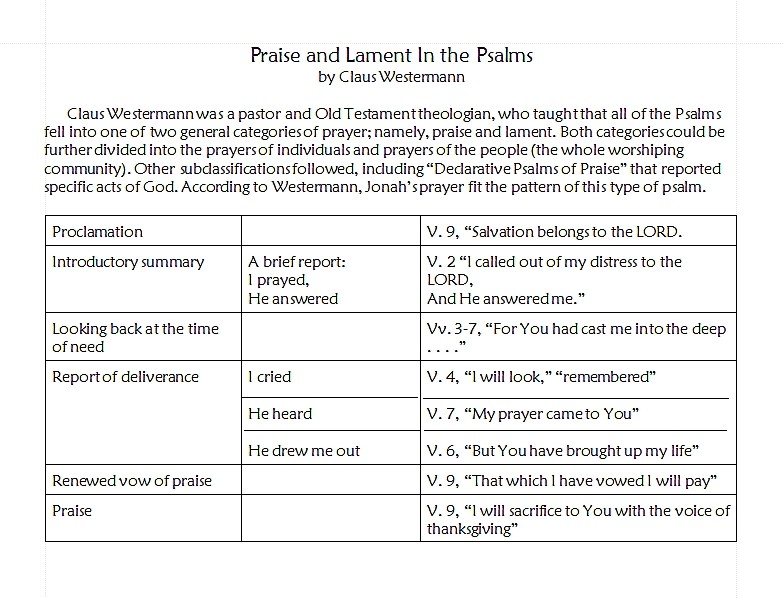
I called out of my distress to the LORD,
And He answered me.
I cried for help from the depth [belly] of Sheol;
You heard my voice. 
Jonah 2:2

Jonah’s prayer is structures as a psalm of praise

Are we meant to assume he composed this poetic prayer inside the fish?
– possibly – it definitely contains lines from other psalms
• maybe he pieced together stanzas he had sung many times before
◦ many “spontaneous” prayers in our churches are little more than a string of cliches
• one thing that strikes me as odd, is there is no mention if his wrongdoing
◦ the closest he comes to an admission of guilt is in verse 8 — an obscure statement
◦ this not a psalm of confession
– the past tense may suggest this was written after the fact and upon reflection
• poetry recreates experience – and psalms take us inside the heart of prayers
• what we have is an embellished account of what his soul endured

To understand the poem, we have to accept its nonlinear development
– the events are out of sequence Continue reading