Repentance

Summary of Rewriting the Brain’s Owner’s Manual

How the brain’s Owner’s Manual is written through a lifetime:
“Neurons that fire together, wire together”
Habits are a person’s history imprinted on the brain and nervous system

The three main sections of the Owner’s Manual
The brain’s outer layer or cortex
sensory (bodily sensations) and motor (bodily movements)
the rational brain (in the frontal lobe, above the eyes–“prefrontal cortex”)
reason, analysis, planning, discretion
The brain’s internal areas
short term and long term memory storage
the emotional brain (limbic system)
romance, fear, anger, disgust, joy, etcetera
The brain stem (area that connects the brain to the spinal chord)
communication center for brain and body
the involuntary brain – regulates many of the body’s systems
toggles between a resting state and a fight or flight state
In emergencies, the brain stem activates the body and parts of the brain
– this happens a split second before a message reaches the rational brain
– some events are imprinted on the limbic system and the body’s nervous system without being recorded in explicit (working) memory
Many automatic, negative, and habitual thoughts are unconscious
– we are unaware of how they were written in our Owner’s Manual
– we need to know what’s written there if we’re going to rewrite it

Challenges:
We are caught up in our thoughts and feelings as if they were reality
“I am not my thoughts. I am not my feelings”
We are not aware of our unconscious automatic thoughts and feelings
we merely think our thoughts and feel our emotions without choosing them
We are addicted (by our brain chemistry) to certain thoughts and feelings
we have developed a dependency on them to help us cope
we continue to have them because they feel “natural”

Neuroplasticity refers to the brain’s ability to change–even to old age
Epigenetics tells us that genes do not determine all aspects of personality
– some genes are not predetermination, but a predisposition
– those genes can be turned on and off
We can rewrite our brains’ Owner and Operations Manual

Ways to Rewrite the Brain

The key to changing how the brain processes information–that is, our core beliefs, perspective, responses and reactions, attitude, moods, and so on–is focused attention. Through focused attention we cultivate the awareness necessary to observe what our brain is doing (and telling us) and then to reshape its neural connections.

Prayer
– bringing the “whole self” to God in silence, calming our soul (Ps. 131:2)
(the body as well as the mind, heart, and soul)
– trusting God has real value in reducing stress and anxiety
– affirming the new self we will be tomorrow by thanking God today

Being – aware of our “here and now” experience
◦ enter your body, “What am I feeling right now?”
◦ enter your mind, “What am I thinking right now?”
◦ enter your emotions, “What is my mood right now?”

Experiencing (all our senses)
Seeing – Hearing – Touching – Tasting – Smelling
– feeling the inside of the body as well as the outside
– discover bad habit “triggers” and catch them in the act

Savoring – positive experiences
– when something pleasant happens, hold on to it
– allow it to sink in so the brain can memorize the feeling of it

Doing – reinforce new neural circuits by acting on your new thoughts
– the brain needs new challenges to continue developing
– be at peace with being a beginner; clumsy at first

Integrating – create a total experience
– combine thought, emotion, physical sensations, and movement

Longing – be passionate about the changes you want to make
– be specific about your practice: Where? When? How?

Repeating – repetition is how we formed our current neural circuits
– practice focused attention
• the more we use those new synapses, stronger the connection
• this is what strengthens our new mental and emotional habits


Notes and handouts for each message in this series can be found on our blog site: http://reflexionsc.net/
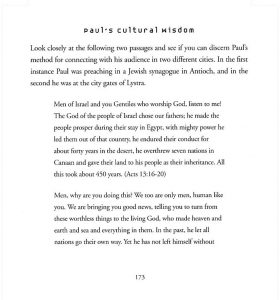
Handout for Acts 14

Apologies for how clumsy this was done, but if you find it really frustrating but you are intensely interested in the material, you can find this book on amazon.com. There Is A Season, by chuck smith, jr and published by WaterBrook.

Season 1

Click twice on page to enlarge

Season 3

Click twice on page to enlarge

Season 2

Click twice on page to enlarge

Season 4

Click twice on page to enlarge

The Biblical Backstory of Acts Chapter 2

“This Is What Was Spoken Of”

The events reported in the second chapter of Acts on the “day of Pentecost” (one of Israel’s annual feasts) is central to the church’s mission. For that reason, we need to pay careful attention to these spectacular phenomena. The Spirit of God came crashing into the bodies of Jesus’ followers, setting the church apart from any previous work that God had done on earth within a human community.

To fully appreciate this world-changing moment requires more biblical background than we have time to cover in our Sunday morning meeting, so this summary is intended to give you an idea of the deep roots these strange events had in the Old Testament.

The Wistful Prayer of Moses

God told Moses to appoint seventy leaders to assist him in the daunting task of taking the horde of Israelite refugees through the desert. The Lord explained that he would place his same Spirit that inspired and empowered Moses on these men. This meant they too would be divinely energized and directed by God.

When “the Spirit rested upon them, they prophesied. But they did not do it again” (Nu. 11:16-25). In instances such as this, the English word prophesy can be misleading. We equate prophesy with words, either spoken or written. But the Hebrew word, as it is used in Old Testament Scriptures, can refer to the experience of a specific moment of inspiration in which God’s divine energy was released into the world through a human person. This inspiration empowers a number of different activities, including those performed by musicians–cf. 1 Chr. 25:1-3, where prophecy is connected with the playing of lyres, harps and cymbals.

That the leaders Moses appointed to assist him experienced prophecy only this one time and “did not do it again,” most likely served to validate the ongoing inspiration of God’s Spirit that would enable them to perform their duties.

For some reason, two men who were on the list of leaders were running late and failed to reach God’s sacred tent in time to join the others. Nevertheless, when the Spirit rested on the sixty-eight, he fell upon these two men as well. While on their way and still in the camp (among the people), they also began to prophesy. Joshua found this offensive and recommended to Moses that he “restrain them.” Moses, however, replied:

Are you jealous for my sake? Would that all the LORD’s people were prophets, that the LORD would put His Spirit upon them! (Nu. 11:27-29)

Apparently, until that moment the experience of God’s Spirit coming on a person in power was unique to Moses. Later on, Joshua is also described as being “filled with the Spirit” (De. 34:9). Otherwise, the experience of being supernaturally energized by the Holy Spirit was not a national privilege but the exclusive experience of specific people.

Who Else Experienced God’s Spirit In this Way?

Short answer: Anyone who had a significant role in the life of Israel, including political, military and spiritual leaders. Also anyone whose participation in worship was of special interest to God. The list includes:

  • Artisans and craftsmen who constructed God’s sacred tent with all its furnishings and decorations (Ex. 35:30-35).
  • People who served as Israel’s judges–i.e., interim leaders whom God used to rescue Israel from foreign invaders and oppressors (Jdg. 3:10; 6:34; 11:29; 13:26, etc.)
  • Israel’s first two kings (1 Sam. 10:6–and notice that like Moses’ leaders, Saul also “prophesied”–; 1 Sam. 16:13).
  • The prophets of Israel (2 Chr. 24:20-21; Eze. 11:5; Mic. 3:5-8, etc.).

Old Testament theologian, Walther Eichrodt, observed that God’s formation of a people devoted to him entailed “the emergence of specially equipped men and women whose leadership in word and deed . . . dragged the dull mass of the people with them, again and again smashing and sweeping away all the obstacles . . . raised against them.” And further on:

“Looking back, we may describe the overall spiritual pattern of classical prophecy as that of a dynamic power released by a new sense of the reality of God. This dynamic, invading Israelite life and thought with overwhelming force, sweeps away all that is stagnant, and unleashes a forward movement which can no longer be restrained, and which, once in full career, pauses for nothing.”

George Ladd commented: “The most notable work of the Spirit in the Old Testament was an ‘official ministry’, i.e., the Spirit endowed certain people because they filled particular offices . . . . The symbol of this official impartation of the Spirit was the anointing with oil.”

And William Barclay wrote, “. . . the fact remains that in general the work of the Spirit is connected with the extraordinary and the abnormal. The experience of the Spirit [in the Old Testament] is not an experience for the common man or the everyday.” It was, instead, reserved for special people appointed to fulfill specific tasks.

A Prophetic Twist

The prophet Joel delivered God’s word to Israel in a time when the nation’s agriculture was being ravaged by locusts. Although the people shared in the blame for their desperate condition, there was a radiant hope on the horizon:

It will come about after this
That I will pour out My Spirit on all mankind;
And your sons and daughters will prophesy,
Your old men will dream dreams,
Your young men will see visions.
Even on the male and female servants
I will pour out My Spirit in those days. (Joel 2:28-29)

Joel’s prophecy almost sounds like a response to Moses’ prayer, that all God’s people would be filled with his Spirit and prophesy. That this outpouring of God’s Spirit would include even children and slaves–society’s least valued members– stresses the universal nature of this promised gift. The destiny of God’s people was to become a “kingdom of priests” (Ex. 19:6), a nation devoted to God’s work, empowered by his Spirit.

Now We Come to Acts Chapter 2

When the disciples experienced the phenomena of the Spirit during Pentecost, the crowd that formed around the believers were astonished and perplexed. When Peter stood up to explain what they were witnessing, he used terms that were familiar to them, quoting from their scriptures and specifically citing the words of Joel that we just read. He introduced the quotation by informing them, “this is what was spoken of through the prophet Joel.” The promised future had arrived and it was happening before their eyes.

The amazing exploits and inspired writings associated with people like Moses, Samson, David, and Jeremiah were extended to all of Jesus’ followers. The work of the Spirit that William Barclay described as “abnormal” and “extraordinary” was being experienced by normal, ordinary men and women. Unbelievable, right?

A few years ago, Clark Pinnock wrote:

“Evangelical religion in our day had tended to become overly intellectualized . . . . We have become insecure in the presence of the strange, paralogical powers of the free, dynamic Spirit. And instead of lamenting our deficiency we have sought to restrict the outpouring of the Spirit to the first century so as to direct attention away from our own spiritual poverty.”

Theoretically, all Christians are special people appointed to a specific task–the task of giving testimony to the resurrection of Jesus. We are empowered to let the world know that Jesus is alive by telling them how he has worked in our lives. Those times in which we are filled with God’s Spirit gives our words greater force and effectiveness.

Introduction to The Book of Acts

A Satellite View of Acts

My intention here is not to provide background information or a structured outline of Acts like you could easily obtain from a study Bible, commentary or find online. Instead, I want us to enter Acts with a general idea of where it will take us. In my first talk I suggest a reasonable plot for the story that Acts tells. The ongoing tension that recurs in almost every episode carries the narrative from beginning to end.

Dear Theophilus (Acts 1:1, The Message Bible)
The Book of Acts is the second installment of a two volume work (the Gospel of Luke being Volume I). The opening chapters of Luke and Acts share certain similarities. The obvious one is that both are addressed to Theophilus. Others similarities include:

  • Predictions regarding what is soon to occur and specific instructions.
  • The ministry of John the Baptist in relation to Jesus Christ.
  • Someone is or will be “filled with the Spirit.”
  • The presence of Mary (at the birth of Jesus and the birth of the church).
  • A period of forty days preparation before Jesus began his ministry and again following the conclusion his ministry (Lk. 4:1-13; Acts 1:3).

Genre
Although Acts is the only New Testament book to report events after the life of Jesus, what Luke recorded was not strictly history.

Biblical scholars have tried to identify the class of literature that would best describe Acts (including one suggestion that compared it to a “television documentary like 60 Minutes”). Why is this important? Because genre affects how we read a book (fiction, biography, poetry, etc.).

For our purposes, we will treat Acts as a sacred text. Perhaps Luke knew it would be read as scripture–in the same way he and his contemporaries heard God’s Spirit speaking “through the mouth of David” (Acts 1:16; 4:25). This is consistent with Paul’s view, that God granted apostles and prophets new revelations to make known his inclusion of Gentiles in the promise of Jesus Christ (Ep. 3:3-7). Luke may have been called to such a role.

Acts may employ a number of well-known literary conventions, but it was not bound to any one formula.

Key Words and Ideas
There is a great deal of activity and far-reaching movement in Acts. Nevertheless, the action tends to swirl around specific themes. Typically, two or more themes will overlap as the stories unfold.

  • Jesus Christ–and the “name” of Jesus.
  • The “witness” that Jesus’ disciples both became and gave (to his ongoing life and work through resurrection).
  • The Holy Spirit, who empowers the disciples to be witnesses.
  • The gospel and the word that is proclaimed everywhere.
  • The kingdom of God–an important piece of the gospel message.
  • Rejoicing and joy as a frequent response when the word of God takes root in a community, family or individual life.
  • Old Testament quotations, which inform decisions made by the apostles and that are used to explain the person of Jesus as well as to understand the phenomena they experience.

Development
Acts is a book of stories, usually told in clusters, in which one event leads to the next. However, Luke does not always create a link between clusters or even between one story and the next, yet he is able to do this without breaking the book’s forward momentum.

Like Acts, Luke’s gospel also created a sense of events being driven forward (in that case, by the emphasis Jesus placed on getting to Jerusalem (e.g., Lk. 9:51; 13:32-35). In fact, the book of Luke begins and ends in Jerusalem (in the temple). Acts, however, begins in Jerusalem and ends in Rome.

We can identify in Acts critical stages of change and spiritual development in the communal life of Jesus’ followers:

  • A shift from Jerusalem as the center to churches in Gentile cities. This is especially evident in the way Antioch becomes a hub for Gentile ministry and mission. In Acts as well as his letters, Paul seems intent on decentralizing Christianity by creating independent churches over which elders were appointed (Acts 14:23) and that operated under the guidance and authority of itinerant apostles and prophets. We may notice that in Acts Paul’s encounters with leadership in Jerusalem did not always go well.
  • A shift from Peter as the movement’s leader in Jerusalem to James being in charge. Perhaps this is the price Peter paid for his ministry to Gentiles.
  • A shift from the church as a Jewish sect to a religion with a Gentile majority. Interestingly, the radical communal life of Jerusalem believers in the early chapters of Acts was not duplicated in Gentile churches.