October 13, 2019

Bel bows down; Nebo stoops;
their idols are on beasts and livestock;
these things you carry are borne
as burdens on weary beasts.
They stoop; they bow down together;
they cannot save the burden,
but themselves go into captivity.
Listen to me, O house of Jacob,
all the remnant of the house of Israel,
who have been borne by me from before your birth,
carried from the womb;
even to your old age I am he,
and to gray hairs I will carry you.
I have made, and I will bear;
I will carry and will save.
Isaiah 46:1-4

Intro: I haven’t prepared a sermon today or a Bible study

What I have is more like a personal meditation
– a thought, not so much for the analytical mind,
• as for the thirsty, needy soul
– depth psychology tells us that the thoughts that move us most,
• that motivate and influence us,
◦ are not our most logical or even conscious thoughts
◦ but stories, symbols and images in our unconscious
• for instance, what stirs a patriotic heart
◦ is not an essay on the philosophical government of democracy
◦ but seeing the American flag raised and hearing “The Star Spangled Banner”

This passage in Isaiah is a piece of prophetic poetry

The Hebrew Scriptures use humor at times
– their most frequent forms are puns, sarcasm, and irony
• their favorite targets are pagan gods and especially idols
Walter Bruggemann tells us Isaiah 46 gives us “a reflection upon the decisive contrast between Yahweh and the other gods”
• Bel and Nebo were two of Babylon’s chief deities
– when the poem describes them as bowing and stooping,
• it paints a picture: these are the larger than life idols of Bel and Nebo
◦ Babylon has been conquered and its idols are being carted off to the foreign land of their enemies
◦ as the wheels of the carts hit bumps and potholes, the idols and rock back and forth, and looked as though these gods were themselves bowing
• gods that the Babylonians assumed could not be defeated,
◦ were not only unable to save Babylon, but were themselves taken captive
◦ they were, in fact, “burdens” on the weary beasts that pulled them

Idolatry, was a big issue for Israel, yet seems irrelevant to us

I read through 1 John this week and saw a similar irrelevance
– the last line of John’s letter says,
Little children, keep yourselves from idols (1 Jn. 5:21)
• nowhere in his letter had John talked about idols
◦ the last chapter is full of Jesus Christ, God’s son
◦ for John, Jesus is not past tense – in him, we are in God (1 Jn. 5:12-15)
• his warning seems about idols out of place
◦ but maybe an idol is anything that comes between us and Jesus
◦ especially any material thing (cf. 1 Jn. 2:15-17)
– in Colossians, Paul lists behaviors we need to get rid of
• last in the list is, greed, which is idolatry (Col. 3:5)
• I think greed maybe our nation’s most prevalent sin
◦ people will make or sell anything to get rich
◦ many people have sold their souls

Like the Babylonians, our god of greed has not saved us
– instead, like the others, this idol has become a burden
• it has put the cost of owning a home out of reach for millions
• it has burdened many people with poor health
◦ it has been a burden on our families, friends and co-workers
◦ and our poor planet is burdened with its toxicity

The Lord our God is everything that idols are not

The “decisive contrst” Brueggmann mentioned is clear in this passage
He says, “Yahweh is an active subject and agent, whereas the gods of Babylon are passive, immobile, mute objects.”

Notice how verse 2 is like a negative image of verse 4
The idols: They stoop
Yahweh: I have made
The idols: they bow down together
Yahweh: I will bear
The idols: they cannot save the burden
Yahweh: I will carry
The idols: [they] themselves go into captivity
Yahweh: [I] will save

To get attention of his people, God says, Listen to me, O house of Jacob
– if they pay attention to what God says, they will learn something
• even more, they gain something
• something of real value
– from “birth” to “old age” signifies the span of Israel’s existence
• although the message is collective and for the nation,
• it speaks to individuals as well
◦ what concerns the community concerns the individual

The idea of God carrying his people is deeply symbolic

It is one of those important archetypes of Jungian and depth psychology
– one of the earliest representations of Jesus is a shepherd carrying a sheep on his shoulders
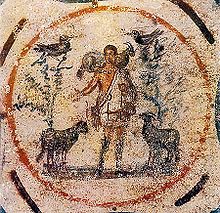
• being carried in the arms of God is a cherished image from ancient times
◦ for example, from the time of Moses:
The eternal God is your dwelling place,
and underneath are the everlasting arms
(De. 33:27)
• this was still an effective symbolic metaphor in Isaiah’s time
He will tend his flock like a shepherd;
he will gather the lambs in his arms;
he will carry them in his bosom,
and gently lead those that are with young
(Is. 40:11)
– it was still effective all the way into the 19th century
• in 1887 Anthony Showalter, who wrote many gospel hymns,
◦ published “Leaning On the Everlasting Arms”

What a fellowship, what a joy divine, Leaning on the everlasting arms;
What a blessedness, what a peace is mine, Leaning on the everlasting arms;
Leaning, leaning, Safe and secure from all alarms;
Leaning, leaning, Leaning on the everlasting arms.
Oh, how sweet to walk in this pilgrim way, Leaning on the everlasting arms;
Oh, how bright the path grows from day to day, Leaning on the everlasting arms;
What have I to dread, what have I to fear, Leaning on the everlasting arms;
I have blessed peace with my Lord so near, Leaning on the everlasting arms;
Leaning, leaning, Safe and secure from all alarms;
Leaning, leaning, Leaning on the everlasting arms.

• and it still worked in 1955, 1995, and 2010, where that hymn was used in the following movies:
◦ The “Night of the Hunter,” “Wild Bill,” and “True Grit”
◦ and the television series “House of Cards,” “Law and Order: Special Victims Unit,” and, my favorite, “The Simpsons”

I’m convinced that this specific imagery can still resonate in our hearts

How can wake myself up to being in God’s arms?

I think we can begin with the bare experience of life
– the problem is, we have to get out of the house,
• put away our cell phones, and see what’s here with our own eyes
• it is too easy to lose ourselves in mediated experiences
◦ watching other people engage in sports
◦ watching the adventures of others, scripted by human minds
– the world of people, pets and other living things is full of surprises
• full of wake-me-up moments

Yesterday I walked Kona, our yellow Lab, along Salt Creek Beach. As soon as we came within sight of the ocean, I saw dolphins. The number of dolphins in the pod was unusually large for as close as they came to the shore. It was a special moment that I wanted others to experience too. A man and woman passed us, walking the other direction with their heads down. I asked them, “Did you see dolphins?” She said, “Really?!” and he asked, “Where?” The woman did not see them at first, so he pointed to them for her. I left them to their own excitement and walked on.
It bothered me that so many others on the beach were missing the show. Some were tanning themselves, others throwing a football or frisbee, and others were staring into their cell phones. I wanted to yell at them through a megaphone, “You’re missing a miracle!”

I did not give myself this life I have
– I have not earned it, do not deserve it, and I do not sustain it
– life is a gift — “and underneath are the everlasting arms”

Conclusion: God reminded Israel that from birth he carried them

And even to their gray hairs he would carry them
– I wonder what will become of me,
• as I age and continue to decline in strength, mental acuity, mobility and influence?
– I have memories from childhood of falling asleep in the family car
• when we would arrive home, Dad would gather me into his arms, carry me into the house and put me to bed
• I can remember being in his strong arms
◦ feeling secure, comfortable, relaxed

That was my first helplessness
– in old age I’ll come to my last helplessness
• again someone take my hand and lead me
◦ feed me, dress me, and help me into bed
◦ all through, from birth to old age, God holds me
• and I am secure in God’s everlasting arms
◦ his arms are my symbol of trust

Trust the arms of the One
who made,
who carries,
who rescues,
and who loves us beyond imagination.

Lord, you have been our dwelling place
in all generations.
Before the mountains were brought forth,
or ever you had formed the earth and the world,
from everlasting to everlasting you are God (Ps. 90:1-2)

October 7, 2019

This is what the Lord GOD showed me: behold, he was forming locusts when the latter growth was just beginning to sprout, and behold, it was the latter growth after the king’s mowings. When they had finished eating the grass of the land, I said,
“O Lord GOD, please forgive!
How can Jacob stand?
He is so small!”
The LORD relented concerning this:
“It shall not be,” said the LORD.
This is what the Lord GOD showed me: behold, the Lord GOD was calling for a judgment by fire, and it devoured the great deep and was eating up the land. Then I said,
“O Lord GOD, please cease!
How can Jacob stand?
He is so small!”
The LORD relented concerning this:
“This also shall not be,” said the Lord GOD.
This is what he showed me: behold, the Lord was standing beside a wall built with a plumb line, with a plumb line in his hand. And the LORD said to me, “Amos, what do you see?” And I said, “A plumb line.” The the Lord said,
“Behold, I am setting a plumb line
in the midst of my people Israel;
I will never again pass by them;
the high places of Isaac shall be made desolate,
and the sanctuaries of Israel shall be laid waste,
and I will rise against the house of Jeroboam with the sword.

Amos 7:1-9

Intro: Amos has an unusual story, as he explains later

I was no prophet, nor a prophet’s son, but I was a [shepherd] and a dresser of sycamore figs. But the LORD took me from following the flock, and the LORD said to me, “Go, prophesy to my people Israel.” (Amos 7:14-15)

God put him on this mission after Israel passed the point of no return
– they had strayed so far from God, they were no longer “his people”
• God showed Amos the consequences of their betrayal
◦ but the way God delivers the vision is rather interesting
• it is as if he was trying out various possibilities with Amos
◦ there is an obvious pattern here, as if they were following a script
– God described a catastrophe; first, a locust invasion, then a fire storm
• Amos protested to both with the same words (with one exception)
◦ such disasters would result in Israel’s extinction
◦ so both times, God relented, “It shall not be” — or “Okay, not that”
• this sort of conversation has been referred to as “prophetic dialogue”
◦ here the drama is played out to underscore God’s goal
◦ it was not to decimate Israel or destroy them completely

This is explicitly stated near the end of Amos:
Behold, the eyes of the Lord GOD are upon the sinful kingdom,
and I will destroy it from the surface of the ground,
except that I will not utterly destroy the house of Jacob . . . .
All the sinners of my people shall die by the sword
(Amos 9:8-10)

The third vision reveals how God would judge his people selectively
– Amos, what do you see? – a plumb line is a string weighted on one end
• holding the other end, the hanging string would delineate a true vertical
◦ today, building a wall we would use a bubble level or laser
• in the vision, the walls were already built
◦ the plumb line was being used to test the integrity of the walls
◦ the idea: God had a criterion for determining his true followers
– when meditating on this passage, what came to me was this
• almost any object or event can embody a revelation
◦ a carpenter’s tool, a farmer’s harvest, a produce stand
• if we look, we’ll notice; if we notice, we can observe
◦ the language here is important:
“showed me,” “Behold” (4x), and “what do you see?”
◦ asking ourselves, “what do you see?” can take us to a deeper place
◦ into the moment and into ourselves
But do not try to force a meaning on things
Simply listen and whatever God has to show you come to you

I did not choose this passage today to share my meditation on it

Something else is on my mind, and it has bothered me for a long time
– I have always been drawn to Christian mystics
• to those souls that have hungered and thirsted for God
◦ and devoted their entire lives to pursue him in script and prayer
◦ who gave up everything, taking on vows of poverty and chastity
• but on occasion, I’ve been creeped out by their beliefs or practices
◦ an easy example is the severe asceticism of some
(to rivet their attention on God and avoid sin, they abused their bodies)
◦ what bothers me is the absence of support from or correlation to scripture
– I’ve wondered, What is the source of their insights if not Bible?
• their own experience? culture? philosophy? other influences?
• there is a sad history of mystics within the church who went too far
◦ for instance, the Gnostics, Arians, and Montanists

Recently I’ve been reading an author whose name I won’t mention
(because I really enjoy his books and don’t want to discourage anyone from reading them)
– he is insightful, inspiring, helpful and encouraging
• but he describes the awareness gained through contemplation
◦ as “the ground of awareness itself”
◦ and “the flowing luminous vastness that is interior silence”
• years ago I read Paul Tillich’s definition of God as “the ground of all being”
◦ I get it–the statement is true, but it’s an intellectual concept
◦ and it isolates one facet of God while excluding others–
others that are equally important
– what concerns me is the vagueness of these formulations
• Tillich also stressed the idea of God as “the wholly other”
◦ it is true, God is transcendent
◦ but the other half of the truth is that God is immanent
• I realize God is beyond the ability of the human brain to define
◦ but does that bring me any closer to him?

I read somewhere that much of our theology is negative
– we say that he is invisible, intangible, immutable, immortal
• we also refer to him with absolutes
• omnipotent, omniscient, omnipresent, all-loving
– but these statements don’t do much to connect us to him
• they do not spell out the ways he is here for us
• Christian spirituality includes a great breadth of truth
◦ the journey will take us deep in to some regions,
◦ but each region is one vein of an infinite matrix from which no other vein can be excluded

We have to be exercise caution with theology

It can be a short step from truth to heresy
– this happens when one half of a truth is overemphasized
• G. Campbell Morgan referred to St. John as a “contemplative”
(others have used the term “mystic”)
◦ in his gospel, he says the logos that came “was God”
◦ in 1 John, he says God is phos (light), zoe (life), and agape (love)
• these represent multiple aspects of God’s nature
◦ they work because John does not insist on one to the exclusion of any of the others
– read 1 John closely – John’s theology is emphatically personal
• his reference to the “blood of Jesus” is concrete not abstract
◦ the application of Jesus’ blood is mystical
◦ but the shedding of his blood was literal
• in fact, the biblical revelation of God as Person is so strong,
◦ it risks anthropomorphism (describing him in human terms)
◦ yes, there’s the cloud that obscures our vision (Mt. 17:1-8)
but there’s also the voice from the cloud–
the voice of a Person who owns Jesus as his Son

God is not an abstraction nor is he a concept
(and you are not a concept, and I’m not a concept)

I think many Christians pray to their concept of God
– we cannot dispense with our concepts,
• we just have to remember that God is person
◦ he has a name
◦ and he’s revealed it to us so we can call on him
• the prophets’ and apostles’ encounters with God,
◦ were never like floating in a vast luminescence
◦ they were a meeting of minds, conversations, I-Thou
– last week Kelsey reminded us, God is not an object
• we cannot study him under a microscope or find him through telescope
◦ we can’t make images of him, because God is Spirit (Jn. 4:24)
◦ our exp isn’t something we can carve in wood or sculpt in stone
• but we can make this positive and definite statement:
◦ God is person
◦ that is what makes it possible to be in relationship with him

There’s one other facet that needs to be clarified

It has become popular in some circles to stress monism–oneness
– this is obviously important because God is One
• Jesus and the Father are One
◦ we are One with Jesus and One with each other
• but oneness does not obliterate our individual selves
◦ and it does not obliterate dualism
◦ Kelsey pointed out last week that dualism is important
but some believers don’t see it’s importance
and some are even anti-dualism
– we’re told that dualism is a Greek idea, derived from Plato’s philosophy
• that monism was the Hebrew worldview
• but read the first chapter of Genesis
◦ God brought order to the original chaos by dividing things
◦ first light and darkness, then an expanse separating waters,
then the dry land and oceans
• dualism AND monism are two halves of the same whole
◦ we are looking at the reverse sides of the same coin
◦ “diversity within unity” describes both the triune God and his church
– I regret there isn’t enough time to go over this as much as I would like
• but give dualism some serious thought
• the basic categories of scripture are: heaven and earth
◦ God and humankind–i.e., God and us!

Conclusion: What is the true heart of Christian spirituality?

You see, this is the wrong question
– the correct question is Who is the heart of Christian Spirituality?
• there is one obvious answer: Christ!
• not a vaguely defined universal Christ-consciousness
◦ but the man Christ Jesus (1 Tim. 2:5)
– what our souls hunger and thirst for,
• what we are striving for in Christian spirituality is to know Jesus (Php. 3:7-11)
• our progress is measured by our growth in the grace and knowledge of our Lord and Savior Jesus Christ (2 Pet. 3:18)

In my first lengthy conversation with Fr. Romuald, he told me,
“In the Hebrew language, there are no abstract or impersonal words. Everything is concrete and down-to-earth language. All Hebrew says is ‘you’ and ‘me.’ There is no verb in between us. It is, ‘I for you, you for me.’”

This has been my primary concern today
to remind you, make certain your contemplation
is an opening to the Person and to his presence
And that our spirituality is definite
and therefore we speak openly and clearly (2 Cor. 3:12)
Our goal is not to become more spiritual
or mystical,
but to know Jesus Christ
And then, to get to know him even better,
until knowing him, we are fully transformed by him

Repentance

Summary of Rewriting the Brain’s Owner’s Manual

How the brain’s Owner’s Manual is written through a lifetime:
“Neurons that fire together, wire together”
Habits are a person’s history imprinted on the brain and nervous system

The three main sections of the Owner’s Manual
The brain’s outer layer or cortex
sensory (bodily sensations) and motor (bodily movements)
the rational brain (in the frontal lobe, above the eyes–“prefrontal cortex”)
reason, analysis, planning, discretion
The brain’s internal areas
short term and long term memory storage
the emotional brain (limbic system)
romance, fear, anger, disgust, joy, etcetera
The brain stem (area that connects the brain to the spinal chord)
communication center for brain and body
the involuntary brain – regulates many of the body’s systems
toggles between a resting state and a fight or flight state
In emergencies, the brain stem activates the body and parts of the brain
– this happens a split second before a message reaches the rational brain
– some events are imprinted on the limbic system and the body’s nervous system without being recorded in explicit (working) memory
Many automatic, negative, and habitual thoughts are unconscious
– we are unaware of how they were written in our Owner’s Manual
– we need to know what’s written there if we’re going to rewrite it

Challenges:
We are caught up in our thoughts and feelings as if they were reality
“I am not my thoughts. I am not my feelings”
We are not aware of our unconscious automatic thoughts and feelings
we merely think our thoughts and feel our emotions without choosing them
We are addicted (by our brain chemistry) to certain thoughts and feelings
we have developed a dependency on them to help us cope
we continue to have them because they feel “natural”

Neuroplasticity refers to the brain’s ability to change–even to old age
Epigenetics tells us that genes do not determine all aspects of personality
– some genes are not predetermination, but a predisposition
– those genes can be turned on and off
We can rewrite our brains’ Owner and Operations Manual

Ways to Rewrite the Brain

The key to changing how the brain processes information–that is, our core beliefs, perspective, responses and reactions, attitude, moods, and so on–is focused attention. Through focused attention we cultivate the awareness necessary to observe what our brain is doing (and telling us) and then to reshape its neural connections.

Prayer
– bringing the “whole self” to God in silence, calming our soul (Ps. 131:2)
(the body as well as the mind, heart, and soul)
– trusting God has real value in reducing stress and anxiety
– affirming the new self we will be tomorrow by thanking God today

Being – aware of our “here and now” experience
◦ enter your body, “What am I feeling right now?”
◦ enter your mind, “What am I thinking right now?”
◦ enter your emotions, “What is my mood right now?”

Experiencing (all our senses)
Seeing – Hearing – Touching – Tasting – Smelling
– feeling the inside of the body as well as the outside
– discover bad habit “triggers” and catch them in the act

Savoring – positive experiences
– when something pleasant happens, hold on to it
– allow it to sink in so the brain can memorize the feeling of it

Doing – reinforce new neural circuits by acting on your new thoughts
– the brain needs new challenges to continue developing
– be at peace with being a beginner; clumsy at first

Integrating – create a total experience
– combine thought, emotion, physical sensations, and movement

Longing – be passionate about the changes you want to make
– be specific about your practice: Where? When? How?

Repeating – repetition is how we formed our current neural circuits
– practice focused attention
• the more we use those new synapses, stronger the connection
• this is what strengthens our new mental and emotional habits


Notes and handouts for each message in this series can be found on our blog site: http://reflexionsc.net/

September 15, 2019

Podcast

Therefore I will judge you, O House of Israel, every one according to his ways, declares the Lord GOD. Repent and turn from all our transgressions, lest iniquity be your ruin. Cast away from you all the transgressions that you have committed, and make yourselves a new heart and a new spirit! Why will you die, O house of Israel? For I have no pleasure in the death of anyone, declares the Lord GOD; so turn and live.
And I will sprinkle clean water on you, and you shall be clean from all your uncleannesses, and from all your idols I will cleanse you. And I will give you a new heart, and a new spirit I will put with in you. And I will remove the heart of stone from your flesh and give you a heart of flesh Ezekiel 18:30-32 and 36:25-27

Intro: Why are these two passages not a contradiction?

First, God tells Israel to make for themselves a new heart and spirit
– then later, he says he will give them a new heart and spirit
• which is it? Do create the new self we are to become or does God?
◦ asking the question this way suggests an apparent contradiction
◦ it assumes that the situation must be either this or that
• either we are the active agents for change or God is the active agent
– the right question to ask:
“In becoming a new person, what is my part and what is God’s part?”
• now, instead of a contradiction there is cooperation
◦ but complementarity might be a better word

In quantum physics one object may consist of two properties, both of which cannot be measured at same time. For instance, in one experiment light presents itself as a wave; in another it presents itself as particles. This was difficult for many physicists to accept. They believed light had to be either a wave or particles, it could not be both. To date, there is no one experiment that demonstrates light as both wave and particle. Whether it acts like a wave or particles depends on how you look at it.

• examined one way, it looks like our faith depends entirely on us
◦ examined another way, our faith depends entirely on God
. . . work out your own salvation with fear and trembling,
Our faith depends on us, right? But the sentence goes on to say,
for it is God who works in you, both to will and to work for his good pleasure (Php. 2:12-13)
Now our faith depends entirely on God–even our willingness
. . . to all those who did receive him, who believed in his name, he gave the right to become children of God,
Being God’s children depends on, right? But the same sentence says,
who were born, not of blood nor the will of the flesh nor of the will of man, but of God (Jn. 1:12-13)
Now being God’s children depends on God

Today we review and conclude all we’ve learned up to now

We began with the word “repent” – “to think after” or “change the mind”
– there is a biological side to this change
• we have to change what our brains are doing
Curt Thompson, “We do not experience anything without there being a corresponding neuron firing pattern that represents that experience.”
• to produce one thought requires thousands of brain cells
◦ the brain forms habits by activating the same cluster of neurons,
◦ repeating the same pattern
– I used the analogy of creating a path through overgrown field
• the more you trample down the weeds, the clearer the path
◦ and the easier and quicker it is to travel that path
◦ that is how habits are formed in the brain
• the brain doesn’t discern if a habit is healthy or unhealthy
◦ some of our idea about ourselves and others are wrong
◦ we are all broken in some way, wrong about some things

We have referred to our brains’ programming as our “Owner’s Manual”
– most of what is written there is unconscious
• there are many well-worn paths along which it is programmed to run
• and the way it runs is reflexive, reactive, and automatic
– to repent is to rewrite the brain’s owner’s manual

There is a key skill we must learn to rewrite the owner’s manual

Let’s go back to Ezekiel for a moment
Son of man, these men have taken their idols into their hearts, and set the stumbling block of their iniquity before their faces. Should I indeed let myself be consulted by them? (Eze. 14:3)
– Ezekiel’s visitors did two things that were related and were wrong:
• they took something into their hearts and set something before faces
◦ “set before” — to intentionally make a thing the focus of attention
• this is how the had internalized their idolatry; taken it into their hearts
Daniel Siegel, “One of the key practical lessons of modern neuroscience is that the power to direct our attention has within it the power to shape our brain’s firing patterns, as well as the power to shape the architecture of the brain itself.”
“The intentional focus of attention is actually a form of self-directed experience: It stimulates new patterns of neural firing to create new synaptic linkages.”
– in Ephesians and Colossians, Paul says we are to
put off old the self
and
put on the new self
• our part of this is doable, but it requires our focused attention

The practice of contemplative prayer trains us to focus attention

The prophet Habakkuk was frustrated by what he saw in society
– but what God told him was coming disturbed him even more
• frustrated, he made a decision:
I will take my stand at my watchpost
and station myself on the tower,
and look out to see what he will say to me,
and what I will answer concerning my complaint
(Hab. 2:1)
◦ in other words, before doing anything else,
◦ he was going someplace where he could hear from God
• the revelation he received became the foundation for Paul’s doctrine of “justification by faith”
◦ in fact, it is quoted at least four times in New Testament
– we cultivate awareness by quietly sitting in our observation tower
• we need a place alone with God where we can watch and reflect
◦ by reflect, I mean look at the reflection of our thoughts, ideas, feelings, perspective, attitude, reaction to situations, and so on
• we cannot change if we let our lives pass unnoticed

Awareness is not simply knowing that I am doing something
– it is observing myself doing something
• walking, having a conversation, thinking a thought
• it is not simply knowing something is happening
◦ it is an involved observation of an event as it unfolds
◦ an inner experience of interest and curiosity
– Daniel Siegel has an exercise he uses with many of his clients
• he has them bring their attention to middle of the room
◦ then move their attention to wall opposite them
◦ then move their attention back to the middle of the room
◦ then he has them bring their attention close to their faces
Siegel, “Notice how your attention can go to very different places.”
• we can send our attention to different places
◦ internal and external, real and imaginary

Sitting in the observation tower of contemplative prayer,
– we cultivate our present moment awareness
• we can get to the point where we detect
◦ when we’re mindfully aware and when we’re mindless
– it’s possible to learn to make decisions that are twenty times wiser
• if we pause, calm ourselves, and bring awareness to God’s presence
Curt Thompson, “. . . if I am aware that my fear is deeply connected to my breathing and heart rate, I can reduce my fear simply by consciously breathing deeply and slowly whenever I sense myself becoming fearful.”
• he says, “whenever I sense myself” – we cultivate this awareness too
◦ we listen to what goes on inside our bodies
◦ even if I’ve deafened myself to my body my whole life
Siegel, “. . . the brain is open to change across the lifespan. Because it responds to the focus of attention and to the experiences we create intentionally, there [is] great hope that those unrealized neural connections could still be stimulated to develop.”

Our bodies register a large variety of sensations
– sometimes we mistake a sensation for an emotion
• I knew a woman who thought she was always on verge of having a heart attack
• our bodies have something to tell us — we have to learn to listen
Curt Thompson, “. . . many elements of our mind/body matrix are means by which God is trying to get our attention, but we have not had much practice reflecting on them.”

Another area where we want to deepen our awareness: our self-talk

There is a lot of this going on in the Psalms
– for example, Why are you cast down, O my soul . . . ? (Ps. 42:5)
• there is negative self-talk
All in vain have I kept my heart clean
and washed my hands in innocence
(Ps. 73:13)
• and there is positive self-talk
Return, O my soul, to your rest
for the LORD has dealt bountifully with you
(Ps. 116:7)
◦ what are you telling yourself about your feelings, etc.?
◦ what are you telling yourself about you?
– we want to be aware of our thoughts as they arise
• I’ve found a helpful habit is to ask, “What am I thinking about?”
◦ then with slow deep breaths, become aware of my thoughts
• what do you want to reinforce? What do you want to resist or erase?

Conclusion: All through this series of lessons I have taught our part

I want to finish today with God’s part
– Andre’ Louf tells a story about the day he became an Abbot
• he requested a quote be read by Francois Fenelon
◦ it had to do with spiritual directors, which would be one of his duties
• after the reading, the Abbot who blessed him told Louf,
“. . . that is indeed what you will have to do from now on. Never try to impose yourself on your brothers. Of course, you would do very well, but grace can do more!”
– and that is the title of Louf’s book
• the last and most important lesson of this series

This is what I will leave us
The road ahead will be sometimes difficult,
sometimes frustrating and sometimes overwhelming
Some of us will be tempted to give up
But we will not give up,
not if we go forward fully dependent on God’s grace

Martin Laird, “. . . something that Christianity calls grace (God as constantly giving, constantly pouring Himself out) is an utterly reliable necessity.”

Whatever we give to this project,
God will add immeasurably more

September 8, 2019

Podcast

If the Spirit of him who raised Jesus from the dead dwells in you, he who raised Christ Jesus from the dead will also give life to your mortal bodies through his Spirit who dwells in you.
So then, brothers and sisters, we are debtors, not to the flesh, to live according to the flesh. For if you live according to the flesh you will die, but if by the Spirit you put to death the deeds of the body, you will live. For all who are led by the Spirit of God are sons of God. For you did not receive the spirit of slavery to fall back into fear, but you have received the Spirit of adoption as sons, by whom we cry, “Abba! Father!” The Spirit himself bears witness with our spirit that we are children of God.
Likewise the Spirit helps us in our weakness. For we do not know what to pray for as we ought, but the Spirit himself intercedes for us with groanings too deep for words. And he who searches hearts knows what is the mind of the Spirit, because the Spirit intercedes for the saints according to the will of God Romans 8:11-16, 26-27

Intro: Yesterday morning when I woke up, I felt stressed

I think now, that it was worry over preparing today’s talk
(imagine preparing and delivering an oral report every week)
– it began with a mild funk, but gradually intensified
• do you know how it is when you have a big job before you
◦ and you’re anxious to get to it immediately?
◦ having to do all the little daily chores first seems so annoying
◦ and I still had my regular morning reading and prayer time
• one reading was from Hebrews 12, and I thought to myself,
“Yes, yes, I’ve read this a hundred times!”
◦ coming to the words we’re not to grow weary and fainthearted, I cringed
◦ I felt both!
◦ and the key theme of the chapter 12 is endurance
It is for discipline that you have to endure (Heb. 12:7)
– the passage goes on to say God disciplines those he love–like a father
• and in the moment, all discipline seems painful
◦ then it hit me, “That’s what this moment is about!”
◦ my nervous system was in a reactive state and needed to be calmed
◦ this was an opportunity to practice my discipline in prayer
• God does not create our misery or stressful situations
◦ the world does — as Jesus said:
. . . do not be anxious about tomorrow, for tomorrow will be anxious for itself. Sufficient for the day is its own troubles (Mt. 6:34)
In the world you will have tribulation (Jn. 16:33)
◦ what God does, is make this an opportunity to practice discipline
– it’s like the first time I took a bad spill when learning to ride bike
• my dad did not cause me to fall off my bike
◦ but he was there to comfort, me and encourage me to get back on
• God did not want me to be miserable yesterday morning,
◦ but neither did he want my misery to be wasted

Today’s talk will cover unique forms of prayer

Practicing these disciplines, will improve our progress
– remember, we are rewriting the owner’s manual of our brains
• like Paul said in the Romans passage above,
we are putting to death the deeds of the body
• we are breaking the connections between brain cells of old habits
– these prayers are unique, because in them we don’t do all the talking
• I think most of us have learned to pray with our rational minds
◦ in prayer, we express our thoughts and feelings to God
◦ so our prayer tends to be a monologue rather than a conversation
• prayer from our spirit, and in the Spirit is wordless
If I pray in [an unknown language] my spirit prays but my mind is unfruitful. What am I to do? I will pray with my spirit, but I will also pray with my mind (1 Cor. 14:14-16)
◦ Paul is saying, public prayer has to be with the rational mind
◦ but our private prayers can come from another place within us

A few weeks ago I tried to frustrate you by reading from Romans 7 in the King James Version of the Bible
– there Paul described the “human condition” as it played out in his life
• he knew right from wrong, and wanted to do right,
◦ but something within him drove him to do wrong
• the answer to that inner conflict is in chapter 8
◦ God’s dynamic, powerful Spirit lives in us
◦ he assists us with everything God wants to do in our lives
– this includes prayer
• and when we do not know what to pray, the Spirit prays in us
• prayers too deep for words

So what are these unique forms of prayer?

First, we learn to seek God
– this is all through the Bible, especially the Hebrew Scriptures
• sometimes we’re told to seek God–and something else
Seek the LORD and his strength (Ps. 105:4)
◦ but mostly we are to seek God for himself
Seek his presence [face] continually (Ps. 105:4)
• this speaks to our primal need for God
◦ the creature in need of its Creator
As a deer pants for flowing streams,
so pants my soul for you, O God.
My soul thirsts for God,
for the living God.
When shall I come and appear before God?
(Ps. 42:1-2)

When Paul argued his faith with philosophically-minded Athenians, he explained that God organized the divisions of humankind according to their place geographically and in time. He did this so that they should seek God, and perhaps feel their way toward him and find him. Yet he is actually not far from each one of us, for in him we live and move and have our being (Acts 17:26-28). He was speaking to their primal need for God that drove them to seek him beyond all of their other deities, even though he was “unknown” to them.

– we never outgrow this essential need for God
• searching for God, we do not settle for ideas about God
◦ we don’t spend our time contemplating a God-concept
◦ we may notice our ideas about God, but we move past them
• it’s important to remember what Paul said about God being
not far from each one of us
◦ we do not conjure God, we do not make him present
◦ we open ourselves to the present moment and find him here

Then you will call upon me and come and pray to me, and I will hear you. You will seek me and find me, when you seek me with all your heart. I will be found by you, declares the LORD (Jer. 29:12-13)
Ask, and it will be given to you; seek and you will find; knock, and it will be opened to you. For everyone who asks receives, and the one who seeks finds, and to the one who knocks it will be opened (Mt. 7:7-8)

Next, we learn to wait for God
– this too is found throughout Hebrew Scriptures, especially the Psalms
• but the classic verse that most of us know is in Isaiah:

Have you not known? Have you not heard?
The LORD is the everlasting God,
the Creator of the ends of the earth.
He does not faint or grow weary;
his understanding is unsearchable.
He gives power to the faint,
and to him who has no might he increases strength.
Even youths shall faint and be weary,
and young men shall fall exhausted;
but they who wait for the LORD shall renew their strength;
they shall mount up with wings like eagles;
they shall run and not be weary;
they shall walk and not faint
(Isa. 40:28-31)

• everyone loves the idea expressed here – and wants it that renewal
◦ but few are willing to actually do what it requires – wait for God
– waiting is not passive, just sitting around doing nothing, killing time
• it is looking forward to the arrival of something important
◦ anticipation, alertness, attentiveness, and a readiness to respond
• we pause – we center ourselves in God – we rest – we trust

Next, we learn to watch in prayer
O my Strength, I will watch for you,
for you, O God, are my fortress
(Ps. 59:9)
Watch and pray that you may not enter into temptation. The spirit indeed is willing, but the flesh is weak (Mk. 16:38)
– typically, we are watching for whatever threatens us
Martin Laird says, “This . . . is an ancient contemplative practice called vigilance or watchfulness.”
• we’re not watching in fear or anxiety
◦ it is a quiet and calm observation of the present moment
◦ we observe whatever thought or feelings occur
• this was the job of the gatekeepers in the temple
◦ they monitored what was brought into the sanctuary
This is God’s Message. Be careful, if you care about your lives, not to desecrate the Sabbath by turning it into just another workday, lugging stuff here and there (Jer. 17:21, the Message)
◦ we monitor whatever enters the time we spend in God’s presence
– eventually we discern that thoughts and feelings are not reality
• they only appear real when we are lost in them
◦ you are not what you think or feel about yourself
• we also learn to discern the difference between thoughts
(and the stories we add to our thoughts and feelings, which cause us chaos and distress)
◦ rather than being victims of our thoughts, we become witnesses of them (Martin Laird)

Another unique prayer we learn is to be still
Be still, and know that I am God (Ps. 46:10)
I do not occupy myself with things
to great and too marvelous for me.
But I have calmed [or stilled] and quieted my soul . . .
(Ps. 131:2)

The last unique prayer I’ll mention is that we learn to be silent
– notice the following verses combine waiting, seeking and silence:
The LORD is good to those who wait for him,
to the soul who seeks him.
It is good that one should wait quietly
for the salvation of the LORD. . . .
Let him sit alone in silence
when [the yoke] is laid on him;
let him put his mouth in the dust–
there may yet be hope
(Lam. 3:25-29)
• “mouth in dust” is not about people degrading themselves
• it simply means, stop talking!
◦ silence all those inner voices that distract us from God

Conclusion: Our rational minds can form words and concepts of God

But we cannot with our rational minds embrace God himself
– we embrace him with the soul
• it is our with our spirit that we seek God
◦ that we wait, watch, and sit in silent stillness
• when we find, receive and the door is opened
◦ the encounter with God is Spirit to spirit

These strange forms of prayers
become the arms with which we reach out to God,
and when we enter the stillness of the present moment–
waiting, watching, listening–
God draws near,
embraces us in his love,
and breathes new life into our spirit

August 25, 2019

Podcast

Beloved, let us love one another, for love is from God, and whoever loves has been born of God and knows God. Anyone who does not love does not know God, because God is love. In this the love of God was made manifest among us, that God sent his only Son into the world, so that we might live through him. In this is love, not that we have loved God but that he loved us and sent his Son to be the propitiation for our sins. Beloved, if God so loved us, we also ought to love one another. No one has ever seen God; if we love one another, God abides in us and his love is perfected in us. . . . 1 John 4:7-21

Intro: Wednesday morning, I drove three of my grandchildren to school

Before leaving their home, Calum complaining he had a stomach ache
– he suggested to me that he didn’t think he should go to school
• I assured him, he’d be fine once he got with his friends
◦ then he told me he also had a sore throat
• I felt that there was some a little sadness behind his complaint
◦ I know that school creates stress for him
◦ the thought of saying good-by to grandpa bothered him
– I said, “Just go until recess. If you still feel sick, then go to the office”
• later, my son Scotty told me, “Maybe next time don’t give him that option”
• it’s true – I caved-in to his manipulation
(But it’s possible Grandpa wanted to be with Calum as much as Calum wanted to be with Grandpa)

Our relationships are not only important, but crucial
– Johann Hari cites research into studies on loneliness
• it turns out, feeling lonely causes cortisol to spike as much as trauma
(cortisol is a hormone released in the blood stream in response to stress)
◦ loneliness creates as much stress to the body as being physically attacked
◦ being isolated from others creates a serious health risk
• loneliness increases:
◦ the damage of the major health risks and illnesses–e.g., heart disease
◦ the risk and severity of depressive and anxiety disorders
◦ the likelihood that a person will shut down socially
◦ becoming suspicious, fearful of strangers, and hyper-vigilant
◦ of being “more likely to take offense where none was intended”
– we need healthy relationships with other people to be whole persons

Our summer project has been to understand and practice repentance
– but to change the direction of our lives requires changing our brains
• the brain’s owner’s manual has been written over our lifetime
• something that is alarming if your think about it:
◦ almost anyone can write a chapter in my brain’s manual
◦ even complete strangers
(an AA quote: “The people who know how to push your buttons are frequently the ones who installed them”)
– we humans have this power

Death and life are in the power of the tongue,
and those who love it will eat its fruits
(Pr. 18:21)
Gracious words are like a honeycomb,
sweetness to the soul and health to the body (Pr. 16:24)

• we can use this power to heal ourselves and others

John is sometimes referred to as the Apostle of Love

It is certainly a central theme in his writings
– we can tell by the way he talks about loving others,
• that he knows the concept is simple and it is true, but it is not easy
– love isn’t one specific feeling, attitude, or way of treating others
• love takes many different forms
◦ it can be a voluntary weakness or an unyielding strength
• and there are many ways love can unravel
◦ whatever philosophers, scientists, or poets may say about love,
◦ there is no life in Christ apart from love — for God is love

John specifies that we’re to love one another and our brother

Today I want to talk specifically about family, friends and neighbors
– from our closest bonds, as in marriage,
• to congenial interactions with others on campus or at the workplace
– the brain’s owners manual on this subject is fascinating

A friend in high school who vowed he would never have children,
– defined babies as organisms that functioned,
“They sleep, they cry, they eat, they poop”
• that was a prevailing view until about fifty years ago
• a baby’s nervous system was considered to be all reflex
◦ when stimulated, it could be activated or calmed
◦ but the infant was not aware of being a self performing an action
– in the seventies, researchers began filming infants and mothers
• they discovered, in the words of Colwyn Trevarthen, that “infants are actually born with playful intentions and sensitivity to the rhythms and expressive modulations of a mother’s talk and her visible expressions and touches.”
◦ even in their first year, “infants evoked ‘intuitive parenting’”
◦ babies are born with skills that later enable them to learn language
Catherine Mary Bateson noted that infants had other abilities, including rituals for healing ruptures in their relationship with their mothers
• these were confirmed by neuroscience in 1990s with new imaging technology that enabled researchers to observe activity in a living brain
Trevarthen, “Actions, even a newborn’s, are intelligent and conscious.”

A friend of mine has been effective in treating children on the autism spectrum
– typical symptoms include trouble communicating and social interaction
• my friend doesn’t offer a “cure,” but enables these children to progress
• her work is focused on toning the vagus nerve
– the human brain has twelve cranial nerves – the vagus is number 10
• its roots are in brainstem
◦ from there it receives and sends signals down into body and up into various structures in the brain
• its functions are both sensory (feeling) and motor (movement)
◦ it informs the brain of what is going on in the major organs
◦ it also affects the activity of heart and lungs

The vagus is the primary nerve in turning on and off the emergency system
(the technical term is the Autonomic Nervous System, which when activated triggers the sympathetic system and when calmed triggers the parasympathetic system)
– the sympathetic mode is frequently referred to as “fight or flight”
• the parasympathetic mode is a calm, restful state
• the vagus is constantly active in regulating various body functions
– it connects with muscles involved in facial expression
• it is responsible for activating the smooth muscles of the digestive tract
• the vagus also connects with the vocal chords,
◦ where it affects the modulation and intonation of speech
• the vagus nerve connects with the middle ear
◦ it is responsive to various sounds: potential danger or soothing speech
◦ the vagus nerve adjusts the middle ear to pick up specific frequencies

Imagine the role all these systems (face, voice, heart, lungs, stomach, etc.) play in relationships
– for instance, Stephen Porges refers to its role in the brain’s “Social Engagement System”
• facial expressions that communicate empathy and concern
• tilt head, nod – a comforting tone of voice
◦ this calms the heart and slows breathing of another person
◦ and all of this is unconscious
– the vagus nerve switches on the body’s alarm when in danger

Porges, “If our nervous system detects safety, then it’s no longer defensive. When its no longer defensive, then the circuits of the … nervous system support health, growth, and restoration. …the most important thing to our nervous system is that we are safe. When we’re safe, magical things occur. They occur on multiple levels, not merely in terms of social relations, but also in accessibility of certain areas of the brain, certain areas of feeling pleasure—being expansive, being creative, and being very positive as well.”

One other word on the brain

Scattered through various regions of the brain are mirror neurons
– these are what cause our bodies to jump when watching a scary movie
• I used to watch skateboard videos with my son Scotty – bad falls
◦ we saw some very painful spills
• the skater’s pain registered in various areas of his or her brain
◦ just watching the spill, caused activation in the same areas of our
◦ this is where we get our capacity for empathy
– Daniel Siegel refers to the ability to to feel what another feels “attuned communication”
• when we not only understand what another is saying,
◦ but feel what another is feeling
• we all need to be heard, but we also need to be felt

I have been in conversation with someone whose opinion differed from my own
– after arguing our positions for awhile,
• the other person says something, and for a moment I stop
◦ I was suddenly hearing this person differently
◦ then the conversation was no longer about defending my position
• I had not given up my ideas or changed my mind
◦ but I was now listening to the whole conversation
◦ not merely the specific words or phrases
– what happened was that in that moment, I have felt what she felt
• there was no longer any point in arguing
• my role in the conversation shifted
Siegel, “When we attune with others we allow our own internal state to shift, to come to resonate with the inner world of another.”
◦ what the Apostle Paul tells us is,
Rejoice with those who rejoice, weep with those who weep. Live in harmony with one another (Ro. 12:15-1)
◦ that harmony or resonance is a skill that is strengthened with practice

Conclusion: Can you see how our practice of prayer will help us in relationships?

We learn to regulate our own emotions
– then with our nervous system calmed,
• we naturally help to regulate the emotions of others
• or we are prepared for this to work the other way
◦ we allow others to help us regulate our emotions

Whoever is slow to anger is better than the mighty,
and he who rules his own spirit than he who takes a city
(Pr. 16:32)

God designed our brains for relationships
In telling us to be righteous,
God intended us to do what was right in every relationship
(what is good, just, honest, appropriate, and loving)
If, like me, you believe you need growth in this area,
then together let’s do what will help us most
We can start by developing a calmer soul in silent prayer
And next we can take friendship seriously,
by being friendly and being a better friend
Most of all, I must be a safe person
Judgmental people are not safe!

Let your speech always gracious (Col. 4:6)

September 1, 2019

Podcast

I therefore, a prisoner for the Lord, urge you to walk in a manner worthy of the calling to which you have been called, with all humility and gentleness, with patience, bearing with one another in love, eager to maintain the unity of the Spirit in the bond of peace.
There is only one body and one Spirit—just as you were called to the one hope that belongs to your call—one Lord, one faith, one baptism, one God and Father of all, who is over all and through all and in all.
Ephesians 4:1-6

Intro: Several times in the last few weeks I have quoted Johann Hari

Hari is an author and journalist who struggled with depression
– eventually he realized antidepressants weren’t helping him
• so he began researching other options and interviewing experts
• he found anxiety and depression have less to do with a chemical imbalance in the brain (as pharmaceutical companies have told us)
◦ and more to do with environmental factors and lost connections
– the first half of his book explores how we have been cut off from:
• meaningful work
• meaningful values (for which we have substituted “junk values”)
• status and respect (apart from our position in social hierarchies)
• the world of nature
• a hopeful or secure future
• other people
– Hari tells stories of people who have re-connected with what we’ve lost
• in doing so, their anxiety or depression has diminished significantly
• more so than if they had been taking prescribed medications

If you were looking for happiness, would your chances be better in
– Japan, Taiwan, Russia, the United States, or Britain?
• the answer: Japan, Taiwan, or Russia—definitely not the US or Britain
Hari, “. . . our Western version of happiness doesn’t actually work . . . .”
◦ if you pursue happiness here, you do it for yourself
◦ you accumulate things, status and experiences for yourself
• in Asia or Russia, people pursue what’s best for the village, group, or tribe
• happiness is a shared experience
– sadly, in recent years our culture has become increasingly individualistic

We need to add a chapter to the brain’s owners’ manual

We can title it, “Christian Community”
– we have a picture of Christian community here in Ephesians 4
• Paul had prayed for the Ephesians
◦ that God would bring them into his infinite love
◦ and that they would experience the fullness of its dimensions
and to know the love of Christ that surpasses knowledge (Ep. 3:14-19)
• now, with the Ephesians building on that love,
◦ he wanted to see the Spirit of God form them into a community
◦ to do this, some old brain circuits had to be pruned

v. 1, walk in a manner worthy of the calling to which you have been called
v. 17, you must no longer walk as the Gentiles do
v. 22, put off your old self, which belongs to your former manner of life
v. 24, put on the new self, created after the likeness of God

– Paul writes about Christian community–a lot!
(for starters, see Rom. chapters 12 & 14; 1 Cor. 12-14; Col. 3)
• we have seen that to be a whole person requires neural integration
◦ various brain structures have to be in sync
◦ these harmonious functions must be in sync also with the body
• for the last two weeks we’ve gone over relational integration
◦ after God and close relationships, the next step of integration
is a spiritual community
◦ notice how Paul emphasizes “oneness” in verses 4-6:

The same theme appears in 1 Corinthians: For just as the body is one and has many members, and all the members of the body, though many, are one body, so it is with Christ. For in one Spirit we were all baptized into one body—Jews or Greeks, slaves or free–and all were made to drink of one Spirit (1 Cor. 12:12-13)
Martain Laird says a helpful image of community is a wheel
“The hub of the wheel is God; we the spokes. Out on the rim of the wheel the spokes are furthest from one another, but at the center, the hub, the spokes are most united to each other. . . . The image was used in the early church to say something important about that level of life at which we are one with each other and one with God. The more we journey toward the Center the closer we are both to God and each other. The problem of feeling isolated from both God and others is overcome in the experience of the Center.”

In mid-July I read through Ephesians
– waking up one morning, someone came to mind
• a person from my past
◦ immediately I relapsed
◦ into old familiar feelings of resentment and disgust
• I thought my heart had been purged of those feelings
◦ but my nervous system was still holding on to them
You know, it is never just the event–the argument, the abuse, the betrayal–that we remember and buzzes in our minds, but our commentary on the event. We have stories about what happened, conversations that we repeat and new conversations that we rehearse, perhaps with the hope of unleashing them on our abusers one day. We do this to try to make ourselves feel better in the moment. And it never works; it just carries the bad feelings forward.
◦ anyway, what I felt was not right – at all
– once I was fully awake and reading this chapter, I came to verse 31:
Let all bitterness and wrath and anger and clamor and slander be put away from you, along with all malice
• the very feelings that had been triggered in me!
◦ and then verse 32:
Be kind to one another, tenderhearted, forgiving one another, as God in Christ forgave you
◦ that seemed impossibly out of reach – until . . .
• I sat with Jesus – then my soul found a safe shelter in him
◦ nothing anyone has done to me can touch me there
◦ he holds me in his kindness and tenderness
(he knows my sore spots)
• any bad feelings toward anyone else dissolve in his presence
◦ Jesus again enabled me to forgive – to love

The target we are aiming for is love

The aim of our [mission] is love that issues from a pure heart and a good conscience and a sincere faith (1 Tim. 1:5)
– this is what needs to be written into our brain’s owner’s manual
• love is an integrating energy, a psychological and spiritual glue

Put on then, as God’s chosen ones, holy and beloved, compassionate hearts, kindness, humility, meekness, and patience, bearing with one another and if one has a complaint against another, forgiving each other; as the Lord has forgiven you, so you also must forgive. And above all these put on love, which binds everything together in perfect harmony (Col. 3:12-14)

– Daniel Siegel lists types of communication for healthy relationships
• reflective conversations
◦ that help others listen to their feelings and their bodies
“. . . reflective conversations can create new states of mindful awareness.”
• attuned communication – we went over this last week
◦ the neural resonance with another person; the experience of empathy
• interpersonal and integrative communication
◦ each person respects the different experiences of the others
◦ this results in forming a link or re-connection between them
◦ similar neural pathways are formed among participating members – we can add to this list Susan Smalley and Diana Winston’s
• mindful communication (or compassionate communication)
◦ it looks for information from those involved in the conversation
◦ it thinks through and discusses issues from a positive perspective
◦ it accept the fact that there are “multiple perspectives”
(not only multiple opinions, but perspectives behind the opinions)
◦ those involved are able to describe their thoughts and feelings
◦ each one acknowledges what all the others have to say
◦ each one is a participant in a conversation with other participants
◦ the participants take turns

When I read about the kind of conversations that build community,
– I can’t help but think of our experience with Lexio Divina
• first it brings us together–in prayer
• then it takes us into the Scriptures
• we allow the Spirit to take a word down into our souls
• we hold it within and allow it to awaken what’s there
◦ then we share – our thoughts and our souls
◦ this doesn’t mean we tell all our secrets
– lexio divina cannot just “happen” – it requires special conditions
• as Johann Hari has said, “To end loneliness, you need other people—plus something else. You also need . . . to feel you are sharing something with the other person, or the group, that is meaningful to both of you. You have to be in it together.”
• I think Paul states it perfectly:
. . . speaking the truth in love, we are to grow up in every way into him who is the head, into Christ, from whom the whole body, joined and held together by every joint with which it is equipped, when each part is working properly, makes the body grow so that it builds itself up in love (vv. 15-16)

To speak the truth in love doesn’t mean we tell others,
“I need to tell you something. I’ve never really liked you . . .”
“I was deeply offended by what you said”
“What I have to say is for your own good”
“No one else will tell you this, so it’s up to me”
– I don’t know the truth about anyone else!
• I barely know the truth about myself (see 1 Cor. 4:5)
• but what I do know about myself is the truth I can speak
– some people are guarded
• they talk in generalities, “Christians need to be more loving”
• or talk doctrine, or “What the Bible is saying here is . . .”
– in guarding themselves, they make others feel unsafe

To speak the truth in love is to:
– create a safe place – our souls won’t show up if we don’t feel safe
– listen – with our ears and attention of course, but also with body
• what am I feeling? it may be empathy with what someone else has shared
– share – what is yours, what you feel most deeply

Conclusion: What if there’s someone in the community who irritates you?

“I can’t just make myself love someone”
Explore your brain’s owner’s manual – what in you gets triggered?
– what is the commentary you’re brain has written about it?

Try a daily compassion meditation:
“May God let me feel his joy today”
then, for someone you love, “May God let _________ feel his joy today”
then, “May God let my family feel his joy today”
then, “May God let my friends and neighbors feel his joy today”
then, “May God let every stranger I see feel his joy today”
then, “May God let those who have hurt (or annoy) me feel his joy today”
then, “May God let everyone, everywhere feel his joy today”
– at first it may be difficult to bless those who have hurt you
• but praying this prayer every day will begin to change you
• it will help to form new synapses in your brain
◦ and eventually you will be free, well, whole regarding that person
◦ you will have the heart of Jesus toward that person

There will be bumps and struggles
but if we don’t give up,
there are also great rewards

August 18, 2019

Podcast

I was ready to be sought by those who did not ask for me;
I was ready to be found by those who did not seek me.
I said, “Here I am, here I am,”
to a nation that [did not call on] my name.
I spread out my hands all the day
to a rebellious people,
who walk in a way that is not good,
following their own devices
Isaiah 65:1-2

Intro: This week, I had a blow-up with one of my grandchildren

The details aren’t important – what matters was my reaction to it
– that night, I woke up around 2:00 am and could get fall back to sleep
• my mind was rehearsing what I would say to that child two days later
◦ I would explain how hurt and disappointed and angry I felt
• and none of that would have done either one of us any good
– the realization came to me that those thoughts would keep me awake all night
• so I took a deep breath and went another direction
• I prayed, “Lord, please show me why I’m overreacting like this. What am I hanging on to from my past? Or what from my past is hanging on to me?”
◦ I don’t have an answer yet,
◦ but just asking that question resolved my tension
– I could go back to just being a grandpa
• the misbehavior had been my grandchild’s
• the overreaction had been mine

The aggravation and agitated thoughts were the old me
– my nighttime course correction was the new me
• I am changing — slowly, because repentance is a process
• we do not change in an instant
◦ it took years of experience to wire the old self into our brains
◦ it will take awhile to erase and rewrite the brain’s owner’s manual
– we’ve seen how the new self is an integrated self — a whole person
• thoughts and feelings, the body and brain work together in sync
• last week, I talked about our primary integration
◦ that is the integration of our lives into the life of God
◦ I feel we need to go over this some more before moving on

Isaiah’s message from God must have shocked his audience

God wanted Israel to find him; he was even willing to help them find him
– but no one was looking for him
• he reached out to them, but no one stretched out their hands to him
• he was that close to them, and they were oblivious to him
For what great nation is there that has a god so near to it as the LORD our God is to us, whenever we call upon him? (De. 4:7)
– “Here I am” is a familiar phrase in the Scriptures
• Abraham, Jacob, Moses, Samuel, Isaiah spoke this phrase
◦ it is the normal response to a call – including when God called
◦ in our passage, this phrase is marked by two unusual features:
1. A reversal – God is not the one calling, but the one responding
2. God says it twice – the effect is to give it force (like bold font)
• God wants to be found
◦ “Here I am” – he gives away his location
◦ there’s only one reason he would not be found; if no one was looking

Our connection with God is the pivot point of our change
– we do not have to create a connection with God,
• he’s already taken care of everything
◦ it’s like a radio that has all of its components
◦ it just has to be turned on and adjusted to the right frequency
• as Christians, it’s a matter of waking up to what’s inside us

Do you not know that your bodies are members of Christ? (1 Cor. 6:15)
Or do you not know that your body is a temple of the Holy Spirit within you, whom you have from God? (1 Cor. 6:19)

– how do we discover our connection with God?
Seek the LORD and his strength;
seek his presence [panyim, his “face”] continually
(Ps. 105:4)
• it is searching for, and gazing on God’s face that we are changed
And we all, with unveiled face, beholding the glory of the Lord, are being transformed into the same image from one degree of glory to another (2 Cor. 3:18)

One of Israel’s patriarchs, Jacob, left home and traveled to to a distant land where he came to a well. Shepherds were there by the well with their flocks, but they were not watering them. A large stone covered the mouth of the well. Because it was midday and they had plenty of time to return their flocks to pasture, Jacob asked why they were not giving them water and taking them back out. But they told them, it was a local custom to wait for all the flocks to arrive before removing the stone from the well.
Jacob took initiative and removed the stone himself, then watered the flock that belonged to his uncle (Gen. 29:1-10).

We do not have to pray God will give us living water
– he already has, and the living water is in us (see Jn. 4:10-14 & 7:37-39)
• we need to dispense with the old custom, remove the stone,
• and drop a bucket into the well of our souls
– we need to discover, not create, our connection with God

We know how to search for our lost keys

But how do we seek God? We are told:
“Go to the Bible” – this is helpful
– the Bible tells us about the God we are seeking
– but the book points to a person (Jn. 5:39)
“Meditate on the Scriptures”
– there are certainly times of meditation when our hearts are warmed and God seems near
– but most of the time we are only reflecting on words and ideas
• and we have not found God himself
“Pray” – yes, prayer is interaction with God
– so we learn how to pray – formal, written and spontaneous prayers
• but one day we realize we’ve prayed, but not to God
◦ that we had no sense of his presence
◦ that we were looking for things, for answers, but not his face
• even if we are answered with miraculous signs and wonders,
◦ our hearts want more, need more
O God, you are my God; earnestly I seek you;
my soul thirsts for you;
my flesh faints for you,
as in a dry and weary land where there is no water
(Ps. 63:1)
“Go to church” —
In the Old Testament, people frequently went to the temple to seek God
– but the whole temple system became corrupt (more than once)
• eventually it totally fell apart
– God’s true people discovered that everywhere they went
• God was there

You see, we run into problems if:
– we look for God as an object in the world
• or we’re seeking a sign, a vision, an angel
– we postpone seeking God for any reason
• like until we learn more, make more progress or improvements
God is always right here, in this present moment
– his name is “I am” — and he is — he is everywhere, all the time
. . . whoever would draw near to God must believe that he is and that he rewards those who seek him (He. 11:6)
• seeking God is focusing our attention on him
• and doing it in there here and now of this present moment

This brings us to the practice of contemplative prayer
(you will find an example in the simplified outline at the end of these notes)

The biggest challenge we’ll have with contemplative prayer is distraction
– and the greatest distractions always come from our own brains
• we can’t be upset about this, it’s what the brain does

St. Augustine, “God is saying, ‘Be still and see that I am God” (Ps 46). But you refuse to be still. You are like the Egyptians tormented by gnats. These tiniest of flies, always restless, flying about aimlessly, swarm at your eyes, giving no rest. They are back as soon as you drive them off.”
Abbot John Chapman acknowledged that “for beginners, the great difficulty is with distractions.” He says distractions “have to be kept quiet, but they cannot be stopped. So that it is, on the one hand, useful to have certain words to repeat, which keep the imagination occupied (it is like throwing a bone to a dog, to keep him quiet while he gnaws it) and on the other hand, to be in a place that is quieting, [sacred], and restful.”

– in recent years, the use of a prayer word has been taught as “Centering Prayer”
• but it goes back many centuries
• in the fifth century, John Cassian interviewed desert monks
◦ a companion of his asked Fr. Isaac,
“[Tell us how we] may ever keep the idea of God in the mind, so that by always keeping it before our eyes, when we find that we have dropped away from Him we may at once be able to recover ourselves and return thither and may succeed in laying hold of it again without any delay from wandering around the subject and searching for it.”
Fr. Isaac recommended, “O God make speed to save me: O Lord, make haste to help me.”
• some suggest a single sacred word
◦ and to say it only when we need to return our attention to God
• others suggest that a word or phrase be repeated with each breath
– the point is that we resist being roped into our distracting thoughts and feelings
• that we have a way to effectively turn our focus away from them
• and resume our awareness of God’s presence

There is a benefit that comes from distractions

They provide us with a training exercise
– having a tool to deal with them, we are able to keep returning to God
For thus said the Lord GOD, the Holy One of Israel,
“In returning and rest you shall be saved;
in quietness and in trust shall be your strength”
(Is. 30:15)
• the more we repeat the practice, the more it becomes a habit
• eventually we our return is natural and hardly affects the moment
– distractions also helps us discover our triggers
• then, once we discover how those triggers were formed,
◦ they become conscious memories and lose their power
• there also comes a time when God’s presence is more interesting than the distractions

Conclusion: There are beneficial side-effects of contemplative prayer

Emotional regulation–no longer being out of control
Resilience (our ability to bounce back from an upset quickly)
Lowered blood pressure — and a host of other physiological benefits
– but these are only side-effects
– our primary concern in contemplative prayer is our experience of

The nearness of God,
the loving encouragement of Jesus
and the energizing breath of the Spirit

______________________________________________________________________

The following is a simple guide to the practice of contemplative prayer. There are many variations, and I would urge you to find what works best for you. For some people, it can make a huge difference if they find a quiet place in nature, near (or on) the ocean, or in a garden, somewhere they can easily get to every day. What matters is not that you follow a specific form or take specific steps, but that you make however you spend this time you devote to God your own.

Find a quiet place
Sit in a comfortable position
Closing your eyes will help cut down distractions
– if you have to keep them open, hold your gaze on one thing
Begin with by drawing in a deep breath
– pause, and then relax the tension in your body as you exhale
– focus on the air entering and exiting your body
– progressively slow your breathing, still taking full breaths
When your mind wanders, gently return to your breath
– do this gently and without judgment or even thinking about it
Beginning at the top of your head, relax every muscle in your body
– feel that you’re making room in your body for God’s Spirit
– surrender to God’s peace
– relax your forehead, your eyebrows and eyes
– relax your mouth, lips and tongue
– relax your jaw and ears
– keep moving down to the tips of your fingers and toes
Be aware of what you are doing, as if observing yourself
– watch each breath come and go
– notice each muscle releasing its tightness
– notice your awareness
As you exhale, say, “God”
– or you can say, “Jesus,” or “Spirit,” or choose any word of your own
– after a few moments, try saying, “You”–directly to God
– allow yourself to sense his presence
– know God is right here, around you, breathing into you
When you’re finished stand up slowly
– calmly, gently move into your next activity
– continue to hold your awareness on God for as long as possible
– know he is with you–always

August 11, 2019

Podcast

Therefore, if anyone is in Christ, he is a new creation. The old has passed away; behold, the new has come. All this is from God, who through Christ reconciled us to himself and gave us the ministry of reconciliation; that is, in Christ God was reconciling the world to himself, not counting their trespasses against them, and entrusting to us the message of reconciliation. Therefore, we are ambassadors for Christ, God making his appeal through us. We implore you on behalf of Christ, be reconciled to God. For our sake he made him to be sin who knew no sin, so that in him we might become the righteousness of God. 2 Corinthians 5:17-21

Intro: Now might be a good time for a quick review

We began with the word repent – a second thought, change of mind
– this means we change the organ of thought: the brain
• we change how brain cells connect with other brain cells
◦ we rewire neurons to form new thoughts, feelings, actions
• we are re-writing the brain’s owner’s manual

Daniel Siegel, “. . . experience for the brain means neural firing. When we have an ‘experience,’ clusters of neurons are activated to send electrical signals down their long lengths. The gene activation and protein production triggered by neural firing can create new synapses, strengthen existing ones, alter the packets of [neuro-chemicals] that are released or the receptors that receive their messages, and even stimulate the growth of new neurons. . . . Neurons that fire together, wire together.”

– think of Paul’s statement, put off the old self . . . and put on the new self
The old has passed away; behold, the new has come.

Last week, to become a whole person requires integration

When we bring our awareness to God’s presence in prayer,
– we experience our wholeness in God
• and then what stands out? what seems out of place?
• the disconnected parts of the new self
◦ these are the neural connections we want to prune and replace
– my grandson frequently downloads games onto my iPhone
• one is a find-the-difference game, which shows two similar pictures
• I have a strategy for spotting the differences if the images are side-by-side
◦ crossing my eyes I create “one frame” between two blurred images
◦ the subtle differences immediately pop out
• something similar happens in contemplative prayer
◦ whatever is not part of our wholeness in Christ pops out

Daniel Siegel says that integration is crucial for optimum health
– he lists “eight domains of integration”
• we talked about the first six last week
◦ they have to do with integration within the brain and body
• the two other domains are interpersonal integration and temporal integration
– but towards the end of The Mindful Brain, Siegel adds a ninth
• “transpirational integration”
◦ an integration that breathes across the other eight domains

Daniel Siegel, “Transpiration opens our minds to another dimension of perception. The sacred suffuses each breath, our essence, each step through this journey of life. As we breathe life across the many domains of integration, we come to see ourselves as extending beyond the temporal-spatial dimensions that limit our view of the horizon. Transpiration gives us vision to see what is beyond our eyes.”
Neuroscientist, Jaak Panksepp identified seven primary motivational systems that drive human psychology and physiology
• but in doing therapy, he added another important system: Spirituality
“since that is so important for getting people over the hump of addictive disorders as well as, more widely, for finding the path to a life well lived.”

What Siegel and Panksepp address is the most important integration

The integration of our lives into the life of God
– Paul says something radical regarding our relationship with Jesus
• we are “joined” to him (1 Cor. 6:15-17)
◦ he uses the analogy of the most intimate physical union
• until we are united with God, I don’t think we realize how fragmented we are within ourselves
◦ a disconnected life is the norm in our culture
◦ God desires, and assists, and supports our integration
– there is a theological word for this integration: reconcile
• first time I read through the New Testament, it was in the Good News Bible
• for reconcile, it has “changed us from God’s enemies into his friends”
◦ that is what reconcile means and it is what reconciliation does
We were God’s enemies, but he made us his friends through the death of his Son. Now that we are God’s friends, how much more will we be saved by Christ’s life! But that is not all; we rejoice because of what God has done through our Lord Jesus Christ, who has now made us God’s friends (Ro. 5:10-11, GNB; cf. Col. 1:21-22)

Every human relationship is fragile and easily bruised

Every relationship breaks down sometimes
– perhaps the most common breakdown is in communication
• we misunderstand, or feel we haven’t been heard,
◦ or communication is cut off for some reason
• the pattern of our enduring relationships is rupture and repair
◦ we can survive the ruptures, because they’re followed by repair
◦ frequently, communication is even better after the repair
– we do not handle our relationship with God any better than we do with each other

When humans first appear in scripture, their world is perfectly integrated
– the intimacy of man and woman is indicated by the fact that they
were both naked and were not ashamed (Gen. 2:25)
(neither was afraid to be seen by the other, nor embarrassed of their body)
• intimacy with God is indicated by their evening strolls (Gen. 3:8)
• intimacy with animals is indicated by the fact that Adam met and named each one (Gen. 2:19-20)
• intimacy with the natural world consisted of tending the garden and enjoying its produce (Gen. 2:15-17)
– but the moment their relationship with God was ruptured, everything reversed
• now, instead of intimacy, they lived in alienation
◦ the humans were alienated from their own selves and each other
(their nakedness now became an issue, and they covered it; Gen. 3:7)
◦ alienated from nature and the soil that had fed them (Gen. 3:19)
◦ alienated from God’s immediate presence (Gen. 3:24)
• the story is meant to tell us why the world is the way it is
◦ why we can’t eat everything that grows from the ground
◦ why we can’t pet lions or swim with killer whales
◦ why we have such a hard time living in peace with others

Adam and Eve are representative characters
– they are stand-ins for all humankind
• in other words, if it were you, you would have done the same

That was the rupture – the repair began with a family

God revealed himself to Abraham and pulled him into a relationship
– he continued to reveal himself to Abraham’s descendants
• and he pulled them into a relationship–a covenant relationship
I will be your God and you shall be my people (Le. 26:12)
• although that relationship was ruptured,
◦ God promised a permanent healing through Israel
◦ the promise was fulfilled and rupture healed in Jesus Christ
– in Jesus we are integrated into a union with God
• the rupture does not define us
◦ old thoughts and feelings we had about ourselves do not define us
◦ we know the rupture is fixable
• what we are asked to do is to acknowledge the rupture,
◦ and trust Jesus to take it from there
If we say we have no sin, we deceive ourselves, and the truth is not in us. If we confess our sins, he is faithful and just to forgive us our sins and to cleanse us from all unrighteousness (1 Jn. 1:8-9)

We need to ground ourselves in two parts of this cure

The first part is God’s grace
– this is so vast and amazing that few Christians live in its fullness
• this is the essential factor in our spiritual integration
◦ and we cannot make it happen, have no control over it
• we cannot get to where we want to be in God,
◦ by any program, method, or technique

The second part is faith–or, more to the point of our experience, trust
– we trust God’s grace when we let go:
• of trying to win his love
• of guilt and shame
◦ that have been wired into our neural circuits
◦ we’ll keep sabotaging ourselves if we don’t get this straight
. . . whenever our heart condemns us, God is greater than our heart, and he knows everything (1 Jn. 3:20)
• of habitual, negative thoughts about ourselves
◦ we’re not made of steel or concrete
◦ we are fresh clay and we are being re-molded
– we practice trust when we calm our souls in God’s presence
Martin Laird says when this is habit, it “cultivates dynamic stillness”
• a striking expression, “dynamic stillness”
• a divine energy is present in our silent stillness

Conclusion: Here is the mystery of God’s grace, the miracle:

We are already where God wants us to be
– there’s a section of Isaiah 41 in which God tells Israel,
I am the one who helps you
• then he says, you shall do this and you shall do that:
◦ listing three powerful demonstrations of his help
• he follows this with a fourth you shall
And you shall rejoice in the LORD (Is. 41:14-16; a proper, natural response!)
◦ giving thanks for our future self is a way of trusting God
◦ this is the prayer of faith

Thomas Merton, “In prayer we discover what we already have. . . . We already have everything but we don’t know it and don’t experience it. Everything has been given to us in Christ.”
His divine power has granted to us all things that pertain to life and godliness, through the knowledge of him who called us to his own glory and excellence (2 Pe. 1:3)

– we need to grow in awareness of the grace already given us
• one of God’s promises to his exiled people was that they would return
◦ and once they were again in Zion, they would
possess their possessions (Ob. 1:17)

Our brains were created for connection
All that we need for re-connection is already ours
Calming ourselves in God’s presence is a return to Eden
It is God’s rest, where we enjoy his fullness (Heb. 4:6-10)
When we give God thanks today for what we will be tomorrow,
we are praying in faith
So stick with your practice of listening in silence
your practice of trust
and your practice of giving thanks

August 4, 2019

Podcast

(I’m going to play a mean trick on you by quoting this particular passage from the King James Version of the Bible.)
Wherefore the law is holy, and the commandment holy, and just, and good. Was then that which is good made death unto me? God forbid. But sin, that it might appear sin, working death in me by that which is good; that sin by the commandment might become exceeding sinful.
For we know that the law is spiritual: but I am carnal, sold under sin. For that which I do I allow not: for what I would, that do I not; but what I hate, that do I. If then I do that which I would not, I consent unto the law that it is good. Now then it is no more I that do it, but sin that dwelleth in me. For I know that in me (that is, in my flesh,) dwelleth no good thing: for to will is present with me; but how to perform that which is good I find not. For the good that I would I do not: but the evil which I would not, that I do. Now if I do that I would not, it is no more I that do it, but sin that dwelleth in me. Romans 7:13-20 (KJV)

Intro: I wonder if Paul intended this passage to frustrate its readers

Paul describes a frustrating struggle, a losing battle with himself
– suppose he wanted his readers to feel that frustration for themselves
• if so, Dr. Seuss could not have done a better job of creating confusion
• however, my guess is that Paul wrote it in a state of frustration
– early on, he had put every effort into living a sinless life
• but every time he thought he had achieved it,
◦ a new sin sprouted in some area of his life
• if he spent his entire time with nothing other than God’s law,
◦ even the law introduced him to sins he had not known existed

What then shall we say? That the law is sin? By no means! Yet if it had not been for the law, I would not have known sin. For I would not have known what it is to covet if the law had not said, “You shall not covet.” But sin, seizing an opportunity through the commandment, produced in me all kinds of covetousness. (vv. 7-8)
and
. . . through the law comes knowledge of sin (Ro. 3:20)

• my guess is that when Paul brought this old struggle back to mind,
◦ he re-lived the experience of frustration it created for him
◦ then he wrote in the intensity of that frustration

If we were to put a modern label on Paul’s struggle,
– we might say he was conflicted – at war with himself
• other terms come to mind, such as:
◦ fragmented, compartmentalized, “dis-integrated,” dis-connected
– “the flesh” Paul refers to is another term for the old self (Ro. 6:6)
• or the brain’s old owner’s manual
(last week, Steve Pereira said “operation manual,” which I think I prefer)
• the flesh cannot be integrated with our spirit
◦ therefore, its old neural circuits must be pruned

Every significant problem is the result of a broken connection

We’ll track this statement for next two or three weeks
– but today, we’ll stick with the brain
• Paul’s conflicted state indicates a internal disconnection
(between spirit and flesh)

Joseph LeDoux explains how the brain “holds the self together.” He says, “The bottom line is simple: Functions depend on connections; break the connections and you lose the functions.”
He mentions a term coined by Norman Geshwind, “disconnection syndromes”–that is, disorders that result from a break in communication between different structures in the brain.

◦ there are many reasons we split-off parts of ourselves
◦ our past, or emotions, or why we repress certain needs or feelings
• these internal contradictions diminish and interfere with life

Abraham Maslow wrote, “Isolating two interrelated parts of a whole from each other, parts that need each other, parts that are truly ‘parts’ and not wholes, distorts them both, sickens and contaminates them.”

◦ we need all parts working together to be ourselves
◦ otherwise, as James said,
a double-minded person is unstable in all his or her ways (Jas. 1:8)

Maslow asks, “If ‘heaven’ is always available, ready to step into . . . is always a possibility for any serious and thoughtful person . . . . What prevents this from happening?.” He answers that it is “a state in which we are not ‘fully functioning,’ not at our best, not fully human, not sufficiently integrated.”

A key function of the brain’s new operation manual is integration

Previously I have quoted from Johann Hari’s book Lost Connections
– he suggests that lost connections are the primary causes of anxiety and depressive disorders
• in his chapter on the brain, he describes how it is changed by broken connections
• but he adds “reconnection can change it back”
– according to Daniel Siegel, the key to mental health is integration
• he lists “eight domains of integration”
◦ the first six have to do with brain’s operation manual
(we’ll get to the other two next week

  1. The integration of consciousness
    • this is the opposite of being scatter-brained
    ◦ distracted by too many competing thoughts
    • integration occurs when we can focus our attention on one thing
    Martha, Martha, you are anxious and troubled about many things, but one thing is necessary (Lk. 10:41-42)
  2. Horizontal integration
    • by this, he is referring to the brain’s two hemispheres
    • the right hemisphere:
    ▫ is more directly connected to the limbic system, brain stem, and body
    ▫ it is less concerned with rules and more concerned with feelings
    ▫ the right hemisphere is the artist, the poet, the dreamer
    • the left hemisphere:
    ▫ has less direct communication with what goes on happening below it
    ▫ its functions are logical, sequential, it is “a list maker,” and looks for cause and effect
    ▫ the left hemisphere is the scientist, the engineer, the thinker
  3. Vertical integration
    • connecting everything below the neck to everything above
    ◦ skin, muscles, bones, organs send signals upward
    ◦ trauma can block those signals
    ▫ but we can also repress those signals by self-discipline
    ▫ we can refuse to listen to what our body is trying to tell us
  4. Memory integration
    • explicit memory – what we can bring into awareness
    • implicit – what is buried in the unconscious
    ◦ the brain’s automatic, habitual reactions
    ◦ sometimes healing requires some of the hidden stuff to be brought to surface
    • the integration of explicit and implicit memory relates to next domain
  5. Narrative memory
    • normal memory consists of stories
    (that have a beginning, a middle, and an end)
    ◦ this is how we make sense of our lives, past and present
    • my mother’s childhood made no sense, and she kept much of it from us
    ◦ it wasn’t until she was in her fifties that her older sister told her,
    “Well, you know, Mom was schizophrenic”
    ◦ that’s when her childhood and teenage years began to make sense
    ▫ until then, an important and necessary piece was missing
  6. State integration
    • two mood states can occur at the same time
    ◦ then they tend to compete or conflict
    ◦ for instance, I may need solitude, but at same time I’m lonely

I am convinced that integration is a key theme in the Scriptures
– what was one of Jesus’ main concerns regarding his disciples?
you must not be like the hypocrites (Mt. 6:5)
• we’ll take a closer look at the biblical role of in integration later on
• for now we’ll merely note:
Teach me your way, O LORD,
that I may walk in your truth;
unite my heart to fear your name
(Ps. 86:11)
Blessed are the pure in heart, for they shall see God (Mt. 5:8)
◦ the pure heart is a single heart, an integrated heart

Conclusion: How do we begin to move toward integration?

We have already begun moving that direction

Daniel Siegel, “How we focus our attention is the key to promoting integrative changes in the brain. With the integration of consciousness, we actually build the skills to stabilize attention so that we can harness the power of awareness to create choice and change.”

You integrate both hemispheres of brain when you
confess with your mouth that Jesus is Lord and believe in your heart that God raised him from the dead . . . . For with the heart one believes and is justified, and with the mouth one confesses and is saved (Ro. 10:9-10)
– speech is mainly a left hemisphere function
– belief is mainly right hemisphere

Jesus Christ holds us together

For by him all things were created, in heaven and on earth, visible and invisible, whether thrones or dominions or rulers or authorities–all things were created through him and for him. And he is before all things, and in him all things hold together (Col. 1:16-17)

In Jesus, everything is redeemed, reconciled, healed, made whole
We spend time in silence with him,
our total attention focused on him
Then he takes the “many things” of our anxious hearts
and directs us to the one, necessary thing
that puts us back together