Making Our Way Through 2025

Podcast

Facebook

Welcome and Prayer: Jim Calhoun

Come Lord and join us here today.
Gather us together.

When justice fades along with our hopes
Gather us together

When mercy seems distant and foreign and lost and forgotten
Gather us together

When kindness and respect Gentleness and civility
Retreat and feel like old worn memories
Gather us together

When arrogance and pride overwhelm us
And schemes of disregard win the day
Gather us together

When love is focused on things and money
And people are used and misused and torn
Gather us together

Gather us together, Lord
Where you are
Where we can hear your voice
Where our hearts can be healed
Where you make things whole again

Gather us together, Lord, and restore our hope
Reignite our love Rekindle our imaginations
Repair our relationships
Gather us together Lord and give us a song to sing
Fill us with praise for all you do
In our lives day after day
Bring us to worship
In word and deed
Body and soul
Hearts full to overflowing
Amen

Morning Talk: Scotty Smith

Approaching 2025, I found myself struggling with hope for the new year
– I think of myself as an optimist
• for instance, Divorce equals two Christmases and two birthdays
– but today’s world looks grim
• vicious election cycle, out of control inflation, wars, many tragedies, etc.
• I have been searching for hope

Reading through the Scriptures, I came across Paul’s letter to the Romans
– he wrote to a start-up church that he had never visited
• it was a church divided–not unlike our nation and even churches in our nation today
• what caught my attention, was his message to them about a future glory

I consider that our present sufferings are not worth comparing with the glory that will be revealed in us. For the creation waits in eager expectation for the children of God to be revealed. For the creation was subjected to frustration, not by its own choice, but by the will of the one who subjected it, in hope that the creation itself will be liberated from its bondage to decay and brought into the freedom and glory of the children of God.

We know that the whole creation has been groaning as in the pains of childbirth right up to the present time. Not only so, but we ourselves, who have the firstfruits of the Spirit, groan inwardly as we wait eagerly for our adoption to sonship, the redemption of our bodies. For in this hope we were saved. But hope that is seen is no hope at all. Who hopes for what they already have? But if we hope for what we do not yet have, we wait for it patiently.

In the same way, the Spirit helps us in our weakness. We do not know what we ought to pray for, but the Spirit himself intercedes for us through wordless groans Romans 8:18-26

Paul acknowledges our present suffering, our frustration, and bondage to decay
– these are related to our material situations and circumstances
• that is always where hopelessness is rooted
◦ and there is no denying them
◦ consider the person writing this letter; he experienced a great deal of real suffering
◦ that fact adds power to his words
• our hope lies in liberation from these material concerns
– Paul writes about a hope that is unique to believers
• our salvation in Jesus sets us apart
• he points out, that even though we already have the fruit of the Spirit,
◦ inwardly, we groan as we wait for the fulfillment of God’s work

Really? Even with love, patience, kindness, we still groan inwardly?

Paul explains, “Who hopes for what they already have?”
– when children see their wrapped gifts under the Christmas tree, they have hope
• hope for the special surprise that is hidden from them
• but as soon as the gift is opened, the hope is gone — it is fulfilled
– to me, the fruit of the Spirit is like a sneak peek of heaven
• the fulfillment of our hope
• if life were without challenges or suffering, if it were all ease and fun,
◦ there would be no need or purpose for hope
◦ in fact, that kind of life sounds a lot like heaven

Hope is built into our Christian character

C. S. Lewis described hope as a “theological virtue” that is “not a form of escapism or wishful thinking, but one of the things a Christian life is meant to do.”
Verse 26 has become one of the most comforting promises for me
– there are times I certainly do not know what I “ought to pray for”
• this verse is like giving a hug to someone who is grieving when words cannot bring comfort
◦ it reminds me of the “Footprints In the Sand Poem”
(There are several different versions of this, but the one that speaks to me is when walking with Jesus along a shore, I look back and see two sets of footprints, but in some places there’s only one set. I turn and complain to Jesus, “Why weren’t You there for me?!” His reply, “Those were the times when I carried you.”)
Henry Alford, “. . . the Spirit also helps our weakness; not helps us to bear our weakness, as if the weakness were the burden, which the Spirt lifts for us and with us, but helps our weakness, us who are weak, to bear the burden.”
• the Spirit bolsters our hope
◦ I believe the next section of scripture can have a similar effect

And we know that in all things God works for the good of those who love him, who have been called according to his purpose. For those God foreknew he also predestined to be conformed to the image of his Son, that he might be the firstborn among many brothers and sisters. And those he predestined, he also called; those he called, he also justified; those he justified, he also glorified.

What, then, shall we say in response to these things? If God is for us, who can be against us? He who did not spare his own Son, but gave him up for us all—how will he not also, along with him, graciously give us all things? Who will bring any charge against those whom God has chosen? It is God who justifies. Who then is the one who condemns? No one. Christ Jesus who died—more than that, who was raised to life—is at the right hand of God and is also interceding for us. Who shall separate us from the love of Christ? Shall trouble or hardship or persecution or famine or nakedness or danger or sword? As it is written:
“For your sake we face death all day long;
    we are considered as sheep to be slaughtered”
Romans 8:28-36

Paul faced those very threats he lists
– but he knew was it was to receive from God through Jesus “all things”
William Barclay, “That, to Paul . . . life was an eager anticipation of a liberation, a renovation, and a re-creation wrought by the glory and the power of God.”
• I see this hope also as a fuel for Paul in his ministry of spreading the good news

Story time

When my daughters, Addison and Adrianna, were very small we enjoyed a day at Disneyland. I borrowed a friend’s car to make the trip to Anaheim, but before leaving his house he warned me, “The gas gage doesn’t work, so you might want to fuel up before you get on the Freeway.” Being excited to get to the park right away, I skipped his advice. We went on every ride we could fit into the time available to us, so we did not get back on the road until midnight.

Anaheim boasts being home to “the happiest place on earth,” but Southern Californians know there is a dark side to the city where gangs roam and thugs threaten the safety and lives of others. We were driving through one of those dark areas when we ran out of gas. Fortunately, I could see a gas station down the road. I left the girls in the car with their mom, and walked to the gas station, then headed back with a can of gas in my hand.

I came to an intersection where I had to cross to the other side of the street. I could see two guys on the opposite corner, waiting for the “walk” sign to cross to my side. We would cross paths in the middle of the street. I kept my eyes on them as they came toward me, expecting them to look up. Both were wearing hoodies that covered their faces, kept their heads down, and had their hands in their pockets. I was beginning to feel like this was a weird situation. Now I was looking at them closely, and as they passed by me they began to pull their hands out of their pockets, and they were both wearing latex gloves and in their hands was something metallic–like maybe a metal club or bat. Immediately, I turned and ran. Then they began running after me.

I stayed in the street, running against traffic hoping that one of the drivers would stop and help me. No one did. The two men were also swerving between cars, trying to close the distance between us. I ran faster when there was a lull in the traffic until I was dodging cars once again. When I looked back, they had given up the chase and were running in the opposite direction.

Returning to the car, I quickly refueled, and we were back on the road safe and sound. As soon as my heart slowed enough for me to think semi-clearly, I asked God, “What was that about?” It was one of those times when God was not quiet. What he said to me was, “I’m not finished with you yet.” All I could say was, “Okay.”

Running out of fuel can be dangerous

– running out of hope can also be dangerous
– our sense of hope can be challenged by tragic events, disappointments, loss, confusion, and so on
• by the time Paul wrote the Romans, he was no stranger to suffering and persecution
◦ the very things that can cause our level of hope fuel to run low
◦ but Paul saw his suffering as an opportunity to bring glory to God

No, in all these things we are more than conquerors through him who loved us. For I am convinced that neither death nor life, neither angels nor demons, neither the present nor the future, nor any powers, neither height nor depth, nor anything else in all creation, will be able to separate us from the love of God that is in Christ Jesus our Lord Romans 8:37-39 (through HIM who loved US)

Oswald Chambers, “These things can and do come in between the devotional exercises of the soul and God, and separate individual life from God; but none of them is able to wedge in between the love of God and the soul of the saint.”

This raises the question, “Why do we suffer if God loves us?”

Is it to glorify God?
To create a contrast between the blessings of heaven and hardness of life on earth now?
To test our faith?

Tribulation is difficult, and I always want to understand the “why” of my suffering
– turning to the Bible’s Wisdom Literature (Job, Proverbs, and Ecclesiastes) I learn:
From Proverbs: God is just. He rewards the righteous and punishes the wicked
From Ecclesiastes: Good is not always rewarded and evil is not always punishment. Everything is meaningless
From Job: The most blameless man gets the worst treatment imaginable
• naturally, Job demands answers from God
◦ God presented him with many of the wonders of his creation and all the operations he oversees
• Job’s response is truly inspired:

“I know that you can do all things;
    no purpose of yours can be thwarted.
You asked, ‘Who is this that obscures my plans without knowledge?’
    Surely I spoke of things I did not understand,
    things too wonderful for me to know.

“You said, ‘Listen now, and I will speak;
    I will question you,
    and you shall answer me.’
My ears had heard of you
    but now my eyes have seen you.
Therefore I despise myself
    and repent in dust and ashes”
Job 42:2-6

We won’t always understand what is going on
– some things are “too wonderful for us” (above our pay grade)
• I did not understand why God told me he was not finished with me yet
◦ and it didn’t matter
◦ like Job, the encounter with God was enough to satisfy my soul

And the peace of God, which transcends all understanding, will guard your hearts and your minds in Christ Jesus Philippians 4:7

Conclusion: How are you going to walk in hope in 2025?

How are you going to refuel your hope?
Through sharing the good news with others, like Paul?
Is there something you need to surrender?
Will you bask in eager expectation of heaven, the fulfillment of all hope and joy?

When I look back on my life from here,
I can see where God was present–during my trials and tribulations
So that’s my plan for this year;
to be more aware of God’s presence,
and to pay more attention to the glimmer of heaven sprinkled throughout each day

I will leave you with this Benediction, again from Romans:

“May the God of hope fill you with all joy and peace as you trust in him,
so that you may overflow with hope by the power of the Holy Spirit.
Amen


The Novi Community – 11/17/2024

Welcome and Prayer: Jim Calhoun

Come Lord, join us here today.
Sometimes we get it all wrong
Sometimes we ask the wrong questions
Focus on the wrong things.
Sometimes we are confronted by a situation
A problem
A disaster
And we ask ourselves
If we are clever enough
Or strong enough
Or rich enough
To handle it, manage it,
beat it back
Or make it go away.
Or maybe we try to ride the wave of circumstance hoping,
hoping everything will be okay,
at least for us.

Acting like this is a solo project
And we are on our own
The beginners and finishers
The ones in control
Like we are some kind of super hero
Or just folk lost and forgotten,
alone.

And this is our mistake
And we ask your forgiveness
For in truth we know you are with us.
We feel it in the cool breeze
We feel it in the warmth of the sun
We see it in the warmth of a smile
You are with us in all the ambiguity of life
In all of its complexity
In all of its brokenness

And Lord, we are with you
Willing
Remembering just who you are
And who you have been to us
Knowing you are steady in ways we can never be
Trustworthy in ways we can never be
Concerned and considered and loving in ways we can never be

And we are with you
Partners by your invitation
Made family by your invitation
No longer slaves but friends
Working together for the things your hold dear

Come close today Lord
Hold us dear
Fill us with your concerns
And fill us with your joy
And send us out
Together
To do as you ask
Full of expectation
Full of your peace
Knowing all shall be well
Because You are You
Amen

Morning Talk: Steve Gumaer

Steve and his wife Oddny founded The Novi Community, an non-profit organization devoted to the care of children in war-torn parts of the world. With the help of a clinical psychologist whose passion and mission has been to help children process the traumatic experience of living in a war zone. Without the loving support, close attention, and interaction with care givers who understand their needs, children are left to deal with the cruelty and chaos on their own. Novi provides much needed training to teachers, therapists, and parents to meet these needs. The majority of the training they provide is hands-on, showing care givers how to make use of play, games, personal interactions, and other projects to regulate the hearts, minds, and bodies of these young souls.

The first big question we ask in life is, “Who am I?”
– at first, our sense of identity is derived from our parents
• later on, it is society that is telling us who we are
◦ besides these influences, we are also affected by how we fit in at school and are treated by other kids
• having some idea of who we are, we try to settle into our place in the world
– then life throws us a curve and we get a shock
• perhaps a divorce, or the death of someone we hold dear, or the loss of a job
◦ then we realize we’re not who we thought we were
• at this point, we begin our adult search, “Who am I now?”
◦ we peel back the layers of a self defined by others
◦ we want to get down to the essence of our true self

When I began this adult quest for a sense of self, I read books
– at first I read the Bible
• I assumed that if I did what it said, I would become my true self
◦ I was dutiful in my reading and compliance to scripture,
◦ but I discovered that it’s not that simple
– I read other books as well
• high on my list were books on psychology
◦ from them I learned:
The true self is often hidden by what happened to you as a child
• I realized that was what had kept me from finding the answer to who I am
◦ my early trauma did not result from living in a war zone, but from my childhood home

[It turns out that following Jesus requires us to lose our self in order to find our self (Mt. 16:24-25). We need to see that our “perceived self,” defined as it is by the world (parents, culture, and other influences) is not our true self, which we find in following Jesus. Paul makes a similar contrast between the old self and the new self (Eph. 4:20-24).]

Early in our marriage, my wife Oddny and I found ourselves in Thailand
– we were visiting refugee camps, providing desperately needed supplies to survivors of the ethnic in Myanmar
• during one of our visits, we met Rose, who was a well-known figure in the camps
◦ she had a reputation for the many ways she had assisted others
◦ she launched a program to assist children who were being overlooked in the refugee camps, because they came without parents or older siblings, and had no one to look after their welfare
• Rose had created a “library” for the women refugees
◦ the library consisted of stories the women shared with each other in small groups
◦ Rose’s compassionate leadership allowed them to feel safe enough to tell their stories of being violated by Myanmar soldiers
– in spite of all that she had suffered personally,
• we witnessed within Rose a power, an inexhaustible energy to do good for others
• as I observed Rose, it seemed to me that she had more of Jesus in her than I

A research crew came to Myanmar

They were there to document the plight of the ethnic peoples who were being driven from their villages, and either killed or enslaved
– the crew visited one burned out village, where at first they found no survivors
• but a soft cry led them to one little girl
◦ either her parents hid her and their own bodies were among the dead around the village
◦ or she was separated from them when others fled for their lives
• the crew brought the little girl to Rose
◦ fortunately, the little girl had heard of Rose, and trusted her
◦ Rose became her foster parent
– Rose needed financial support to care for the child
• when asked how much money she would need annually,
◦ she sat down and began calculating what it would cost for food, clothing, and education
◦ she determined the amount necessary to meet the girl’s needs would be $30.00

This, and other experiences like it, sent me back to the Bible

In all my previous study of the Scriptures, what had I missed?
– what I found was a beautiful thread that began in the first five books and ran all the way through to the end
• again and again, God emphasized his concern for the widow, the orphan, the stranger, and the poor
◦ and again and again, he revealed to his people that it was their job to care for the widow, the orphan, the stranger, and the poor
– when Jesus was asked what one must do to “inherit eternal life,”
• he affirmed the two greatest commandments:
You shall love the Lord your God with all your heart and with all your soul and with all your strength and with all your mind,
and love your neighbor as yourself
• when asked, “And who is my neighbor?” Jesus told the parable of the “Good Samaritan”
◦ the parable illustrates what Jesus taught elsewhere,
◦ and the message is anti-racism, showing love to the enemy, caring for the stranger
But if anyone has the world’s goods and sees his brother in need, yet closes his heart against him, how does God’s love abide in him? Little children, let us not love in word or talk but in deed and in truth (1 Jn. 3:17-18)

Today’s news is filled with sights and sounds of the devastation and atrocities of wars around the world
– the suffering and heartache of it is so distressing that we can’t handle it and turn away
• that’s okay to turn away, but it doesn’t mean that we do nothing
• we return to the greatest commandments for instructions as to how we must respond

When Rose took that little girl in and become a mother to her,
– she wasn’t just being a “good Christian”
• she wasn’t just obeying a commandment
• she was love in action
– Rose did not have to advertise her ministry
• people simply knew that they could come to her
• the great commandment is not about doing our duty
◦ it’s about pulling back a curtain and revealing love
◦ to reveal love, is to reveal God to others, for “God is love”

Who am I?
– when we discover the truth, it becomes a whole new source of life and energy in us

Why is The Novi Community in Ukraine?

Why are we in other war zones?
My wife, Oddny, was in Iraq during the United States conflict with Isis
– one night she and her team had to take shelter from a wave of missle strikes
• in the morning they exited from their shelter to a mass of human bodies
◦ out of the rubble, a father came to her with his twelve year old daughter
◦ one arm was bound because it had been severely damaged by shrapnel
• Oddny told the father, “We have to get her to the medic right away”
◦ but he waved her off and speaking English he said,
“Her arm is not her biggest problem. No, her biggest problem is that she is not talking, she is not eating, she is not sleeping, she is not responding to anyone or anything.”
◦ his next words will ring in our ears forever
“It is nice to heal her body, but who will heal her heart?”
– that question has become our challenge
• how can we heal the hearts of children that have been broken by war?

With that goal in mind, we found a clinical psychologist whose research and work has been helping children traumatized by war
– he has been going into Ukraine with us, training teachers, therapists, parents, and other care givers
• they are learning how to work with children to help the process the enormous challenge of living through the nightmare of warfare

Conclusion: The Novi Community is about healing a child’s heart
If their hearts are not healed properly, they’ll be incapacitated to ever live a normal life,
or they’ll be reactive and neurologically dysregulated, unable to control their actions,
or they will be forced to adopt other ways of coping, which may include crime and violence
We have learned from the research of qualified specialists,
that the most reliable to predict a child’s potential healing is
“One adult that the child can trust”
So we go
to war zones
to be with the children there, and walk with them through the nightmare
The person who goes out to love, becomes the embodiment of love
And that is what we strive to be
But the work before us is massive, and we can’t do it alone

We are told that humans are social creatures, that we belong in communities
And it is true; we are all connected
Reflexion–your spiritual community here in Orange County–is a part of The Novi Community
We are one
We are grateful for your love, prayers, and support
You are alongside us and assisting us to have boots on the ground,
providing resources that are helping and healing a generation
Thank you

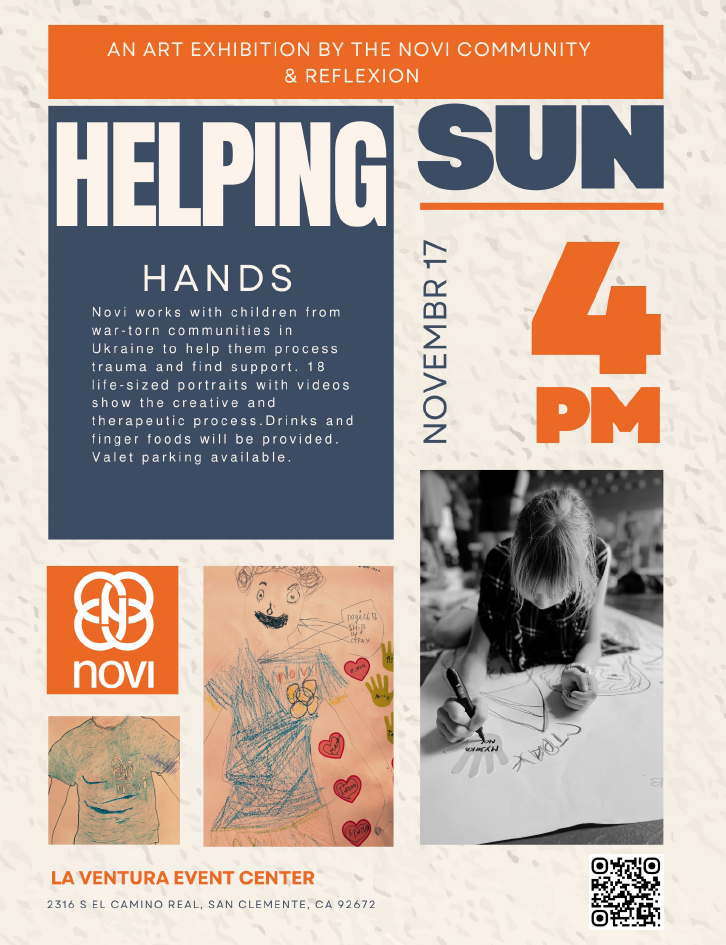
Helping Hands Exhibit

Sunday, November 17 The Novi Community will host an art exhibit, featuring hand drawn portraits made by children living in several of war-torn cities of Ukraine. Their work will be on display at the
La Ventura Event Center
2316 South El Camino Real
San Clemente, California
The doors will open at 4:00 pm and will run for four hours. There is no admission fee.

Children living in warzones are deprived of basic needs such as safety, education, and nutrition that are required for positive development. They are also exposed to violence, loss, displacement, and all the disturbances created by war. These factors often lead to severe emotional trauma, mental development, social disorders, and skills necessary to thrive throughout their lives and into adulthood.

In the chaos of violence, where young lives are fractured and isolated, Novi reconnects, heals, and uplifts. Supported by care and compassion, these children don’t just survive—they learn, grow, and rediscover joy. Novi equips them to form and maintain friendships and build their futures. We provide specialized training and tools to volunteers, social workers, teachers, therapists, and others who work with children in these high-stress environments. All Novi interventions are based on regional needs and are initiated through local professionals and caregivers. We cooperate with community organizations and institutions, obligating ourselves to the highest ethical standards.

Helping Hands is a play-oriented group activity that helps young children develop emotional awareness and healthy ways to cope with their feelings. Children begin by drawing a life-sized self-portrait and then are led to identify strong emotions, where they are felt on their bodies, and what helps them to cope with these feelings. These impressions are expressed artistically in their drawings. The intervention is adaptable for special needs and can be used in multiple sessions, with a focus on regulation, triggers, coping, and processing. In brief, we are working to preserve the normal childhood life experiences. This activity is just one part of a program that includes play, games, and lots of fun.

We invite you to visit the exhibit and witness the effectiveness of Helping Hands in the lives of the children whose artwork will be on display.

For more information on The Novi Community, please visit novi.ngo

Guest Speaker – 10/08/2023

Podcast

Facebook

Welcome and Prayer: Nancy Lopez

Good morning, RefleXion Community. The Lord is with you!

A few times this week I was in conversation with others—and, honestly, with myself—about the condition of our hearts.  Since Chuck is teaching from Jeremiah, it’s easy to focus on the verse that says, “The heart is deceitful above all things, and desperately sick; who can understand it?”  Even if we believe that in Jesus we’ve been given a new heart, we’re distraught that we still have the old one.  And sometimes then we remain in shame, or fear.  Or we might try to cover it up with an acceptable image.

We know the greatest commandment is, “You shall love the Lord your God with all your heart and with all your soul and with all your mind.”  Jesus invites us to bring our whole life and follow him.  So, what does our whole life look like?  Would we go to a doctor and not bring our wounds?  Would we not come to talk about our schedule and plan without bringing an agenda?  Why would we think that we can’t bring our full, sick hearts to the One who created them?  We are not yet fully formed.  We are not yet healed.  And He has the light and love and grace we need.

Here’s the invitation we read in Hebrews,  “So let us come boldly to the throne of our gracious God.  There we will receive his mercy, and we will find grace to help us when we need it most.”  This is the way to healing, not to withhold our sickness, but to bring it in to his presence.  Are we ashamed, fearful, or do we just think we don’t need healing?  In all ways we try to deal with our sin without God, we can call it an attempt at sin management. We bring our whole heart, our whole body, our whole mind to God.  We open to His gracious presence.  Remember how Paul prayed about his weakness, and the Lord said to him, “My grace is sufficient for you, for my power is made perfect in weakness”?

Let’s not obsess about getting it right.  Trust God; trust Grace.  May we enjoy his presence this morning.

Let me pray for us:

Gracious God, we desire to be made whole.  We hear your good invitation to come in confidence to your throne of mercy and grace.  Thank you for your presence with us always; we are making space for listening and leaning into what you have for us. This world is in chaos; may our participation in it bring hope and peace.  Prepare us to be the people who come in your name, for your glory, for your kingdom, Lord Jesus. Amen

Guest Speaker: Ed Piorek

IT’S ALL ABOUT LOVE

Love the Lord your God with all your heart, and with all your soul
and with all your mind and with all your strength…and love your neighbor as yourself

LOVING GOD
“The first and most fundamental contribution of the Contemplative Tradition is that it constantly fans the
flames of our ‘First Love’ (Rev. 2:4). Its message is this: ‘Love God with all your heart…love God with all
your heart…love God with all your heart. Without heart-love you have nothing.” Richard Foster)

Love is the purest motivation for solitude, silence and simple prayer.
Love desires intimacy above all other things. (Psalm 27:4)

One thing I ask from the Lord,
this only do I seek:
that I may dwell in the house of the Lord
all the days of my life,
to gaze on the beauty of the Lord
and to seek him in his temple.

Psalm 116:1, Jesus’ Prayer.

GOD LOVING US

Contemplation positions us to experience the First Love of God the Father (1 John 4:18)
Love may have felt stirrings in our hearts.

“Trinity inhabits the soul by divinely illuminating its intellect with the wisdom of the Son,
delighting its will in the Holy Spirit, and by absorbing it powerfully and mightily in the delightful
embrace of the Father’s sweetness.” (St John of the Cross)

Love surrounds us even in the silence.

We need to see silence as a living presence of itself…not just an absence, but by that
very fact, a presence.” (Richard Rohr)

LOVING OTHERS

All life is meant to be at the same time profoundly contemplative and rich in active work.” (Merton)

Loving with the Father’s Heart of compassion.
Loving others as human beings created in the image of God.

1 Kings 19, The Low Whisper 07/09/2023

Podcast

Facebook

Welcome and Prayer: Nancy Lopez

Welcome RefleXion Community!           The Lord is with you!

Last week, when Chuck finished the Meditations on Mark, he offered that the ending, though seemingly truncated, was meant for us to extend by our lives.  I’m reading a book right now, by Parker J. Palmer entitled “On the Brink of Everything.”  His friend had described watching her toddler discover life, and in wonder said that the child was on the brink of everything.  And so are we!  It reminds me of the phrase Jim sometimes uses: “standing on the edge of eternity.” 

It is mysterious and a wonder to be in the meeting place of the unfolding of ourselves and the revealing of each day as it comes to us.  Perhaps the best that we can do is to stay awake and in awareness and to present ourselves as whole and willingly as we are able. 

Or are we striving each day to live the perfect life, and what does that look like anyway?  We believe that Jesus led the perfect life, don’t we?  Well, did He have trouble, temptations, and trials?  Did He have enemies?  Was there chaos and confusion around Him?  You bet. 

I quote Christianity.com here:

“It was fitting that God . . . should make the author of their salvation perfect through suffering” (Hebrews 2:10).

Wasn’t Jesus perfect when he was born in the manger? And didn’t he live a sinless life? Wasn’t his death the death of an innocent man? Yes. He was morally perfect. That is one kind of perfection or completion.

But there is another kind of perfection or completion that comes only by experience. Jesus entered fully into the sufferings of this world and emerged victorious over them. He was completed in his experience on the earth by the things he suffered. That is why he may be called the “author” of our salvation.”

A friend of mine says that when her children were little and she read them the fairy tales—you know, the ones that end with “and they lived happily ever after,” she always said, “and they lived happily ever after, with an occasional argument.”  We are on the brink of everything:  things happy and things very hard.

I’m going to try to remind myself of that every morning this week; I’ll let you know how it goes.

Let’s pray:  Dear Lord, save us from the temptation to be made perfect through anything but Your work.  Open our eyes to wonder and to the mysterious indwelling of Your Holy Spirit and to our own souls.  May this day reveal Your Presence to us and Your work for us.  May we awaken to it, and step in to it, for the sake of the Name of Jesus and His Kingdom come.  Amen

Morning Talk: chuck smith, jr.

Intro: We’re going to spend time this morning with a unique person

Elijah was one of the most gifted prophets in scripture
– in fact, he became the representative of all the prophets,
• right up to and including John the Baptist, who came
in the spirit and power of Elijah (Lk. 1:17)
• Elijah will teach us a lesson on hearing the voice of God

Before we get into his story – two points I find interesting

First, if we look close at our story in 1 Kings 19, we’ll find obvious connections between Moses and Elijah (Ex. 34-35)
– Elijah journeys into the same wilderness that Moses had led Israel
• it will take Elijah awhile to reach his destination–forty days (Moses was there with Israel forty years)
◦ Elijah’s destination was Mount Horeb–the same mountain Moses climbed
◦ on Mount Horeb, Moses experienced God as close as any human could
• God told Moses he would pass before him and he did (Ex. 33:19 & 34:6)
◦ using the same Hebrew word, God passed by Elijah (v. 11)
◦ there is, however, a big difference between their encounters with God! (we’ll come to that)
– the other point of interest, is how the storyteller uses “behold”
• five times, we are invited to look at what is happening
◦ in one place we read that, Elijah looked, and behold
• in other words, we’re suddenly looking through Elijah’s eyes
◦ “behold” alerts us to what deserves our attention

Why do we find Elijah taking an arduous journey?

You probably know this story – if not, you need to hear it
• the queen of Israel was a real Jezebel–in fact, she was the original Jezebel
she had a gift for writing nasty letters
• in a letter to Elijah, she swore, “By this time tomorrow, you’ll be dead”
• Elijah read it and “ran for his life” – south, through Judah
down to Beersheba, which was a small town that bordered the wilderness
it was the last outpost of civilization
Day one: Elijah walked maybe twenty miles into the desert
towards evening he came to small tree and sat down in its shade
• before falling asleep, he prayed,
“I’ve had enough. I can’t do this any more.
O Lord, kill me – better I die by your hand than Jezebel’s.
I tried, but I can’t succeed any more than anyone before me.”
• like much of our prayer, this was not a complete prayer
it was only half a prayer–he just poured out his thoughts
he was venting, saying the words,
but he didn’t expect God to answer
• at some point in the night or next morning, “Behold”
someone was waking him up – an “angel” touched him and told him, “Get up and eat”
• Elijah looked, and behold . . . cake baked on hot stones and a jar of water
he ate, drank, and fell asleep again
• sometime later, the angel returned – he did and said the same thing
only this time he gave Elijah an explanation for the meal, for the journey is too great for you
• Elijah was back on his feet–and he walked for over a month,
day and night, until he reached Mount Horeb, “the mount of God,” according to the storyteller
that has an ominous ring to it
• Elijah settled into a cave – we’re not told how long he was there before the “visitation”
• while there, “behold, the word of the LORD came to him”
“word of the LORD” has a special significance in scripture
it refers to the way God communicated with his prophets
it’s not like a sermon, reading a letter, or listening to news
the word of Yahweh was a divine power – it came with energy
Jeremiah described it as a fire burning in his heart and bones,
and a hammer that breaks rocks to pieces
in this instance, the word of the LORD came with a question
“What are you doing here, Elijah?”
Elijah replied, “I have been very jealous for the LORD, the God of hosts. For the people of Israel have forsaken your covenant, thrown down your altars, and killed your prophets with the sword, and I, even I only, am left, and they seek my life to take it away” (v. 10)
• I don’t know, but to me that sounds rehearsed
it sound like all the thoughts that kept tumbling around inside Elijah’s head
anyway, it doesn’t answer God’s question
an answer to God’s question would have been something like:
“I’m running away–hiding out”
“I’m giving up–handing in my resignation, I failed–I quit”
Or, “I’ve come here looking for answers”
• God’s short response:
“Go out and stand on the mount before the LORD”
And behold, the LORD passed by, and a great and strong wind tore the mountains and broke in pieces the rocks before the LORD, the LORD was not in the wind. And after the wind, an earthquake, but the LORD was not in the earthquake. And after the earthquake a fire, but the LORD was not in the fire. And after the fire the sound of a low whisper 1 Kings 19:11-13
• I said before that there’s a big difference in Moses’ and Elijah’s encounter with God
this is it – God did speak to Moses in thunder and fire
the writer of Hebrews tells us, For you have not come to what may be touched, a blazing fire and darkness and gloom and a tempest and the sound of a trumpet and a voice whose words made the hearers beg that no further messages be spoken to them. . . . Indeed, so terrifying was the sight that Moses said, “I tremble with fear.” (Heb. 12:18-21)
Elijah did not hear the word of the LORD in the windstorm, earthquake, or raging fire
but if not in the cataclysms, then what?
• what shall we call what Elijah heard?
The King James Version: a still small voice
The New American Standard Bible: the sound of a gentle blowing
The English Standard Version: the sound of a low whisper and in the margin, a sound of thin silence
• when Elijah heard that quiet voice, he covered face with his cloak
then he stepped out in front of cave, And behold there came a voice to him
God repeated his same question – Why would he do this?
• I can only guess, it is because God didn’t accept Elijah’s first answer
Elijah, however, could not come up with a new answer
his brain was stuck in all the same repetitive thoughts
nothing is new, nothing has changed, nothing creative occurred to him
• So God tells him, “Get back on your bike and let’s try it again”
• in this story, what has God done for Elijah?
God fed him, gave him some physical exercise, had him rest for awhile,
and then God gave Elijah new assignments and sent him back to his work

The design of this story is made so obvious that even children can see it

We want to hear from God, have him answer our questions, reveal his will
– we want it to be so real to us, that there’s no room to doubt it’s him speaking to us
• but he chooses to speak so quietly and mysteriously,
◦ that we cannot be certain whether or not we heard him
• the lesson this story teaches us, is that like God’s prophet,
◦ we have to learn how to listen so that we hear
– if we’re waiting for something loud, or big, or audible, we may never hear God
• we have to learn to listen to the sound of thin silence
In the beginning of Revelation, Jesus dictates seven letters to seven churches, and each letter says,
Whoever has an ear, let them hear what the Spirit says to the churches
• it isn’t enough to read or listen to these letters read,
• people need to be attentive and hear the message in the letters
– sounds enter our ears constantly: animal and human voices
• sounds in nature and sounds of machinery
◦ but if they’re not calling my name, I don’t pay attention
◦ we can listen, but not hear (having ears do you not hear? Mk. 8:18)
• so the key to hearing God’s quiet voice is to pay attention
– when our orange tree is in bloom, I sometimes stand near it
• I want to inhale its fragrance – this releases pleasurable neurochemicals in my brain
• listening for God is like savoring – you slow down
you look and let your eyes receive colors, shapes, and shades
you breathe and smell the aromas of the moment
you swallow and feel how your soft palate and esophagus know how to process your food

This last week I was reading in the Psalms and one morning spent time with this one verse:
I have calmed and quieted my soul,
like a weaned child with its mother;
like a weaned child is my soul within me (Ps. 131:2)
My meditation: “Every believer needs to learn how to do this! We need to be able to calm and quiet our souls in God. ‘Self-regulation’ is the ability to settle ourselves down when we’re upset, afraid, anxious, sad, and so on. In this psalm the poet self-regulates his emotions by visualizing God holding him as a small child is held in its mother’s arms. Those people who have the most unrest in their souls are the ones who trigger agitation in the souls of others, who incite fear and start fights. Because of all that God is to us, we can learn to regulate our own emotions in him and his loving care, and thereby become the calm and soothing voice to others”

Listening means focusing our awareness
– when we get good at this, all we have to do is ask:
“Am I in awareness right now?” and we’ll know instantly
– try this: without moving, be aware of your right hand
• how it is positioned – whatever it feels
• do this for a full minute
• now shift awareness to your left hand and do the same thing
• do you see that you’re able to focus your awareness wherever you want
– to hear God and receive his peace, know where to focus your awareness
Look at the birds of the air: they neither sow nor reap nor gather into barns, and yet your heavenly Father feeds them. Are you not of more value than they? . . . And why are you anxious about clothing? Consider the lilies of the field, how they grow: the neither toil nor spin, yet I tell you, even Solomon in all his glory was not arrayed like one of these (Mt. 6:26-30)
• focus your attention on things that are above on whatever is true, whatever is honorable, whatever is just, (etc.), then listen to one of those things with all your senses
Brennan Manning, “Being fully present in the now is perhaps the premier skill of the spiritual life.”

I hesitate to tell you this, but it’s important: Have some kind of Bible reading practice
I won’t say that you need to read through the entire Bible
If it helps, stay in your favorite parts and continue to reread them
Discipline yourself to read with awareness, and hold onto what God says to you
Do not simply listen to the Scriptures in your mind, but hear them in your heart and soul

Conclusion: We can choose to make aware listening a habit

It is so seldom that we listen in this way, that when we do,
we almost always receive an insight from God

Meditations in Mark Ch. 16 07/02/2023

Podcast

Facebook

Welcome and Prayer: Nancy Lopez

Welcome to the RefleXion Community!  The Lord is with you.

Take a deep breath.  Chuck and Jim almost always use this phrase to lead us in to our quiet time, whether it be here on Sunday mornings or in preparation for Lectio Divina.  Meditation teachers use the breath not only to prepare us, but as an anchor to bring us back to center if our mind wanders during meditation.  I’m familiar with using breath work in these ways.  And, just recently, I have realized that a deep breath or two will bring me back to Presence, to the present, in my daily walking-around life. 

I am often focused on the future: “What’s next?  How can I resolve that?  What’s the plan?”  I have an habitual “future orientation.” Some of us are more “past oriented,” ruminating on “What happened?  Why did I do that?  What if I had made another choice?  That was an awful experience, etc.”  Those types of thoughts keep us in the past.  Our minds can be habituated in either direction, as our pattern of thinking.  The breath has been very effective at bringing me back to being present—to the person in front of me, to God with me, to information being presented.

I’ve been noticing that when I’m stuck in my future orientation mode, it’s accompanied by a sense of urgency, and I have come to realize that that’s because there’s not enough oxygen there—in the future.  My breath is shallow, which creates a sense of urgency, of hurry. It feels to me like inhale, inhale, inhale just to keep going.  I mentioned this to a friend who gets stuck in a past orientation.  She said that to her living there was exale, exale, like a long sigh.  I don’t know if anybody here can relate, but I thought I’d share my experience.  In any situation I can use a few deep breaths to foster Presence.  So, when I catch myself not paying attention and my mind is wandering, I come back to a full breath of inhale and exhale, and that puts me in Presence; that’s where the oxygen is.

The book of Job talks about the breath of life:

“In his hand is the life of every living thing and the breath of all mankind.  The Spirit of God has made me, and the breath of the Almighty gives me life.”

Our opening prayer today comes from Psalm 150.  Please join with me:

Praise the LORD! Praise God in his sanctuary; praise him in his mighty heavens!  Praise him for his mighty deeds; praise him according to his excellent greatness! Praise him with trumpet sound; praise him with lute and harp!  Praise him with tambourine and dance; praise him with strings and pipe!  Praise him with sounding cymbals; praise him with loud clashing cymbals!  Let everything that has breath praise the LORD! Praise the LORD!  Amen

Morning Talk: chuck smith, jr.

Intro: We’ve come to the last chapter in Mark’s gospel

And to the enigma at the end of the book
– that’s because the story ends at Mark 16, verse 8
• you say, “Chuck! My Bible still has more verses”
◦ “Yes, I know, but read the fine print”
• the most ancient manuscripts that we have in our possession end at verse 8
◦ scholars tell us the quality of the Greek writing changes at verse 9
◦ the evidence supports the abrupt ending
– this has become a fascination for me – so, it has been a frequent meditation
My meditation: “Verse 8 is a fitting end to a story well told. Rather than satisfy our curiosity regarding what happened next, we are left in suspense. Verses 9-20 are clumsy in comparison to the rest of Mark. I imagine an ancient scribe coming to the last line and feeling like the bridge is out. Frustrated, he says, ‘No, no, no—this won’t do at all. Mark cannot come to an end with a cliffhanger.’ So at some point in history, someone or some committee added an epilogue that they felt provided a satisfying resolve to the end the story.
These editors had inspired material at hand to cut-and-paste, so it wasn’t like they were making stuff up. From John’s gospel, they borrowed the story of Mary Magdalene’s encounter with Jesus near the tomb. From Luke’s gospel, they took the story of two disciples on the road to Emmaus and the setting for Jesus appearing to the eleven disciples over a meal. Matthew recorded the story of Jesus’ command to go into all the world with the gospel that the editors borrowed to fill out verses 9-20 here as an epilogue. The stories were true, they were just taken from the other sources.
However, this attempt to provide additional details was not nearly as creative or effective as Mark’s writing. One indicator of a foreign hand is the fact that this ending is very ‘preachy’—a characteristic that Mark avoided. There is a message in the final verses, but it is blatant and has none of the subtlety Mark has been careful to maintain. Some people who are not good storytellers or writers use an authoritarian style in which they tell people what they should feel and how they should respond. They do this to compensate for a lack of skill.
There is no other resurrection story in which Jesus rebuked his disciples for their ‘unbelief.’ Instead, in his post-resurrection encounters, Jesus approached them in gentleness and love. His first words to the frightened disciples was, ‘Peace be with you’ (Jn. 20:21). He willingly offered Thomas his hands to examine to verify that he really was Jesus. He lovingly restored Peter to discipleship and ministry. He ate a fish with his disciples to alleviate their fears that they were seeing a ghost. But the editors of Mark have Jesus scolding the disciples for their hardness of heart. If we go back into the substance of Mark’s gospel, we see that Jesus knew they would be shocked by his death and have difficulty believing in his resurrection. Jesus soothed, instructed, promised, and reconciled with his disciples, but there was no rebuke.
I think the editors were adding a rebuke of their own. Perhaps they felt it was necessary in order to frighten readers who came to the end of the story and did not believe Jesus had risen from the dead. The editors were warning those readers that their hearts were hardened. This is too often the very message that has been used to abuse faithful believes. The implicit message of authoritarian preachers, parents, youth leaders, and other Christians with ‘control issues’ is, ‘Jesus won’t love you if you don’t believe in his resurrection and eat your vegetables.’ But that is not what we hear from Mark or from the Lord himself. Jesus tells us that his ‘yoke is easy, and [his] burden is light’ (Mt. 11:30).
These extra verses were not necessary. Any reader who came to this apparent ellipsis—i.e., ‘dot, dot, dot’—would know this could not possibly be the end of Jesus. Anyway, I think the person-to-person reports of Jesus’ resurrection probably had a more dynamic effect than the bogus addition. Besides, Mark’s story was first told to communities of faith that would not have existed had Jesus not risen. They did not need convincing.”
• I have had a couple more thoughts about the way Mark ends:
◦ first, I think I know why Mark leaves off where he does (we’ll come to that)
◦ second, he’s already given us the ending–parable in chapter 12
Remember his story about the owner of a vineyard, who sent his son to collect the produce they owed him. But the tenants killed the son. Then Jesus asks, “What will the owner of the vineyard do?” That is the question at the end of Mark. What will God do next? Jesus answered this question, “He will come and destroy the tenants and give the vineyard to others” (Mk. 12:9). Fifty days after Jesus’ resurrection, God poured out his Spirit on the first Christian community, and within about forty years the temple in Jerusalem was destroyed. God turned his vineyard over to his new church.

Now let’s return to the verses we can trust as original
When the Sabbath was past, Mary Magdalene, Mary the mother of James, and Salome bought spices, so that they might go and anoint him. And very early on the first day of the week, when the sun had risen, they went to the tomb. And they were saying to one another, “Who will roll away the stone for us from the entrance of the tomb?” Mark 16:1-3

My meditation: “The Sabbath ended Saturday evening, so when the markets reopened the women were able to buy the supplies they would need to anoint Jesus’ body. However, they would have to wait until daylight to go to the tomb safely. Carrying spices and oil, there was good reason to wait until they could see clearly and fulfill their mission efficiently. That they went ‘very early’ indicates their eagerness to prepare his body for burial, even though he was already placed in a tomb that was securely sealed.
(I love the coincidence of words, in English, that the women went to the tomb after ‘the sun had risen’ and arrived at the tomb after the Son had risen.)
‘Anointing him’—that is, his dead body—was a kind and loving act that the family and closest friends would provide. They came regardless of what they had witnessed at the cross. What did they think of him now? That he was not the Christ after all? That he had failed his mission? That their hope in him would be buried in his tomb? If they had such thoughts, what they knew to be fact was all that he had done for them and others, that he was a good man, and that someone needed to perform this service to his body.
A number of obstacles stood in their way. One was their concern over the ‘very large’ stone that blocked the entrance. Another was the soldiers stationed there to guard the tomb. But something that would have never entered their minds was that the corpse would not be where it had been placed.
Though they were not able to not care for Jesus’ body as they had planned, we can recall that this service had already been provided to him. While Jesus was at dinner in Bethany, a woman poured perfumed oil over his head. Jesus explained the meaning of her actions, saying, ‘She has done what she could; she has anointed my body beforehand for burial’ (Mk. 14:8).”

And looking up, they saw that the stone had been rolled back—it was very large. And entering the tomb, they saw a young man sitting on the right side, dressed in a white robe, and they were alarmed. And he said to them, “Do not be alarmed. You seek Jesus of Nazareth, who was crucified. He has risen; he is not here. See the place where they laid him. Mark 16:4-6
My meditation:‘And looking up they saw that the stone had been rolled back . . . .’ Mark devoted a great deal of thought and creative storytelling to highlight the theme of looking and seeing as a necessary development in discipleship. In the heart—the very center of the book—he tells a story about the disciples looking but not seeing. To ‘look’ is to notice and perhaps observe, but to ‘see’ is to perceive. So Jesus asked his disciples, ‘Having eyes do you not see?’ (Mk. 8:18) In a normal day I look at countless things, but what do I see? Do I pay enough attention to whatever it is God wants me to see? I have been at this many years; has my spiritual vision improving at all?
The women had been worried about the large stone, but when they looked up it had already been rolled out of the way. We are pestered by some worries that could be resolved instantly just by looking up.
The women bravely entered the tomb, but what they saw (and what they did not see) alarmed them. The body was missing and a young man was calmly sitting inside. Mark says they were ‘alarmed’—I imagine their emotions were in free fall, plunging from grief to sudden panic.
‘Do not be alarmed,’ the young man told them. But why should they not be alarmed? Because Jesus had announced he would rise from the dead? Because they did not have time to panic because there was too much to do? Because overnight the world had changed and they were now living in the new reality? Perhaps that was it. From now on there would be no need for alarm. ‘And behold, I am with you always, to the end of the age’—Jesus’ last words to the disciples in Matthew’s gospel.
The young man (the other gospels tell us he was an angel) spoke from his vantage point and perspective, not theirs. He said, ‘You seek Jesus of Nazareth,’ but they were not looking for Jesus. They were looking for his corpse.
The angel invited the women to come closer and ‘See the place where they laid him.’ The women—and the readers too—are given a visual experience to help absorb what has happened. It was an experience of emptiness. The past-tense indicates the slab that once held the body of Jesus was no longer occupied.”

“But go tell his disciples and Peter that he is going before you to Galilee. There you will see him, just as he told you.” Mark 16:7
My meditation: “The angel gave the women simple instructions as to what they were to do next. They were to go and tell Jesus’ disciples that he would meet them in Galilee. This was actually a reminder of what Jesus had told them the night before his crucifixion (Mk. 14:28). It was a prearranged meeting.
When instructing the women to inform the disciples, the angel made an odd specification, ‘and Peter.’ What?! Was Peter no longer a disciple? Had Peter wandered off alone? Had he separated himself from the others? Did he feel that he had disqualified himself and was not worthy to be associated with the true followers of Jesus? There is no way we can know. However, the angel did refer to him by his new name, the name that Jesus gave him.
I know people who would insist on cutting Peter from the team. They do not know what Jesus knows. That once Peter was ‘sifted like wheat,’ he would be a changed man, capable of strengthening his brothers (Lk. 22:31-32). Sometimes I am grieved and troubled by the absence of mercy among Christians and in many churches. Is it okay for me to harbor bad feelings toward these merciless believers? Only if I want to be like them. But Jesus tells me that God ‘”is kind to the ungrateful and the evil, and therefor, ‘Be merciful, even as your Father is merciful”’ (Lk. 6:36). Mercy must win!”

And they went out and fled from the tomb, for trembling and astonishment had seized the, and the said nothing to anyone, for they were afraid. Mark 16:8

My mediation: “The angel’s instructions were first of all to ‘go.’ Jesus’ first words to his disciples and others were, ‘Come, follow me’; his last word of instruction was ‘Go.’ ‘All authority in heaven and on earth has been given to me,’ he told his disciples at the end of Matthew’s gospel, Go therefore and make disciples of all nations . . . .’ (Mt. 28:18-19).
My meditation: “The women came to the tomb courageously. If soldiers were posted there, they would deal with them. If the stone was in place, they were already thinking about how it could be moved. They were preparing themselves for any potential problem. Nothing would stand in their way. But what they had not prepared themselves for, was an empty tomb and a heavenly angel. So they fled from the tomb. Mission aborted. Of all the instructions the angel gave them, the only one they obeyed was ‘Go.’ They were more than willing to do that post haste.
I look back at all the times Jesus performed a miracle or confided something with his disciples and told people, ‘Tell no one’—and more than once he said this with a stern voice. Now, at last, people are told to ‘go tell,’ but these women ‘said nothing to anyone—not even Peter. Eventually they got around to the disciples. Mark does not criticize them. He most likely learned their story from them. And he concludes his book with their story.

Conclusion: Now I will explain why this is the perfect ending

For Mark, there is no final chapter, no end to the story of Jesus
Whether the disciples went to Galilee or not, he leaves up in the air
But if the disciples were to go to Galilee, they would see Jesus
Mark’s message to us is, “Look for Jesus where he can be found, and you will see him”
Jesus can be found, for instance, in the story Mark has told us about him

If we still ask, “But how does the story end?”
Mark’s answer is, “That is up to you”
He slides the scroll across the table, hands us his pen, and tells us,
“Here, you write the end of this story.
How the story ends for you depends on what you do with it.”

A letter from Steve with The Novi Community

Dear Chuck,

Thank you for the support your community gave to Novi last month. It helped us push forward with Novi Life Kit orders and continue with distribution along the front lines of the conflict. Right now the Life Kits are being sent to summer camp locations along the front line and are being used as a tool to train children to self regulate and have fun even though their world is a battlefield. 

As of last week, we’ve also trained more than 600 adults (since January) to use the kits and a few other tools developed by our psychologist mentors we use to help children in war zones self-regulate and find their way through the conflicts trauma free.  Our work is affecting the lives of tens of thousands of children now. We’ve only been working in Ukraine since last June so it feels miraculous to us that we are making such a large impact. This knowledge is a deal changer for the children and their parents who can’t figure out how to get their children’s emotional life back on track.

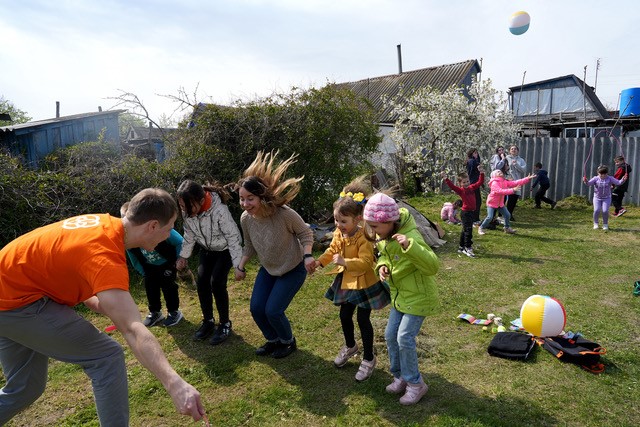
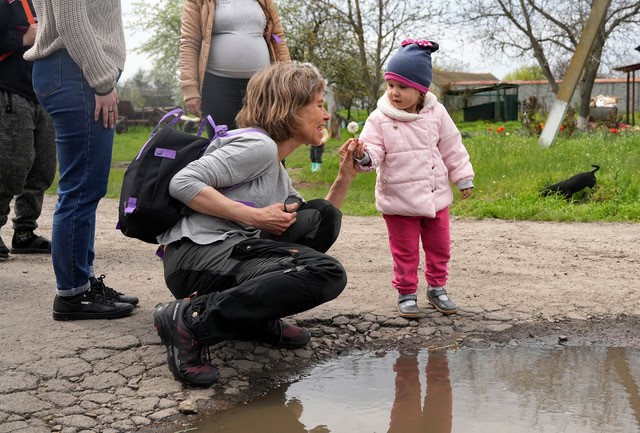
I’m attaching a few photos from Novi’s last trip to the front line. My wife was on this team as you can see. The top photo is of Jon playing through the activities of the Novi Life Kit with kids living within five miles of the front line. Artillery hits this village every night and explosions were heard throughout the day while our team showed children creative and fun ways to be in a calm, instead of shut down and fearful, state. It was beautiful to see children respond so positively and even more inspiring to watch as the adults realized that they could have their beautiful children back at the dinner table with a giggle instead of a depressed and sad demeanor. Many parents told us their greatest concern was that they’ve permanently lost their children emotional health to the war and when they saw things change, begged us for more training. This was in Donetsk and Kherson and was organized by churches that remain at the center of these humble communities.

Please thank the generous souls at Reflexion for being part of this. I am grateful and empowered by your practical actions of love.

Best Regards,
Steve
Steven Gumaer | The Novi Community
www.novi.ngo

Meditations In Mark – chapter 14 06/18/2023

Welcome and Prayer: Nancy Lopez

Welcome, friends! Happy Father’s Day; may you take joy in the perfect love that Your Heavenly
Father has for you.             He is with you!

One of the metaphors that is used for our personhood, our souls if you will, is that we are an instrument.  Many types of tools and devices can be labeled an instrument, and of course, one type is a device for playing or producing music. 

Can we imagine that we are each an instrument in an orchestra. During our lives, each one of us has been fine-tuning our instrument, learning skills, gaining an ear for our own style of music, and knowing what our instrument can do.  So, we’re playing together as an orchestra, and we notice that one instrument is off—off key, off the beat—and we’re distracted and annoyed by it, or maybe even upset and angry.  So, we put down our instrument to go over to the other person to correct him or her. 

And what if each one of us found someone else that wasn’t harmonizing with the music, and we each put down our instruments to go tell them how they should be playing?  Well, if we all put down our instruments, there would be no music at all!

The message is to “keep playing your instrument.” If we have learned to play by
The Spirit notes of kindness, gentleness, and goodness, then we must keep playing for there to be music.  Perhaps the instruments next to that other one will be enough for them to begin to resonate with the orchestra from their position.  If need be, we can take up our instrument and go sit beside them and keep playing…loud and clear so they can hear and be attuned.  Attunement is relational; to tune something, we need the relationship of a related instrument, human-to-human, for example.  One doesn’t tune a piano by talking to it.  You can’t tune a cello with a tree, nor a violin with a squirrel! 

When we are with someone who isn’t attuned, it’s difficult for sure.  Yet, don’t you think, especially in the body of Christ, that we’re built for it? Personally, I have to remember to play my instrument of patience and kindness with family members, goodness and faithfulness with friends, and remember that I am an instrument of love and peace, always.  I can’t stop making music.

Will you pray with me:

Though our mother and father forsake us, you will never forsake us, Father God.  The prayer Jesus made for our oneness is beyond our comprehension.  Yet the mystery attracts us, to live like You, always inviting, always making space for the new way of the Spirit.  Open our eyes and hearts to the particular ways we can participate in this new way and live without betraying the very precious privileges that we have as ambassadors of the new kingdom.  Amen

Morning Talk: chuck smith, jr.
It was now two days before the Passover and the Feast of Unleavened Bread. And the chief priests and the scribes were seeking how to arrest him by stealth and kill him, for they said, “Not during the feast, less there be an uproar from the people.”
And while he was at Bethany in the house of Simon the leper, as he was reclining at table, a woman came with an alabaster flask of ointment of pure nard, very costly, and she broke the flask and poured it over his head. There were some who said to themselves indignantly, “Why was the ointment wasted like that? For this ointment could have been sold for more than three hundred denarii and given to the poor.” And they scolded her. But Jesus said, “Leave her alone. Why do you trouble her? She has done a beautiful thing to me. For you always have the poor with you, and whenever you want, you can do good for them. But you will not always have me. She has done what she could; she has anointed my body beforehand for burial. And truly, I say to you, wherever the gospel is proclaimed in the whole world, what she has done will be told in memory of her.”
Then Judas Iscariot, who was one of the twelve, went to the chief priests in order to betray him to them. And when they heard it, they were glad and promised to give him money. And he sought an opportunity to betray him.
Mark 14:1-11

Intro: This chapter is like a collage, a patchwork of people

The story moves from one group or person to another
– each one adds something to the unfolding plot
• e.g., the chapter begins with familiar faces (priests and scribes)
My meditation: My first thought is that this is Jesus these religious leaders want to eliminate. He has done only good; he has opened windows to the kingdom of God; he has advocated for spiritual and humanitarian reforms; and he has healed countless people.
My second thought is the devious approach the religious teams use to eliminate him. There is something about injustice that disturbs me so intensely it keeps me awake at night. My feelings are intensified if the injustice is intentional, perpetrated through deceit, and manipulates the court. In the most horrific cases, the victim is not only innocent, but a good person.
A third thought is that God allowed this to happen to his Son! He allowed the bad guys to win.
Does this mean I have to give up my outrage at injustice? Not if it is in my power to ensure justice for someone else. However, when it comes to an injustice against myself, then quite possibly I must lay down my sword—and at the same time let go of the intense feelings that rise within me. I will need to stand close to Jesus. That is where I’ll find the grace to be at peace.
– in my next meditation I introduce the theme I want to develop today: “a beautiful thing”
My meditation: “Every phrase in verses 6-9 is a rich resource for meditation. The line I hear this morning is ‘a beautiful thing.’ The story of Jesus and this woman is framed by ugly things. Beforehand, religious leaders were plotting to arrest and kill Jesus, and afterward, Judas showed up to betray Jesus to them.
Jesus knew beauty. Doing beautiful things for others had been his trademark. Now this woman does a beautiful thing to Jesus.
I’m trying to recall a time when anyone else had done a beautiful thing for him. Perhaps the women who traveled with Jesus and his disciples, providing ‘for them out of their means’ (Lk. 8:3). Otherwise, who else among the thousands, came to Jesus to give him something rather than to get something from him?
Previously, Jesus had sent disciples on errands. Two of them fetched a donkey and two others located and prepared a room to celebrate Passover. On both occasions, these men were given clear instructions regarding what to do. No one told this woman what to do. She came up with the idea of this beautiful thing on her own, and went about it in her own way.
Love does beautiful things!
Obedience to a command, or doing one’s duty, or stepping up when work is required—these actions may get things done, but there may or may not be any beauty in them. There may not be any love in them either.
Hate does ugly things. So does fear. So does greed. The roots of ugly behavior appear in this chapter. But in this story, love gives generously. Love is creative. Love does beautiful things.”
• another time a different line caught my eye in this same story
My meditation: “At the end of verse 7, Jesus says, ‘But you will not always have me.’ The opportunity to do a beautiful thing for Jesus had an expiration date. Some opportunities will always be here. Others will come for only a moment. We may have a sincere desire to perform Christian service to others, but never get around to doing it. Perhaps we’re like Peter when Jesus said to him, ‘The spirit indeed is willing, but the flesh is weak’ (v. 38). As for this woman, did she discern Jesus’ sadness? Is that why she felt she had to do something for him, something that would perhaps make him feel better?
I don’t think it was likely that the disciples felt anything like empathy for the Lord. Not even when he confided in them that one of them would betray him. Instead, each man thought only of himself, and asked, “Is it I?”. And when Jesus told them his soul was sorrowful to the point of death; they fell asleep. And when he was arrested, ‘they all left him and fled.’ What could one of the disciples have done that night? At the least, perhaps wash Jesus’ feet.
Our opportunities regarding doing the good we can do depend on our resources, the nature of the need to be met, and timing. I ask, ‘What can I do?’ Jesus answers, ‘Well, she did what she could.’ Was that enough? For Jesus it was.
Jesus said ‘wherever the gospel is proclaimed in the whole world, what she has done will be told in memory of her.’ Maybe he meant more than a memorial in her honor. Maybe she demonstrates the way the gospel of Jesus works in people when they open their heart to it. Out of love for Jesus, they do whatever they can. Perhaps the most they can do is give a child a cup of cold, clean water. That is enough. It’s that simple.”

I was going to alternate my meds in this chapter between beautiful and ugly

But instead, I will highlight the unattractive parts
1. We’ve seen already the religious team conspiring with Judas
2. Then, the disciples scolding the woman
• at same time inadvertently insulting Jesus, by referring to the gift she lavished on him as a ‘waste’
3. The heartbreak of Jesus’ announcement during dinner (that one of the twelve would betray him)
• Jesus closest and most loyal followers, are consistently disappointing in this chapter
My meditation: “Jesus told his disciples they would desert him, but Peter told Jesus he was wrong. All the apostles promised Jesus they would not run away–but they did. Three times, Jesus told his apostles to stay awake, and each time they fell asleep. Right up to the end, they were stumbling over themselves. Were they the best that Jesus could find? I don’t know. All I know was that they were the ones Jesus wanted–and I am no better than they were. Jesus loved, chose, trained, died, and rose again for losers.”
4. In the garden, Jesus said, his soul was crushed with sorrow
• it’s terribly wrong that he was thrown into this agony
5. The arrest: they came ‘with swords and clubs,’ when they could have been civil
• it was also ugly that his arrest was intentionally hidden from the crowds
6. The lopsided trial–they were prepared to accept false accusations
7. The way Jesus was mistreated and abused
• they did more than rough him up–they wanted to humiliate him
• this wasn’t justice – it was pure animosity and hostility
8. Peter’s denials – this was a different order of ugliness
• Peter caused the kind of pain that only a trusted friend can inflict

I have often meditated on Jesus’ prayer in the garden

Once, in Israel, I sat with my son Mike, off by ourselves in an olive grove
– we closed our eyes and imagined Jesus begging the Father to remove this cup from me
• then rising to his knees, perhaps raising his hands to the sky, he prayed,
Abba, Father, . . . not what I will, but what you will
• in our guided meditation, we watched him walk away to check on the three nearest disciples
◦ then we heard the loud voices of those who came for him. And so on.
My meditation: “It upsets me to think of Jesus so ‘distressed and troubled.’ As he said to Peter and James and John, ‘My soul is very sorrowful, even to death.’ As I read this, I long to be there with Jesus through his terrible night and crushing sadness. I want to be with him as he has been with me through my soul-wrenching grief. He asks his friends to keep watch. I think that would be easy to do, even if I felt sleepy, as long as every few minutes I could stroll to the gate and see if anyone was approaching the garden. But he told his three closest friends, ‘remain here,’ and I’m sure that made it more difficult for them to stay awake. It had been a hard week and a long day, and they had enjoyed a big meal. And the garden was so quiet and dark and the hour was so late. Seeing the Lord in his broken state was not enough to enable them to fight off their drowsiness.”
– another time, I carried this thought a little further
My meditation: “Jesus’ message in the previous chapter was, ‘stay awake – stay awake – stay awake’ and ‘be on your guard – be on guard – be on guard.’ Now in the hour of crisis, the disciples could not stay awake and they dropped their guard. Is there a better example than this of the way Christians can hear teaching on the ‘end times,’ even get worked up about it, yet that teaching does not result in changed behavior?
The first time Jesus returned to disciples and found them sleeping, he told them,
Watch and pray that you may not enter into temptation (v. 38)
– we are not creatures, obligated to obey a creator so that our work is blessed
• God has called us into a relationship with himself
◦ and he has sealed the relationship with a covenant
• there will always be two sides of this relationship, each interacting with the other
God’s side: In the Lord’s Prayer, we pray, And lead us not into temptation
(temptation can be hardship, pain, or any difficulty that tests our faith and loyalty. The flip-side of that is, deliver us from evil)
our side: watch and pray that you may not enter temptation
– every Christian learns how to “say prayers” – that’s easy
• but prayer that consists in watching is something else
My meditation: “Sad to say, I find comfort in the fact that the disciples could not stay awake as Jesus asked, and yet they still belonged to him. If only they knew what was coming! They would have stood up straight with their eyes wide open. But that is precisely the point! We don’t know when, or how suddenly the next crisis will hit. We will either be awake and ready, or else the alarm siren will wake us up. On guard, we are better prepared to meet the hour. Awake and ready, we are less stressed or anxious. A good percentage of prayer consists in waiting and watching.”

What I feel while reading this chapter is chaos (seems like everything is out of control)
– but it isn’t! Everything went according to an ancient script
• for instance, when Jesus told the disciples, ‘You will all fall away,’ he added, ‘for it is written’ (v. 27)
• then at moment of his arrest, he did not put up a fight, but said, ‘let the Scriptures be fulfilled’
◦ the ancient Scriptures were the prophetic script
My meditation: “I hear Jesus announcing the beginning of what God had been preparing through the ages, the culmination of redemption in this dark hour.”

Conclusion: We can’t leave this chapter without seeing biggest moment in Mark’s Gospel

Again the high priest asked him, “Are you the Christ, the Son of the Blessed?” And Jesus said, “I am, and you will see the Son of Man seated at the right hand of Power, and coming with the clouds of heaven Mark 14:61-62
My meditation: “Until now, Jesus had been strict about keeping his identity a secret. Even when his own disciples accurately identified him as “the Christ,” “he strictly charged them to tell no one about him.” But now he boldly acknowledges his identity. Moreover, he reveals it to his enemies–the very ones who will use it against him! The high priest hears the ‘sworn testimony’ of Jesus. He and the council are given the complete revelation that Jesus had hidden all through the years of his ministry. But now, at last, his hour had come.”

Now we know where Mark has been leading us
He has wanted us to follow this person, from Galilee to Jerusalem,
across valleys and over mountains
He has wanted us to witness his healing touch,
hear his words of truth and revelation,
and discover how the heart of God beats within his chest
Mark wanted us to discover for ourselves,
that Jesus is no ordinary human person,
and know that we could trust him–now and always

Palm Sunday 04/02/2023

Podcast

Facebook

Welcome and Prayer: Nancy Lopez

Good morning!  Welcome to the RefleXion Community.  The Lord is with you.

The humble barnacle, those critters that attach themselves to the bottom of boats and dock pilings,  I don’t know anyone who has an affinity for them.  When they are born, they float for a very short time and then attach to the first things they find, and that is pretty much where they live out the rest of their lives.  They rely on the flow of the water passing by them, which they comb for food.  They have a hard shell, and if they sense a potential threat, they withdraw into those shells.  Wait….are we talking about barnacles or humans?!  We’re all pretty good at attaching to places we feel safe, retreating into our shells, and settling for what comes to us for our spiritual food.

But, what if one little barnacle had the desire to let go of what he’d always known and float down the flow of the river?  The ones he had been with would probably all yell, “No!  Don’t go!  Danger, Danger!”  But then he did let go and flowed freely again.  Then, what if the little barnacles who lived downstream saw him and they, too, felt invited to detach from what they’d always known, where they’d felt safe, and to follow the flow?  What if they said to each other, “I didn’t know we could do that!”

Today, we celebrate Palm Sunday.  Jesus was rejected by many, because He represented a new way to God and a new way to live.  Some yelled “No, Danger!”    And some felt invited to follow this man.  There was a large crowd around Jesus on Palm Sunday, people who threw down their cloaks and their old religion and chose to follow Jesus.  On this Palm Sunday, which people will we be?  Are we able to imagine that God will come to us in fresh ways?  Do we believe we can hear and trust His invitations?  Are we willing to be ones who can follow the New Way, the new Way of the Spirit?

Shall we pray? Father God, Jesus the Christ, Holy Spirit given to us, reveal to us Your Presence.  Thank you for opening for us the new and living way.  We will follow You.  Thank You for those who have led us and encouraged us.  Thank You for Your Holy Spirit Who is forming us.  We welcome You.  Amen

In our quiet time this morning, I wonder if we can step in to the Palm Sunday scene.   Let’s begin by taking a few deep breaths and then settling into a natural breathing and a comfortable yet alert posture.  Place yourself in the Palm Sunday scene as you imagine that it was.  You are arriving with others to the growing crowd.  It’s quieter than you imagined it would be.  Each one is attentive and waiting for Jesus to arrive.  Each one as the Spirit moves them is throwing down their cloak and laying down palm branches of welcome.  As we are waiting for His arrival, our desire to see Him intensifies, the passion of the crowd moves us into a collective anticipation.  We are here together, yet you are aware of your heart alone.  Let this be your moment to experience the waiting for and the coming of Jesus.

Morning Talk: Jim Calhoun

The beginning of the Passion

Let’s start with Jesus in Jerusalem. (John 10) The Feast of Dedication (Hanukkah)
There is a confrontation.
“If you are the Christ tell us plainly”
“I told you but you did not believe.“
“For which of my good works will you stone me?”

Jesus slips away and goes into hiding to Bethany across the Jordan some twenty-four miles away
While he is in hiding Jesus gets word that his friend Lazarus is very sick.
He delays his departure by a couple of days and we don’t know why.
Eventually he travels to Bethany about twenty-two miles from where had be staying.
He is met by first one sister and then the other and is taken to Lazarus’ tomb.

Though it seems plain that Jesus knew he would resuscitate his friend he was deeply emotional at his tomb.
Many people were there and watched as Lazarus walked from the tomb.
Unlike before Jesus couldn’t put a lid on this. Too many had seen it.

This set off a whole chain of events that led to Jesus’ death. How can this be? The raising of someone from the dead seems to be an unalloyed good.
But the opinions of what they had seen were widely and wildly different. Some believed that Jesus was the Christ and some thought he used the power of the devil.
Some praised God and some reported his actions to the authorities.
The authorities in this case were the high priests, keepers of the temple. They were the Sadducees and the Pharisees and they had quite the conversation about Jesus.

He’s what they said: If we let him go on like this, everyone will believe in him, and the Romans will come and take away both our place and our nation.
Judea was occupied territory and had been for a long time. People responded to this differently.
The Sadducees were most closely tied with Rome. They were the keepers of the temple. The head of the temple , the chief priest was appointed by Rome. The Sadducees had no expectation or place in their thinking for a messiah.
The Pharisees – they thought the law was primary in matters not the temple. They put up with Rome wishing to be more or less left alone.
So the Sadducees and Pharisees worried that Jesus, if he were the Messiah, would disrupt the deal with Rome. They would lose their jobs, status, lives and the nation would be sacked.

I’ll say that this was a reasonable thought. When Herod the Great took power in 37 BC he slaughtered forty-five members of the Sanhedrin (the high Jewish council). They knew from recent history how it could go. And they knew Rome was tougher than Herod. In fact in a few years, Rome would tear down Jerusalem stone by stone in response to a revolt against them.

The high priest says this: it is better for you that one man should die for the people, not that the whole nation should perish.
This is a classic political assessment. Unknowingly it is also a prophecy.
Jesus did die for the people and for the nation. In fact, for us all.

By now Jesus knew it was no longer safe to be seen in public so he went into hiding again. This time he went to Ephraim in the wilderness, about sixteen miles north of Jerusalem.
Jesus returns to Bethany six days before the Passover. He stays with Lazarus and his sisters. That night Mary anoints his feet with perfume prefiguring his death. The next morning they head into Jerusalem.

Jesus mounts a young donkey. It is a statement all will understand. He comes in peace. The prince of peace. The anointed one. The messiah who will bring peace to the world.
The people (from Galilee) recognize him. He was the one who raised Lazarus from the dead. They cheered him. They laid down their cloaks and palm branches in homage.
It is hard to imagine how long this lasted. A few minutes? An hour or two? I don’t know. Nothing I know clearly says. But it doesn’t last long. Soon Jesus is talking about his impending death.

This moment of triumph was the beginning of the end. It begins the passion week. As true and correct as it is that Jesus was to be celebrated as the promised messiah, it didn’t last long.

We don’t live in a triumphant age.
We aren’t there yet.
While we experience some of the redemption promised in Christ we don’t have it all.
We live in the era of now but not yet.
We want to be triumphant. We want the struggles and battles to be over. We want the suffering and heartbreaks to be done. We want to be without worry. But not yet. We are still in the thick of it.

Some people act like we live in the age of triumph. That we should have all we desire.
It isn’t so.
Every person who is healed and recovers will one day succumb. Every person we know will die. That is how it will be in this era. We live in the time of now but not yet.
Now we get Christ and one day every tear will be dried
Some people hold that prosperity is every Christian’s due.
It isn’t so.
Not in this era.
Think of our poor brothers and sisters, faithful in Christ. They don’t get private jets. They probably don’t have basic medical care.
And brothers and sisters closer to home, faithful in Christ do they get to name anything in their imagination and demand God give it?
Not in this era.
We live in the time of now but not yet.
Now we get Christ and one day all of God’s riches will be ours and ours to share.

Some people hold that we as Christians should be first among all people. That others should comply with us, bend their will to ours, grant us deference and privilege.
It isn’t so.
Our place is known by how we serve others not by how they serve us. This era is when we love our neighbors as ourselves, and we lay down our lives for others because there is still a need for that.
Now we get Christ and one day the whole world will know peace, shalom.

Savor the good gifts of God when they come The happy gifts
A fortuitous circumstance
A rescue from a bad situation
A problem resolved unexpectedly
A great parking space.
Whatever it is savor it
Celebrate it
Keep a journal
Revisit these stories
Hold those moments close.
You may need that encouragement

Learn to recognize the more difficult gifts of god.
Loneliness
Suffering
 Sacrifice
These are the deeper gifts in this day. They cause us to turn to God
To depend upon God
To reorient toward God
Thank God for these in your life.
You can write these down too.
Cherish them.
Knowing God is with you in them just the same as the happy gifts.

These are the blessings of this age. Matthew 5
Listen carefully for your blessing. Thank God for what you hear. Listen carefully for the ones you yearn for and then give yourself to them.
This is the true spirituality of this era. Of the now but not yet:
Blessed are the poor in spirit, for theirs is the kingdom of heaven.
Blessed are those who mourn, for they shall be comforted.
Blessed are the meek, for they shall inherit the earth.
Blessed are those who hunger and thirst for righteousness, for they shall be satisfied.
Blessed are the merciful, for they shall receive mercy.
Blessed are the pure in heart, for they shall see God.
Blessed are the peacemakers, for they shall be called sons of God.
Blessed are those who are persecuted for righteousness’ sake, for theirs is the kingdom of heaven.