January 29, 2017 – Jonah 1:17-2:10
A Song From the Belly of the Beast
And the LORD appointed a great fish to swallow Jonah, and Jonah was in the stomach of the fish three days and three nights. Then Jonah prayed to the LORD his God from the stomach of the fish Jonah 1:17-2:1
Intro: The story of Jonah could have ended when the storm calmed
For example,
“Then the sailors threw Jonah into sea, and the Lord found a replacement”
– but because God had something else in mind, so the story goes on
• today’s episode is a brief narrative with a prayer inserted into it
• the narrative part begins in 1:17-2:1 and introduces Jonah’s prayer
◦ the narrative concludes in 2:10 with Yahweh’s answer
– rather than let Jonah drown, Yahweh appointed a great fish
• not to scare Jonah, but to swallow him
◦ “appointed” will be used three more times
(each time, it refers to a specific action God took with Jonah)
◦ also, like Nineveh, the wind, storm and sailors’ fear, the fish was great
• so now, Jonah was either treading water or sinking
◦ probably thinking, “This is it”– then a huge fish started circling him
◦ but after being swallowed, he still wasn’t dead — he was alive inside the fish!
Three days . . . the way the Old Testament uses figures is neither technical nor exact
– rather, numbers are frequently used in stories to create a sense of volume
• regarding the three days and three nights,
Uriel Simon observes, “This is a common idiom to denote a period that is long, but not too long”
◦ it can be a period of purification (Ex.19:10-11), restoration (Ho. 6:2), or completing a journey (Ge. 22:3-4)
• being inside the fish could not have been comfortable, or easy to breath, or smelled very good
◦ but that it was three days before Jonah prayed, demonstrates how stubborn he was
– Then Jonah prayed to the LORD — what the captain asked him to do, but he had not done
• it was not the prospect of dying that got to him, but being stuck in limbo
. . . and he said,
I called out of my distress to the LORD,
And He answered me.
I cried for help from the depth [belly] of Sheol;
You heard my voice. Jonah 2:2
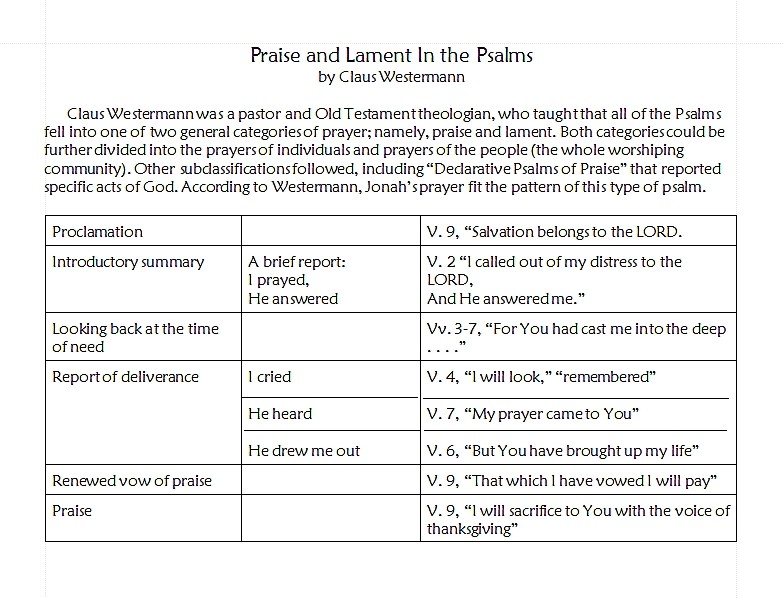
Jonah’s prayer is structures as a psalm of praise
Are we meant to assume he composed this poetic prayer inside the fish?
– possibly – it definitely contains lines from other psalms
• maybe he pieced together stanzas he had sung many times before
◦ many “spontaneous” prayers in our churches are little more than a string of cliches
• one thing that strikes me as odd, is there is no mention if his wrongdoing
◦ the closest he comes to an admission of guilt is in verse 8 — an obscure statement
◦ this not a psalm of confession
– the past tense may suggest this was written after the fact and upon reflection
• poetry recreates experience – and psalms take us inside the heart of prayers
• what we have is an embellished account of what his soul endured
To understand the poem, we have to accept its nonlinear development
– the events are out of sequence Continue reading
January 22, 2017 – Jonah 1:7-16
A Journey Jinxed by Jonah
Each man said to his [shipmate], “Come, let us cast lots so we may learn on whose account this calamity has struck us.” So they cast lots and the lot fell on Jonah. Jonah 1:7
Intro: Remember the theme of this story
From the time that Jonah runs from his divine assignment,
– God works him over, trying to get Jonah to see as he sees and so feel what he feels
• Jonah’s education involves authentic contact with Gentiles
◦ the focus of this episode is on the captain and crew caught in the storm
• the words, Come, let us express a resolve to take action together (cf. Is. 1:18)
◦ mate translates the Hebrew for “neighbor”
◦ their investigation will be a group effort
– the key word in this episode may be learn, which in Hebrew is yada’
• yada’ is “know” — the crew needs to know something to help them whether the storm
• like Jonah, they are also receiving an education,
◦ and their education comes in stages
Stage one: to learn on whose account the calamity occurred
The word for calamity is translated wickedness in verse 2
– it is one of two words in today’s story that has dual meanings:
• the moral evil of wrong doing
• the negative experience of circumstances such as trouble, tragedy, and hardship
– the sailors felt they needed to know the cause of the storm
• then they might be able to find a way to counteract it
• as we saw last time, these veteran mariners recognized it supernatural quality
In biblical times, if knowledge was unavailable by ordinary means,
• almost every ancient cultures had means for consulting the gods
◦ casting lots was like rolling dice
• marked stones were thrown and their colors or symbols interpreted
◦ or else they were placed in a pouch and withdrawn at random, one at a time
(like drawing straws to see who draws the shortest one)
◦ Israel observed this practice in a variety of sacred contexts
(for example, Joshua cast lots before the LORD; Jos. 18:8)
– the appeal of a random chance process was that the outcome could not be controlled
Hebrew scholar, Uriel Simon, observed, “No one challenged the validity of the method, because it was viewed as divinely guided . . .”
The lot is cast into the lap,
But its every decision is from the LORD (Pr. 16:33)
• it worked! the lot fell on Jonah
• God made use of all means available; the sea, the wind, the sailors’ fear, and the lots
Then they said to him, “Tell us, now! On whose account has this calamity struck us? What is your occupation? And where do you come from? What is your country? From what people are you?” Jonah 1:8-9
Stage two: the sailors were to know specific details
When they said to Jonah, On whose account . . ., it may not have been a question Continue reading
January 15, 2017 – Jonah 1:4-6
Mayday! Mayday! Mayday!
The LORD hurled a great wind on the sea and there was a great storm on the sea so that the ship was about to break up. Then the sailors became afraid and every man cried to his god, and they threw the cargo which was in the ship into the sea to lighten it for them. But Jonah had gone down below into the hold of the ship, lain down and fallen sound asleep.
So the captain approached him and said, “How is it that you are sleeping? Get up, call on your god. Perhaps your god will be concerned about us so that we will not perish.” Jonah 1:4-6
Intro: Let’s take a quick look at the previous episode
God gave Jonah an assignment, and Jonah ran away
– he found and boarded a ship that was going across the sea
• we were told that Jonah paid the fare and went with them
• two important words: with them
– like a person who joins a group going backstage, “I’m with them”
• his plan: hide in crowd, lose himself among Gentiles
Why did Jonah choose the sea?
– in Israel’s mind, their God was about land–the land
• the land promised to Abraham and his descendants
• and especially soil suitable for cultivation
◦ the wilderness, mountains and the sea were associated with chaos
◦ wild, disorganized and unpredictable spaces that threated human life
– Jonah sailed for a distant land, one for which God had no concern
• in doing so, he made a fundamental mistake
◦ he confused his small world for God’s real world
• in today’s episode, the sea becomes God’s agent for thwarting Jonah
Meanwhile, Jonah was not talking to God–he just took off
• and God was no longer talking with Jonah
• but they were communicating
◦ through his actions, Jonah was saying, “I’m not going to Nineveh”
◦ and through his actions, God was saying, “Sure you are. You’re just doing it hard way”
V. 4, God responds and the gloves are off
God did not send a breeze as a mild warning
– it was a great wind that whipped up a great storm
• and God did not just send it, but he hurled it
Phillip Cary, “. . . he hurls it as if it were a weapon, a spear or a stone to smash the little human vessel to bits.”
• the repeated usage of a key word in the story (great) reveals God’s seriousness
– the ship’s planks were stretched and strained and about to come apart–death was near
I love and deeply appreciate God’s patient pursuit of the person he’s chosen
– patient, and also relentless
• he would not let Moses off the hook – nor Paul, but chased down both of them
• God does not give up – he will have the one he wants
◦ by brute force if necessary, though he prefers our cooperation
– you and I are not interchangeable stage actors
• in a play, if one actor cannot perform a standby will fill in and the show goes on
◦ but only you can do what God has made you and prepared you to do
• you matter to him — so much that he will come after you
V. 5, The scene on deck is a riot of frenzied activity Continue reading
January 8, 2017 – Jonah 1:1-3
Once Upon A Time
The word of the LORD came to Jonah the son of Amittai saying, “Arise, go to Nineveh the great city and cry against it, for their wickedness has come up before Me.” But Jonah rose up to flee to Tarshish from the presence of the LORD. So he went down to Joppa, found a ship which was going to Tarshish, paid the fare and went down into it to go with them to Tarshish from the presence of the LORD. Jonah 1:1-3
Intro: The Book of Jonah is a story, and it is a wild one
Yet facets of the storyline sound very familiar
– a person trying to escape his or her destiny,
• a ship caught in a storm at sea,
• a large fish that shows up at exactly right moment
– these are elements found in the world’s most beloved folktales
• the story does not require much background information to understand it
◦ everything we need to know is in the text
• the only troubling questions are the big ones:
◦ What is this story? and, Why is it in the Bible?
Was Jonah meant to be read as a record of historical events?
If so, why isn’t it included in the historical books?
– for example, in the one place Jonah is mentioned (2 Ki. 14:25)
• the Elijah and Elisha stories are told in the places they appear in 1 and 2 Kings
– Jonah was not recognized as being primarily historical, but as prophetic
• note that prophecy does not mean “prediction”
◦ it was an inspired event in which one received and delivered God’s word
• even still, the Book of Jonah is not like any other prophetic writing
- The other books of prophecy are exactly that–mostly prophecies
They have little or no narration
Jonah, however, is all narration with one short prophetic sentence (3:4) - Jonah’s unparalleled success–an entire populace turned to God
Not even one of the big name prophets experienced this response - Jonah did something no other prophet did; he ran away
Sometimes prophets told parables (Hebrew, mashal)
– Nathan’s rich man, poor (2 Sam. 12:1-8); Isaiah’s vineyard (Is. 5:1-7); Ezekiel’s many parables (notably Ezekiel 16:1-42)
• but it is like the whole book of Jonah is a parable
• it is the story itself that conveys God’s prophetic word
What is the message of Jonah?
It has to do with a man’s struggle with God over justice
– it’s like the Book of Job in this way; he too struggled with justice
• but Jonah’s concern had a very different twist
◦ Job: Why do bad things happen to good people?
◦ Jonah: Why don’t bad things happen to bad people?
Why don’t they get what they deserve?
• but this struggle isn’t the main point of the story, it just sets it up
◦ spoiler alert! Continue reading
January 1, 2017 – John 16:5-7
Our “Advantage” In 2017
But now I am going to Him who sent Me; and none of you asks Me, “Where are You going?” But because I have said these things to you, sorrow has filled your heart. But I tell you the truth, it is to your advantage that I go away; for if I do not go away, the Helper will not come to you; but if I go, I will send Him to you. John 16:5-7
Intro: A married couple in one of our Wednesday night meetings, happened to mention that I performed their wedding
Another couple said the same, then another, and another
• turns out, I had officiated the weddings of more than half those present
• more than one of those marriages are thirty-plus years old
– some of the engaged couples requested to observe Communion during their wedding
• so at that point of the service I would make it a point to say,
“[her name] and [his name] have asked that their first act as husband and wife is to observe the Lord’s Supper”
◦ what a great way to enter marriage!
◦ begin by receiving Jesus into the union of the new life they will share
• today, Reflexion’s first act in the new year will be to observe Communion together
◦ we begin 2017, receiving Jesus once again into our hearts and our community
How could it be to disciples’ advantage for Jesus to leave them?
Stories of Jesus reveal the inestimable value of his physical presence
– most of all, he brings God near to men, women and children
– when he sees suffering, he feels it
– when people confide secrets, he forgives
– he is loyal; he never betrays a trust
– his counsel is the best wisdom
• he always gives the perfect answer
– he meets the very real need for human touch
– he calms fears, heals wounds, resolves doubts, and restores hope
– besides all this, disciples could point to him and say,
“There he is! Go to him and see for yourself” (cf. Jn. 1:45-46)
So how could it be to our advantage to not have this Person always here? Continue reading
December 18, 2016 – Luke 2:25-35
A Seasoned Christmas
And there was a man in Jerusalem whose name was Simeon; and this man was righteous and devout, looking for the consolation of Israel; and the Holy Spirit was upon him. And it had been revealed to him by the Holy Spirit that he would not see death before he had seen the Lord’s Christ. And he came in the Spirit into the temple; and when the parents brought in the child Jesus, to carry out for Him the custom of the Law, then he took Him into his arms, and blessed God, and said,
“Now Lord, You are releasing Your bond-servant to depart in peace,
According to Your word;
For my eyes have seen Your salvation,
Which You have prepared in the presence of all peoples,
A light of revelation to the Gentiles,
And the glory of Your people Israel.”
And His father and mother were amazed at the things which were being said about Him. And Simeon blessed them and said to Mary His mother, “Behold, this Child is appointed for the fall and rise of many in Israel, and for a sign to be opposed–and a sword will pierce even your own soul–to the end that thoughts from many hearts may be revealed.” Luke 2:25-35
Intro: Christmas is not only a day, it is a season
It is the most important season for America’s economy
– but we’re already well aware of that
• it starts too soon and is crammed with too much
– for Mary, Christmas season was kicked off when the angel approached her
• in both Hebrew and Greek “angel” and “messenger” are the same word
• angel messengers arrive straight from the presence of God
Normally, when encountering humans, the angel’s first word is, Do not be afraid
– how Gabriel began with Zacharias who was troubled by his presence (Lk. 1:13)
• and the same with the angel who appeared to the shepherds when they were terribly frightened (Lk. 2:10)
◦ it seems that with Mary, Gabriel forgot to deliver his opening line
• I don’t think it is a misreading to sense Gabriel’s excitement
◦ Gabriel blurted out what he knew about Mary when he saw her:
favored one – she was chosen for something great
the Lord is with you – she would not fail; could not fail
(in scripture, this second statement means everything will be okay)
– perhaps, when he saw her reaction to him, he remembered the “Don’t be afraid” part
• Do not be afraid – and for second time he said her name
◦ Mary was known to the angels in heaven
• what he did not say was, “Be terrified, for your destiny is upon you”
◦ the plans she had for coming years had been scrapped
◦ all she can do now was to wake up each morning and discover where God’s plan would take her
That one Christmas changed everything for Mary
The beginning of Joseph’s Christmas season was more complicated
– he did not first learn about Mary’s destiny from angels
• I think we sometimes read Bible in fairytale mode
◦ we don’t stop to think about its real-life impact on these people
• Joseph did not instantly think, “It’s a miracle!”
◦ he assumed the worst – still, he was a good man
◦ he planned a secret divorce rather than expose her to public shame
– the Scriptures do not explore whatever inner anguish he felt
• while considering this course, angel came
◦ he too was told not to be afraid – and specifically, to take Mary as his wife
◦ an angel explained to Joseph that the Child in her was of the Holy Spirit (Mt. 1:20)
• Matthew adds that this was a fulfillment of prophecy: Emmanuel, “God with us” (Mt. 1:22-23)
◦ so, whereas Mary was told, the Lord is with you
◦ we learn from Matthew that in Jesus, the Lord is with us all
The way Jesus enters any human life works the same for us as Mary and Joseph Continue reading
December 11, 2016 – Luke 1:26-38
Holiday Food for Thought
Now in the sixth month the angel Gabriel was sent from God to a city in Galilee called Nazareth, to a virgin engaged to a man whose name was Joseph, of the descendants of David; and the virgin’s name was Mary. And coming in, he said to her, “Greetings, favored one! The Lord is with you.” But she was very perplexed at this statement, and kept pondering what kind of salutation this was. Luke 1:26-29
Intro: Mary was one of a kind
Never has anyone else been asked to become what she became
– the surrogate mother of the Messiah, the Son of God
• nevertheless, her uniqueness illustrates something:
◦ a response to God that is necessary universal
• the response is a way of holding the gifts of Spirit that bears the fruit of the Spirit
◦ a way to receive life so that it gives birth to more life
◦ Mary signified her acceptance of God’s will when she said:
May it be done to me according to your word (Lk. 1:38)
– Mary received God’s word into her whole self; heart, mind, soul and body
• the baby within her was infinitely more than her body,
◦ nevertheless, he was sheltered and nourished by her body
◦ in this way he became a human person in our world
• when we give our consent to God’s word to live and work within us, it reproduces life
Mary’s initial response wasn’t enthusiastic joy
In verse 29 she was perplexed and kept pondering the angelic greeting
– perplexed sounds like “confused,” but the Greek word hints at “disturbed”
• the word translated pondering means “to turn over in the mind”
• she was trying to penetrate the meaning of this unusual greeting
– ponder is one of four words Luke uses regarding Mary’s thought process
• I do not think Luke’s use of these words was incidental
• they reveal something about Mary’s inner life
◦ the way Mary moved along in God’s will Continue reading
December 3, 2016 – Luke 1:67079
Gateway to God’s Heart
And his father Zacharias was filled with the Holy Spirit, and prophesied, saying:
“Blessed be the Lord God of Israel,
For He has visited us and accomplished redemption for His people,
And has raised up a horn of salvation for us
In the house of David His servant–
As He spoke by the mouth of His holy prophets from of old–
Salvation from our enemies,
And from the hand of all who hate us;
To show mercy toward our fathers,
And to remember His holy covenant,
The oath which He swore to Abraham our father,
To grant us that we, being rescued from the hand of our enemies,
Might serve Him without fear all of our days.
And you, child, will be called the prophet of the Most High;
For you will go on before the Lord to prepare His ways;
To give to His people the knowledge of salvation
By the forgiveness of their sins,
Because of the tender mercy of our God,
With which the Sunrise from on high will visit us,
To shine upon those who sit in darkness and the shadow of death,
To guide our feet into the way of peace.” Luke 1:67-79
Intro: John the Baptist occupied a unique turning point in biblical history
The transition from the Old Testament era to the New Testament times
– more specifically, John was the end of the prophetic tradition associated with Elijah
• a tradition that reached its climax in John (Lk. 7:28)
• in fact, there was a strong link between John and Elijah
◦ he came in the spirit and power of Elijah (Lk. 1:17)
◦ in some way John was a prophetic fulfillment regarding Elijah (Mal. 4:5-6; Mt. 17:10-13)
For all the prophets and all the Law prophesied until John. And if you are willing to accept it, John himself is Elijah who was to come. He who has ears to hear, let him hear. (Mt. 11:13-15)
– it is clear that Zacharias and Elizabeth still stood very much in the Old Testament
• for example, their connection to Aaron and their description, “righteous…and walked blamelessly” (Lk. 1:5-6)
• in fact, their situation echoed that of Abraham and Sarah
◦ the old couple who could not produce a child, yet miraculously gave birth to Israel
– my point is: the more you know about the Old Testament, the easier it is to interpret Zacharias’ poem
When it came time to name Zacharias’ son, certain uncanny events occurred
– such that neighbors were astonished and even fearful
• the were wondering, What then will this child be(come)?
– the poem is God’s answer to that question
• that is why Zacharias was filled with the Holy Spirit
◦ so he could deliver this inspired poem
There are two parts to Zacharais’ poem
The two parts are delivered in two long sentences
– the first part is history, the second was the present and future
• first, the poem travels backward through time to David, the prophets, then Abraham
• then it turns around and addresses his child’s future and One whose way he would prepare
– the first part is praise, the second is prophecy Continue reading
November 27, 2016 – Mark 1:1
Reconcilable Differences
The beginning of the gospel of Jesus Christ, the Son of God. Mark 1:1
Intro: I want to carry our current theme of prayer through Christmas
Mark is an odd place to start, because he does not tell the Christmas story
– instead, he tells us who Jesus is and goes straight to his story
• gospel: good spell (old English, a story or speech) a good message
◦ it is like hearing a relative who was in a car accident survived and is well
• we need good news, because something is wrong with the world
◦ something is wrong with us
– we live in a world of lost spiritual intimacy — not only with God
• but with the world of nature, human society, family, ourselves
◦ our world is fragmented – the pieces don’t go together
• the anger, hostility, violence and cruelty in our nation is staggering
◦ we have become strangers in a strange land
Daniel Siegel has pointed out that every relationship has instances of rupture
– we know this – we have felt rejection, insecurity, cut off from a friend or lover
• Siegel says that the answer to rupture is repair
◦ the repair he recommends requires education, retraining, courage, humility
(and probably therapy)
• people who experience too many fractures tend to give up
◦ in relationships they adopt defense strategies rather than intimacy strategies
– we need good news, we need hope, we need help — we need Jesus
. . . if anyone is in Christ, he is a new creature; the old things passed away; behold new things have come. Now all these things are from God, who has reconciled us to Himself through Christ and gave us the ministry of reconciliation, namely, that God was in Christ reconciling the world to Himself . . . . (2 Cor. 5:17-19)
So Mark says, The beginning of the gospel, which refers to a specific moment in history
– but, for us, the good news begins when we pick up the book and read
• the beginning is now – something new is entering our lives
• we can put up with a lot–trouble, imperfection, setbacks–if we have hope
Reading through Mark this week, I noticed something
There are themes or events or unusual phenomena that appear at
the beginning of Jesus’ story and reappear at the end
– of course, this is not surprising if we clearly understand his story
• Christmas and crucifixion are inseparable
More than once, Helmut Thielicke wrote, “The manger and the cross are made from the same wood.”
• the angel who appeared to Joseph told him,
. . . you shall call his name Jesus, for He will save His people from their sins (Mt. 1:21)
◦ “Savior” is one of the words that defines his life
◦ it was in his dying that he delivered life to us
Now My soul has become troubled; and what shall I say, “Father, save Me from this hour?” But for this purpose I came to this hour. Father, glorify Your name. (Jn. 12:27-28)
– I have four examples of themes that tie the beginning and end of the gospels together
First, angels appear at the beginning of his story
Both Matthew and Luke report a flurry of angelic activity
– they make announcements and give people encouragement and assistance
• then they return at the end of all four gospels to announce Jesus’ resurrection
– only two other times during Jesus’ ministry do they emerge from their invisible realm
- The first is close to the beginning
– right after Jesus’ temptation (Mk. 1:13), angels ministered to him - The second is close to the end
– the night prior to his crucifixion (Lk. 22:43) an angel strengthen him
– so these other two visitations occurred at times of severe crisis