


 Draw near to God and He will draw near to you
He came to His hometown and began teaching them in their synagogue, so that they were astonished, and said, “Where did this man get this wisdom and these miraculous powers? Is not this the carpenter’s son? Is not His mother called Mary . . . ?”
And they took offense at Him. But Jesus said to them, “A prophet is not without honor except in his hometown and in his own household. Matthew 13:54-55, 57
Jesus Christ knows what it is to be rejected.
He was in the world, and the wold was made through Him, and the world did not know Him. He came to His own, and those who were His own did not receive Him. (Jn. 1:10-11)
He was despised and forsaken of men / A man of sorrows and acquainted with grief;
And like one from whom men hide their face / He was despised and we did not esteem him (Is. 53:3)
A beautiful person in every way, yet rejected. If you, also, experience rejection, do not assume it is because read more…
Summoning two of his disciples, John sent them to the Lord, saying, “Are You the Expected One, or do we look for someone else? Luke 7:19 (read verses 18-35)
INTRO: This week, Barbara said she was going to look into getting a bus pass for next month
Gasoline is simply too expensive right now to keep filling up her tank
Gas prices right now, like the tidal changes along the West Coast due to the earthquake in Japan, illustrate the famous “Butterfly Effect”–only it’s not the flapping of a butterfly’s wings in Brazil nor is the effect a tornado in Texas
The hike in the cost of gas is the result of another famous physics’ model, the “Domino Effect” in the middle-east as the population of one nation attempts the achievement of those in another nation that brought down the authoritarian rule of an elite
I read an interesting article in Jadaliyya, in which Lina Khatib described the typical response of Arab autocrats to the current protests in their nations: read more…
Draw near to God and He will draw near to you
The kingdom of heaven is like a treasure hidden in the field, which a man found and hid again; and from joy over it he goes and sells all that he has and buys that field.
Again, the kingdom of heaven is like a merchang seeking fine pearls, and upon finding one pearl of great value, he went and sold all that he had and bought it. Matthew 13:44-46
Treasure . . . it was there all along, but hidden. The treasure was a source of joy. As long as the treasure was hidden, the man in the story did not know this joy. Had he passed that field every day unaware of the joy beneath him?
Jesus’ purpose for the parables is to give us knowledge of that which is present yet invisible (vv. 31-33). Truth is hidden in the ordinariness of the parables, the kingdom of heaven is hidden in every moment, and God is hidden in Jesus Christ. Jesus told parables to enable his followers to go beyond looking to seeing (Mk. 8:17-21). read more…
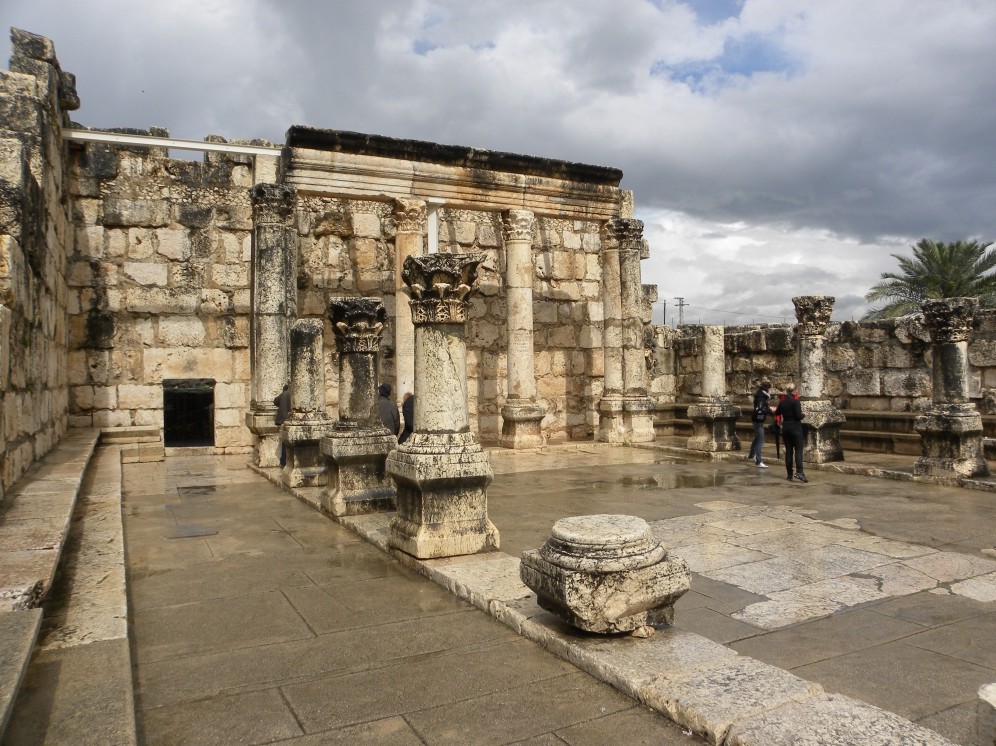
Now when Jesus heard this, He marveled at him, and turned and said to the crowd that was following Him, I say to you, not even in Israel have I found such great faith.” Luke 7:9 (read 7:1-19)
INTRO: So many centuries have passed since the time of Jesus, it isn’t often that archeology can locate an exact spot that is mentioned in the gospels
– one of the exceptions is the synagogue in Capernaum
– the ruins of the structure you see there today was built on the site of the first century synagogue
Draw near to God and He will draw near to you
And He said, “The one who sows the good seed is the Son of Man, and the field is the world; and as for the good seed, these are the sons of the kingdom; and the tares are the sons of the evil one; and the enemy who sowed them is the devil, and the harvest is the end of the age; and the reapers are the angels.” Matthew 13:37-39
This poor planet! There is too much violence, too much suffering, too much grief, too much evil.
Looking into the distant future, Jesus saw a time when “The Son of Man will send forth His angels, and they will gather out of His kingdom all stumbling blocks, and those who commit lawlessness, and will throw them into the furnace of fire” (v. 41). Imagine this: Planet Earth innocent and healthy, where everything is perfect–exactly as it should be–, nothing corrupt or impure, nothing abusive or oppressive, nothing that involves one person exploiting, using, or harming another. read more…
Although Jesus’ concerns were not political, there are always political consequences attached to beliefs that are strongly held and practiced–provided the beliefs are significant and life-changing. It is therefore necessary to look closely at the teaching of Jesus and ask how it could affect our participation in various social systems–e.g., political, corporate, and religious. It is a characteristic of social and economic systems to produce classes like those in verses 20-26; poor and rich, hungry and well-fed, ostracized and praised, etc.
Since this was not the theme of our Bible study, I thought it might be helpful to add a few thoughts for us to consider along these lines. I hope the following stimulates your own ideas and creativity. I have adapted these points from Helmut Thielicke’s, The Evangelical Faith, vol. 2.
- All human systems, no matter how compassionate or well-intentioned, will be corrupted by humans. This fact alone should prevent us from becoming politically or religiously fanatic.
- Programs that aim at changing a system or conditions within a system without changing the human heart are doomed. (Slave owners in the South found ways to continue to enslave African Americans after the Civil War without referring to it as slavery.) Greed and self-love can find ways to abuse others in any human system.
- The essence of the gospel is that nothing can “separate us from the love of God, which is in Christ Jesus our Lord” (Ro. 8:38-39). This includes corrupt, human systems.
- We cannot be complacent about the ways in which systems abuse people. Within the systems surrounding our lives, we will find unguarded places where we are free to make our own decisions and in some way counteract the dehumanizing effects of the system.
- Some people are held more responsible than others for a system’s abuses–”there are levels of guilt. . . . Dependents and those on fixed incomes who are reduced to poverty are far less to blame than the powerful class of politicians and managers” (Thielicke).
But love your enemies, and do good, and lend, expecting nothing in return; and your reward will be great, and you will be sons of the Most High; for He Himself is kind to unrighteous and evil men. Be merciful, just as Your Father is merciful. Luke 6:35-36 (Read verses 20-49)
INTRO: I’ve been thinking about a book I would like to write
The Psychology of Jerks: How to Spot Them and Avoid Them (or otherwise learn to deal with them)
Not every jerk tries to be one
– not because he has an inflated ego, or simply doesn’t care, or is not all that bright
– some jerks are just guys who have a flawed set of values and if that is all they know, then for them success comes from practicing those values rigidly
– for example, to some people it is a virtue to never pay full retail price for anything (what they cannot see is how that practice can hurt other people)
– if such a person feels the need to try harder, he simply contiues to do the wrong thing, but more intensely read more…
Draw near to God and He will draw near to you
He presented another parable to them, saying, “The kingdom of heaven is like a mustard seed, which a man took and sowed in his field; and this is smaller than all other seeds, but when it is full grown, it is larger than the garden plants and becomes a tree, so that the birds of the air come and nest in its branches.” Matthew 13:31-32
Parables are not illustrations or even mere analogies, but also riddles–they conceal as much as they reveal (Mt. 13:13-15). Some people who heard Jesus’ parables were able to solve the puzzle, while others went away, no doubt, confused or unimpressed. The truth was there for those who had ears to hear (vv. 9 & 43), but not everyone was prepared or willing to hear it. read more…
It was at this time that He went off to the mountain to pray, and He spent the whole night in prayer to God. (Lk. 6:12; read verses 12-19)
INTRO: In 2005, I was able to spend a month in a monastery
Later, when I was talking about my experience with a man from the church–a rather cynical person–, he asked, “How do they justify their lives? They have it sort of easy, don’t they? All they concern themselves with is their own spirituality. What are they doing for others?”
Leaving aside the spiritual support they give to others simply by being there, through counsel, and through their daily prayers for the world, I simply replied, “Given the billions of people in the world today, don’t you feel that it’s justifiable if just a few of them are totally devoted to glorifying and worshiping God?”
His question highlights a common misperception about Christian spirituality; namely, that it is an escape from life, self-focused, and that it does nothing that touches the world
read more…
Draw near to God and He will draw near to you
And he said to them, “An enemy has done this!” The slaves said to him, “Do you want us, then, to go and gather them up?” But he said, “No; for while you are gathering up the tares, you may uproot the wheat with them.” Matthew 13:28-29
In the parable, when the servants of the landowner discovered and reported to him that weeds were growing alongside his wheat, he immediately discerned what happened, “An enemy has done this!” He did not blame the seeds, soil, or servants, but recognized the work of an enemy. read more…
 Daily Meditations From the Scriptures