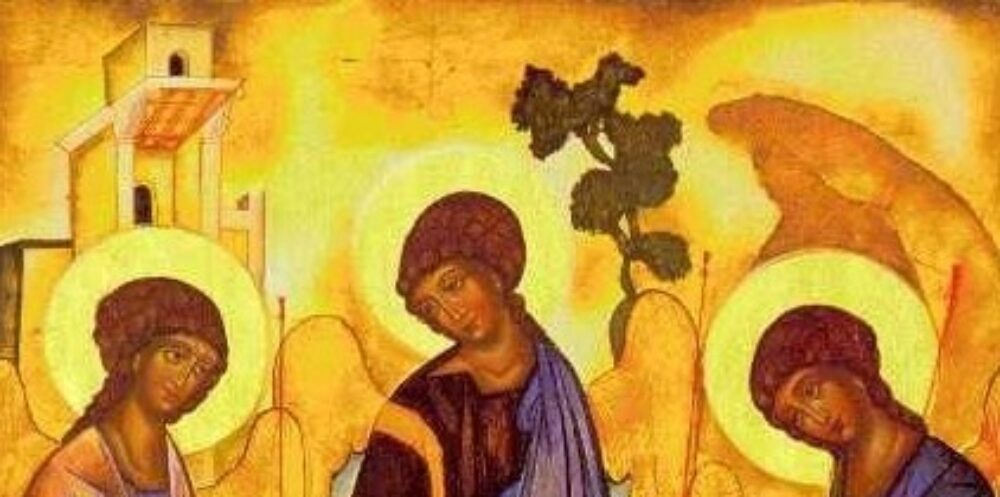
Jesus’ Grand Entrance
Our Scripture reading is based on Mark 11:1-10, but combines details from all four Gospels.
As they approached Jerusalem, at Bethphage and Bethany, near the Mount of Olives, He sent two of His disciples, and said to them, “Go into the village opposite you, and immediately as you enter it, you will find a colt tied there, on which no one yet has ever sat; untie it and bring it here. If anyone says to you, ‘Why are you doing this?’ you say, ‘The Lord has need of it’; and immediately he will send it back here.” They went away and found a colt tied at the door, outside in the street; and they untied it. Some of the bystanders were saying to them, “What are you doing, untying the colt?” They spoke to them just as Jesus had told them, and they gave them permission.
This took place to fulfill what was spoken through the prophet:
“Say, ‘Fear not’ to the daughter of Zion,
‘Behold your King is coming to you,
Gentle, seated on a donkey,
Even on a colt, the foal of a beast of burden.’”
These things His disciples did not understand at the first; but when Jesus was glorified, then they remembered that these things were written of Him, and that they had done these things to him.
Intro: Most of us have read or heard this story many times
But have you ever asked, What purpose does it serve?
– how does this fit into entire ministry of Jesus?
• what value is there in this quasi-political rally around Jesus?
• what does the makeshift parade accomplish with all its shouting and flag-waving?
◦ only they did not have flags or imperial banners so they gathered leafy branches from nearby fields
◦ and there was no red carpet, so thrift-store clothing was tossed on the ground for him to ride over
– Jesus had never allowed the crowds to do this before (cf. Jn. 6:15), so why now?
• what does it change? What does it prove? By the end of the week he was dead
Later on, the disciples were asking the same question
– as John said, they did not understand these things at the time
• but with reflection it came to them
• they saw in it the fulfillment of scripture written long ago, in Zechariah and Psalm 118
– with uncharacteristic public display, Jesus arrived at the very gates of Jerusalem
• he assumed the role that was uniquely his, confirming what Peter had confessed
◦ that Jesus is “the Messiah, the Son of the living God” (Mt. 16:16)
◦ although, at that time, Jesus ordered his disciples to “tell no one about Him” (Mk. 8:30)
This morning we will observe Jesus through the lens of these Palm Sunday events
Jesus had been making preparations for this day
I don’t mean, he made “arrangements”
– William Barclay thought Jesus had made a previous arrangement with the owner to use his donkey
William Barclay, “‘The Master needs them,’ was a password by which their owner would know that the hour which Jesus had arranged had come.”
• I’m doubtful that was the case – the essence of this story is not its careful planning, but its spontaneity
• not everything had been worked out
◦ still, Jesus was certain it would come together — note how well he perceived how things would unfold:
Go into the village and this will happen
Untie the colt and this may happen
If that happens, say these words and this will happen
– this is what I mean by “making preparations”
• Jesus had been preparing, not the big event, but himself
• preparing himself for this moment of recognition, for this final week of conflict with rigid religion
◦ preparing himself for Gethsemane, rejection and crucifixion
◦ he tried to prepare the disciples, but they could not fathom what he said — so he just prepared himself
The hour has come for the Son of Man to be glorified. . . . Now My soul is troubled; and what shall I say, “Father, save Me from ths hour”? But for this purpose I came to this hour. Father, glorify Your name. (Jn. 12:23, 27)
It’s always a little surprising to see that, like us, Jesus had needs read more…
What Have We Been Missing?
Now as Peter was traveling through all those regions he came down also to the saints who lived at Lydda. There he found a man named Aeneas, who had been bedridden eight years, for he was paralyzed. Peter said to him, “Aeneas, Jesus Christ heals you; get up and make your bed.” Immediately he got up. And all who lived at Lydda and Sharon saw him, and they turned to the Lord. Acts 9:32-43
INTRO: I know some of us still don’t get contemplative prayer
Or why we begin Sunday mornings in silence, seeking God or waiting on him
– it is difficult to sit a few minutes in openness, responsiveness and receptivity, so why bother?
– I hope that the answers becomes clear for you today
When we catch up with Peter, he is on the road
Maybe he was following leads to locate pockets of believers
– or perhaps he was looking for such communities to encourage them
• or he was simply drifting, allowing the Spirit to direct him
– Lydda is modern day Lod, the location of Ben Gurion Airport
• it was there that Peter “found” Aeneas – as though he was on the alert for opportunities
• Luke is skimpy on the details
◦ it seems he just wants to keep the story moving — we would like a lot more information
◦ like how did Peter know that Jesus was healing Aeneas?
– “Sharon” refers to the coastal plain that ran from Joppa to Mt. Carmel
• Aeneas’ physical healing resulted in people making a turn to the Lord
• I once heard an evangelist quoted as saying, “People change, but not that much”
◦ but Luke has been showing us that it is possible to change that much
Now in Joppa there was a disciple named Tabitha (which translated in Greek is called Dorcas); this woman was abounding with deeds of kindness and charity which she continually did. And it happened at that time that she fell sick and died; and when they had washed her body, the laid it in an upper room. Since Lydda was near Joppa, the disciples, having heard that Peter was there, sent two men to him, imploring him, “Do not delay in coming to us.” Acts 9:36-38
Peter’s next destination was Joppa, a seaport on the Mediterranean (modern Jaffa)
– in Luke 8:1-2 we are told the twelve disciples were with Jesus on the road
• but Luke also tells us there women were also present
◦ the women, however, are not specifically referred to as disciples
• but here, Tabitha is a disciple–the only New Testament use of the feminine form of “disciple”
– the little we know about Tabitha is what we read here
• nevertheless, there’s enough to reveal the impact made by the kindness of a good person
• that is why the believers in Joppa were not ready to let her go
So Peter arose and went with them. When he arrived, they brought him into the upper room; and all the widows stood beside him, weeping and showing all the tunics and garments that Dorcas used to make while she was with them. But Peter sent them all out and knelt down and prayed, and turning to the body, he said, “Tabitha, arise.” And she opened her eyes, and when she saw Peter, she sat up. And he gave her his hand and raised her up; and calling the saints and widows, he presented her alive. It became known all over Joppa, and many believed in the Lord. Acts 9:39-42
At this point we may feel like we’re experiencing de ja vu
– it is as though we were watching a rerun of events reported in Luke 8
- Jairus had “implored” Jesus to come to his home (Lk. 8:41)
◦ the messengers “implored” Peter to come to Joppa - In his home, Jairus’ daughter was dying (and died before Jesus arrived, Lk. 8:43, 49)
◦ Tabitha’s body lay dead in the upper room in Joppa - Mourners were already present and weeping in Jairus’ home (Lk. 8:52)
◦ widows were weeping in the upper room when Peter arrived - Jesus sent the mourners out
(leaving only Jairus, his wife and Peter, James and John; Lk. 8:51 & cf. Mk. 5:40)
◦ Peter sent the mourners out - Jesus took the girl’s hand and spoke two words to her (Lk. 8:54)
◦ Peter reversed order, first speaking two words to Tabitha, then taking her hand
Peter’s education and training had prepared him for this moment
– having been with Jesus, he followed the example that had been set for him
– in Joppa, the physical miracle resulted in people coming to faith in the Lord
And Peter stayed many days in Joppa with a tanner named Simon. Acts 9:43
Again, Simon Peter is associated with another “Simon”
What does it take to turn our lives toward God?
Or to come to a faith in God when you had never believed or trusted in him?
– we assume it takes exactly the sort of thing we see in this passage: a miracle
• but that is exactly what Jesus hoped we would transcend (Jn. 20:29)
◦ however, that is not my concern right now
• what I want us to consider is that two bodies were the focal points of the miracles
◦ one body was paralyzed and the other was dead
Psalm 139 is a psalm of wonder
– wonder is not the theme of the poem, but its tone
For You formed my inward parts;
You wove me in my mother’s womb.
I will give thanks to You, for I am fearfully and wonderfully made;
Wonderful are Your works, and my soul knows it very well.
My frame was not hidden from You,
When I was made in secret,
And skillfully wrought in the depths of the earth;
Your eyes have seen my unformed substance;
And in Your book were all written
The days that were ordained for me,
When as yet there was not one of them.
How precious also are Your thoughts to me, O God!
How vast is the sum of them.
If I should count them, they would outnumber the sand.
When I awake, I am still with You. (Ps. 139:13-18)
• the psalmists frequently write this way: my heart, my bones, my kidneys, my lips
◦ all that is felt or done by these body parts are experiences, functions, and expressions of me
◦ nor was it only Israel’s poets who paid attention to external and internal stimuli
• visceral sensations were indicators of how a person was doing
When I kept silent, my bones wasted away
Through my groaning all day long.
For day and night your hand was heavy upon me;
My life’s juices were turned into the drought of summer. (Ps. 32:3-4, literal)
◦ listening to our body, we can recognize even mild anxiety, fear, or upset
◦ the body also reveals the status of a person’s relationships — with God and others
– furthermore, God attempts to communicate with us through our bodies
“Knowledge of God somehow thrusts deeper roots within the human organism itself even beyond the mind’s ability to think and analyze.” Edwin McMahon & Peter Campbell
A model of the brain as a three-story building read more…
Christ, the Ruler of All
Now Saul, still breathing threats and murder against the disciples of the Lord, went to the high priest, and asked for letters from him to the synagogues at Damascus, so that if he found any belong to the Way, both men and women, he might bring them bound to Jerusalem Acts 9:1-2
Intro: Do you remember the 1997 movie, Amistad?
African men and women were on a slave ship from Cuba to the U.S.
– they staged a revolt on board and took control of the ship
• misled, they sailed into U.S. waters and were apprehended by the American navy
• put on trial for mutiny, they were at a loss not knowing the English language
– one of the slaves began thumbing through a Bible, “reading” the drawings in it
• from those pictures alone he was able to decipher the story of Jesus
◦ in it he found comfort and hope
Perhaps you’ve seen children’s Bibles with illustrations of some of the stories
– these are meant to increase a child’s interest and his or her understanding
• God’s design for his sanctuary included sacred art (Ex. 25:18-20; 26:1)
• when serving in the Holy Place, the priests were surrounded by angels
– so we begin this morning with sacred art
Early Christianity’s form of sacred art: Icons
In my religious upbringing, there was no place for icons
– what we were told, Roman Catholics worshiped idols
• we were never taught the difference between idols and icons
◦ or between worship and veneration
• nevertheless, we had pictures
◦ in our “Sunday school” classes we colored in pictures of Bible stories
◦ sappy paintings of Jesus decorated the front wall of the sanctuary
– when exposed to icons, I thought they looked weird – I didn’t get them
• but prior to my first trip to Russia, a friend had me to rethinking icons
◦ then, when visiting orthodox churches, I found myself deeply moved
◦ it was learning to read and art appreciation at the same time
• there is still a lot of junk art that that annoys me, but icons are–something else
Like books, icons communicate through visual symbols
– they deliver their message not only conceptually, but directly
• their purpose is facilitate an encounter — to give the viewer an opportunity to:
◦ experience the story they tell
◦ experience the truth they proclaim
– what could be done with the interior walls of churches?
• Nilus, a fifth century monk suggested the following:
“Let the hand of the artist fill the church on both sides with pictures from the Old and the New Testaments, in order that the illiterate, who cannot read the Divine Scriptures, should, by looking at the painted images, bring to mind the valiant deeds of those who served God with all sincerity and be themselves incited to rival the glorious and ever-memorable exploits, through which they exchanged earth for heaven, preferring the invisible to the visible.”
◦ in the seventh century, John of Damascus, the great defender of icons wrote:
“What the written word is to those who know letters, the icon is to the unlettered” (though “all of us,” he added “benefit from what is painted in the icons”)
• when you see an icon, think of it being like a book – a “devotional”
◦ it is something you read to warm the heart to God’s presence
◦ a tool that serves to inform and inspire
But why the funny looking art form? read more…
The Word Goes On the Road
Saul was in hearty agreement with putting him to death. And on that day a great persecution began against the church in Jerusalem, and they were all scattered throughout the regions of Judea and Samaria, except the apostles. Some devout men buried Stephen, and made loud lamentation over him.
But Saul began ravaging the church, entering house after house, and dragging off men and women, he would put them in prison. Therefore, those who had been scattered went about preaching the word. Acts 8:1-4
Intro: In this chapter we are going to get lessons in evangelism
I rarely address this subject and for a number of reasons
- Both “personal” and programmatic evangelism have been overemphasized
• the term “Great Commission” never appears in the Bible
◦ the great commandment (and second) do appear–in Jesus’ teaching
◦ but they are often ignored or merely given lip service
• John 3:16 is a foundation for thinking theologically about evangelism
For God so loved the world, that He gave His only begotten Son, that whoever believes in Him shall not perish, but have eternal life. - Step-by-step methods of “soul-winning” miss the point
• it is typical that in our western world we reduce evangelism to a “science” - Evangelism is less about what we do than who we are
• the hypocrite’s preaching betrays rather than supports the gospel
Klyne Snodgrass, in discussing the parable of the Good Samaritan said, “The parable, like most of Scripture, is concerned with identity. In effect, when people asked Jesus ‘What do I have to do?’ he asked in return ‘What kind of person are you?’ . . . what we are cannot be torn from what we do.”
To be clear: Evangelism is the communication of the evangel, with the intention to persuade people to receive the message, respond with faith and repentance, be forgiven their sins and become followers of Jesus Christ.
Evangel is “gospel” in the New Testament, meaning a good message or good news
– evangelizo is to evangelize – bring good news
• this word occurs five times in this chapter and is associated with four other words:
1.) the word, 2.) the Spirit, 3.) baptism and 4.) rejoicing (the effect of receiving it)
– to evangelize is to tell the story of Jesus
• but those who tell it must have a personal experience of salvation through Jesus
◦ they are witnesses of Jesus’ power to transform a human life
◦ this has been emphasized in Acts from the start (1:8, 22; 2:32, 40; 3:15; 5:32; etc.)
Verses 1-4, Incentive to take the word on the road
Here’s something you won’t find in any Guide to evangelism:
To Pastors: The way to motivate your congregation to get out of the church and preach the gospel, do something to bring such intense persecution that they are driven from the church. Or set the building on fire.
– verses 1-4 could have been a fitting conclusion if placed at end of chapter 7
• their purpose here is to provide a transition to the events of this chapter
• perhaps there is benefit in seeing the gospel thrive under the shadow of persecution
Stephen’s death unleashed a flood of pent up rage
– we do not know persecution
• at least not like believers at other times and in other places
• I grew up in a denomination that considered itself persecuted
◦ it wasn’t persecuted, but we were criticized and ridiculed for being weird
– there’s no need to go looking for persecution
• if we don’t live in a time of persecution, let’s not create it
◦ but neither is it right to avoid persecution at all costs
◦ and at the very least we are to:
Remember the prisoners, as though in prison with them, and those who are ill-treated, since you yourselves also are in the body. (Heb. 13:5)
• follow Jesus as authentically as you can and you will come under attack
◦ and most likely, the assault on you will come from other Christians
An odd effect that we will see repeated in Acts: read more…
The Faith And Flaws of Our Fathers
The high priest said, “Are these things so?” And [Stephen] said, “Hear me, brethren and fathers! The God of glory appeared to our father Abraham when he was in Mesopotamia, before he lived in Haran, and said to him, ‘Leave your country and your relatives, and come into the land that I will show you.’ Then he left the land of the Chaldeans and settled in Haran. From there, after his father died, God had him move to this country in which you are now living. But He gave him no inheritance in it, not even a foot of ground, and yet, even when he had no child, He promised that He would give it to him as a possession, and to his descendants after him. But God spoke to this effect, that his descendants would be aliens in a foreign land, and that they would be enslaved and mistreated for four hundred years. And whatever nation to which they will be in bondage I Myself will judge,’ said God, ‘and after that they will come out and serve Me in this place.'” Acts 7:1-3
Intro: This chapter is obviously a continuation of last week’s episode
When the high priest asks, “Are these things so?” what “things” is he referring to?
– the charges leveled against Stephen; namely, that he spoke against:
• Moses, God, the temple and the Law (6:11, 13)
• and that he said Jesus would
destroy this place [the temple] and alter customs which Moses handed down to us. (Acts 6:11-14)
◦ Stephen had not said these things
◦ but they are what the prejudiced ears of his accusers heard
– now Stephen is given opportunity to defend himself
• rather than begin by correcting them regarding what he actually said,
◦ he took them back to their ancient roots
• he will make his defence by weaving into an account of biblical history
Verses 1-8, Abraham was the father of their race and faith
Stephen said it was “the God of glory” who appeared to Abraham
– although this is merely an introductory statement, it makes a point
• one of the accusations against Stephen is immediately contradicted
◦ i.e., that he spoke against God — his reverence for God is clear
– he reminds the Council that Abraham moved at God’s call
• as early as Abraham, God had a plan
◦ Stephen will trace that plan through the rest of his speech
• he moves quickly through Isaac, Jacob and Jacob’s sons (the twelve patriarchs)
◦ God’s plan was unfolding through their lives too
Verses 9-16, Stephen slows down when narrating Joseph’s story
Joseph suffered a lot at the hands of his brothers
– his first few years in Egypt were also difficult, Yet God was with him
– God carried his plan forward through his life
Verses 17-44, Moses takes up the longest section of Stephen’s speech
This is commensurate with the importance given to Moses read more…
Turning the Next Corner
Now at this time while the disciples were increasing in number, a complaint arose on the part of the Hellenistic Jews against the native Hebrews, because their widows were being overlooked in the daily serving of food. Acts 6:1
Intro: There are insights in this chapter I do not want us to miss
So I am going to spend more time than usually in providing a perspective on it
– if we can see the key issues, it will help to clarify who we are at Reflexion
Paul Hiebert, a missionary in India, later became a renown cultural anthropologist
– his interest in folk religion led him to research in the process of institutionalization
Hiebert observed that “Institutions, like people, go through cycles of growth, maturation and ‘hardening of the categories.’ The result is often a loss of vitality and life they once had. We must balance stress on church growth with church renewal or we will plant many churches which in a few decades will be dead.” [italics added]
Hiebert also identified stages of institutionalization:
- “The founding parents of an institution often pay a high price to join it, and take personal risk. They join together in a fellowship of high intensity, personal in nature and caring. The result is a feeling of warmth and tremendous purpose and fellowship.”
- “The second generation is raised inside the organization, and this makes them radically different. . . . To stay is the easiest course with little sacrifice.”
- “The third generation is more removed from the founders and has less of their vision. Nominalism enters, and many stay in because it is the course of least resistance.”
- “The fourth generation and on are well entrenched and the institution for them is a way of life. They have much invested in it in terms of their own identity and so want to maintain it not for what it does in ministry for the world, but what it does for them as persons.”
We begin here, because in chapter 6 we find two organizations in conflict
– first, the community of disciples that is on the crest of a spiritual movement
• its leaders are discovering that growth does not come without a cost
– secondly, the established religious institution
• its leaders and some of its devoted followers feel threatened by the community
◦ the community is finding its way forward,
the institution has arrived
◦ the community is learning how to function
the institution’s functions are fixed in place
V. 1, The community’s growing pains
We learned of generous donations to the community
– now we see one of ways those donations were used to help the needy
• cultural tensions in the larger society surfaced within the community
• “Hellenists” were Jews who had absorbed Greek culture
◦ this gave locals the impression they had been compromised
– Hebrew widows knew the language and local customs
• they would be familiar with the system and who to contact for relief
• I doubt that those in charge were conscious of their bias and unfairness
Something good happening — while the disciples were increasing
– but that was exactly the situation that created the internal problems
• new challenges surface with growth
◦ especially in a group made up of people from diverse backgrounds
• these challenges require the loosely formed communities to organize
◦ Israel’s complaints in the wilderness required organization
(that one book of the law is entitled “Numbers” indicates the need to count and order the twelve tribes)
◦ Jesus organized the multitude to avoid a chaotic situation when he fed them
(he told the disciples, Have them sit down in groups of about fifty each — Lk. 9:14)
There are certainly positive outcomes as a result of having organization and structure: read more…
Problems, Progress and Persecution
But a man named Ananias, with his wife Sapphira, sold a piece of property, and kept back some of the price for himself, with his wife’s full knowledge, and bringing a portion of it, he laid it at the apostles’ feet.
But Peter said, “Ananias, why has Satan filled your heart to lie to the Holy Spirit and to keep back some of the price of the land? While it remained unsold, did it not remain your own? And after it was sold, was it not under your control? Why is it that you have conceived this deed in your heart? You have not lied to men but to God.
And as he heard these words, Ananias fell down and breathed his last; and great fear came over all who heard of it. The young men got up and covered him up, and after carrying him out, they buried him.
Now there elapsed an interval of about three hours, and his wife came in, not knowing what had happened. And Peter responded to her, “Tell me whether you sold the land for such and such a price?” And she said, “Yes, that was the price.” Then Peter said to her, “Why is it that you have agreed together to put the Spirit of the Lord to the test? Behold, the feet of those who have buried your husband are at the door, and they will carry you out as well.
And immediately she fell at his feet and breathed her last, and the young men came in and found her dead, and they carried her out and buried her beside her husband. And great fear came over the whole church, and over all who heard of these things. Acts 5:1-11
Intro: As we go through this chapter, keep asking yourself two questions:
“Who got it right?”– that is, who was doing God’s work in God’s way?
– the apostles, who knew Jesus and his teaching?
– the priests and religious Council that followed the law of Moses?
“How can this new community prevent itself from becoming the old institution?”
– the apostles did not consider their life in Christ as separate from Judaism
– but could they avoid pouring old wine into the new wineskins? (Lk. 5:37-39)
• could its unique form resist the influence of their roots in institutional religion?
An upsetting story with a subtle sub-theme
Beginning in the previous chapter (vv. 35 & 37), feet are referenced
- Property was sold and its proceeds were laid “at the apostles’ feet”
• donations made for those in need were placed at apostles’ disposal
◦ at their feet symbolizes control
• the figure of speech is repeated in chapter 5
◦ only there was a serious malfunction in Ananias and Sapphira’s case
◦ Luke indicates their scheme with terms like
kept back, for himself, and with his wife’s full knowledge - “Feet” have a different connotation in v. 9 regarding Ananias’ pallbearers
• in this instance, feet are used as a synecdoche
◦ that is, where something is referred to by one of its parts
◦ in this case, feet refer to those to whom they belong and their assigned mission
How lovely on the mountains
Are the feet of him who brings good news,
Who announces peace
And brings good news of happiness . . . . (Is. 52:7) - A third reference to feet brings us back to the apostles (v. 10)
• but now it is not donations laid at their feet
◦ rather, Sapphira “fell at his feet” and died
• the reference this time is to proximity
◦ Sapphira dropped dead at the scene of the crime, so to speak
“Truth” has been strangely warped in our culture
We are no longer surprised by deceit in business, politics or law courts
– for many people, truth doesn’t mean what is real, but what is believable
• advertisers “spin” products and campaign consultants “puff” a politician’s image
• Jesus addressed this issue in the Sermon On the Mount
Beware of practicing your righteousness before men to be noticed by them; otherwise you have no reward with you Father who is in heaven. [Hypocrites] love to stand and pray in the synagogues and on the street corners so that they may be seen by men. Truly I say to you, they have their reward in full. (Mt. 6:1 & 5)
◦ it is the difference between appearance and reality
For a long time, Calvary Chapel pastor’s mantra was, “Teach the Word”
– Bible studies were considered the foundation of a successful church ministry
• after awhile, the repetitions sounding of this single note began to concern me
• without a corresponding emphasis on character, it was flawed
◦ I ran into a lot of people who knew the Bible and could look seriously devout
◦ but they were also unloving, argumentative, hateful and abusive
– I don’t feel that I have it in me to deal with any more deceit
• I’m worn out with people who cannot be straight forward with me
◦ I am fine if a person will just tell me what he or she is after
◦ ask them a simple question and all you get a lot of double-talk
• it’s understandable why God would want to nip duplicity in the bud
There is another layer of potential sin and compromise in this episode read more…
Our Off-Road Faith
On the next day, their rulers and elders and scribes were gathered together in Jerusalem; and Annas the high priest was there, and Caiaphas and John and Alexander, and all who were of high priestly descent. When they had placed them in the center, they began to inquire, “By what power, or in what name, have you done this?”
Then Peter, filled with the Holy Spirit, said to them, “Rulers and elders of the people, if we are on trial today for a benefit done to a sick man, as to how this man has been made well, let it be known to all of you and to all the people of Israel, that by the name of Jesus Christ the Nazarene, whom you crucified, whom God raised from the dead–by this name this man stands here before you in good health. He is the stone which was rejected by you, the builders, but which became the chief corner stone. And there is no one else; for there is no other name under heaven that has been given among men by which we must be saved.” Acts 4:5-12
Intro: I want to tell you a story about a friend of mine
He’s a good person – very perceptive and compassionate
– he is a man of God – and someone who needs order in his life
• he likes things neat and tidy and for day to be arranged
– for awhile, he was responsible for grandson one day a week
• he found arranging a schedule for a three-year-old a difficult project
◦ when he asked his wife for help, she told him, “Just take him out and go have an adventure”
• this isn’t babysitting – it is entering the world of a grandchild
◦ seeing through his or her eyes
◦ it is remembering how to have fun and how to be amazed
God doesn’t babysit us – he enters our circumstances
– he says, “Let’s have ourselves an adventure. Let’s find out where this road takes us”
• a highly structured, tightly controlled Christianity isn’t an adventure
◦ a Christianity consisting of cliches isn’t an adventure
◦ an excessively emotional Christianity isn’t the adventure we’re after
– an adventure is entering and exploring the unknown
• it is risk and challenge, hardship and danger,
◦ it thrill and accomplishment (at least the accomplishment of overcoming our fear)
• Christianity was meant to be an adventure
◦ why do you think Paul told us to put on armor?
The Christians in Jerusalem, directed and moved by the Spirit, were discovering the adventure
– they were willing to learn where the road they were on would lead them by taking it
– as to God’s will, they were learning it by living it
The road they were on led them into trouble
Trouble with the authorities isn’t adventure we hope to have
– v. 2, the “Sadducees” had a vested interest in the message of resurrection (v. 1 & cf. 23:8)
• they also had a majority position of influence in Israel’s religion and political structure
– the opposition of the Council (or Sanhedrin, v. 15) posed a significant danger
• they were the end of Jesus’ ministry
There are significant parallels between the interrogation and Luke 20
First, in Jerusalem Jesus’ authority was also questioned by priests, scribes and elders
Tell us, by what authority You are doing these things, or who gave You this authority? (Lk. 20:2) read more…
Old Dogs and New Tricks
Now Peter and John were going up to the temple at the ninth hour, the hour of prayer. And a man who had been lame from his mother’s womb was being carried along, whom they used to set down every day at the gate of the temple which is called Beautiful, in order to beg alms of those who were entering the temple. When he saw Peter and John about to go into the temple, he began asking to receive alms.
But Peter along with John, fixed his gaze on him and said, “Look at us!” And he began to give them his attention, expecting to receive something from them. But Peter said, “I do not possess silver and gold, but what I do have I give to you: In the name of Jesus Christ the Nazarene–walk!” And seizing him by the right hand, he raised him up, and immediately his feet and his ankles were strengthened. With a leap he stood upright and began to walk; and he entered the temple with them, walking and leaping and praising God.
And all the people saw him walking and praising God; and they were taking note of him as being the one who used to sit at the Beautiful Gate of the temple to beg alms, and they were all filled with wonder and amazement. Acts 3:1-10
Intro: Acts chapter 3 follows the pattern of chapter 2
It begins with a miracle and the miracle draws public attention
– the general reaction is wonder and amazement
• then Peter delivers a speech that provides a context for the miracle
◦ his central theme is Jesus Christ — and the name of Jesus
• the point of all this is that God calls the crowd to himself through Jesus
– but unlike chapter 2, in this episode there’s a complication
• after the speech, Peter and John are taken into custody
• and this complication is carried over into the next chapter
Let’s move in for a closer look
Archaeologists have excavated stairs leading to the temple mount
– this was the southern entrance and the primary approach for most people
• the stairway is broad enough to accommodate hundreds of people coming and going
◦ nearby shops provided items needed for worship
◦ and a number of small pools served for ritual cleansing
• there’s no doubt Jesus and his disciples walked these steps
◦ this is where I imagine Peter and John encountering the beggar
◦ it is easy to see why invalids would come here to beg
– Peter and John were not going to the temple to preach or make a scene
• it is likely that “the hour of prayer” was becoming a routine in their new life
• I would assume that they had seen this man before, since he was a regular there
◦ it is also possible that they seldom noticed him or the many other beggars
◦ they all blended into the background scenery one passed to get to the temple
Luke’s phrase “from his mother’s womb” prohibits clinical detachment
– it is more intimate than “congenital” or “from birth”
• it triggers different sentiments, combining hope and heartache,
◦ maternal nurture and a cruel fate, a loving biological bond and a systems failure
• that every day he was “carried” and “set down” there casts him in an infant-like state
◦ still dependent on others — though he was more than forty years old (4:22)
– I wonder if as a child, this beggar ever envied the kids who could run and jump
Going on with Peter and John, the story becomes uncomfortable
Seasoned beggars can pick out compassionate, empathetic people
– perhaps he recognized these qualities in Peter and John and called to them
• when Peter heard him, he “fixed his gaze on him”
• this is something you never do
◦ first, disabled do not like to be stared at — they want normal treatment
◦ second, it’s harder to look a needy person in the eye and say no
– for a moment, the air is electric with nervous tension read more…
The Church Catches Fire
When the day of Pentecost had come, they were all together in one place. And suddenly there came from heaven a noise like a violent rushing wind, and it filled the whole house where they were sitting. And there appeared to them tongues as of fire distributing themselves, and they rested on each one of them. And they were all filled with the Holy Spirit and began to speak with other tongues, as the Spirit was giving them utterance.
Now there were Jews living in Jerusalem, devout men from every nation under heaven. And when this sound occurred, the crowd came together, and were bewildered because each one of them was hearing them speak in his own language. They were amazed and astonished, saying, “Why, are not all these who are speaking Galileans? And how is it that we each hear them in our own language to which we we were born?” Acts 2:1-8
Intro: In 1965 Harvey Cox published The Secular City
As if reporting confirmed facts, he declared the end of religion
– explored possibilities for theology in a godless world
• in the not to distant future, churches would no longer exist
– in 1995, Cox published Fire From Heaven
• in this work he reported the vitality of Pentecostal religion
◦ his research included visiting churches, “revival” meetings and interviews
• it is a warm, thoughtful and insightful work
◦ in the preface, Cox reflects on his earlier sociological and theological influences
“Perhaps I was too young and impressionable when the scholars made those sobering projections. In any case I had swallowed them all too easily and had tried to think about what their theological consequences might be. But it had now become clear that the predictions themselves had been wrong.”
◦ the vitality of Pentecostal faith was evidence of how wrong they were
Pentecostal religion doesn’t prove God exists
– it proves that religious beliefs and fervent devotion are still alive for some people
• but to me it makes sense God’s light would radiate from this corner of Christendom
– the modern Pentecostal movement was all about fire and and heat
• it grew out of a strong belief that Acts 2:
◦ is a record of literal history
◦ and the phenomena reported still occurs in the lives of believers
The Event
We’re not told where this occurred, but it was a large enough space for celebration
– it was also large enough to accommodate onlookers
• though it’s likely that the crowd spilled out into the streets
(Notice how the repeated use of “and” links each statement in the first four verses, speeding up the action and intensifying the drama. The text does not slow down until the crowd really begins to wonder what is happening and then moves very slowly when they list the various regions associated with the “dialects” they heard.)
it began with the sound of a violent storm
• there was no gale force wind, just the sound
• the sound was followed by fire–or what looked like fire
• then whatever was happening hit the apostles and others who were there
And they were all filled with the Holy Spirit
◦ that is when they started speaking in tongues
◦ and this has been the hallmark of Pentecostal religion
I don’t want to get distracted by speaking in tongues (it’s been a big distraction)
– either they spoke languages they had never learned
• or they spoke gibberish that was (miraculously) understood by bystanders
– an act of God, like tower of Babel, but reversal of it
• instead of many languages resulting in confusion, they communicated one message
• “the magnificent things of God”
The Effect
Luke leaves no room for guess-work regarding the response of onlookers
– they were “bewildered” (v. 6), “amazed & astonished” (v. 7)
• and “continued in amazement and great perplexity” (v. 12) read more…


Daily Meditations From the Scriptures