How did Jesus get himself in trouble with the authorities? What was his crime? He did not preach heresy, dishonor the temple, or disparage the Scriptures. In fact, his teaching threw greater light on the Scriptures and he restored the dignity and sacredness of the temple, while removing and denouncing its corruption.
Jesus got himself in trouble by pointing out the compromise and failure of the current system and announcing to the crowds that there was another, better way to walk with God. That is why the gatekeepers of the old system–the institution–wanted him dead. That is why they treated him as a robber. In their eyes, he was a robber. If the common people followed him, the current leaders would eventually lose their positions of religious authority and political power (Jn. 11:48).
Jesus was not an “outlaw” (Good News Bible), rather he fulfilled the law. But because certain leaders wanted to hang on to their wealth and control of religion, and many people wanted hang on to their egos, Jesus was labeled an outlaw. That is why the mob entered the Garden of Gethsemane with swords and clubs, because He was righteous and they were not.
O Jesus, You are truly our Champion. You did not reject Your Father’s house, but took a stand against the true robbers who had made it their den. You walked apart from conventional religion, not because it was rotten at the core, but because it had lost its core. You were not an outlaw, but an outsider, who “suffered outside the gate.” Give us the grace and courage to join You there, regardless of the consequences.
Why Did Jesus Say That?
When the wine ran out, the mother of Jesus said to Him, “They have no wine.” And Jesus said to her, “Woman, what does that have to do with us? My hour has not yet come.” John 2:3-4
INTRO: Last week we began looking at statements Jesus made in John’s Gospel and asking,“Why did Jesus say that?”
This week brings us to a small village not far from Nazareth
– it is not on any major road
• it sits on a hilltop, where the homes are clustered close together
• descending from the village, the hillside is terraced, like steps, where they planted olive orchards and vineyards
– the valley below Cana, is one of most fertile in Galilee
We arrive here on a good day – a wedding feast is being celebrated
– elderly people are sitting under shade trees, children are chasing each other, and of course the bride and groom are being paraded around and given lots of hugs and mazal tov
– there are also several widows in attendance – not sad-looking, “poor me” women, but take-charge types
• one of them plays an important role in the story, though she is not named
• she is simple referred to as “the mother of Jesus”
– Jesus also was invited, along with five or six of his first disciples read more…
Why Did Jesus Say That?
They said to Him, “Rabbi (which translated means Teacher), where are You staying?” He said to them, “Come and see” John 1:38-39
INTRO: For the next few weeks, we’re going to look at some of the statements Jesus made and ask, “Why did Jesus say that?”
I’m not concerned with producing the best rational answer to fit the context and so on
– I’m looking for a personal answer and if possible to see inside the Lord’s head and heart
– taking what we know about Jesus and using our imagination, we will seek to understand him
• we won’t be trying to discover doctrines, but to get to know Jesus
To help make our study more manageable, we’ll stick with the Gospel of John
So . . ., Why did Jesus tell the two disciples of John the B, “Come and see”?
It will be helpful to learn how John sets up this story read more…
The King of the Kingdom
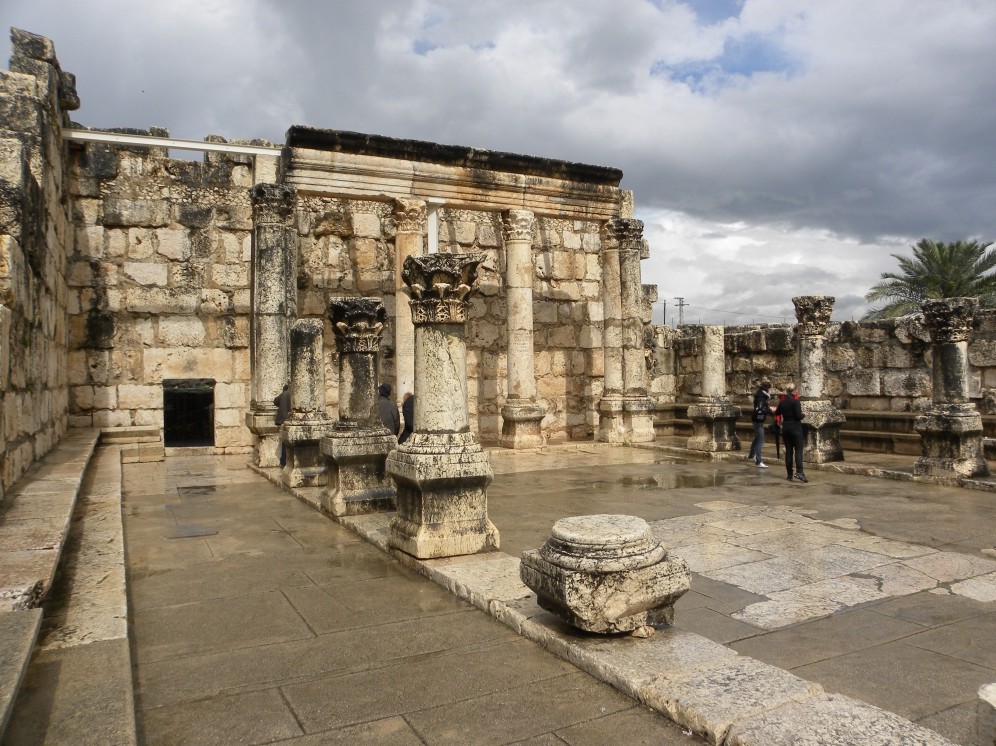
They went into Capernaum; and immediately on the Sabbath He entered the synagogue and began to teach. They were amazed at His teaching; for He was teaching them as one having authority, and not as the scribes. Mark 1:21-22
INTRO: Have you reminded yourself this week, “The kingdom is at hand?”
[Pause, crickets chirp, preacher is disappointed, but he goes on]
It occurred to me that a good follow up to last week would be to meditate on the the King of the kingdom
– but I immediately I resisted the thought
– there are some subjects I try avoid, because they have been cluttered with so much nonsense
• a case in point is “spiritual warfare”
• elaborations have resulted in exaggerations to the point that biblical truth has been buried and lost
However, something came up on Monday that caused me to change my mind
Mark focuses attention on people’s reaction to Jesus’ teaching
He doesn’t give any explanation why Jesus was allowed to teach in the synagogue
– I imagine people coming in and asking, “Who is that guy? Why is he talking?”
• he came without credentials or recommendations
– but after hearing a few words from his mouth, they were amazed
• they recognized the voice of authority and the ring of truth
• Jesus didn’t need to present airtight arguments or play on their emotions with sentimental stories
When there was a sudden and explosive interruption, they witnessed another dimension of his authority
– his words were not only true, they were powerful
Mark continues to develop the theme of Jesus’ authority
– “the Son of Man has authority on earth to forgive sins” (Mk. 3:10)
– Mark doesn’t always use the word, “authority,” but it is obvious in his statement about being, “Lord of the Sabbath” (2:28) and in his actions when, “even the wind and the sea obey Him” (4:41)
What we see in the early chapters of Mark is the kingdom of God advancing in the world
– it enters and takes over one domain after another
• illness, spirits, sin and guilt, wind and waves
– Jesus is bringing his kingdom into every human situation and every situation is changed
Many years ago, a family told me God wanted them to be missionaries
Later, they sold everything, moved to Costa Rica, and went through language school
– within a couple of years, they started a church in a small mountain village
– after some time, they wrote me to ask if I knew of any good books on spiritual warfare?
• they explained that they’d found something hidden in their home
• locals told them it was a hex and that someone had put a curse on them
– nothing in their previous Christian experience had prepared them for this read more…
Jesus Christ, off balance, reeling, in need of support from his friends. The perfect One whose lips spoke truth, whose touch brought healing, whose heart, soul and mind were pure, and who never failed to obey his Father. Our example, our Teacher and Redeemer was crushed with sorrow “to the point of death.”
This is the hour, the cup, the relentless will of the Father, as the universe looks on. There is nothing we can do for him. Even the angels in heaven cannot alleviate his sadness.
Some of us, who have also experienced heartache “to the point of death,” are comforted that “the man of sorrows” was “acquainted with grief” and knows our pain (Isa. 53:3). But there is something else here that we should not miss. Some of our deepest griefs are meant to take us into the Lord’s heart and give us insight into his suffering.
Lord Jesus, when our loss of a loved one hurt so deeply it felt like we could not take another breath, we did not think, “Ah, so this is what Jesus felt in the garden! This is the pain that broke His heart.” For a moment, our souls have known something of the agony of Yours, only our pain is finite and Yours infinite. Thank You for holding onto us with a love we will never understand.
The kingdom of God is at hand
Now after John had been taken into custody, Jesus came into Galilee, preaching the gospel of God, and saying, “The time is fulfilled, and the kingdom of God is at hand; repent and believe in the gospel.” Mark 1:14-15
INTRO: When we resume our Thursday night meetings in September,
We will start working our way through Jesus’ parables
– specifically, the ones that elucidate his teaching regarding the kingdom of God
– it was Barbara’s suggestion that I use this morning to provide an introduction to that topic
The Bible’s Overarching Story
There are a few stories in the Bible where everything works the way they should
– Esther is an example of this
• in the end, bad guys hang on their own gallows and the good guys rule the empire
– in Daniel, too, the various episodes turn out as we would hope
• believers who stay true to God cannot be roasted or devoured while their enemies end up as ashes or grime between the claws and teeth of lions
These snapshots show us how circumstances are resolved in a world where God is in charge
– there’s a reason these stories appeal to us
– they turn out exactly the way we would expect if God constantly intervened in human affairs
But when we come to the life of Jesus, the story is messed up — the Son of God should not be tortured to death on a cross
– we see the world not as it should be, but as it is
• people have taken control of the plot, and announced, “We do not want this man to reign over us” (Lk. 19:14) read more…
He has made everything appropriate in its time. He has also set eternity in their heart, yet so that man will not find out the work which God has done from beginning even to the end. Ecclesiastes 3:11
INTRO: What thought pops into your mind when you hear the term “control freak”?
Do you go straight to a definition? Think of a particular person?
– someone who is compelled to take charge of their environment, including everything and everyone in it
To be fair, we all like to have things in order
– if we need to go somewhere and climb into our car, we expect it to start
• that’s what a car is supposed to do – it’s why we put gas in it and maintain it
Order meets two essential human needs: dependability and predictability
Israel’s spiritual life developed in several directions – or “branches,” such as
– law, prophecy, theology, worship, and the wisdom tradition
– Proverbs is the quintessential example of the wisdom tradition
• it implies a search for order in the world and the practical application of its discoveries to real-life situations
This is exactly where we’ve been the last few weeks the “Preacher’s” poem on timing (vv. 1-8)
– time imposes a kind of order on our lives
– but in verse 9 we hit a snag read more…
A time to love and a time to hate;
A time for war and a time for peace. Ecclesiastes 3:8
INTRO: Doesn’t it feel like poet has saved a surprise for the end of his poem?
Hate and war are subjects that seem inconsistent with an enlightened mind
– it may simply be the differences of time and culture
– in our life with Jesus, it’s hard to find a place for hatred
• don’t we tend to see love as “good” and hate as “bad”?
• “God wants us to love; the devil wants us to hate” — but it’s not that simple
Not only does God want us to hate, but the devil wants us to love
We will have to try to solve this dilemma
Empedocles was a Greek philosopher who lived before Socrates
– his theory was that all matter consisted of four substances, but he added something
• two forces, he named love and strife – these were impersonal forces!
• love unites and creates, strife separates and destroys
Love and hate are definitely two of the most powerful forces in our lives
– think of even one novel or movie where these themes aren’t present
– so the issues at the end of the poem are as big as beginning (birth and death)
• if God had nothing to say about these themes, little else that he said would be relevant
• he wouldn’t have hand on the strongest motivators at work in our everyday lives
So what does God have to say about these “human, all too human” issues? read more…
Jesus did not imply that the disciples were cowards because they would “fall away” that night nor scold them for abandoning him in his hour of need. His point had less to do with their actions later on and everything to do with the fact that he was telling them something about himself, “I will strike down the shepherd, and the sheep of the flock shall be scattered” (v. 31). Jesus was not criticizing his sheep for scattering, that is what sheep do.
Although Jesus did not present his prediction of their flight as a challenge, Peter took it as one. Assuming that the Lord was accusing him of cowardice, Peter exclaimed, “I will never desert You!” This was not the response Jesus wanted to elicit from his disciples. This sad hour was not about Peter, yet he seized it and made it about himself. In doing so, he set himself up for even greater failure and grief.
The self-denial that Jesus demands of his followers means we must relinquish the idea that we are the center of the universe (Mt. 16:24-25). It means we have to remind ourselves sometimes, “It is not about me.” Some people read the Bible and assume all it has to say to them is how bad they are and that God has condemned them. But we get at the truth only when we are able to forget ourselves and bring our attention to the Lord Jesus. We then discover God’s love and mercy.
You knew, O Lord, what Your disciples were going to do, but they had no idea what was going to happen to You or the agony You felt that last night together. Were You looking for compassion, sympathy, and support from them? If so, how sad it was that they could only think of defending themselves needlessly. Help us, Jesus, to get out of ourselves. Be always in the foreground of our thoughts and may we fade into the background.
A time to tear apart and a time to sew together;
A time to be silent and a time to speak.
Ecclesiastes 3:7
INTRO: Physicists argue over the possibility of time travel
I recently read a true story of a man living in 1945, who suddenly found himself in 1975
– it is found in a case history recorded by Oliver Sacks and entitled “The Lost Mariner”
• his patient suffered Korsakoff Syndrome, in which a portion of his memory as well as his ability to form new memories were obliterated
– he had not invented a time machine nor did his body jump through time
• he had passed through thirty years, aging, like everyone else, but he could not recall anything from them
• as a result, he was displaced in time
– his intelligence and skills were useless, because they belonged to the wrong era
Jews returning to Jerusalem after exile came home to a discouraging situation
– so the people began complaining, “The time has not come, even the time for the house of the LORD to be rebuilt” (Hag. 1:2)
– and God answered them, “Is it time for you yourselves to dwell in your paneled houses while this house lies desolate?” (Hag. 1:4)
– God’s message to them was, “Consider your ways”
• nothing was going right for them
• they would plant lots of seed, but small reap a small harvest; put on clothes, but still be cold; make money, but put it in purses and pockets with holes in them so it would all run out
– their timing was off read more…


Daily Meditations From the Scriptures